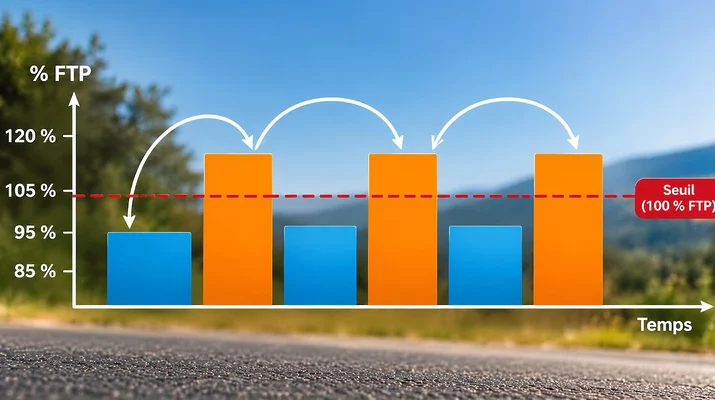




Share the post "Under-over training: understanding the method and properly calibrating your sessions"
On the road as on gravel paths, a race rarely unfolds at a steady power output. An irregular climb, an echelon forming, an acceleration in a group, or simply a fast group ride with friends all demand repeated changes of pace. At times, you have to dig deep, back off slightly for a few moments, and then push power back down without having truly recovered. This is precisely what under-over training (literally “under and over”) seeks to replicate: alternating, within the same block, between efforts just below threshold and others slightly above, without full recovery in between. Here is a closer look.
By Guillaume Judas – Photos: depositphotos.com
The principle of under-over training relies in particular on how the body manages lactate when intensity fluctuates around threshold power. During the over phases, generally situated above threshold power, lactate production increases. Its concentration in the blood can then rise because production momentarily exceeds the body’s utilization and clearance capacity. This goes hand in hand with greater muscular recruitment and therefore more discomfort to manage.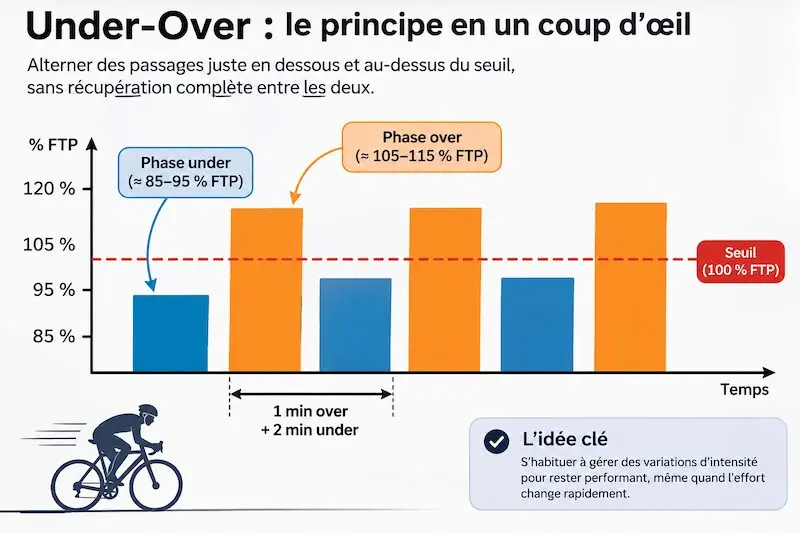
When the intensity drops back down during the under phases, the effort remains sustained, but the body has a little more margin. Part of the lactate produced can be reused as an energy source by muscles and other tissues. The idea is therefore not to make lactate disappear during this sequence, nor to recover completely, but to maintain a high effort while allowing the body to better handle variations in energy demand.
Repeated over several minutes, this work teaches you to handle successive changes in rhythm without losing too much of your capacity to produce power. It targets aerobic capacities, the management of efforts close to threshold, and the ability to accelerate when the leg muscles are already heavily fatigued.
However, under-over training does not replace traditional threshold work or VO2max sessions. It serves a slightly different purpose: being able to maintain a sustained effort despite repeated variations in intensity, such as those frequently encountered in competition.
What is lactate?Long wrongly presented as a simple waste product responsible for soreness and muscle fatigue, lactate is actually an intermediate of energy metabolism and a fuel source for the muscles. It is constantly produced when the body breaks down carbohydrates to provide energy, even at low intensity. When effort increases, its production accelerates. Its concentration in the blood can then rise when its production momentarily exceeds the body’s utilization and clearance capacity. This evolution generally accompanies greater metabolic recruitment, but lactate itself is not responsible for the burning sensation in the muscles. |
Intensities, durations, and profiles
On paper, structuring a session seems fairly straightforward. In practice, everything depends on your level, your capabilities, and above all, the accuracy of the chosen intensities.
- The zones: the under phase is generally located between 85% and 95% of FTP. The effort remains sustained, but controlled enough to allow you to ramp back up above threshold. The over phase is most often set between 105% and 115% of FTP, with efforts sometimes reaching 120% depending on their duration and your level. The higher the intensity, the shorter the sequences should be.
- The alternation: the most common formats combine one minute over with one or two minutes under. You can also invert the proportions, with two minutes above threshold and one minute below. The first type of session allows for more frequent changes of pace, while longer over passages increase the difficulty of maintaining the effort.
- Block length: sequences of 6 to 15 minutes, repeated two to four times with 5 to 10 minutes of easy spinning recovery between each block, make for a solid training foundation. There is no need to immediately try to lengthen the sets. The quality of the alternations matters more than their duration.
FTP is the reference benchmark here, but you must be certain of your current fitness level. As a reminder, FTP on an indoor trainer is rarely the same as FTP on the road. It is best to calculate it for each set of conditions. If it is overestimated, the under phases may already sit at a very high intensity, and the over passages will become hard to sustain. The session then risks turning into an almost continuous effort at the limit of your current capacities, without any real physiological alternation.
Individual differences must also be taken into account. Some cyclists rapidly produce a lot of lactate and strongly feel the passages above threshold. Others possess a good oxidative capacity and handle these variations more easily. The response also depends on endurance, training level, and effort duration. Therefore, no universal combination of intensities and durations exists.




What is FTP?Standing for Functional Threshold Power, FTP is an estimate of the maximum power a cyclist can sustain over a prolonged duration, generally around 40 to 60 minutes depending on rider profiles and testing methods. Expressed in watts, it serves as a reference point to define individual training zones and calibrate session intensity. It evolves with physical fitness and must therefore be regularly reassessed, particularly throughout the build-up. |
Two sample workouts to get started
For a first approach, it is best to choose reasonable intensities and focus on consistency. A 3×9-minute format, alternating two minutes at 90% of FTP and one minute at 108-110%, makes a good introduction. Each block includes three repetitions of this alternation, with six minutes of easy spinning recovery between blocks.
Once you master this first exercise, you can move on to more demanding sequences. For example, three 9-minute blocks alternating two minutes at 92% of FTP and one minute at 115%. The passage above threshold is then more pronounced, without quite reaching maximal aerobic power (MAP) levels. The goal remains to be able to replicate the exact same intensities right through to the end of the session.
These two formats are starting points. You can gradually evolve durations, intensities, or the number of blocks, but it is best to modify only one parameter at a time.
When and how to integrate under-over work into your week
Under-over training finds its place primarily during specific preparation periods or leading up to target events, once your endurance base has been established. It is aimed more at those who already have some experience with threshold work rather than beginners or riders returning after a long layoff. Overall, keep in mind that you should leave this type of session on the shelf in the dead of winter, far from early races.
On the road, rolling routes, false flat climbs, or long ascents allow you to complete this type of workout in good conditions. You simply need to avoid routes too disrupted by intersections or descents, which make maintaining target intensities difficult. On an indoor trainer, the exercise is easier to calibrate down to the exact watt. However, pay attention to ventilation and hydration: thermal strain can quickly increase perceived exertion.
One session per week is generally enough when this type of work is integrated into your schedule. Other demanding workouts must also be accounted for. Placed after several days of heavy load or close to a major VO2max session, it risks adding fatigue without delivering the expected benefit.
Common mistakes to avoid
The first mistake is executing the over sequences far too hard. Pushing to 130% or 140% of FTP on every repetition might feel rewarding, but it strays from the initial objective. The exercise becomes a succession of very intense, hard-to-repeat efforts rather than working on managing variations around threshold. Another mistake is failing to recover sufficiently during the under phases. If you keep pedaling too close to your limit, you lose the necessary margin to properly tackle the next repetition.
Finally, you should not try to finish the workout at all costs when your power output plummets. A significant drop in cadence, a breakdown in pedaling form, or the inability to hold the final over passages are all signs that the block has become too difficult. A good under-over session should allow you to maintain relatively stable power from one block to the next, with cleanly executed passages above threshold all the way to the end.
It is better to finish with the feeling of having mastered the workout rather than having survived the final minutes. That is also what will allow you to repeat the session under good conditions a few days later.
Share the post "Under-over training: understanding the method and properly calibrating your sessions"