
Share the post "Orbea Orca Aero Review: Uncompromising speed"
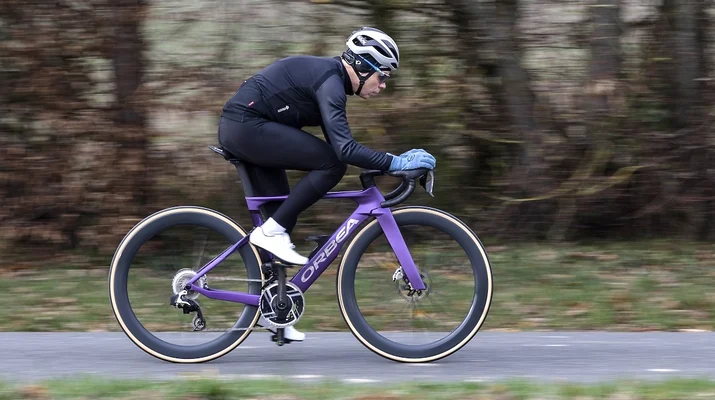
As the fourth generation of the Basque brand’s aero bike, the new Orbea Orca Aero sees its design undergo a thorough overhaul. Rather than banking on a single spectacular innovation, Orbea has multiplied optimizations, from the geometry to the tube profiles, to boost aerodynamics, weight, comfort, and versatility. The result is a race bike that is particularly thrilling on the road, aiming to combine pure speed with efficiency out in the field.
By Guillaume Judas – Photos: ©Vincent Lyky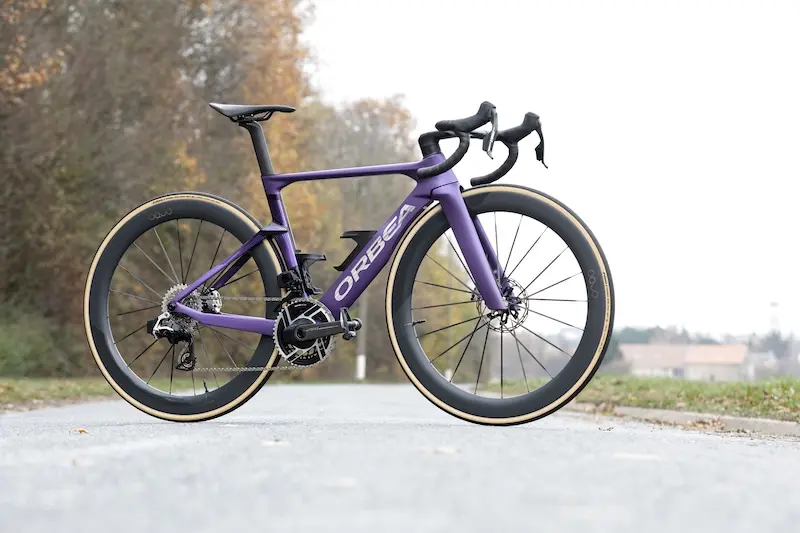
In a market where new generations of bikes routinely promise aerodynamic gains (often hard for us to verify), a few grams shaved off, or increased stiffness, updating an already well-established model is no simple task. Yet that is precisely what Orbea has undertaken with the fourth generation of the Orca Aero, its machine built for fast routes and competition.
The brand knows the demands of the highest level, since it equips the WorldTour team Lotto Intermarché. For professional racers, aero efficiency isn’t everything. You also need to be able to change pace, accelerate out of corners, handle descents, cope with crosswinds, and stay fast after several hours of racing. These are expectations shared by many sportive riders, who simply want to be able to ride their bike over more varied terrain.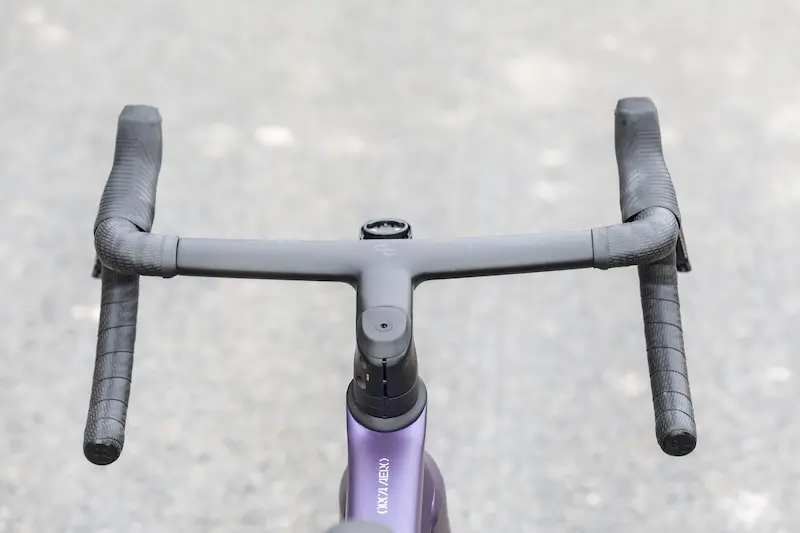
For this sum, you can also opt for the Shimano Dura-Ace build. The other specs are more accessible: SRAM Force with OQUO RP50 LTD wheels at 7,534 €, Shimano Ultegra with the same wheels at 6,734 €, Campagnolo Record 2×13 and OQUO RP50 Team wheels at the same price, or Shimano 105 Di2 at 5,734 €. The frameset with cockpit is priced at 3,034 €. Clearly, it’s the year of 34 at Orbea!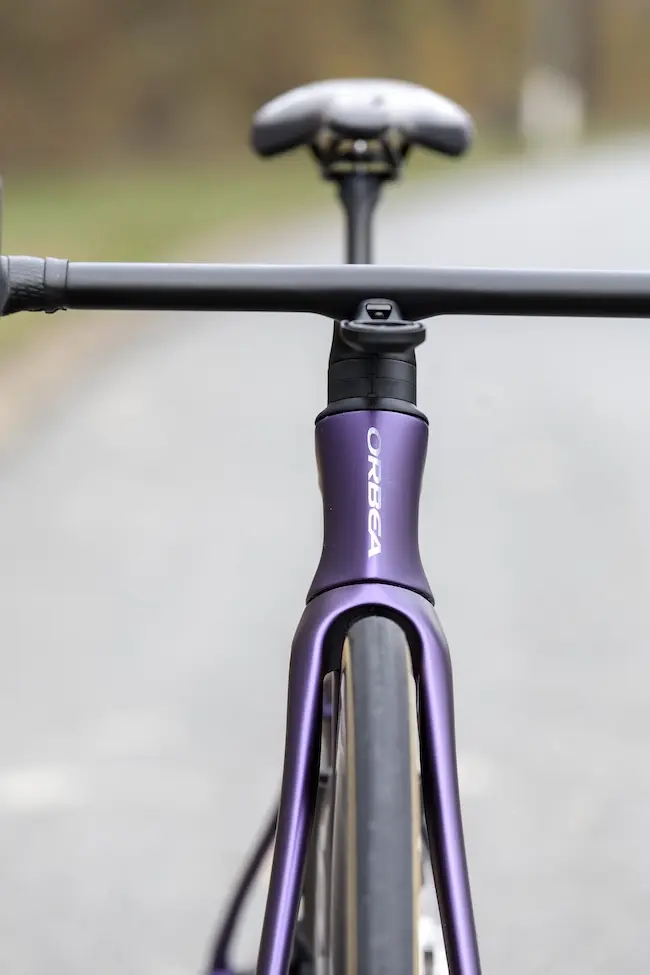
Aerodynamics do not simply vanish the moment the road tilts upward. As the gradient increases, speed drops and weight plays a bigger role in moving forward efficiently. The point at which a lightweight bike becomes more advantageous than an aero bike nevertheless depends on several factors: the rider’s speed, power output, and the characteristics of the two machines.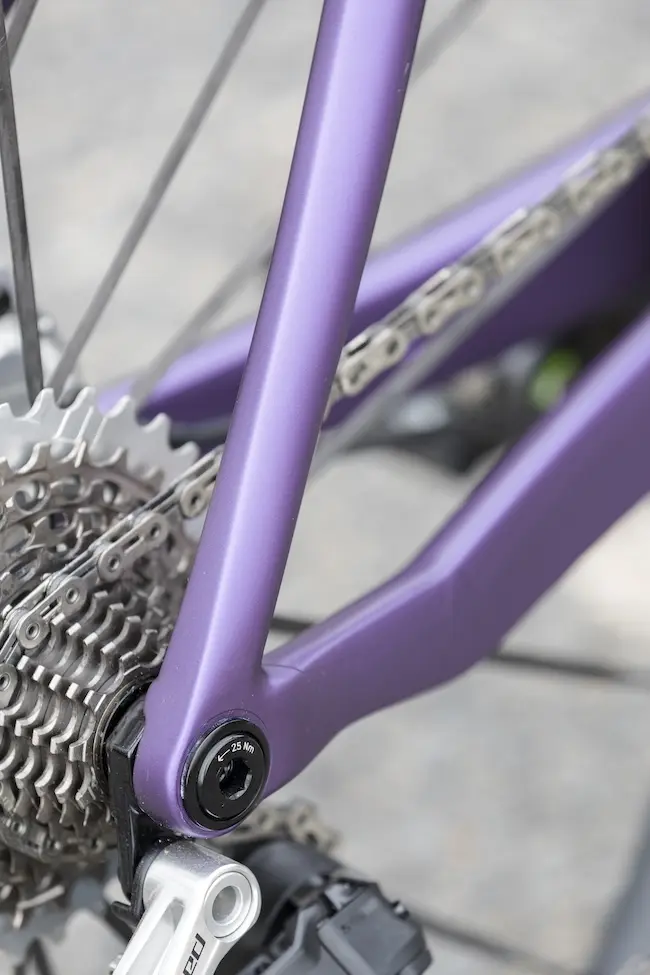
The new Orca Aero notably sheds weight compared to its predecessor. This refinement also benefits climbing performance. Orbea claims a 2-watt saving at 17 km/h on an 8% climb. Even when speed is low and aerodynamics weigh less in the equation, shedding a few grams can therefore make a difference. For riders who alternate fast outings, false flats, and longer climbs, a modern and relatively lightweight aero bike can thus make a lot of sense.
A completely redesigned frame, from geometry to tube profiles
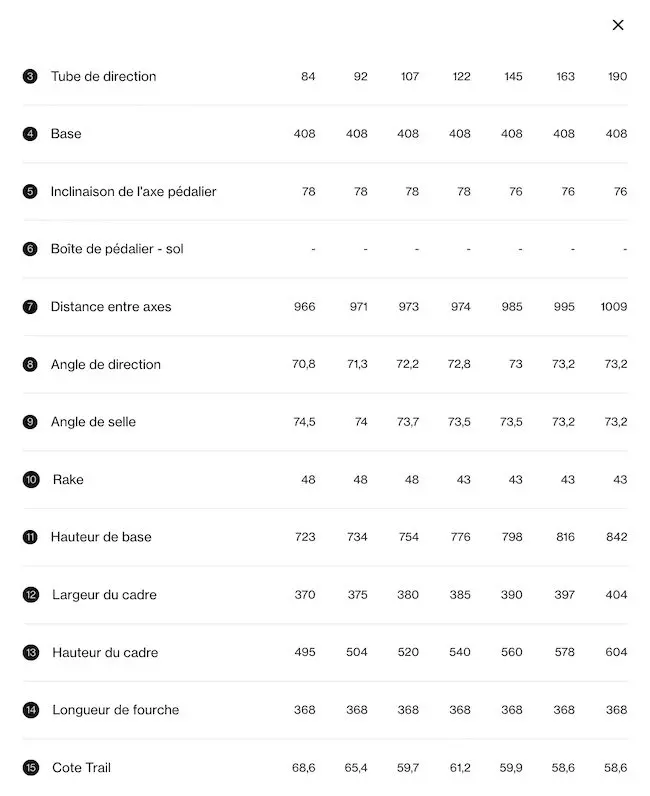
The former Orca Aero was already aerodynamically efficient, but its weight was a handicap. The frame has been re-engineered from the ground up. The geometry evolves notably around the bottom bracket shell, whose height has been lowered to place the rider’s center of gravity closer to the ground. According to Orbea, this provides greater stability, both against crosswinds and on fast descents. The brand also believes this position makes the bike easier to control when the pace picks up and the rider moves their upper body more while pedaling. Finally, it contributes to improving the aerodynamics of the bike-and-rider system as a whole.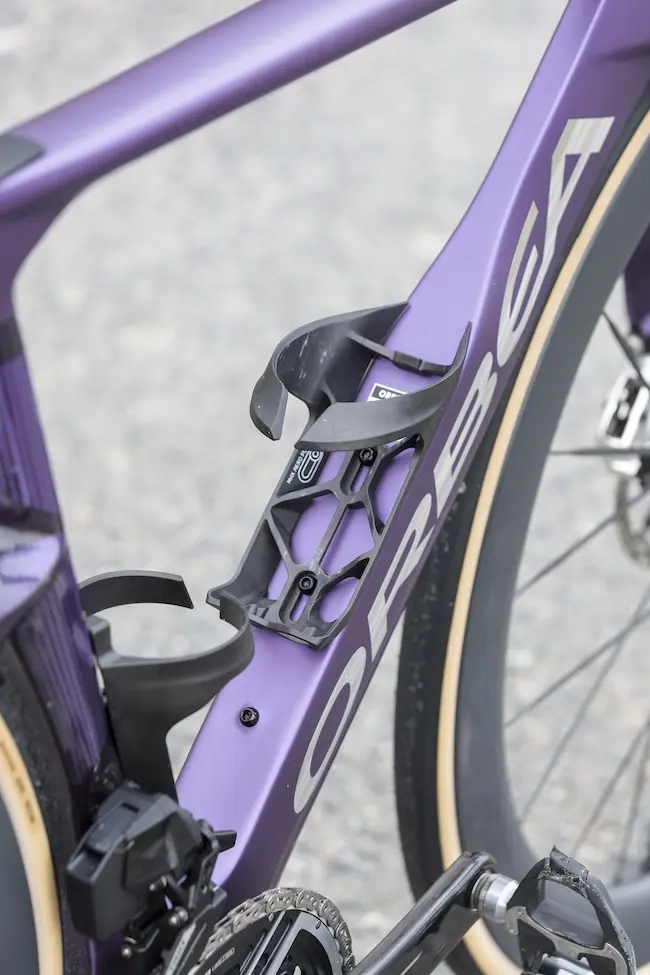
Another interesting detail: the down tube has been shaped to accommodate classic round bottle cages. That might sound anecdotal, but some highly profiled frames mandate specific accessories that can be harder to source or use. Here, Orbea opted for a simple solution without imposing any extra day-to-day constraints.
A drop in weight
Tire clearance is another notable evolution. The new Orca Aero accepts widths up to 37 mm, although Orbea states it optimized the aerodynamics for 29 to 35 mm tires. This makes it possible to mount wider tires to boost comfort or tackle rough roads, or even cobbled sections like those found in the Spring Classics, without sacrificing a bike built to roll fast.
On the aerodynamic front, Orbea claims a 5.1-watt saving for the frame and 14 watts for the bike and rider combined. This latter figure factors in the benefits attributed to the geometry. The manufacturer also quotes a weight of 900 g for the frame in size 53 and 410 g for the fork.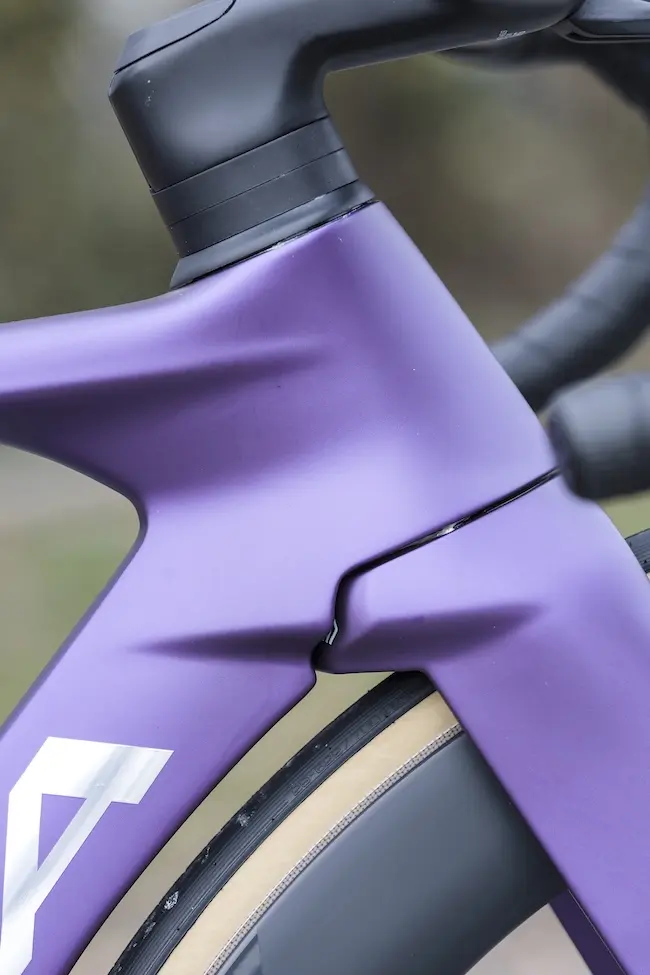
Orbea uses the term aero-capable to describe this new generation. Behind this phrase, the brand mainly wants to emphasize that its bike shouldn’t just perform in the ideal conditions of a wind tunnel. It must also remain usable out on the road when the wind picks up, the terrain changes, or a race forces you out of your usual rhythm.
Attention to detail
To these already exciting figures are added a few practical touches showing that Orbea has paid meticulous attention to the design of this new Orca Aero. Just like on the previous generation, the bike can house a storage box (toolbox) beneath the down tube, behind the front wheel. This option will particularly interest triathletes, even though the device remains prohibited in UCI-sanctioned races. [caption id=”attachment_66843″ align=”aligncenter” width=”650″> Finally, two small rubber pads are built into the fork to protect the paint at the base of the fork legs when resting the bike on the ground, for example to fix a flat. A tiny rubber cap also covers the front thru-axle bolt head, neatening the finish and limiting aerodynamic turbulence. These details won’t radically change the bike, but they testify to a thoroughly polished design. Classy. At first glance, the new Orca Aero looks massive, both aesthetically and in terms of handling. The front end of the bike is particularly thick, and the head angle feels quite steep, suggesting a front end that might be heavy to steer. The rim depth (57 mm), paired with their aerodynamic carbon-spoked wheels, reinforces this visual impression. On the road, the steering is indeed somewhat heavy at low speed, and the bike demands good upper-to-lower-body coordination to feel dynamic when riding out of the saddle. The bike as a whole lacks no stiffness, and you shouldn’t rely on any spring-like flex to generate snap and ease out-of-saddle accelerations. [caption id=”attachment_66839″ align=”aligncenter” width=”800″>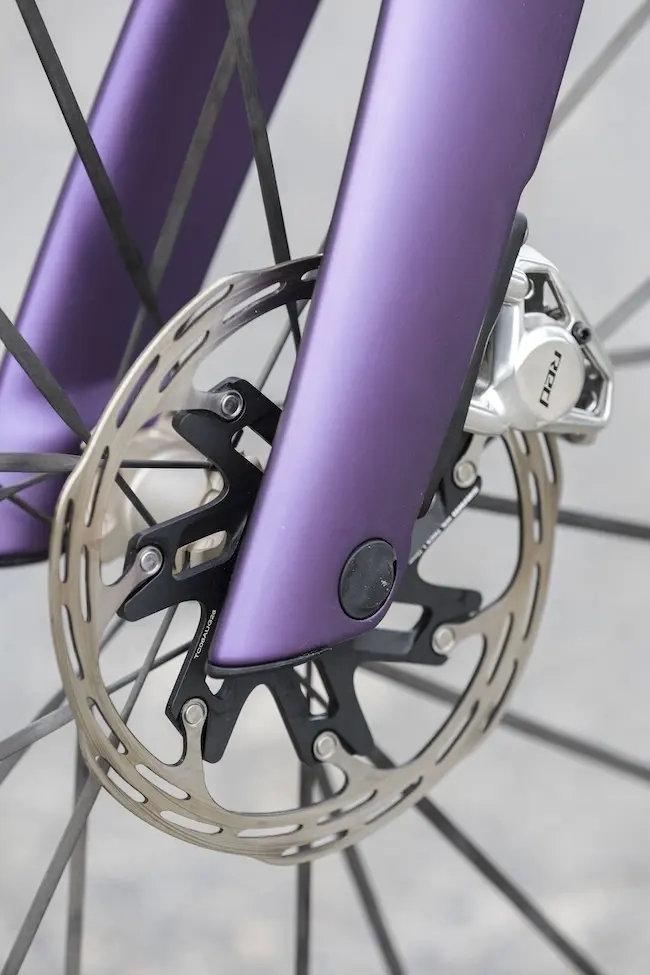
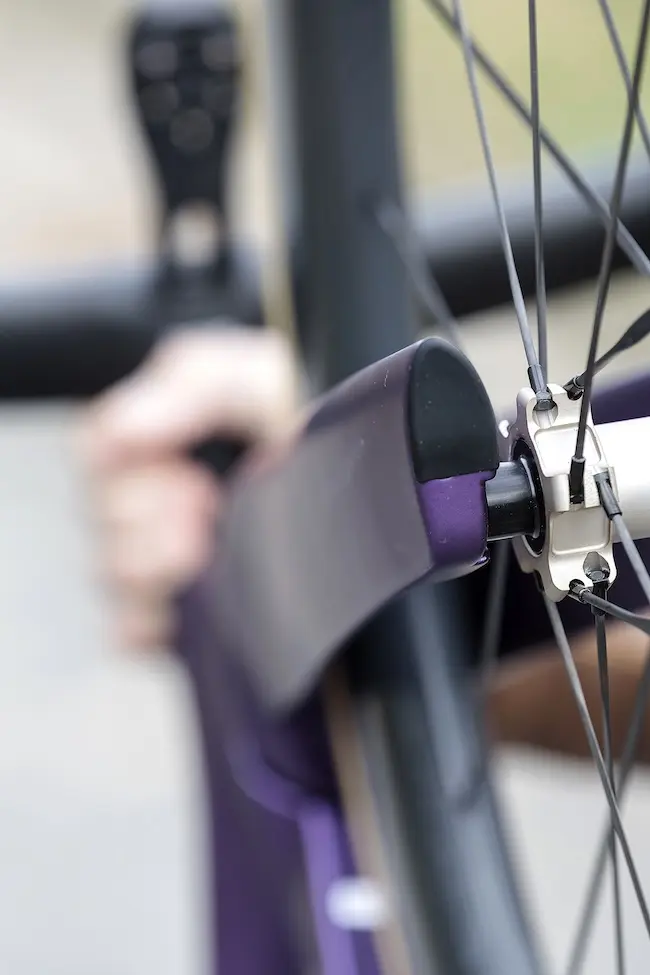 Underneath the fork dropouts, rubber protection is provided to avoid scratching the paint when removing the wheel.]
Beyond the watts, stability in the crosshairs
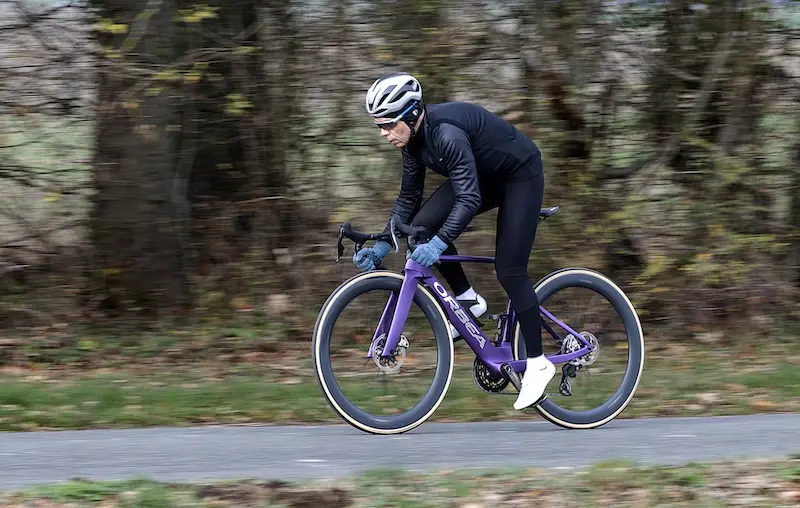 The bike comes alive the more you accelerate.
However, the bike seems to come more alive the harder you push. The steering remains firm, but I would attribute that trait more to the rim depth than to the frame itself. Indeed, I was able to test this bike with shallower rims (45 mm), and I found it a little less demanding in that regard. By upping the pace, the Orca becomes sharper, less harsh, and more dynamic. It remains reasonably comfortable, of course, but gains in responsiveness and therefore versatility.

In fact, I never found myself purposely avoiding climbs during these test rides. Truth be told, after a few dozen kilometers, I had completely forgotten I was riding a bike with such wide tubes. I never felt bogged down on the climbs, and I could even string together sharp accelerations without blowing my legs up, unlike what more exclusive machines like the Cervélo S5 and Colnago Y1RS might demand. Climbing at a strong tempo, I even caught myself thinking the bike felt lighter than it actually was.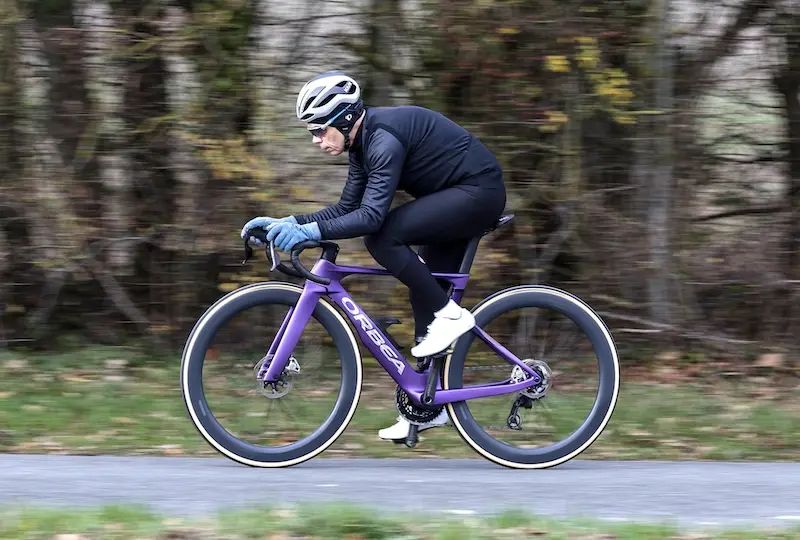
Pros
- Stability
- Sense of speed on rolling terrain
- Reasonable weight for a bike in this category
- Practical details
Cons
- A bit demanding at low speed
- High-performance tires, but fragile
| Orca Aero M11e LTD PWR | |
|---|---|
| Frame | Orbea Orca Aero carbon OMX |
| Fork | Orbea Orca Aero carbon OMX |
| Groupset | SRAM Red AXS 2 × 12-speed |
| Crankset | SRAM Red AXS, 48-35 teeth, Quarq power meter |
| Cassette | SRAM Red, 10-33 teeth |
| Brakes | SRAM Red |
| Wheels | OQUO Road Aero RA57LTD Carbon Spokes |
| Tires | Vittoria Corsa Pro Speed 700 × 29 |
| Cockpit | OC SH-RA10 integrated handlebar |
| Seatpost | OC Orca Aero RA11 Carbon |
| Saddle | Fizik Vento Antares R1 |
| Weight | 7.04 kg in size 49 |
| Price | 11,034 € |
Contact: www.orbea.com
FAQ – Orbea Orca AeroWhat are the main new features of the new Orbea Orca Aero? This fourth generation benefits from a completely redesigned frame, featuring a modified geometry, new tube profiles, and a lower weight. Orbea also claims aerodynamic gains and tire clearance up to 37 mm. What is the weight of the new Orbea Orca Aero? Orbea claims a 900 g frame in size 53 and a 410 g fork. Our size 49 test model, equipped with SRAM Red, weighs 7.04 kg without pedals, including two bottle cages and a head unit mount. Is the Orbea Orca Aero suited to the mountains? Why not. Despite its aerodynamic profile, its contained weight allows it to remain efficient on climbs. It proves dynamic enough not to be restricted solely to flat terrain, even though its handling prioritizes stability and speed over low-speed agility. What tire width can be fitted on the new Orca Aero? The frame accepts tires up to 37 mm wide. Orbea states it optimized aerodynamic performance for widths between 29 and 35 mm. What is the price of the new Orbea Orca Aero? The range offers several configurations, starting from 5,734 € with Shimano 105 Di2. The high-end M11e LTD PWR build with SRAM Red and a power meter is priced at 11,034 €. The frameset with cockpit costs 3,034 €. |
Share the post "Orbea Orca Aero Review: Uncompromising speed"