



Share the post "Cycling: how to protect your perineum and sexual health?"
Three hours into a ride, headwind blowing, and that sensation every dedicated rider knows all too well: your groin going numb. You stand up, shake it out a bit, and it comes back. Then you start wondering, without necessarily daring to ask out loud: does this leave any lasting marks? Good news: cycling is by no means an enemy of sexual health. But when your weekly mileage climbs, a few setup tweaks make a real difference. Here are a few tips.
By Dr Sam Ward, urologist and medical director of kano.care – Photos: depositphotos.com, DR
The perineum is the area located between your sit bones, at the base of the pelvis. It is a crossroads of nerves and blood vessels, as well as a strategic passageway. The pudendal nerve, which provides sensation to the genitals, runs through it, as do the arteries supplying blood to the penis.
On a narrow saddle, your body weight no longer rests solely on your sit bones, those two bones built to handle the pressure. Part of that weight shifts onto soft tissues, which end up crushed against the pelvic bone. The result: compressed nerves and restricted blood flow. Numbness is simply the nerve sending a message: it’s feeling cramped.
What the measurements show
German urologists measured penile oxygenation while cycling using an electrode placed on the glans. Among roughly 40 healthy athletes, blood flow dropped sharply in a seated position for over 70% of them (Sommer et al., 2001).
And what happens as soon as you stand up? An older study had already shown that getting out of the saddle restores this oxygenation, sometimes pushing it back above baseline levels (Nayal et al., 1999). Keep this point in mind; it will come up again in the practical tips.
Cycling and erections: what science really says
On this topic, you will read everything and its opposite. Studies don’t all agree with each other either. On the warning sign front, the same German research team reported that 19% of cyclists logging over 400 km a week complained of erectile dysfunction. In the United States, the National Institute for Occupational Safety and Health (NIOSH) looked at bicycle-mounted police officers, who spend around 25 hours a week in the saddle. The finding: the greater the pressure on the saddle nose, the fewer nocturnal erections—a reliable indicator of erectile health—they experienced.
On the reassuring side, the largest study on the subject compared nearly 4,000 cyclists with swimmers and runners. Cyclists did not exhibit poorer sexual function, even among those who logged high mileage (Awad et al., Journal of Urology, 2018). A British study of over 5,000 cyclists also found no link between time spent on a bike and erectile dysfunction.
How do we reconcile all of this? The risk is real, but it mainly stems from a specific combination: high riding volume, an ill-fitting saddle, and a riding position that loads the front of the pelvis. Otherwise, cycling tends to protect erectile health by keeping your heart and blood vessels in shape. This is precisely what we see in consultations: complaints rarely come from weekend warriors, but frequently from riders who have ramped up their mileage without adjusting their bike fit. To dive deeper into the connection between cycling and erectile dysfunction, the underlying mechanisms are broken down step by step.
Warning signs that should prompt a medical consultation
Transient numbness after a long ride that vanishes within a few minutes once you are off the bike is not alarming in itself. It is a warning, not an injury.
Certain symptoms, however, warrant professional medical advice:
- numbness that persists for several hours, or even days, or that returns on every ride despite adjustments
- recurrent erectile difficulties, especially if they started during a high-volume training block
- perineal pain that sets in, even at rest
- trouble urinating or a weaker stream: cyclists are at a higher risk of urethral stricture (narrowing of the urethra), according to the Journal of Urology study cited earlier.
One crucial point to keep in mind: an erection issue is not necessarily linked to cycling. It can be an early warning sign of cardiovascular disease, diabetes, or high blood pressure. Blaming the saddle without checking further risks missing something more serious. A urologist or general practitioner can help sort it out.
Prevention: choosing and adjusting your equipment correctly
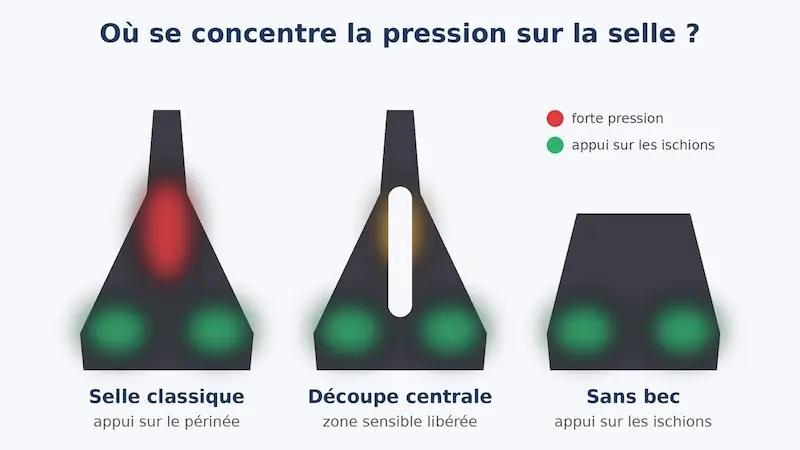
A good saddle isn’t necessarily the plushest one. Too much padding causes the pelvis to sink in, which ultimately puts pressure on the perineum. What matters is that your sit bones find proper support. Their spacing varies from person to person and can be easily measured at a specialty bike shop using a simple pressure-mapping foam cushion.




Saddles with cutouts or central channels relieve pressure on sensitive areas. Short-nosed or noseless saddles go a step further. In NIOSH trials, they reduced groin pressure by at least 65%, with corresponding improvements in sensitivity and erectile function. After six months, only 3 out of the 90 police officers still participating had gone back to a traditional saddle (NIOSH, 2010). Not bad for a group that started out highly skeptical.
Bike fit: saddle height, tilt, and cockpit
A saddle that is too high causes your pelvis to rock from side to side with every pedal stroke. If it is too low, it creates excessive crushing pressure. As for tilt, aim for dead level, or with the nose tipped down just a fraction. A saddle nose pointing upward will press down right where you don’t want it to.
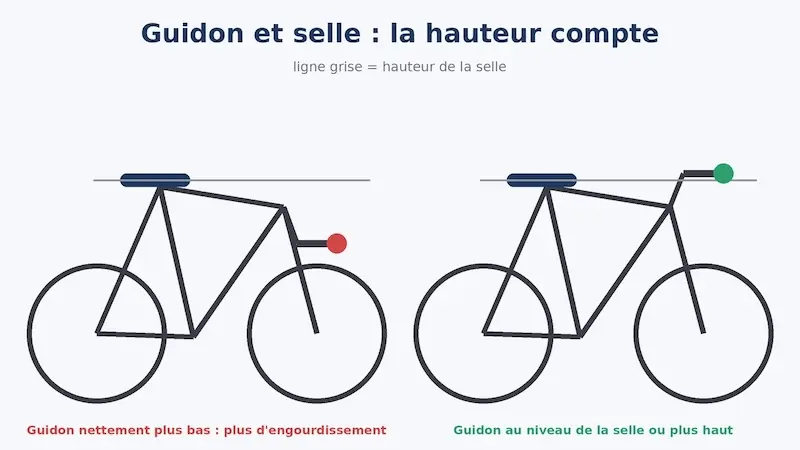
Your cockpit setup matters just as much, though it’s often overlooked. In the large Journal of Urology study, cyclists whose handlebars were level with the saddle—or higher—experienced less numbness and fewer skin lesions than those riding with a significantly lower front end. For triathletes in an aggressive aero position, the compromise is trickier: a professional bike fit is well worth the investment if you are logging over 8 to 10 hours a week.
When it comes to cycling shorts, choose a high-quality chamois, wear them without underwear (seams chafe and compress), and use a fresh pair for every ride. It sounds basic, but it prevents chafing and saddle sores, which can force you to sit awkwardly and overload the front of the pelvis.
During the ride: riding out of the saddle, breaks, and habits
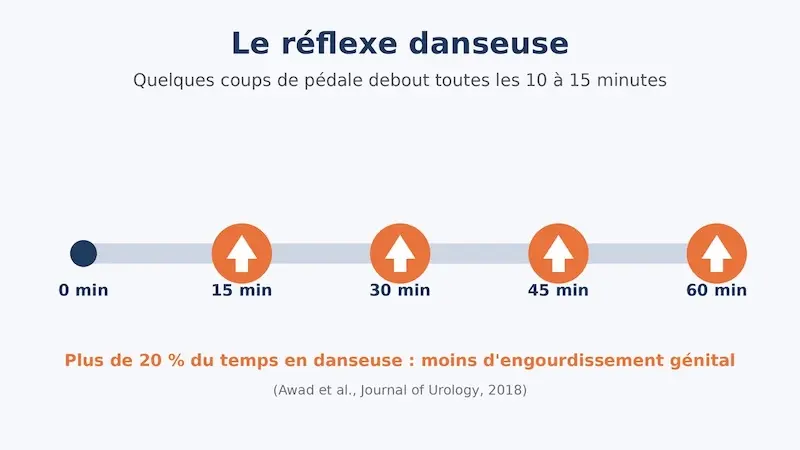
The simplest trick is also one of the most effective: get out of the saddle. Riders who spend more than 20% of their time out of the saddle run a lower risk of genital numbness, according to Awad and his colleagues. There’s no need to power up every single climb standing up. Just a few pedal strokes out of the saddle every 10 to 15 minutes—out of corners or over the crest of a roller—are enough to get blood flowing again.
Other habits help:
- varying your hand positions on the handlebars, which shifts your pelvic alignment
- stopping for a few minutes on very long rides, such as during a coffee or feed stop
- on an indoor trainer, standing up even more frequently, since your position is much more rigid indoors than out on the road
- easing back into it after a break; your perineum needs time to re-adapt as well
Interestingly, a study showed that numbness increases with years in the saddle, frequency of riding, and distance per ride, yet without resulting in poorer sexual function among those cyclists (Baradaran et al., 2019). So while the symptom is common, that’s no excuse to ignore it.
Ride a lot, ride right
Cycling remains one of the best things you can do for your overall health, including your sexual health, which depends first and foremost on vascular fitness. Numbness is neither inevitable nor a mandatory rite of passage for high-mileage riders. It is simply a sign that your bike fit needs tweaking.
A proper saddle, handlebars that aren’t set too low, and regular out-of-the-saddle efforts are usually all it takes. And if symptoms persist despite these changes, talk to a doctor. No embarrassment needed—it’s what they’re there for.
Sources:
Sommer F. et al., Impotence and genital numbness in cyclists, Int J Sports Med, 2001
Nayal W. et al., Transcutaneous penile oxygen pressure during bicycling, BJU Int, 1999
Awad M. A. et al., Cycling, and Male Sexual and Urinary Function, Journal of Urology, 2018
Baradaran N. et al., Bicycle-related genital numbness and SHIM score, BJU Int, 2019
NIOSH, No-Nose Bicycle Seats in Reducing Groin Pressure and Improving Sexual Health, 2010
Hollingworth M. et al., Cycling for Health UK Study, Journal of Men’s Health, 2014
Share the post "Cycling: how to protect your perineum and sexual health?"