



Share the post "ISO and UCI Standards: don’t confuse industrial safety with sporting regulations anymore"
In the cycling world, two acronyms regularly pop up on frames, technical datasheets, and in conversations among riders: ISO and UCI. While they sometimes appear side by side on a road bike seat tube, they have neither the same function nor the same scope. One defines mechanical safety requirements designed to protect the user, while the other determines the technical conditions a bike must meet to be used in competitions governed by world cycling’s governing body. We are here to help clear things up.
By Guillaume Judas – Photos: depositphotos.com
Confusion between the two standards often stems from the fact that UCI approval is perceived as a guarantee of superior quality or strength. That is a misinterpretation we ourselves made for a long time.
ISO standards (primarily the ISO 4210 standard for traditional bikes and EN 15194 for power-assisted models) relate to industrial safety and consumer protection. They define requirements and test methods intended to verify the mechanical strength and safety of bicycles. Compliance with them constitutes, in particular, a recognized means of demonstrating conformity with the regulatory requirements applicable when placing products on the market.
The UCI (Union Cycliste Internationale) technical regulations serve a sporting purpose. Their goal is to preserve fairness among competitors, regulate technological evolution to avoid an out-of-control arms race, and guarantee safety within the peloton.
A triathlon bike with aerodynamic extensions or a road bike weighing 5.8 kg can perfectly well meet applicable safety requirements while being strictly barred from the start line of a race registered on the UCI calendar. Conversely, a UCI-approved bike must also satisfy applicable safety requirements. As part of its approval application, the manufacturer must notably provide a declaration certifying that the materials have been tested in accordance with the required safety standards, specifically ISO 4210. UCI approval therefore does not constitute an additional mechanical certification, nor does it exempt the manufacturer from its safety obligations.
ISO 4210 tests: rigorous mechanical testing
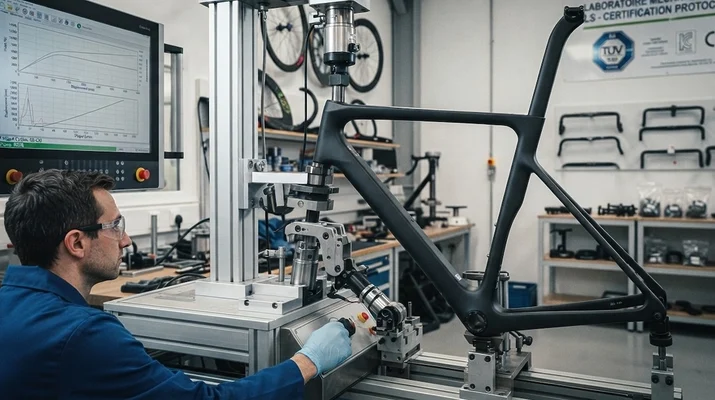
The ISO 4210 standard subjects the bicycle and its components to a battery of laboratory mechanical tests, carried out internally by equipped brands or entrusted to independent bodies such as TÜV, SGS, or CRITT. These tests aim to verify component durability under conditions of repeated stress or impacts, across several representative samples. Some may lead to material degradation or failure, but not all are necessarily designed to destroy the item.
- Fatigue and strength tests: the frame, fork, handlebars, and seatpost undergo thousands of cycles of repeated stress (pedaling, braking, lateral and vertical flexing) on test benches to verify their ability to withstand the forces encountered during use.
- Impact tests: weights are dropped onto certain parts of the frame and fork to simulate impacts and check their ability to absorb energy without premature failure.
- Braking and assembly: the effectiveness of brakes on dry and wet surfaces, as well as the holding power of certain assemblies and fastening systems, are also evaluated according to precise protocols.
UCI approval: regulatory and geometric control
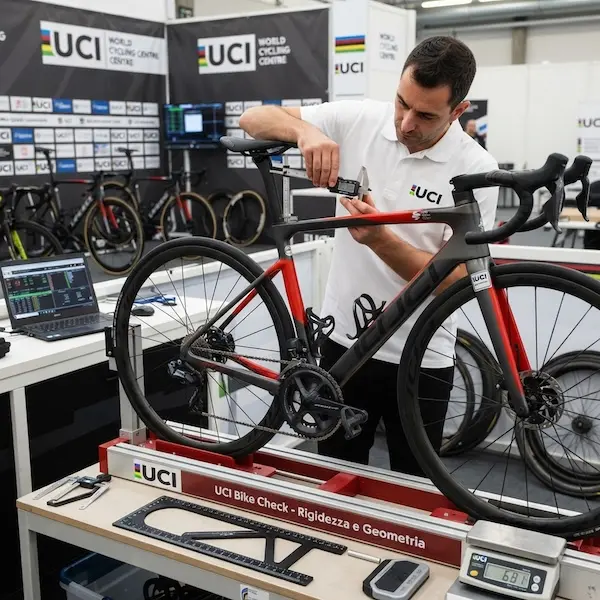
The UCI does not itself perform crash or mechanical strength tests on frames and forks. When a manufacturer submits a frame or fork to obtain the “UCI Approved” label, the procedure primarily focuses on compliance with the technical regulations’ dimensional and structural criteria. Since 2019, however, the manufacturer must also provide a declaration certifying that the materials have been tested and comply with applicable safety standards, notably ISO 4210.
- Checks against blueprints (CAD) and jigs: UCI engineers verify that the frame complies with design requirements, that tube profiles fall within authorized size and width limits, and that the various geometric characteristics conform to the regulations.
- Commercial availability requirement: to prevent prototypes reserved exclusively for an elite few, the UCI also imposes commercial availability conditions for approved equipment. The hardware cannot remain a prototype intended solely for professional riders and must meet the public availability conditions defined by the regulations.
What the law says in Europe
From a legal standpoint, UCI rules hold no regulatory weight for cyclists riding outside competitions governed by this federation or affiliated federations (such as the FFC). An individual is therefore entirely free to ride on open roads with a bike that does not appear on the list of models approved by the UCI, provided they naturally obey applicable traffic laws.
On the other hand, any bicycle marketed within the European Union must satisfy applicable regulatory safety requirements. The European General Product Safety Regulation (GPSR) 2023/988, applicable since December 2024, notably imposes obligations on manufacturers, importers, and distributors regarding safety, traceability, and consumer information.
The ISO 4210 and EN 15194 standards serve as important technical benchmarks to demonstrate this conformity. Applying them notably makes it possible to rely on recognized test methods to verify bicycle strength and safety. However, a distinction must be made between the obligation to place a safe product on the market and the obligation to apply a specific standard: the two concepts are not systematically equivalent.
The case of custom, handmade frames
While the regulatory framework seems relatively clear-cut for mass-produced bikes sold in shops, several situations call for further clarification.
A frame builder crafting a one-off piece at a customer’s request is obviously not in the same position as an industrial manufacturer producing several thousand frames each year. Testing and validation procedures can be adapted to the nature and volume of production. This does not mean, however, that a custom-built frame escapes the general safety obligations applicable to products marketed within the European Union.




The builder remains responsible for the design and manufacture of their frame, as well as its safety. In practice, reputable frame builders rely notably on the technical specifications of the tubes they use—supplied by manufacturers such as Columbus, Reynolds, or Dedacciai—and may carry out specific tests to validate their welds or bonding. Such an approach does not necessarily replace full certification, but it contributes to controlling manufacturing quality.
What about components?
The ISO 4210 standard does not stop at the frame. It includes several parts dedicated to various bicycle elements, notably forks, wheels, steering systems, saddles, cranksets, and brakes. Each family of components is subject to specific requirements and test methods designed to verify its durability under defined operating conditions.
A carbon handlebar or stem sold separately is therefore not exempt from all safety requirements simply because it is not marketed with a complete bike. Their compliance must be assessed in light of the requirements applicable to their category and intended use.
Conversely, the UCI does not subject every component to an individual approval procedure. Frames and forks are subject to a specific procedure, as are certain wheels used in road competition. Other equipment remains subject to the provisions of the technical regulations, particularly regarding dimensions, design, and safety. This is notably the case for handlebars and the position of brake levers, whose characteristics are regulated in competition.
What about direct purchases from Asia and non-EU products?
This is the major point of vigilance for riders. When a cyclist orders a frame, a pair of wheels, or a carbon handlebar-stem combo directly from a seller located outside the European Union—without going through a European importer or distributor—they must exercise extreme caution. Product traceability, manufacturer identification, and conformity verification can prove far more difficult.
Certain Asian subcontractors work with rigorous quality control procedures and have their products tested by recognized laboratories such as SGS or TÜV, particularly according to ISO 4210 protocols. But this does not mean that all products sold on direct-sales platforms benefit from the same level of inspection. A significant portion of generic frames and components provides no verifiable proof of independent mechanical testing.
The “UCI Approved” logo sometimes stamped onto these frames also deserves special attention. It may simply be a graphic reproduction with no official value. To verify an approval, the safest bet remains checking the public list of approved frames and forks on the UCI website, verifying the exact match with the model in question.
In the event of a failure on equipment purchased directly from a company located outside the European Union, the buyer is not necessarily stripped of all legal recourse. On the other hand, enforcing one’s rights and holding a foreign manufacturer liable can prove particularly complicated. This represents a major difference compared to a purchase made from a professional established within the European Union, who is subject to obligations applicable to economic operators.
ISO or UCI: two standards that do not replace one another
When choosing a bike or components, it is therefore important not to confuse the two processes. UCI approval indicates that a frame or fork complies with the technical criteria required to participate in relevant competitions. By itself, it does not constitute a guarantee of superior quality nor proof of fail-safe durability.
For its part, compliance with safety requirements—notably those defined by ISO standards—directly concerns user protection, whether the rider is a competitor or a recreational cyclist. Nor does it guarantee that a component will never break, but it ensures that its design and strength have been evaluated according to precise protocols.
Ultimately, a UCI sticker does not replace a mechanical validation process, any more than ISO compliance makes a bike eligible for competition. Two standards, two objectives, and two levels of control that are best understood before relying solely on a label or a datasheet.
=> All our In-Depth features See all our articlesDossiers
Share the post "ISO and UCI Standards: don’t confuse industrial safety with sporting regulations anymore"