



Share the post "Being coached by an AI: how far can we trust it?"
More and more 3bikes readers are handing over almost all their training to AI. It is easy to see why. It is available on Sunday evenings, and when a three-hour gravel ride falls through, it already has a backup plan. After a few weeks, we also start asking it how good the ride was, whether we have improved, and why our legs felt heavy. At what point do we start asking it what we actually felt?
By Jeff Tatard – 3bikes.fr
We get home from work, we slept poorly, and there is one hour left before dinner. On paper, we have two blocks of 30/30s at FTP. We open the chat and type: “How do I squeeze my workout into the 45 minutes I have left?” In a few seconds, we get a shorter warmup and two blocks that fit the slot perfectly. We might even make it to dinner on time.
Was it worth doing that workout? We forgot to ask that part.
The coach who always has an opening slot
There are good reasons to use AI. When you are starting out, you can ask what threshold is, what you are working on with 30/30s, or what seven-second sprints with long recoveries are for. You can feed it your bike computer data, ask for an example, and come back to the same point three times. For someone who has never had access to a coach, that opens a door.
When you have been riding for a long time, you can give it your training log and ask it to look at something specific. Do our zone 2 rides stay in zone 2 when the road goes uphill? Why do the watts always drop in the last of the three threshold blocks? What has changed since we started commuting by bike three days a week? It can help spot a trend, prepare for a discussion with your coach, or reschedule a week when Saturday gets canceled. You get something out of it when you better understand what you are doing on the bike.
The smartest person is often the one asking the question
On the flight back from Boston, we met Axel, an engineer and AI expert. He explained that how you phrase a question can already steer the answer. If you assume a workout has to be done and ask the AI how to cram it in, it will likely try to figure out how to make it fit your schedule. It might do that very well. The question of whether the workout is still worth doing gets left aside.
We have three times seven minutes at threshold planned for tomorrow. Saturday, we were supposed to do three hours in zone 2. That held up until the first climb. A buddy picked up the pace, we followed, and on the way back we were still taking pulls. Last night, we slept poorly.
We can type “How do I squeeze in my three times seven minutes tomorrow?” Or we can provide the context and ask “Saturday, I rode harder than planned and slept poorly. Based on what you know about my week, what argues for doing threshold tomorrow? What argues for postponing it?”
Right there, you see what Axel meant. In the first question, we have already decided that threshold is on the menu. In the second, we accept that the answer might annoy us. Discernment begins when you ask yourself if you are asking the right question.
That is what bugs us at 3bikes about the term “artificial intelligence.” We might think the tool is smart because it spits out a coherent workout in a few seconds. When we credit it with discernment, we rather quickly forget who chose the goal, recounted the week, and decided what information to feed it.
English speakers have a phrase for that. Shit in, shit out. You inflate your FTP a little, forget to mention Sunday’s ride, and call the fatigue you have been dragging around since Thursday “a bit of laziness.” Even with that, you can still get a wattage-precise plan. You can even save it as a PDF. The Sunday ride will still be missing.




At Kinesis, Mathieu Moretti, a coach and physical therapist, can use AI to review a workout, and then bring things back to something very concrete. At what point did you feel like the bike stopped rolling the same way? For the pragmatists in the group, Mathieu explains intuition as a cognitive shortcut. The brain draws on stored experiences and sometimes recognizes a situation before we can put words to it. On the fourth seven-second sprint, you can feel from the very first pedal stroke that something is missing. You have lived through that kind of start dozens of times. Mathieu invites us to trust that signal, and then see what the numbers can teach us about it.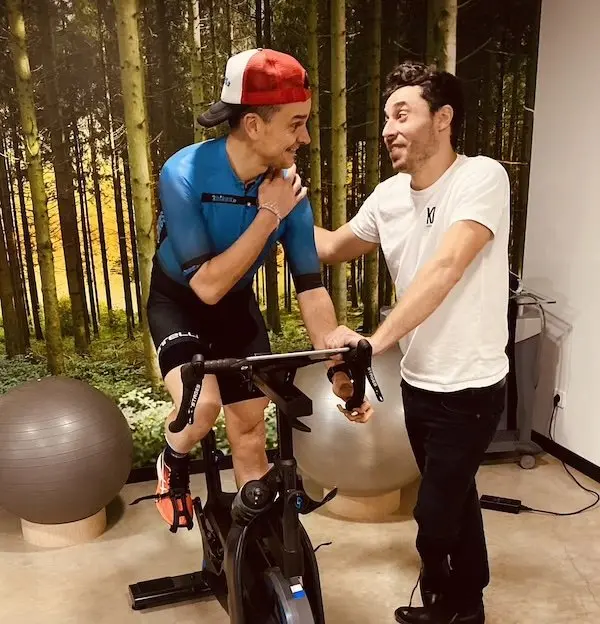
When the coach says yes a little too often
In 2025, OpenAI rolled back a ChatGPT update because it made the model too flattering and too eager to agree with the user. On the bike, you quickly see where that falls apart. We type “I’ve had heavy legs for four days, it’s surely a sign that I’m stepping up to the next level”. If the reply echoes that idea with a bit of vocabulary about adaptation to effort, we can easily mistake complacency for validation.
A coach who knows us can hear in our voice that the week was harder than we claim. They can also ask how the seven-second sprints felt. We put them in to work on neuromuscular aspects, with enough recovery to jump hard every time. By the fourth one, you get out of the saddle and the bike just will not go. On the file, all six sprints are there. On the bike, we know very well how we managed the last two.
By blindly following the arrow
We ride through three villages following the GPS. On the way back, we would be hard-pressed to find the first one again. When you find your own way, you remember the bridge, the closed café, and the climb that starts right after. We needed those landmarks, so we paid attention.
A Canadian study linked routine GPS use to poorer spatial memory performance when subjects subsequently had to navigate on their own. In a survey on generative AI, people who trusted it more reported putting in less critical effort. This research leaves open the question of long-term effects on brain plasticity. It already gives us food for thought regarding what we stop exercising when we delegate.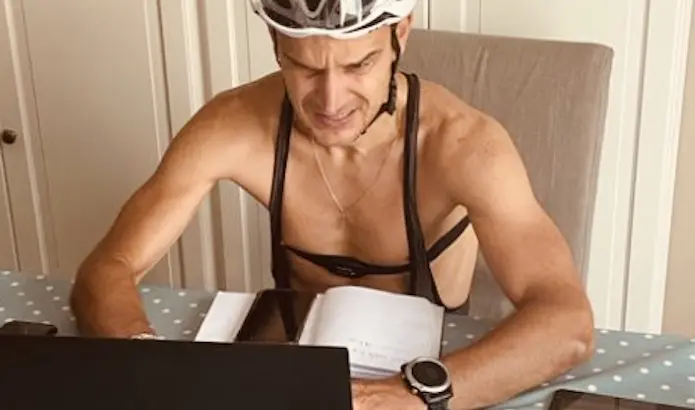
On a bike, intuition also comes from the times you messed up. You started a threshold block ten watts too high and figured out what was going to happen four minutes in. You did a zone 2 ride without constantly staring at the screen and learned to sense the pace at which you could still hold a conversation on a climb. If we wait for the chat’s verdict after every ride, at what point do we learn to trust ourselves?
Mainly, we just expanded our perimeter
The car allowed us to make the same trip faster. Then we started working further away, shopping further away, and seeing people further away. We saved time on the commute and used it to expand our perimeter.
With AI, the training plan comes out in thirty seconds. So we also ask for the debrief, nutrition advice, three variations, and a score out of ten. At work, the document that used to take a whole morning is ready before coffee. And the morning is used to churn out three more. Time saved on a task can quickly turn into extra work.
This goes beyond cycling. At school, at work, or in a club, you can give many more people access to explanations and methods. But how do you learn to challenge an answer if you have rarely had to look for your own? Asking an AI to explain why we do 30/30s is already learning something. Asking it every single evening whether we did the right thing by training is handing over a decision that we will still need to make once the bike computer is turned off.
Next time we get back from a ride, we can open our training log before the chat. Two lines are enough. “Good up to the second climb. After that, the watts were there, but I already wanted to go home.” Then we send the file. If the AI replies “Great workout, objectives met”, we finally have a good question to ask it… What do you make of the second climb?
=> The blind spots of AI in sport for development
=> See All Our Feature Articles
Share the post "Being coached by an AI: how far can we trust it?"