Share the post "Chinese bike brands conquer the global market"
For a long time, Chinese brands were primarily associated with low-cost carbon frames, more or less successful copies of Western models, and products sold through online platforms. However, this image is starting to shift. In just a few years, several Chinese manufacturers have crossed a technological and commercial threshold, to the point of breaking into the professional peloton and directly competing with the market’s historical players. This evolution is reminiscent, in many ways, of the Chinese automotive industry.
By Guillaume Judas – Photos: depositphotos.com
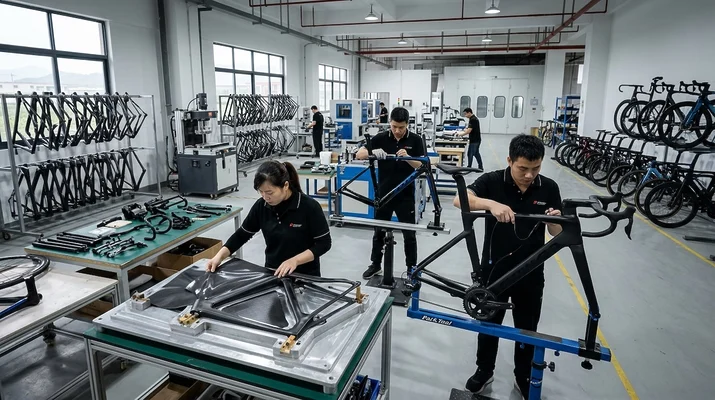
To understand the rise of Chinese brands, we must first look at their industrial history. For years, a large portion of global carbon frame and component production was entrusted to Asian manufacturers, notably in Taiwan. Gradually, some of these industrialists transferred part of their production capacity to mainland China, where they developed infrastructure and trained specialized labor. Chinese subcontractors thus gained significant experience in manufacturing carbon frames, wheels, and components. However, this expertise long remained at the service of Western brands, which retained control over product development, marketing, and commercialization.
The situation began to change when certain manufacturers decided to launch their own brands. They already possessed the machinery, technical skills, and necessary supplier networks. All that remained was to build a commercial identity and convince cyclists worldwide that their products could rival those of established brands.
The development of the domestic market also played a non-negligible role. China now has a sufficiently large customer base of sport cyclists to support brands specializing in high-end products. In particular, it is estimated that there are around 20,000 cycle shops positioned in this segment in the country. By comparison, there are estimated to be between 2,500 and 3,000 specialist shops in France.
Added to this was a shifting economic context. Following the major surge in bicycle demand during the health crisis, manufacturers had to cope with production capacities that had sometimes become excessive and declining Western orders. For certain industrialists, developing their own products and seeking new outlets thus became a particularly attractive prospect.
An evolution reminiscent of the automotive industry
The parallel with the Chinese automotive industry is quite striking. A decade ago, Chinese automakers were still regularly associated with models inspired by, or even directly copied from, European, Japanese, or American productions. Their reputation at the time was very far from that of the major historical manufacturers.
Since then, companies like BYD have profoundly changed the game, particularly in the field of electric cars. China has become a major player in the global automotive industry, with manufacturers capable of developing their own technologies and asserting themselves on international markets.
The bicycle sector seems to be following a comparable trajectory, even if the two industries obviously do not share the same economic and technological constraints. Chinese manufacturers are no longer just seeking to offer a cheaper alternative to Western products. Some are now developing their own technical solutions, investing in research, and attempting to launch brands capable of establishing themselves sustainably on the international market.
Chinese brands at the highest level
This change in status is visible in professional cycling. The most significant example is X-Lab, the high-end brand of Chinese manufacturer XDS, which became a partner of the Astana team starting from the 2025 season. The Kazakh squad thus abandoned Wilier to race on the AD9 aerodynamic model. This arrival in the WorldTour offers the brand international visibility and allows its products to be tested against the demands of top-level competition.
Other manufacturers are also beginning to gain visibility. This is the case for Winspace (with a second-division women’s team that participated in the Tour de France Femmes), Quick Pro (which equipped the 2025 Junior world champion), Pardus (which will equip XEFI, named after the new sponsor replacing TotalEnergies), Incolor, and Tavelo. All of them are developing ranges of road bikes targeted at a demanding clientele, with frames and equipment that have very little to do with the generic or even counterfeit products once associated with Chinese production.
Components shaking up the benchmarks
This move upmarket is not limited to frames. Several Chinese companies are now tackling sectors long dominated by a few major international equipment suppliers. In the drivetrain field, L-Twoo and Wheeltop offer wireless electronic groupsets, as well as mechanical solutions, at prices significantly lower than those of Shimano, SRAM, or Campagnolo. Magene has also been seen offering a power meter that competes with historical brands. Or Coospo with a power meter, a bike computer, a bike radar, or heart rate armbands. Their products are still not widespread in professional pelotons, but they provide an alternative for buyers looking to access electronic shifting without investing several thousand euros.
Carbon wheels represent another sector where Chinese manufacturers have progressed rapidly. Farsports and Craft Racing Works (CRW) illustrate this evolution. These companies, which notably worked in manufacturing for other brands, now market their own products under their own names.
These examples show that Chinese manufacturers are no longer limited to the most accessible products. They are also striving to carve out a place in niche markets, where weight, materials, and manufacturing processes constitute major commercial arguments.
Growing mastery of the production chain
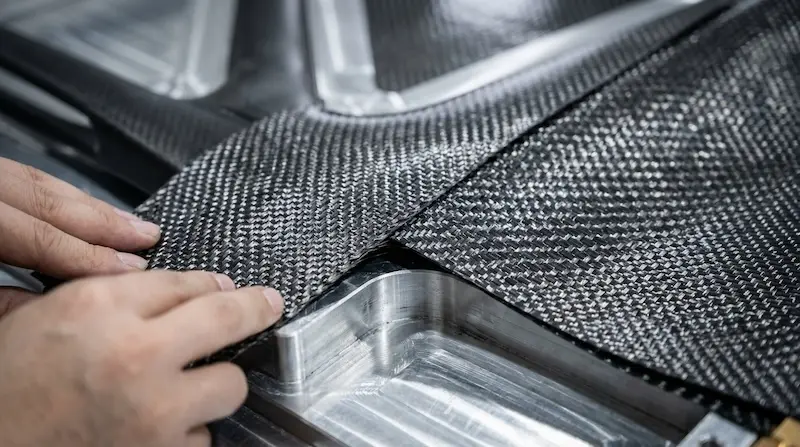
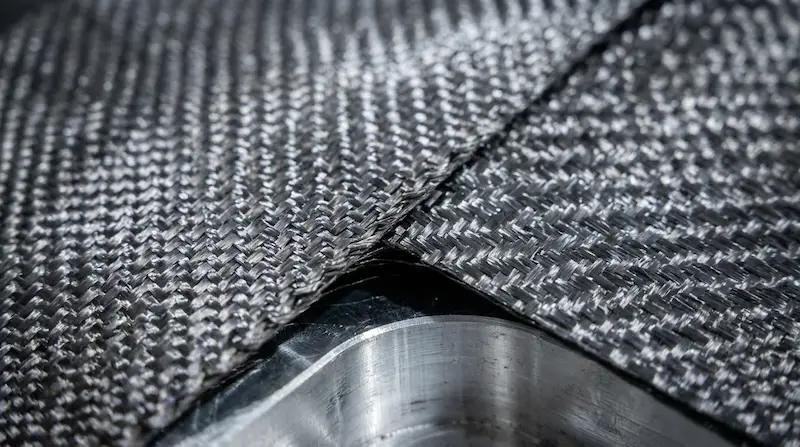
This progress is built on an industrial advantage that is difficult to replicate quickly elsewhere. Chinese manufacturing is already widely present in high-end cycling, sometimes without the consumer even realizing it. Many Western brands have had, and continue to have, their products manufactured in China. Mastery of the production chain thus stands today as one of the primary assets of local industrialists. It is not limited to frame assembly. It also encompasses carbon fiber sourcing, the manufacturing of prepreg rolls, mold machining, the production of internal EPS foam inserts, and painting operations. This integration helps limit the use of intermediaries and allows for better control over the various manufacturing stages. It also helps explain the sometimes significant price gaps between Chinese products and those of historical brands.
The market today offers generic open-mould frames starting from around €600. At the other end, certain specific models exceed €4,000, such as the Incolor SSR, a high-end frame announced at just 750 g with its integrated seatpost and with aerodynamic performance validated in a wind tunnel, much like the greatest brands.
Design that no longer relies on copying
One of the most significant changes undoubtedly concerns product development. Chinese manufacturers now possess design tools comparable to those used by major international brands. Computational fluid dynamics (CFD) software and finite element analysis (FEA) allow them to work on the shapes, stiffnesses, and structural characteristics of a frame even before the first prototypes are built. These tools are complemented by wind tunnel testing and field trials.
The ability to develop a product without systematically going through the reproduction of an existing model constitutes a major evolution in Chinese production. It enables the most advanced brands to build their own technical identity and offer specific solutions. This does not mean that all Chinese manufacturers have the same level of research and development, nor that all their products present equivalent guarantees. The market remains very heterogeneous, between integrated industrialists, specialized brands with their own design teams, and simple distributors of frames manufactured by third parties. But for players who truly invest in development, the gap with established major brands is tending to narrow in terms of technical resources.
Image shift
The next step consists of transforming this industrial capacity into a genuine international commercial presence. Until now, many Chinese brands have primarily operated on a direct-sales model, via their own websites or specialized platforms. An approach that allows for competitive pricing, but presents limitations in terms of distribution, after-sales service, and proximity to consumers. Several companies are therefore now seeking to establish a physical presence in the West.
Because beyond technical performance, the challenge is also one of image. The major historical brands benefit from several decades of presence in races, strong recognition among riders, and well-established distribution networks. Building this legitimacy takes time and significant investment. The initial sponsorship operations in pro cycling respond precisely to this objective. They demonstrate that products can be used at the highest level, while also associating them with teams and riders well known to the general public.
Competition that could intensify
The rise of Chinese brands does not mean that historical players in the bicycle market will quickly lose their position. Designing a good frame or high-performing wheel is not enough to build an international brand’s reputation and longevity. Long-term reliability, quality control, spare parts availability, warranties, and after-sales service remain decisive elements for consumers. Chinese manufacturers must also manage to convince beyond their pricing advantage. To establish themselves sustainably in the high-end segment, they will need to demonstrate their ability to provide commercial and technical support that meets the expectations of Western cyclists.
However, their industrial and technological progress is now difficult to ignore. In a few years, some have gone from the status of subcontractors to that of direct competitors of the brands for which they previously manufactured. The stated goal of several players is now to gain visibility and establish themselves sustainably in major international competitions. Seeing a Chinese brand claim a podium on the Tour de France under its own name within the next ten years is no longer a far-fetched hypothesis. We know today that Chinese brands are capable of making good bikes. It remains to be determined how far they will be able to go in conquering the global market.
Share the post "Chinese bike brands conquer the global market"