Share the post "Review of the Scicon Aeroshade 2.0 Photochromic sunglasses: wide field of view"
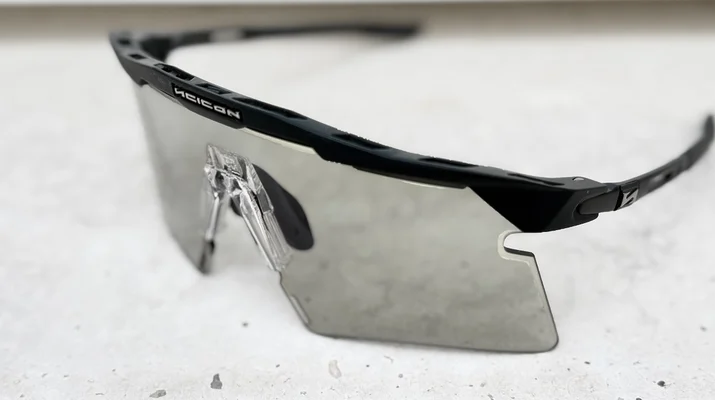
With their large lens and numerous adjustment options, the Scicon Aeroshade 2.0 Photochromic glasses boast interesting features for cycling. We used them for several weeks, on the road and in gravel, to evaluate their optical quality, hold, and everyday comfort.
By Guillaume Judas – Photos: ©3bikes.fr
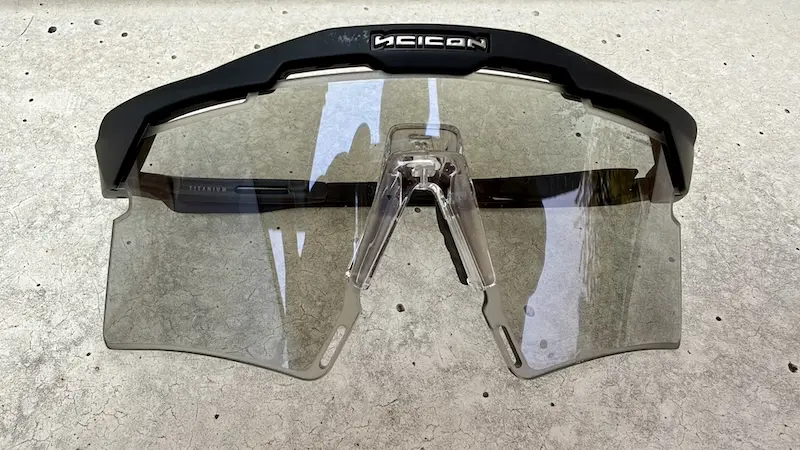
The Aeroshade 2.0 glasses are no doubt familiar to you, since Scicon equips UAE Team Emirates-XRG with a certain… Tadej Pogacar. Looks are one thing. But lens quality is also one of the first things you look at in a pair of cycling glasses. On the Scicon Aeroshade 2.0, the SCN-PP™ photochromic lens proves convincing. It adapts quickly to changes in light, particularly during repeated transitions between sunny sections and undergrowth. You don’t feel any annoying adjustment lag, and visibility remains good even when conditions change frequently.
Light filtration is even, and the perception of terrain contours and contrasts presents no particular issue. In use, the performance seems quite comparable to that of an Oakley Clear to Black photochromic shield, the one I have been using for years. It is therefore a versatile solution that allows you to keep the same lens when the weather or route forces you to go regularly from shade to light.
Substantial protection, with no fogging issues
The large shield of the Aeroshade 2.0 offers particularly generous coverage. It extends quite low over the cheeks and effectively protects the eyes from wind, debris, and turbulence, even when the head is slightly lowered in an aerodynamic position.
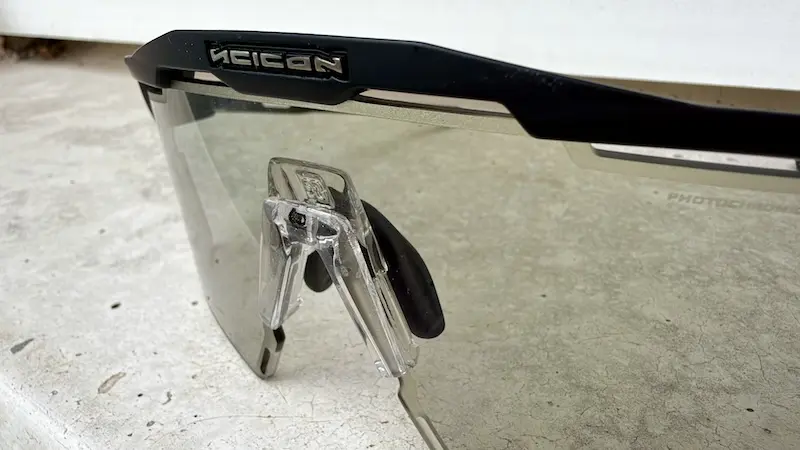
This large surface area might raise concerns about ventilation issues. Yet, I did not experience any fogging during this test, even on cold, damp, and foggy days. The Active Horizon system and the openings built into the lens seem to ensure sufficient airflow. Even during climbs made at low speed with reduced natural ventilation, visibility remains perfectly clear.
Scicon scores major points here, because a pair of high-coverage glasses is not always pleasant when the effort intensifies and speed drops.
In gravel, appreciable protection
It is surely in gravel riding that the Scicon Aeroshade 2.0 find one of their best terrains. Light changes are frequent on forest trails, and the photochromic lens avoids having to take off the glasses or deal with insufficient visibility in shady sections.
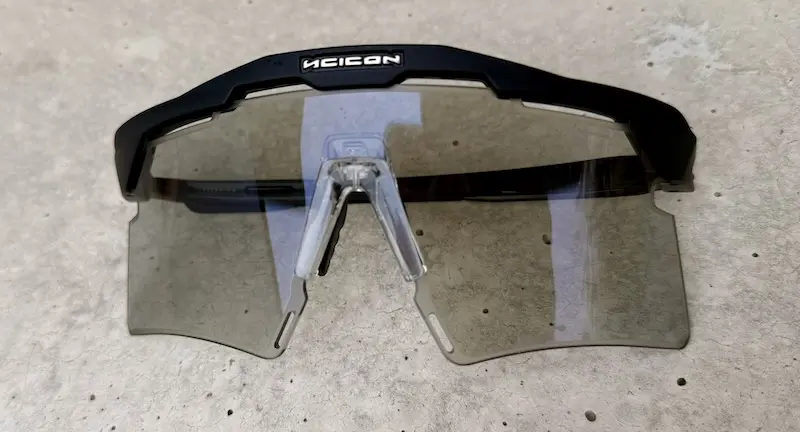
The large surface area of the lens also provides an advantage in terms of protection. Dust, small gravel, and mud splatters are better contained. I therefore appreciated this extra protection on trails, where debris is often plentiful, especially when riding right behind a riding companion.
A neat finish and several adjustment options
The Grilamid TR90 frame of my test pair is paired with medical-grade titanium temples. The whole package has a polished look, without giving an impression of fragility despite the thinness of certain parts of the frame. The design is quite bold, featuring an imposing lens, but remains easy to match with various helmets. The FlexiFit™ temples allow you to adjust their curve to tailor the grip to each individual’s morphology. This is a useful adjustment, especially for finding a good balance between stability and pressure on the temples.
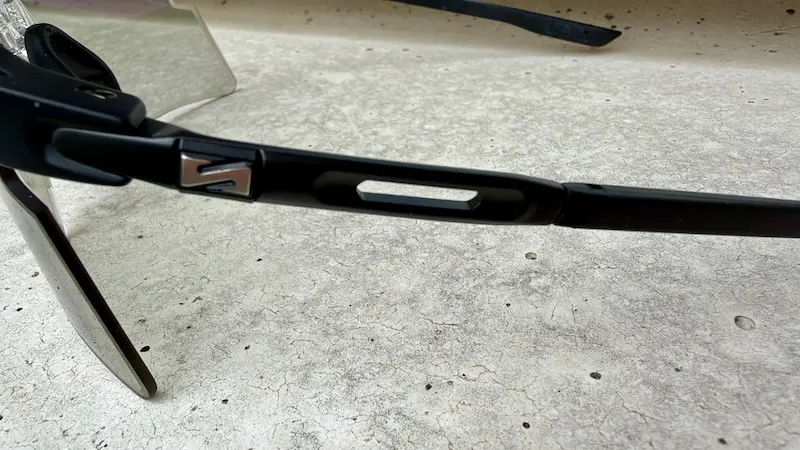
These glasses are available with several color options, whether for the frame, the temples, or the nose piece. A point worth considering for an accessory that is as useful as it is tied to fashion trends.
A firm grip, but nasal comfort leaves room for improvement
Compared to Oakley Radar EV glasses, which I use most of the time, the Scicon Aeroshade 2.0 exhibit a few noticeable differences. The first concerns weight. At a measured 40 g, they are noticeably heavier than the Oakley Radar EV, which weigh 29 g. The difference is not necessarily obvious during the first rides, but it can make itself felt over the hours, especially if the temple and nose adjustments are not quite right.
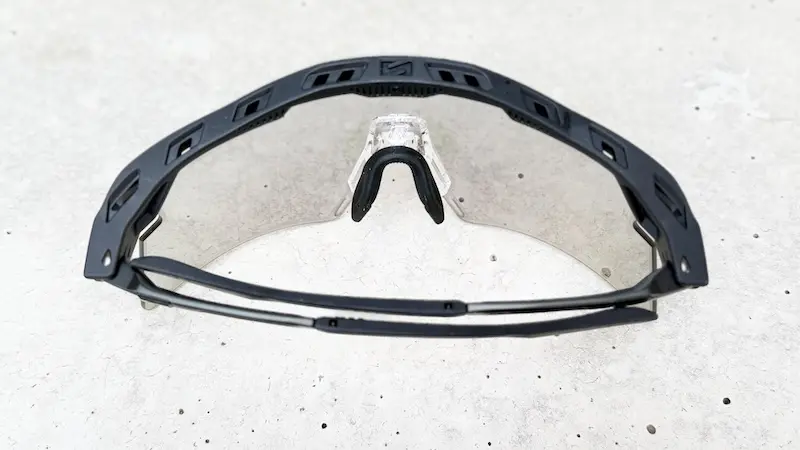
The other difference concerns the nose piece. On the Aeroshade 2.0, it is adjustable, but contact with the nose is quite firm. The material is stiffer and the feel less plush than that of Oakley. The hold is good, but the comfort does not quite reach the same level of softness.
This is not necessarily a dealbreaker, as the sensation also depends on each individual’s morphology. But it is something to consider, especially if you are primarily looking for a pair of glasses that you can forget you are wearing after several hours in the saddle.
Impeccable lenses
The Scicon Aeroshade 2.0 photochromic convinced me with their optical quality, their very wide field of vision, and their ability to effectively protect the eyes and face. The photochromic lens is versatile, light transitions are well managed, and I noticed no fogging issues during testing. Their design lends itself particularly well to gravel riding, but they are also perfectly suited to the road, especially for those who appreciate high-coverage shields.
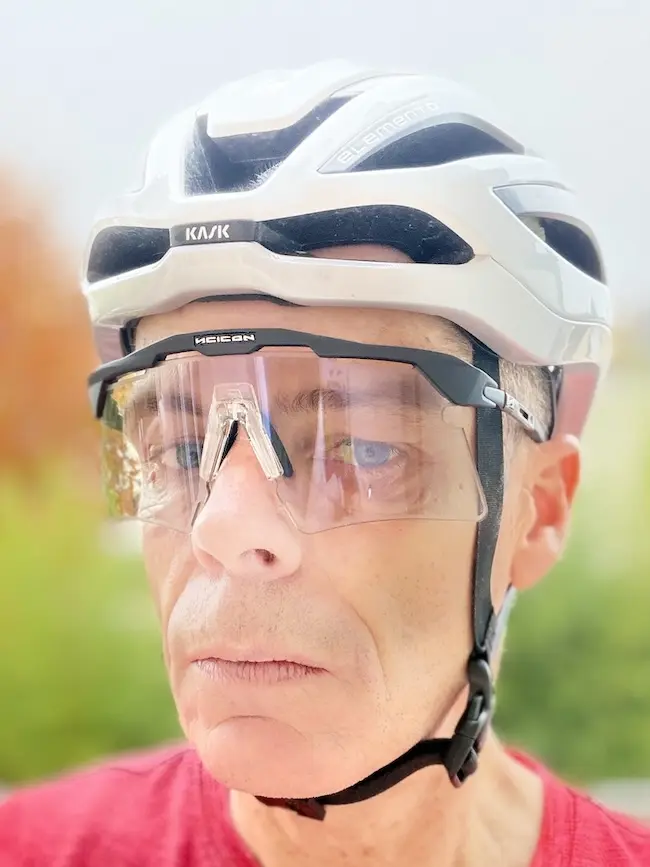
That said, everything is not perfect. Their weight is higher than that of certain competing benchmarks, and the nose piece lacks a bit of suppleness for my taste. Nevertheless, the Aeroshade 2.0 remain a polished pair of glasses that are well worth trying out.
Pros
- Very large field of view and excellent protection
- Effective and versatile photochromic lens
- Good adaptation to changing light conditions, especially in gravel
- Effective ventilation, with no fogging observed during the test
- Neat finish and adjustment options
Cons
- Weight of 39 g, higher than some competitors
- Fairly stiff nose piece, less comfortable than that of the Oakley Radar EV
Technical specifications
| Model | Scicon Aeroshade 2.0 photochromic |
| Lens type | SCN-PP™ photochromic, unbreakable polycarbonate |
| Light Transmission (VLT) | Approximately 18 to 80% |
| Protection | UV400 |
| Categories | 0 to 3 |
| Frame material | Grilamid TR90 |
| Temple material | Titanium |
| Nose adjustment | Horizon Adapt™ |
| Temple adjustment | FlexiFit™ |
| Ventilation | Active Horizon |
| Accessories | Hard case, microfiber pouch |
| Manufacturing | Italy |
| Measured weight | 40 g |
| Price | 250 € |
| Contact | alternativsport.com, scicon.com |
FAQ – Scicon Aeroshade 2.0 photochromicAre the Scicon Aeroshade 2.0 photochromic glasses suitable for gravel? Yes. Their photochromic lens adapts to the frequent light changes found on forest trails and shady sections. The large protective surface also limits dust, mud, and small gravel splatters. How does the SCN-PP™ photochromic lens work? The SCN-PP™ lens automatically adjusts its tint according to the ambient light. It lightens when the light decreases and darkens when the sun becomes stronger. This helps maintain good visibility without having to change lenses during the ride. Do the Scicon Aeroshade 2.0 suffer from fogging issues? During our test, we did not observe any fog formation, even during climbs made at low speed. The Active Horizon ventilation system and the lens openings appear to ensure sufficient airflow. Can the Scicon Aeroshade 2.0 glasses be adjusted to improve their fit? Yes. The FlexiFit™ temples allow you to adapt their curve to the facial morphology. The Horizon Adapt™ system also offers vertical adjustment of the nose piece over a 4 mm range, in order to adjust the position of the lens and the field of view. What is the weight of the Scicon Aeroshade 2.0 photochromic glasses? Our sample weighs 40 g on the scale. This is slightly heavier than some competing glasses, such as the Oakley Radar EV, measured at 29 g. A difference that may matter to cyclists who are particularly sensitive to the weight of their equipment. |
Share the post "Review of the Scicon Aeroshade 2.0 Photochromic sunglasses: wide field of view"