Share the post "Cycling: 6 Strength Training Exercises to Do at Home"
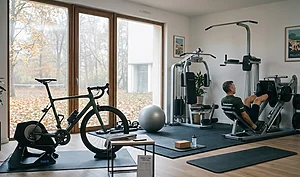
Winter isn’t just the season for indoor trainers and long rides in the drizzle. It’s also the ideal time to lay the groundwork for the coming season. To develop your strength, stabilize your posture on the bike, and prevent chronic pain, you don’t necessarily need a gym membership. Here’s a targeted strengthening program you can do right in your living room with minimal equipment.
By Guillaume Judas – Photos: depositphotos.com
When temperatures drop and days shorten, cyclists often instinctively reduce their mileage. This is precisely where maintenance and muscle strengthening work becomes crucial. Some athletes might even benefit from maintaining this type of routine throughout the season, especially to prevent injuries.
On the saddle, the body functions like a transmission chain: a sufficiently stable torso and pelvis help maintain an efficient position and transmit the power generated by the legs to the pedals. Moreover, the repetition of an essentially linear movement can leave certain muscle groups less engaged than others. Adapted strengthening helps address these differences and better prepare the body for the demands of pedaling.
The goal here with muscle strengthening is clear: gain stability, balance musculature, and enhance pushing power, all without accumulating unnecessary muscle mass.
Necessary equipment: keep it simple
No need to turn your home into a gym. To perform this program effectively, you’ll simply need:
- A thick exercise mat
- A stable chair (or a stair step)
- An elastic band like a mini-band (not essential, only to increase difficulty)
- Adjustable auxiliary weight: a kettlebell, a light dumbbell, or simply a backpack loaded with a few books or a pack of water (not essential, only to increase difficulty)
The 6 key exercises for your winter routine
Prioritize quality of execution over speed. The idea is to master the positioning and feel the work of the muscle groups being targeted. We recommend two sessions per week, for example, Tuesday and Friday, lasting 35 to 45 minutes, with 1 minute 30 seconds of recovery between sets.
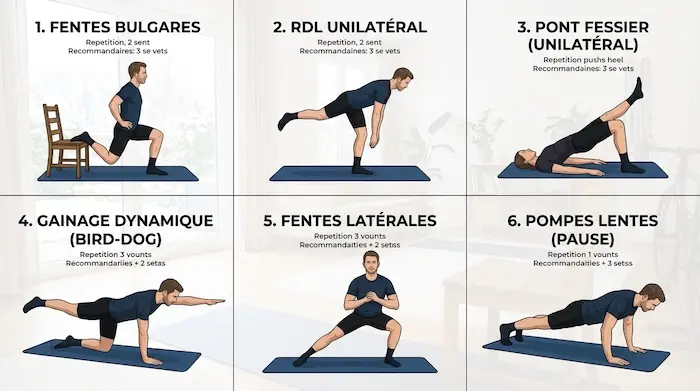
Progression: Start with two sets if necessary. Learn the movements without weight, then gradually increase volume or difficulty.
1. Bulgarian Split Squat (unilateral strength & stability)
Pedaling is a succession of single-leg efforts. Working one leg at a time helps eliminate strength deficits between the left and right sides.
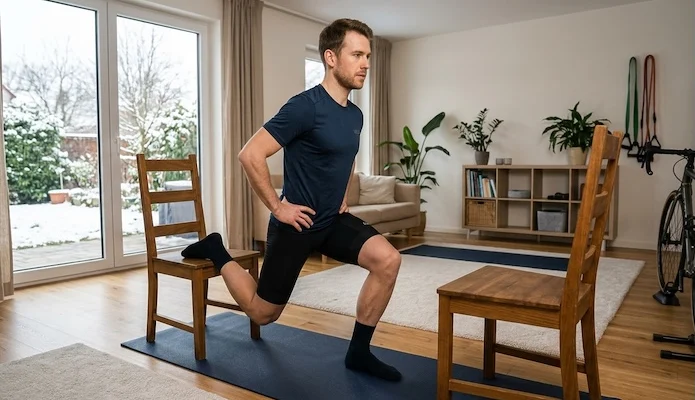
Positioning: Standing, place the top of your back foot on a stable chair.
Movement: Lower your hips by bending your front leg until you reach a comfortable range of motion while maintaining control of the movement. Push off your front foot to return to the starting position.
Volume: 3 to 4 sets of 8 to 12 repetitions per leg.
2. Single-Leg Deadlift (hamstrings & posterior chain)
A fundamental exercise for stretching and strengthening the hamstrings under tension, while locking the pelvis.
Positioning: Standing on one leg, slightly unlocked.
Movement: Hinge your torso forward, keeping your back flat, while extending your free leg backward to align your torso and leg. The pelvis should remain relatively stable, and the movement originates from the hips. Return to the starting position by squeezing your glutes.
Volume: 3 sets of 10 repetitions per leg.
3. Single-Leg Glute Bridge (glutes & pelvic stability)
The gluteus maximus actively participates in hip extension during pedaling. Strengthening them contributes to the development of lower limb strength and pelvic control.
Positioning: Lying on your back, one foot flat on the floor, the other leg extended upwards.
Movement: Lift your pelvis off the floor by pushing through your heel until your shoulders, hips, and knee are aligned. Pause for one second at the top.
Volume: 3 sets of 12 to 15 repetitions per leg.
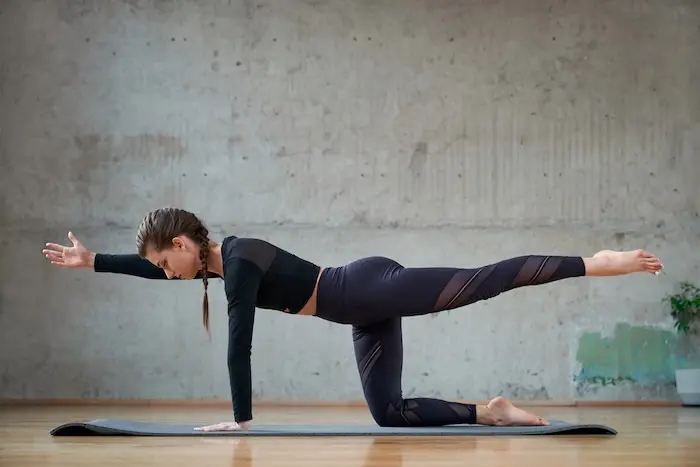
4. Dynamic Plank (axial stability & force transfer)
Rather than an endless static plank, dynamic work teaches the torso to remain still while the limbs move, exactly like on the bike.
Positioning: On all fours, hands under shoulders, knees under hips.
Movement: Simultaneously extend your right arm and left leg horizontally without allowing your pelvis to rotate. Return to the starting position, then alternate with your left arm and right leg, keeping your back stable.
Volume: 3 to 4 sets of 45 seconds to 1 minute.
5. Lateral Lunges (frontal plane strengthening & pelvic stability)
Pedaling primarily involves a front-to-back movement. Lateral lunges engage the hip adductors and abductors, while also working on pelvic stability and lower limb control. They thus complement the work done in the pedaling plane.
Positioning: Standing, feet shoulder-width apart.
Movement: Take a large step sideways, bend the knee of your supporting leg while keeping the other leg straight, then push off the ground strongly to return to the center.
Volume: 3 sets of 10 to 12 repetitions on each side.
6. Slow Push-ups with Pause (upper body support)
Holding the hoods or the drops of the handlebars for several hours actively engages the triceps, shoulders, and scapular stabilizers.
Positioning: In a classic plank (hands slightly wider than shoulders) or on your knees.
Movement: Lower your chest towards the floor in a controlled 3 seconds. Pause for one second at the bottom before pushing back up.
Volume: 3 to 4 sets of 8 to 15 repetitions.
How to integrate these sessions into your week?
Keep in mind that this strengthening routine is a complement to your bike or indoor trainer workouts. Don’t aim to exhaust yourself cardiovascularly: allow yourself 1’30” of recovery between each set to maintain proper form.
Two weekly sessions of 35-40 minutes, interspersed between your rides or speed sessions, can help improve stability and strength over the weeks. This will give you more stability during accelerations, less lower back fatigue, and a stronger pushing sensation on the pedals.
Share the post "Cycling: 6 Strength Training Exercises to Do at Home"