
Share the post "Behind the scenes at Q36.5: we tested the heat in the TerraXCube"
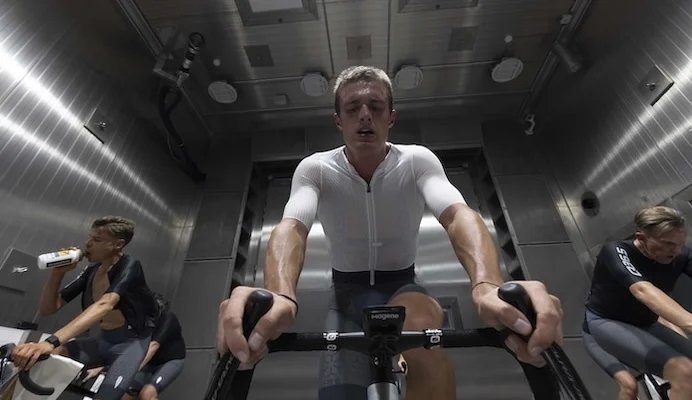
Designing technical cycling apparel isn’t just about picking nice fabrics from a catalogue, stitching panels together, and sending a rider out for three laps of a circuit to sign off on the product. At premium Italian brand Q36.5, research and development rely on a far more rigorous, almost clinical approach. To understand how the body and textiles react to the worst weather conditions, the brand invited us to take part in an unusual experience: an all-out turbo trainer session inside a climatic chamber set to 35°C. Welcome to the heart of the TerraXCube.
By Guillaume Judas – Photos: q36-5.com
21 October 2026, Bolzano. The journey takes some earning. Nestled at the foot of the Dolomites in South Tyrol, the city is nearly a three-hour drive from the nearest airport. Between cancelled flights and missed connections, I will spare you the details of a nightmare journey both on the way there and on the way back. Yet the trip was well worth the effort, granting access to the NOI Techpark and its research hub, Eurac Research.

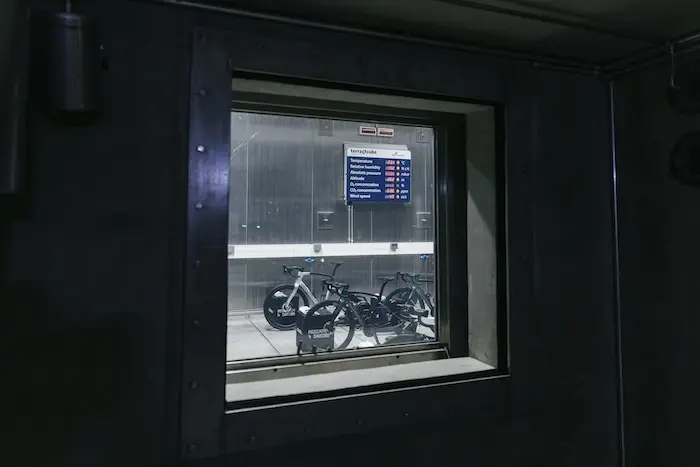
This is where the TerraXCube is located, an extraordinary environmental simulator. This climatic chamber can replicate an impressive variety of planetary climates, with temperatures ranging from −40°C to +60°C, while finely controlling humidity levels, atmospheric pressure, and wind speed. It provides a controlled experimental environment to test athletes and equipment in the most demanding conditions.
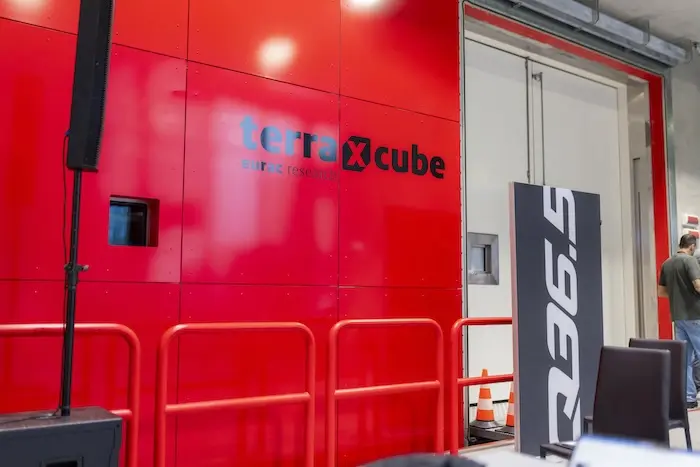
Q36.5 has been collaborating with Eurac Research and the TerraXCube since 2021. It is an ideal geographic proximity, but above all a unique opportunity for this brand founded in 2013. Its name is no accident either, as it directly refers to the ideal body temperature of 36.5°C. The fundamental goal of their clothing is not merely to be lightweight or aerodynamic, but to preserve this thermal balance under effort by promoting sweat wicking and heat dissipation.
Stepping into this state-of-the-art laboratory alongside 19 other journalists from around the world, the plan was not to watch engineers run demonstrations on a screen, but to get down to business and serve as guinea pigs ourselves.
The protocol: 35 minutes at the pace of Montjuïc
There was no question of pedalling blindly or casually spinning the legs in a sauna. The scientific team devised a custom session inspired by real racing: the finale of stage two of the 2026 Tour de France in Barcelona, punctuated by the explosive, repeated climbs up Montjuïc.
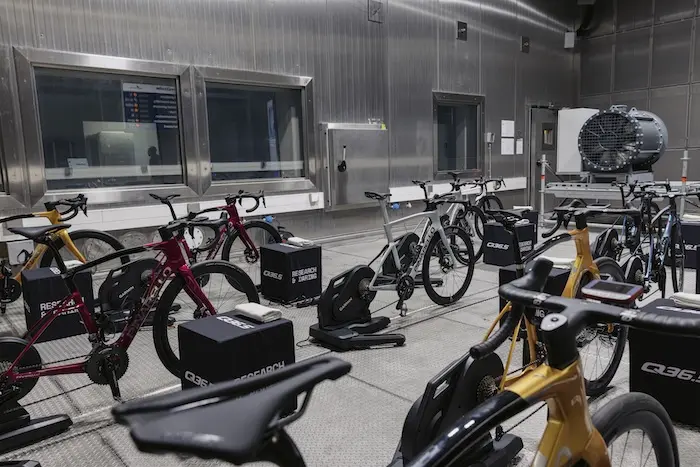
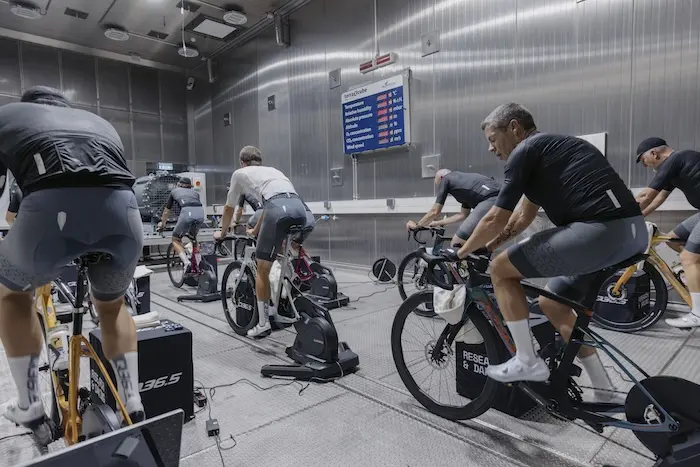
Each participant was set up on a Garmin Tacx Nera smart trainer connected to Zwift. On the menu: 35 minutes of effort split into seven very precise phases, alternating recovery periods, sustained tempos, and vicious attacks. The session begins with a 5-minute warm-up in Zone 2, followed by a first simulated 10-minute climb at a sustained tempo in Zone 4. After 5 minutes of active recovery in Zone 1, the intensity jumps abruptly with a second 4-minute climb in Zone 5, before rolling over the crest into a 3-minute descent to catch your breath in Zone 1. The test then moves onto a 6-minute transitional plateau in Zone 3 to settle the effort, before culminating in a particularly brutal 2-minute final wrap-up pushed into Zones 5 and 6.
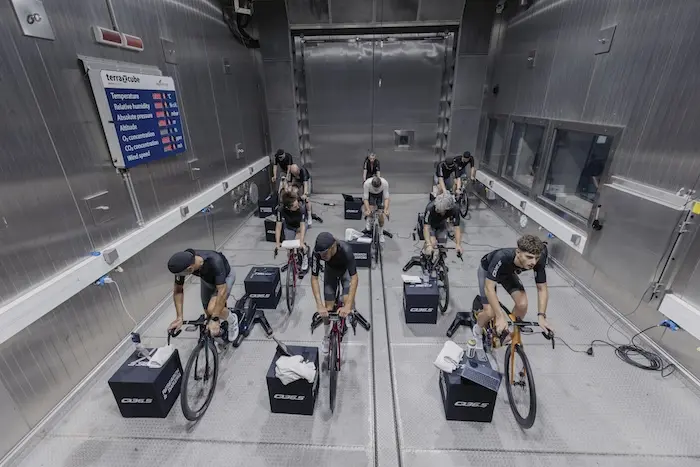
To keep the playing field level, the power zones were pre-calibrated by Mario Kummer (a former pro with the legendary Team Telekom) based on each participant’s FTP (functional threshold power). Even if the watts displayed on the screen were not the same for everyone, the relative physiological demand remained identical.
Inside the chamber, the air was locked at 35°C with 50% relative humidity. To spice things up, the ventilation system replicated realistic airflow: the hot headwind eased during the virtual ascents and picked up speed on the descents.
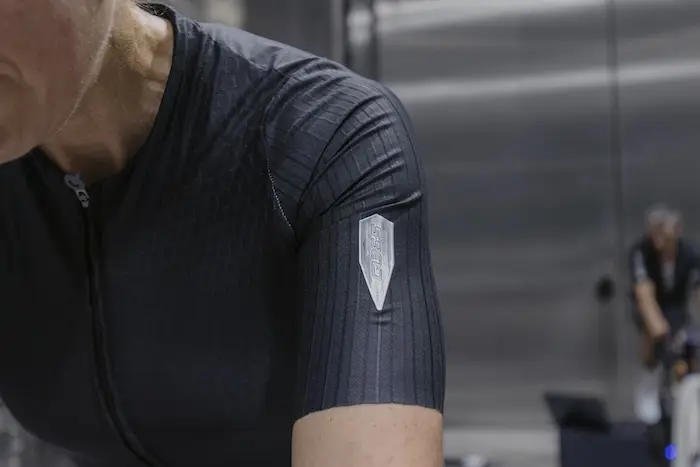
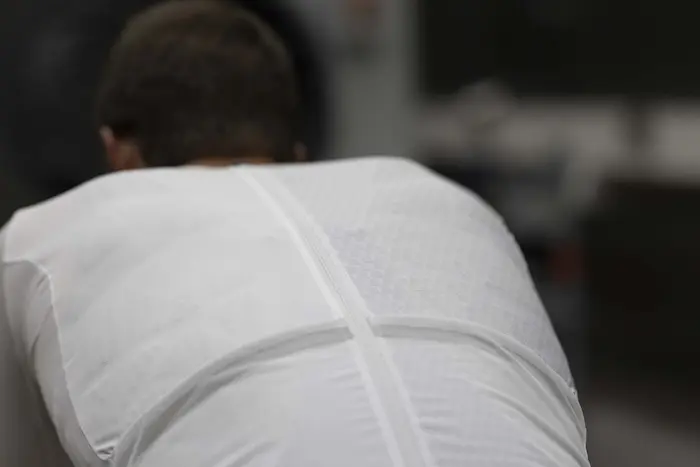
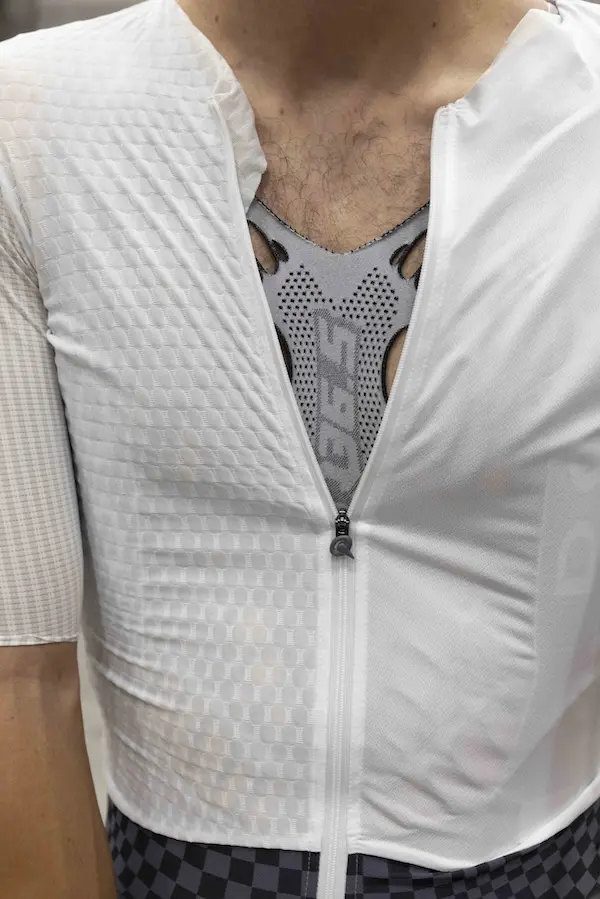
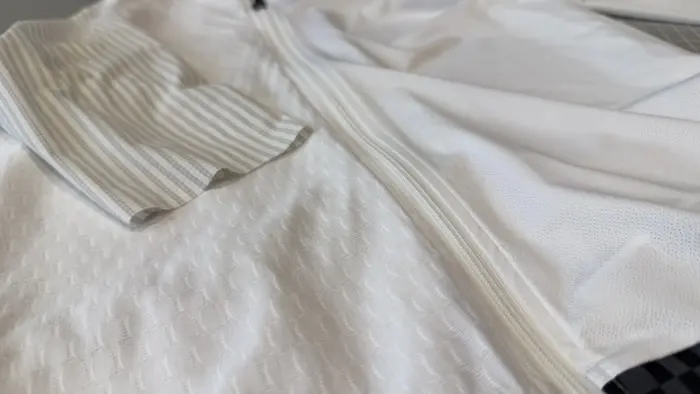
For this test, we were all kitted out in the same outfit: the Gregarius Pro Evo jersey, the Dottore Pro bib shorts, and a Subzero base layer from the upcoming collection. Alongside us, one of the brand’s athletes wore an experimental split jersey: the left and right sides of the torso were constructed with fabrics featuring different properties. The goal? To measure in real time on the same body the difference in thermal dissipation between two textiles.
From paper to reality: a particularly brutal session
On paper, 35 minutes on a turbo trainer seems short and manageable. But as soon as the heavy sealed door of the climatic chamber shuts and the blast of hot air hits your face, real-world reality quickly shatters any confidence. As far as I was concerned, the session turned into a real ordeal. It was late October, and I had not put in any genuine high-intensity efforts for nearly a month. My body was clearly lacking race pace.
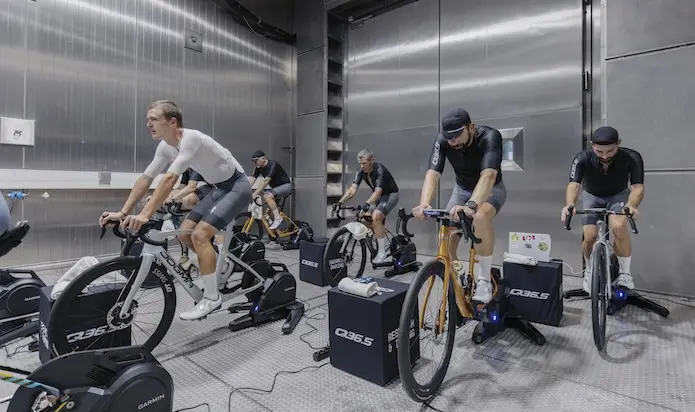
After barely 20 minutes, cardiac drift was unmistakable: my heart rate climbed to 169 beats per minute, a figure very close to my absolute maximum. The discomfort became overwhelming, sweat dripped profusely, and whenever the protocol required dropping the watts to recover, my heart simply refused to settle back down.
Yet I am usually very well adapted to dealing with high heat. Throughout the summer of 2026, I routinely strung together long rides under the midday sun. But between the lack of autumn race fitness, the absence of natural air circulation, and the confinement of the laboratory, my body’s reaction proved much more violent than expected.
What the CORE sensors reveal
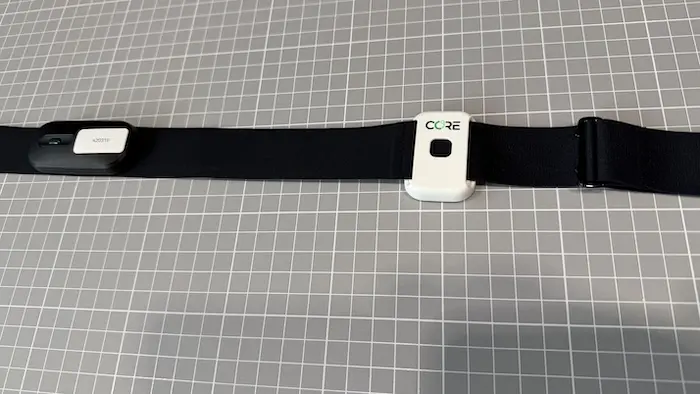
Throughout the test, we were equipped with CORE sensors to monitor skin temperature and estimate core body temperature. At the start of the session, my core temperature was at 37.1°C. Unsurprisingly, it climbed steadily over the 35 minutes to peak at 38.5°C, just after stopping pedalling.
What is the CORE sensor?Now a standard in the professional peloton and across WorldTour teams in particular, the CORE sensor is a small, non-invasive unit that clips directly onto a heart rate monitor strap.
|
The most interesting metric was the time spent in “thermal strain zone 3” (the zone where the body is actively battling overheating, without yet tipping fully into the red). My sensor recorded just 4 minutes spent in this critical zone. Out of the 21 test subjects on the day (journalists and Q36.5 athlete included), only two participants spent less time than me in this orange zone (above it, you’re on fire). Everyone else stayed there significantly longer, despite wearing identical clothing and following the exact same protocol.
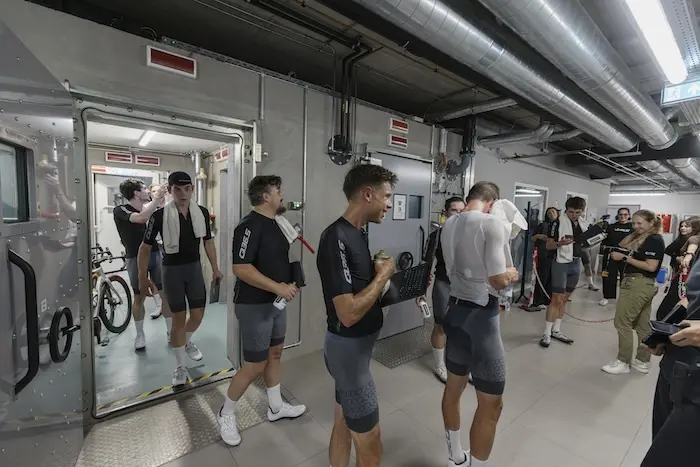
Could this be seen as evidence of residual heat acclimatisation carried over from my summer rides? It is a possibility, though it would be unwise to draw definitive conclusions from a single test. Above all, it highlights the staggering gap that can exist between the subjective perception of effort (a heart at breaking point, a feeling of suffocation) and measured physiological data (an internal temperature under relative control).
As for the experimental split jersey worn by the in-house athlete, the thermocouples revealed a skin temperature difference of a few tenths of a degree between Fabric A and Fabric B. A negligible difference on a casual Sunday ride, but crucial at high intensity: these tenths of a degree make the difference between a cyclist who reaches thermal saturation and one who manages to sustain their effort for a few minutes longer.
Science lays the groundwork, the road has the final say
This day at the TerraXCube sheds valuable light on the Q36.5 method. The brand does not settle for marketing talk about thermoregulation or picking materials out of simple swatch books. It develops measurable protocols, subjects its prototypes to the rigours of scientific research, and collaborates with sports scientists.
Of course, 35 gruelling minutes in a hotbox are not enough to pass definitive judgment on the quality of a winter or summer outfit. Nothing will ever replace long-distance rides, crosswinds, driving rain, and long alpine descents. But this immersive look behind the scenes reveals the exacting standards engineered into every seam. Science and the laboratory provide the quantitative benchmarks needed to design truly refined products. All that is left for us is to get on the bike to verify whether that work translates into the promised comfort out on the open road.
See all our articlesDossiersShare the post "Behind the scenes at Q36.5: we tested the heat in the TerraXCube"


