Share the post "E-bikes and training: the Origine Newton[e] on test"
Often associated with daily commuting or leisure rides, e-bikes can also find their place in athletic training. Michèle Calvi, a cyclocross racer and Masters European Championship medalist, chose the Origine Newton[e] to support her road training, better manage fatigue, and increase her riding volume without sacrificing the ride feel of a traditional bike. Here is her story.
By Michèle Calvi – photos: Bruno Cavelier
Even though I was never afraid of bumping shoulders in a race, as I got older I started to fear crashing. So I gradually moved toward cyclocross, a demanding discipline that requires as much technique as physical fitness. It took me a few seasons of practice, technical work, and specific drills to reach a good level.
Today, I mainly compete in cyclocross races, both regionally and internationally in the Masters category. Last year, I earned a bronze medal at the European Championships in my category, and a fourth place at the World Championships.
The cyclocross season generally runs from early October through mid-February depending on the region. But naturally, to prepare for these winter events, you absolutely have to build up your engine by training on the road year-round. In spring and summer, I ride regularly on the road, doing four rides a week, as much for training as for pure pleasure.
Why an e-bike?
As with many cyclists, the years go by and the body changes too. On my end, I regularly suffer from back pain, aches that especially show up on long mountain climbs or during multi-hour rides. The idea of getting an electric bike had been lingering in my mind for several years. I had already taken the plunge five years ago, but the experience proved inconclusive: an overly heavy bike, unconvincing assistance, and reliability that left much to be desired… So I preferred to wait it out, until technology improved. My goal was simple: find a lightweight, high-performance electric bike that retains true ride feel when the motor cuts out. I had set myself a weight limit of under 11 kg. Today, that is finally the case with the Origine Newton[e], a bike that delivers exactly what I was looking for.
Discovering the Newton[e]
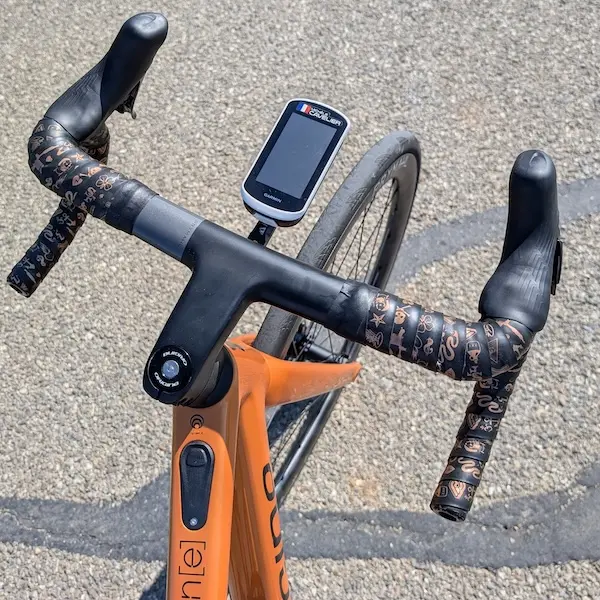
Origine advertises its Newton E as the lightest e-bike in the world. That’s what caught my eye, especially since I have been riding this brand for many years; currently on a size XS Axxome GTR, with Ultegra Di2, equipped with lightweight wheels and high-end components such as the Prymahl cockpit.
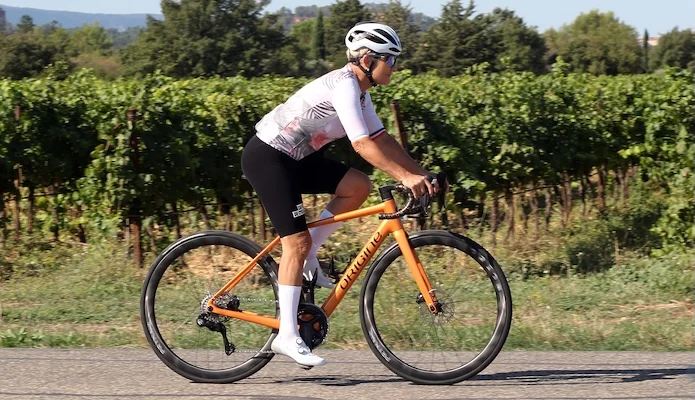
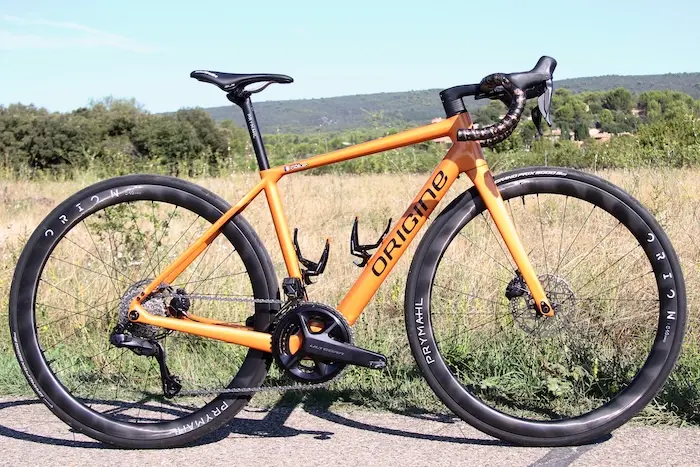
At first glance, nothing suggests this is an electrically assisted bike: the lines are sleek, the battery and motor integration is remarkably discreet, and the whole package exudes understated elegance.
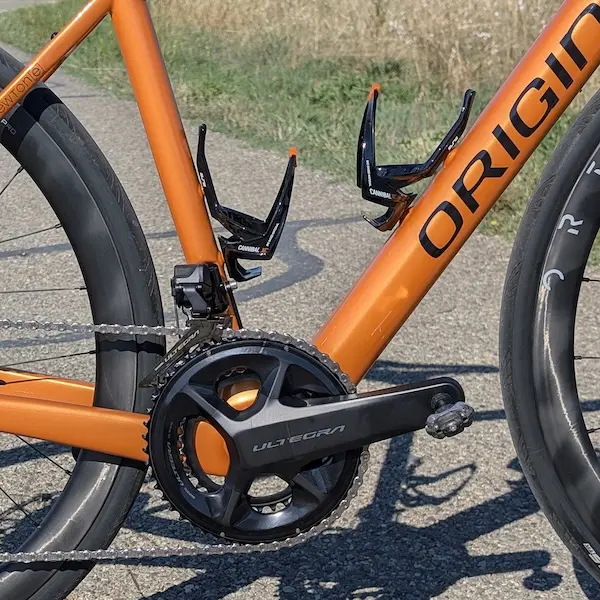
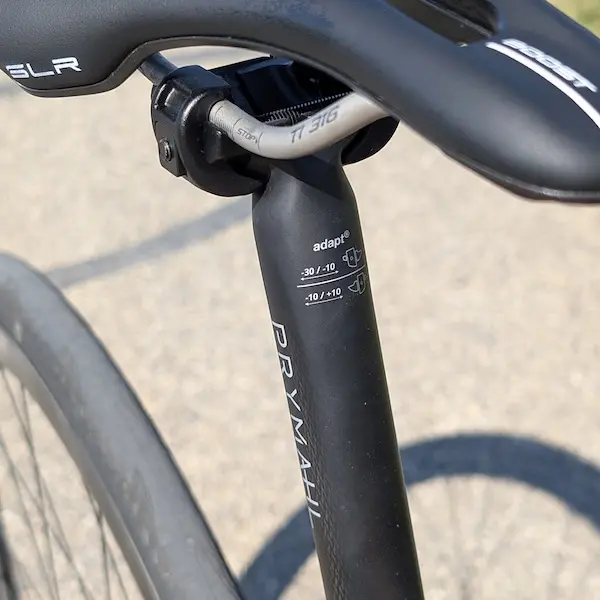
So I configured my Newton[e] on the same baseline: XS frame, Ultegra Di2, Prymahl Orion C40 wheels, and I ordered the same saddle as on my traditional bike, a Selle Italia SLR Lady. Unlike my Axxome, I opted for the Prymahl Adapté Carbon seatpost instead of a straight Pro Vibe. That’s because I need a zero-setback post to optimize my position. Quite remarkably, this Prymahl Adapté Carbon seatpost is a concentrate of technology, weighing just 190 g. Its clamp, patented by Origine, is reversible, allowing you to choose between a Zero Offset setup and a version with 20 mm of setback. Combined with the saddle rail adjustments, this part delivers the widest range of offset on the market, dialable down to the millimeter from +10 mm to -30 mm.
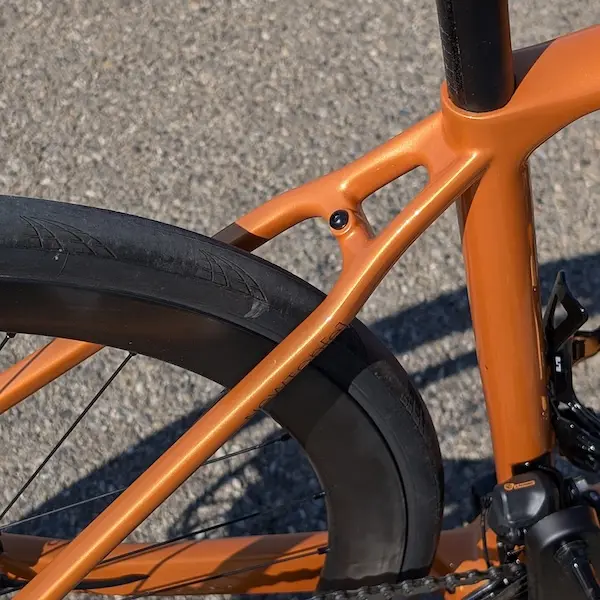
As soon as I received my Newton[e], I was immediately captivated by its looks. At first glance, nothing suggests this is an electrically assisted bike: the lines are sleek, the battery and motor integration is remarkably discreet, and the whole package exudes understated elegance. Right from the first few kilometers, the assistance proves very pleasant. The different modes transition with great fluidity, free of jolts, and backing off to a lower assist level is just as smooth. You quickly forget you are riding an e-bike, as the ride feel remains so natural.
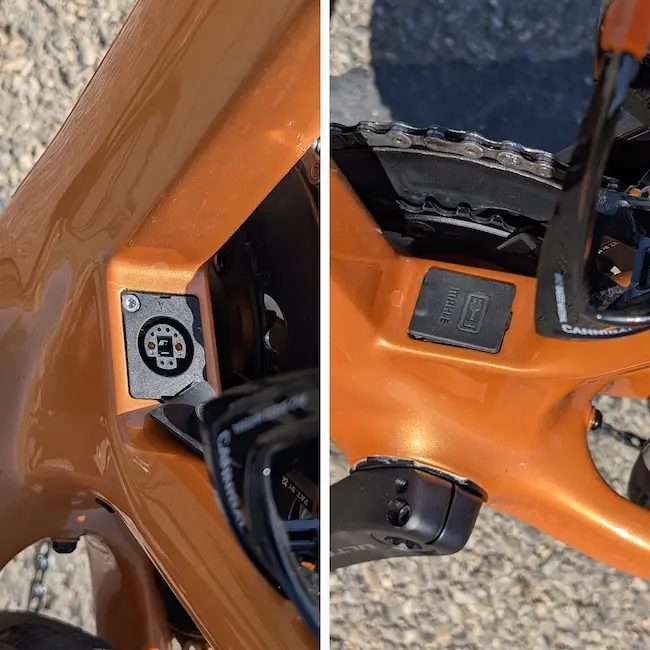
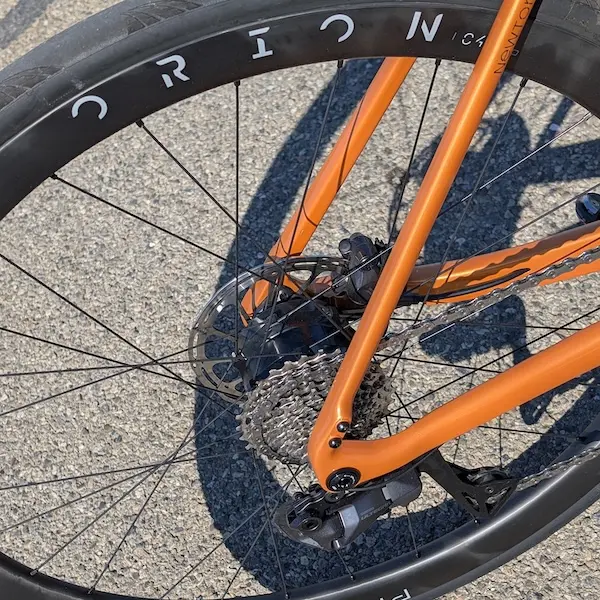
Beneath this traditional bike appearance lies a genuine concentrate of technology. The Mahle X20 motor, integrated into the rear hub, weighs just 1.39 kg and contributes to the bike’s low overall weight. With 65 Nm of torque and a peak power of 275 W, it provides effective assistance, particularly when the road tilts upward. Thanks to its speed, torque, and cadence sensors, the assistance adjusts instantly to your effort, delivering a very natural feel. Once you reach 25 km/h, the motor cuts off with zero drag, preserving the handling characteristics of an acoustic bike. The integrated battery offers up to 100 km of range depending on the route and assist level used. For long rides, an optional range extender brings total capacity to 435 Wh and pushes the range up to 160 km.
The e-bike as a training tool
Contrary to some common misconceptions, I never considered buying an electric bike to replace my acoustic bike. My goal is entirely different: to use it smartly to optimize my training. The first benefit is practical. I regularly ride with my partner. His performance level matches mine in terms of race results, but he’s a man… So, his actual raw fitness is higher.
Long mountain rides or climbing major Alpine passes weren’t always fun for me, nor for him having to ride below his pace. Thanks to the Newton[e], I can now ride with him without him having to wait up or ease off. The motor assistance simply allows me to stay on his wheel and fully enjoy the ride while still getting in some solid pedaling, as in this specific case I make a point of using only the lowest assist level. But it is above all from a training perspective that the Newton[e] makes total sense.
I usually do three or four weekly rides on my traditional road bike. Some sessions are particularly demanding, such as my group rides surrounded mostly by men, and the next day, fatigue can be very real or motivation slightly lower. Rather than skipping a session, I jump on the Newton[e]. I keep riding, keep the legs turning over, work on my endurance, and recover actively while keeping muscular fatigue low. This allows me to increase my training volume without accumulating excessive training stress. My goal is now to do four to five rides a week: three or four on my acoustic bike, complemented by one or two on the Newton[e] whenever appropriate.
A more rewarding workout than it might seem…
Electric assist does not mean everything becomes effortless. The Newton[e] is limited to 25 km/h. As soon as you exceed that speed, the motor stops assisting. On the flats, I very often ride faster than 25 km/h. Under those conditions, I am pedaling entirely under my own steam, but on a bike that is significantly heavier than my acoustic road bike—roughly 3 kg more. In the end, this turns out to be an excellent workout to hold the same speed as riders aboard 7 kg machines…
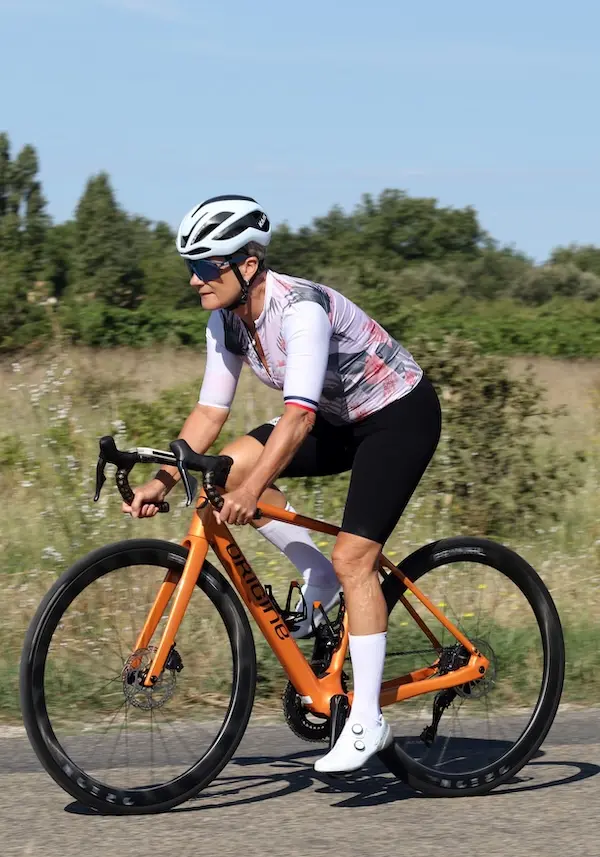
Another surprising takeaway: switching back and forth between both bikes. After a ride on the Newton[e], when I hop back on my classic road bike the next day, the sensations are brilliant. The bike feels much livelier, more responsive, and incredibly easy to turn over. You genuinely feel like it’s lighter and that every single pedal stroke is more efficient.
This bike is astonishing in its handling: it allows you to retain the exact same ride feel as on an acoustic race bike, whether you ride it with or without motor assistance.
Going against the grain
Electric bikes still suffer from many prejudices. Many cyclists only associate them with leisure riding or assume they are meant to replace traditional bikes. Yet, when used thoughtfully, an e-bike can become a fantastic training tool. Used wisely, the Newton[e] allows you to increase your riding volume, recover better between hard sessions, keep up with faster riding partners, and keep logging miles despite a temporary dip in form or a few aches, all while retaining the pure joy of being on a real bike.
In my view, an electric bike is not meant to replace an acoustic bike. The two are perfectly complementary. It is precisely this alternation that lets you take full advantage of each one’s strengths and draw real benefits for both fitness progression and the simple pleasure of riding. After multiple outings with the Origine Newton[e], I am convinced that this is where its true value lies. It pulls off the challenge of combining stealth looks, lightweight build, and high performance. It will win over cyclists who want effective assistance without sacrificing the feel of a traditional road bike.
PROS
- Very lightweight bike for an e-bike
- Understated and discreet looks
- Smooth and natural assistance
- Handling very close to a classic road bike
- Allows you to keep riding on demanding routes and/or with fatigue
CONS
- Bike’s weight is noticeable once the assistance cuts off
TECH SPECS
| Model | Origine Newton[e] |
| Frame | Origine Newton[e] |
| Fork | Origine Axxome III In Disc 12×100 |
| Drive System | Mahle X20 |
| Battery | Mahle iX 250Wh intube |
| Drivetrain | Shimano Ultegra Di2 |
| Crankset | Shimano Ultegra R8100 50-34 T |
| Cassette | Shimano Ultegra R8100 11-30 12-speed |
| Wheels | Prymahl Orion e-C40 Pro |
| Tires | Continental GP 5000S TR 28 Tubeless |
| Handlebar and Stem | Prymahl Cockpit |
| Saddle | Selle Italia SLR Superflow Lady |
| Seatpost | Prymahl Adapté Carbon (+10 -30) 27.2 |
| Weight | 10.3 kg without pedals in size S |
| Price | €7,545 |
| Contact | origine-cycles.com |
FAQ – Origine Newton[e]: Using an Electric Bike for TrainingCan an electrically assisted bike be used for road training? Yes. When used appropriately, an electric assist bike allows you to maintain physical activity, build aerobic endurance, and increase riding volume. In particular, it can complement rides on a traditional bike during less demanding sessions or active recovery phases. Why choose the Origine Newton[e] for cycling training? The Origine Newton[e] combines low weight, smooth electric assistance, and discreet integration of both motor and battery. Its Mahle X20 rear-hub motor delivers a claimed 65 Nm of torque and a peak power of 275 W. It provides a boost on tougher gradients while preserving handling and ride feel very similar to a classic road bike. Can you keep pedaling efficiently when the electric assist cuts out? Yes. The Newton[e]’s motor assistance disengages at 25 km/h, in accordance with applicable e-bike regulations. Above this speed, the rider continues pedaling unassisted. The extra weight compared to a traditional bike can then present an added physical challenge, especially on the flats. How can an e-bike aid recovery after a hard workout? By reducing the effort required in specific situations, an e-bike allows you to keep logging miles without adding as much muscular fatigue. It can thus be used for a moderate-intensity endurance ride or active recovery, depending on the chosen assist level and rider sensation. Can an e-bike replace a traditional road bike for a competitive cyclist? Not necessarily. In Michèle Calvi’s case, the Origine Newton[e] complements her traditional bike rather than replacing it. Alternating between the two allows her to keep high-intensity sessions on the acoustic bike, while utilizing electric assistance to ride alongside faster partners, get out on the road despite temporary fatigue, or bump up overall weekly volume. |
Share the post "E-bikes and training: the Origine Newton[e] on test"