Share the post "COROS DURA 2 Solar bike computer review: the sun eclipses Garmin"
Three Garmin computers, including our latest Edge 1040, four playgrounds, one turbo trainer, a COROS heart rate monitor armband, and three and a half years in its app: we thought we knew what to expect from a cycling GPS. Received ahead of its release, the new COROS DURA 2 Solar surprised us as much by its futuristic silhouette and impressive battery life as by something far less spectacular: the pleasure of setting it up. From the Colnago V4RS to the LYTI gravel bike, from the S-Works Epic to the Tacx NEO 2, our review also uncovers the little details that spec sheets overlook. Starting with a mount that doesn’t get along with our handlebar and a ROTOR UNO groupset that refuses to talk to the computer.
By Jeff Tatard – Photos: ©3bikes.fr
A preview, and almost a blind discovery
There are two categories of cyclists. Those who look at their computer every thirty seconds, and those who claim they never look at it at all. We probably belong to both. We love watts and heart rate graphs. But even more so, we love the open road, the trails, and the pure sensations. It was with this fully assumed contradiction that we welcomed the COROS DURA 2 Solar, offered to 3bikes ahead of its launch on October 22, 2026. And then there’s that name, DURA. Four letters that already seem to whisper one of its main selling points: a computer built to endure. For a long time. A very long time. With the sun as an ally, the promise becomes particularly alluring. But between what a name implies and what a product delivers, there are sometimes quite a few miles to cover. And we were about to log every single one of them.
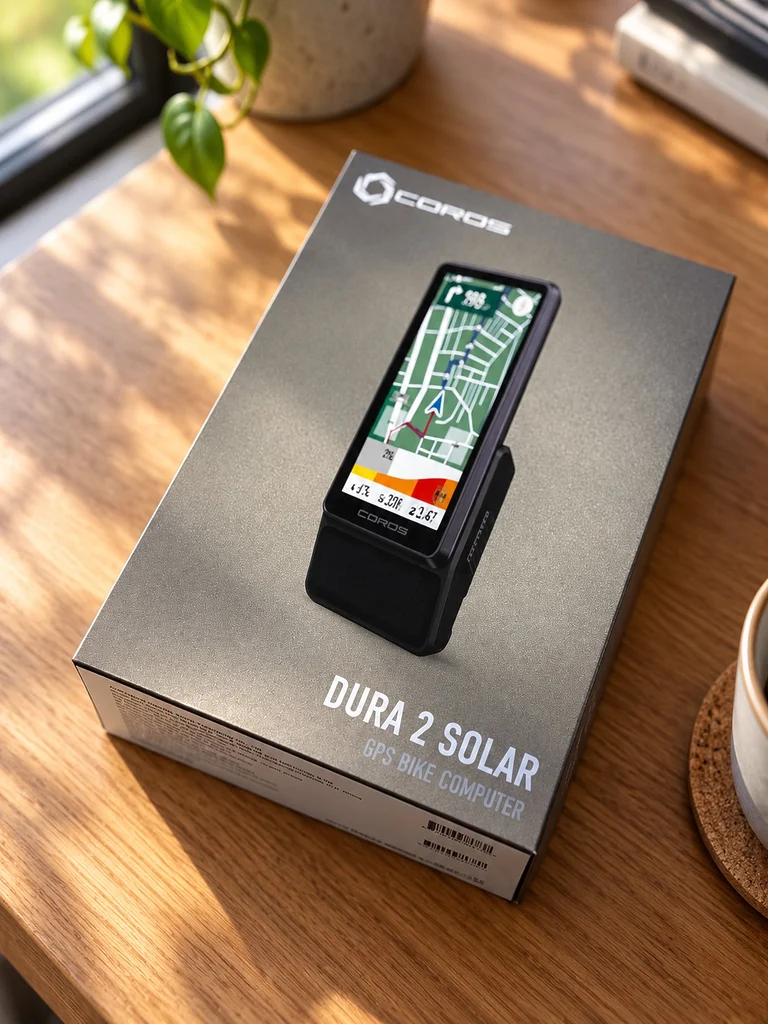
The schedule was anything but comfortable. The proposal arrived in late September, leaving us just a few weeks to receive the device, set it up, and pack in the rides. An international technical presentation was scheduled for October 6, but a work seminar prevented us from attending. The French PR agency offered to send us the press materials after the meeting. We therefore began the test with very little official information about this second generation. In the end, it was perhaps for the best: for once, we were going to discover what the computer actually did for us before reading everything its manufacturer claimed it could do.
Three Garmins later, we didn’t need a fourth computer
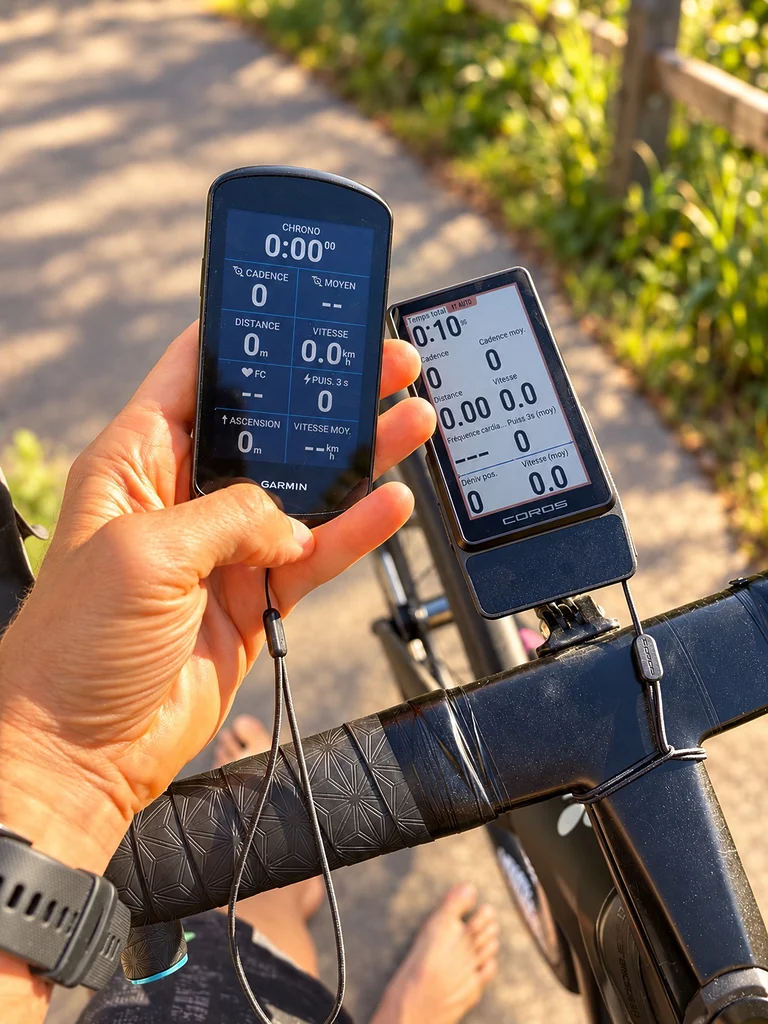
Our last computer was the Garmin Edge 1040, preceded by two other Garmins. We witnessed the evolution of these devices firsthand: more maps, more processing power, deeper analytics, and expanded connected features. The 1040 remains a benchmark, with its 3.5-inch display, a comprehensive platform, and genuine software maturity. It would be absurd to pretend that COROS wipes all that out with a wave of a magic wand. Yet a product can be thoroughly feature-packed without being the one you actually enjoy living with the most.
Here lies the question: does the DURA 2 simplify our daily routines? Time saved is sometimes worth more than an added feature. Garmin has served us efficiently for years. COROS gives us the impression of taking a more direct route to certain functions. We are not looking to award an imaginary gold medal between the two brands. We are comparing two philosophies, and we stand by our preferences.
Three and a half years with COROS… without a COROS computer
That advantage goes by the name of Decathlon GPS 900 by COROS. We’ve been using this watch for about three and a half years, primarily for running. While the bike computer was new to us, the COROS companion app was entirely familiar. We already had our benchmarks, our activities, our consultation habits, and our seamless navigation through the phone screens. Over time, we even developed a clear preference: for our use, we find the COROS app more user-friendly than Garmin Connect.
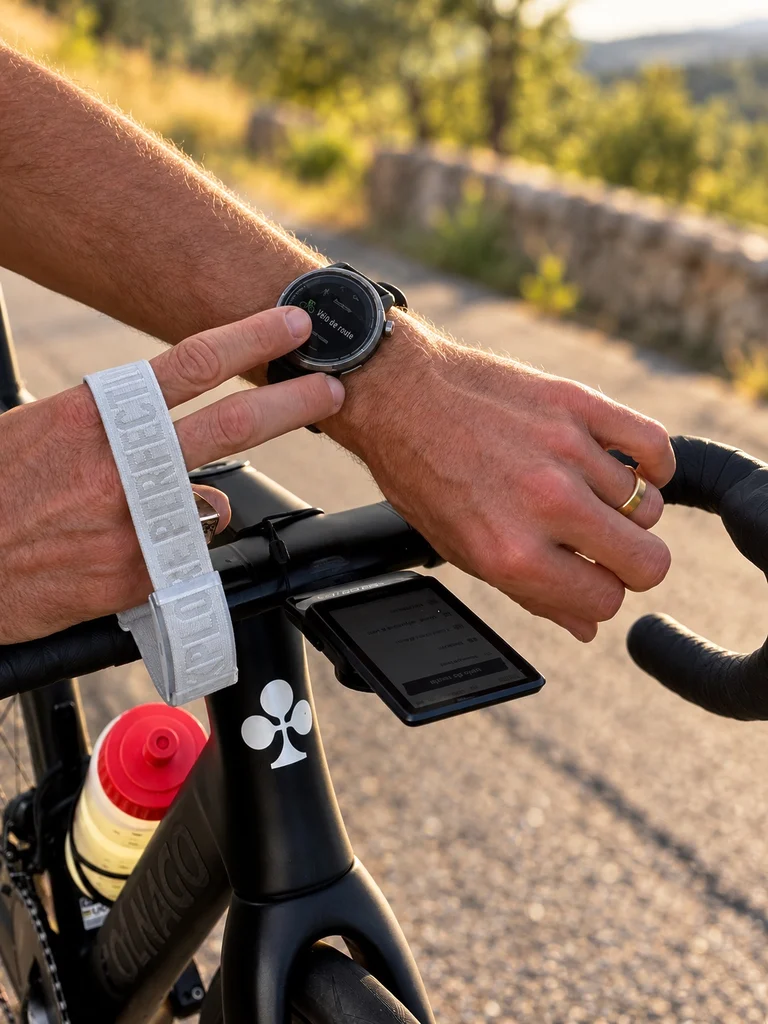
This isn’t a definitive universal verdict, nor is it a dismissal of Garmin’s strengths. Some users will always require specific metrics or features that they prefer to find in Garmin Connect. But COROS seems to follow a more straightforward logic. Essential data points are easier to spot, and everyday actions require far less trial and error. Crucially, this appraisal is built on years of daily use, not the novelty of unboxing a new toy. Pairing the DURA 2 Solar didn’t plunge us into unfamiliar territory: we simply welcomed cycling into a home we already knew inside out.
The original DURA had already posed an awkward question to the competition
To understand what this new generation represents, one must look back at the original COROS DURA. COROS didn’t try to reinvent the cycling computer: the brand shifted the debate toward battery endurance, solar recovery, and ecosystem simplicity. The official spec sheet highlighted a 2.7-inch MIP color touchscreen, offline maps, dual-frequency GPS, a weight of 102 g, and that signature side dial. Above all, it boasted 120 hours of standard GPS use alongside spectacular solar claims under optimal conditions. This was no trivial promise in a market that often obsesses over screen pixels before counting the days between recharges.
The new unit isn’t just expected to be new; it has to improve upon an already distinct formula. It would be tempting to project its predecessor’s specs onto it. That would be a mistake. The unit tested here is genuinely a second-generation model, under embargo until October 22, 2026, and its complete technical spec sheet had not yet been provided to us when we started testing. We will therefore treat the original model’s figures as a baseline, never as certified benchmarks for the second generation.
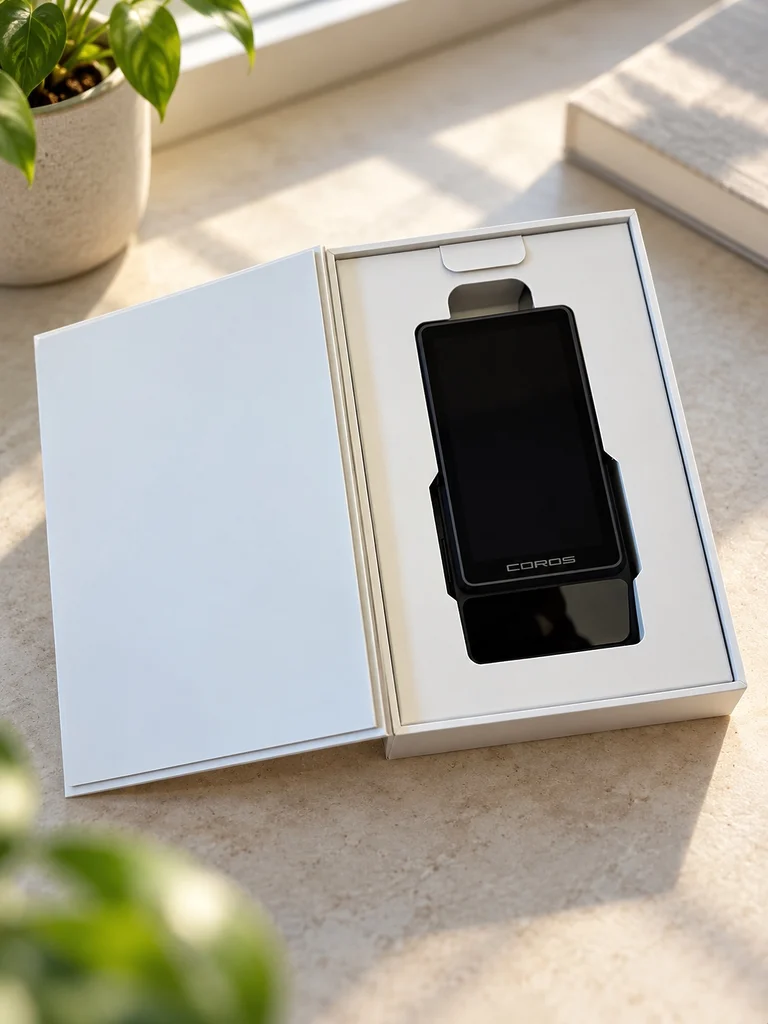
A futuristic silhouette, and not just for show
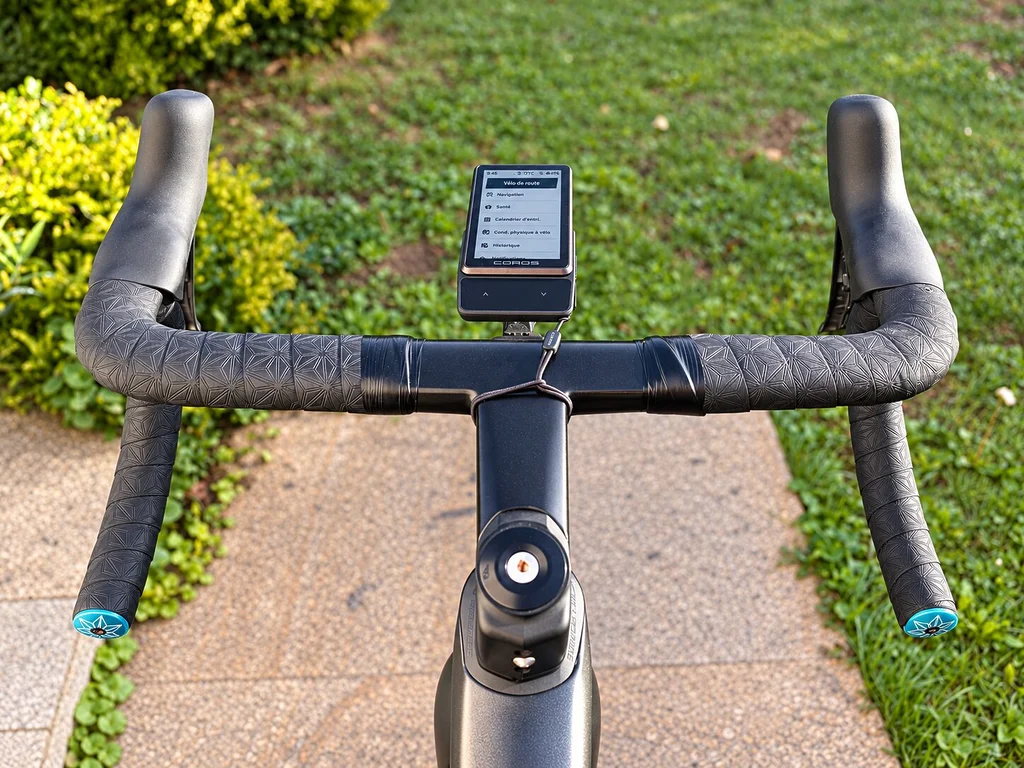
From the moment you open the box, there’s no mistaking the DURA 2 Solar for our old Edge 1040. Where the Garmin plays a traditional tune—a neat, compact computer display engineered for pure performance—COROS delivers a futuristic device that looks like a navigation instrument lifted straight out of an aircraft cockpit. The vertical screen sits atop a wide, dark area housing its hardware and solar charging array. It is unique, recognizable, and undeniably sleek. It simply looks great. And in an industry where devices increasingly look identical, that’s already a welcome change.
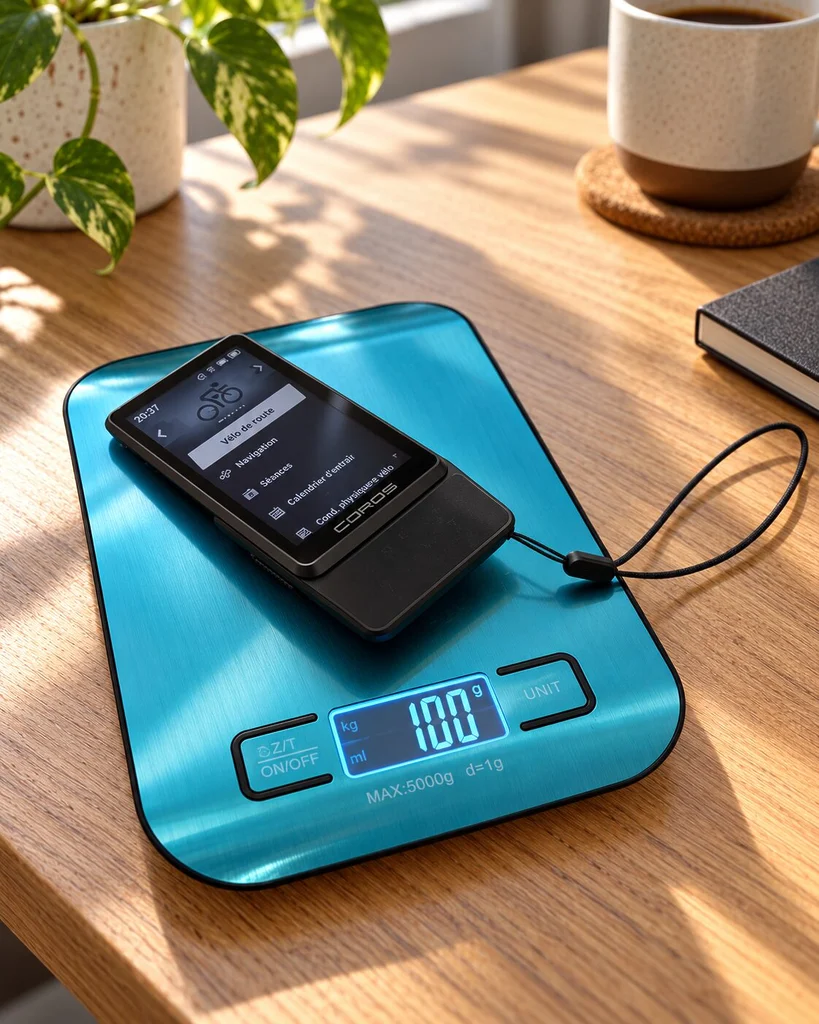
Yet we are always skeptical of gadgets that charm you before you even clip in. A pretty silhouette guarantees neither a readable map nor a glitch-free ride recording. In our photos, the unit definitely looks the part. Out on the bike, ergonomics must prevail. The clear menus, profile access, navigation, and workout screens quickly gave us our bearings. And regarding weight, COROS claims just 99 grams. After an initial weighing that was clearly erroneous, our scales finally settled on 100 grams, with the lanyard still attached. It’s an indicative measurement, but accurate enough to confirm we are looking at a true featherweight. Proof that, even when testing a computer, sometimes you have to reset the scales!
The mount: the detail nobody notices until it gets in the way
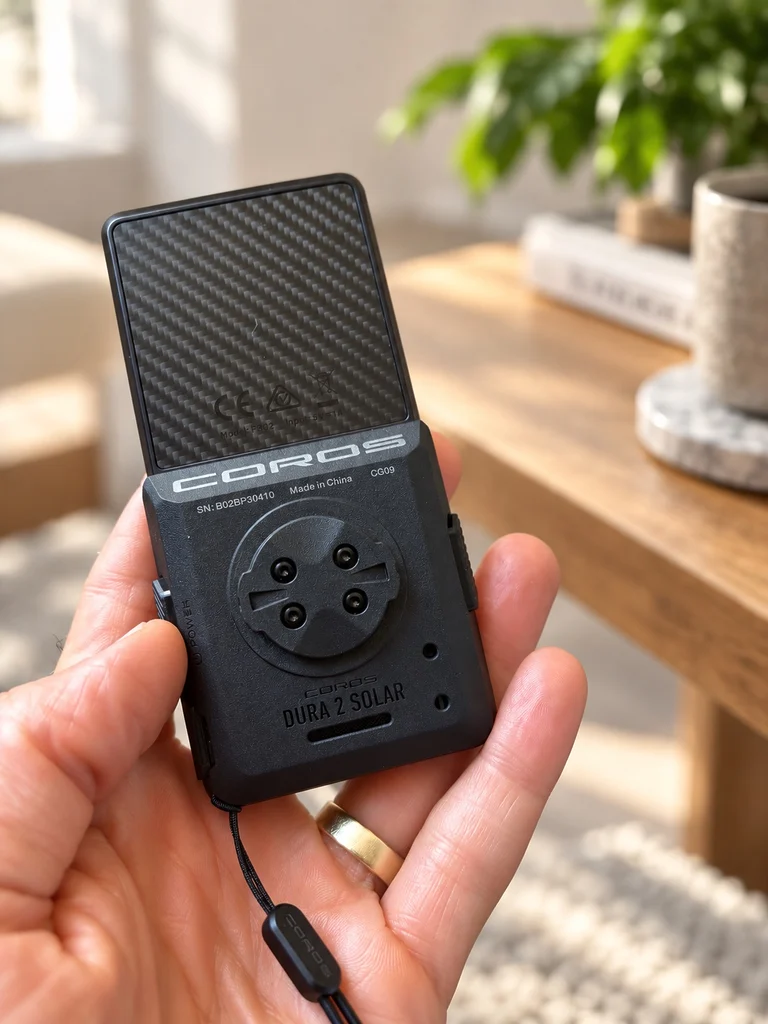
This is probably the most tangible takeaway from this test, and it caught us out on our Colnago. The quarter-turn mount on the back of the DURA 2 is not positioned like the one on our Edge 1040. On the COROS, the mounting disc sits in the lower third of the casing, whereas on the Garmin it is located closer to the center. The result: most of the DURA 2 projects much farther out in front of the handlebar when using the same mount. The aesthetic looks light and airy, almost as if the device is trying to race ahead of the bike.
However, geometry leaves no room for error. We paired it with an out-front mount that was too short for our Colnago cockpit. As a result: the body of the computer contacted the handlebar. This isn’t a connectivity bug or an electronic malfunction, but a real-world hardware compatibility issue you only discover when mounting the device. A compatible quarter-turn interface does not automatically guarantee adequate clearance. Before ordering an aftermarket mount or reusing your Garmin one, double-check the available length and clearances around your cockpit. It may be far less glamorous than solar battery life, but it could save you plenty of frustration in the workshop.
Farewell to the right-hand scroll wheel: learning new ergonomics
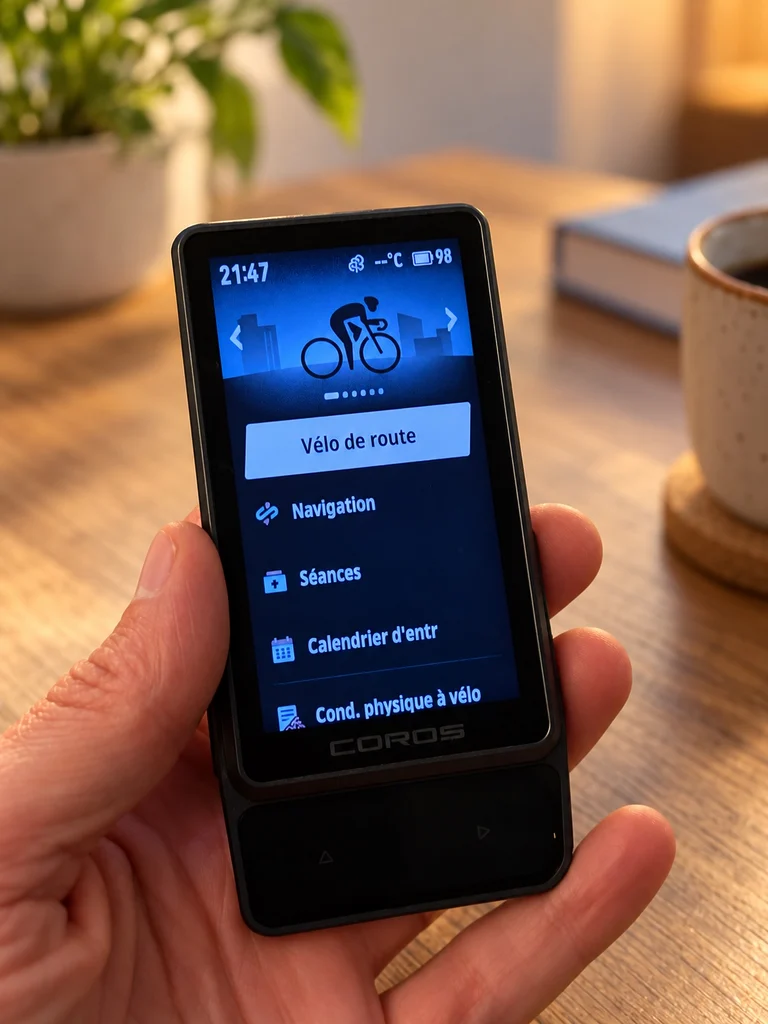
Another major update: the iconic right-hand scroll wheel from the original DURA is gone. On the DURA 2 Solar, COROS has completely redesigned the navigation experience by combining two physical buttons, haptic touch areas beneath the screen, and a responsive touchscreen interface. The right button confirms selections and opens a quick side menu during an activity. The left button acts as a back key and, when long-pressed, can even activate voice control. As for the haptic controls below the display, they allow you to swipe through data pages without having to smudge the screen. It’s a thoroughly modern setup designed above all to streamline interactions on the move.
Will you miss the dial? That comes down to personal habits. A rotary dial has its perks, especially with thick winter gloves or on rough terrain. But COROS provides alternative ways to interact with the device, notably two-finger pinch-to-zoom on maps. And here’s a quirky addition: a double tap on the screen can even sound a virtual bell via the integrated speaker. It’s a clever way to alert pedestrians, even if it doesn’t entirely replace a proper mechanical bell. It seems that after teaching our computers to track our miles, we are now teaching them to politely say “excuse me”! While these new controls take a little getting used to, COROS clearly didn’t drop the scroll wheel just on a whim.
The app as a true command center
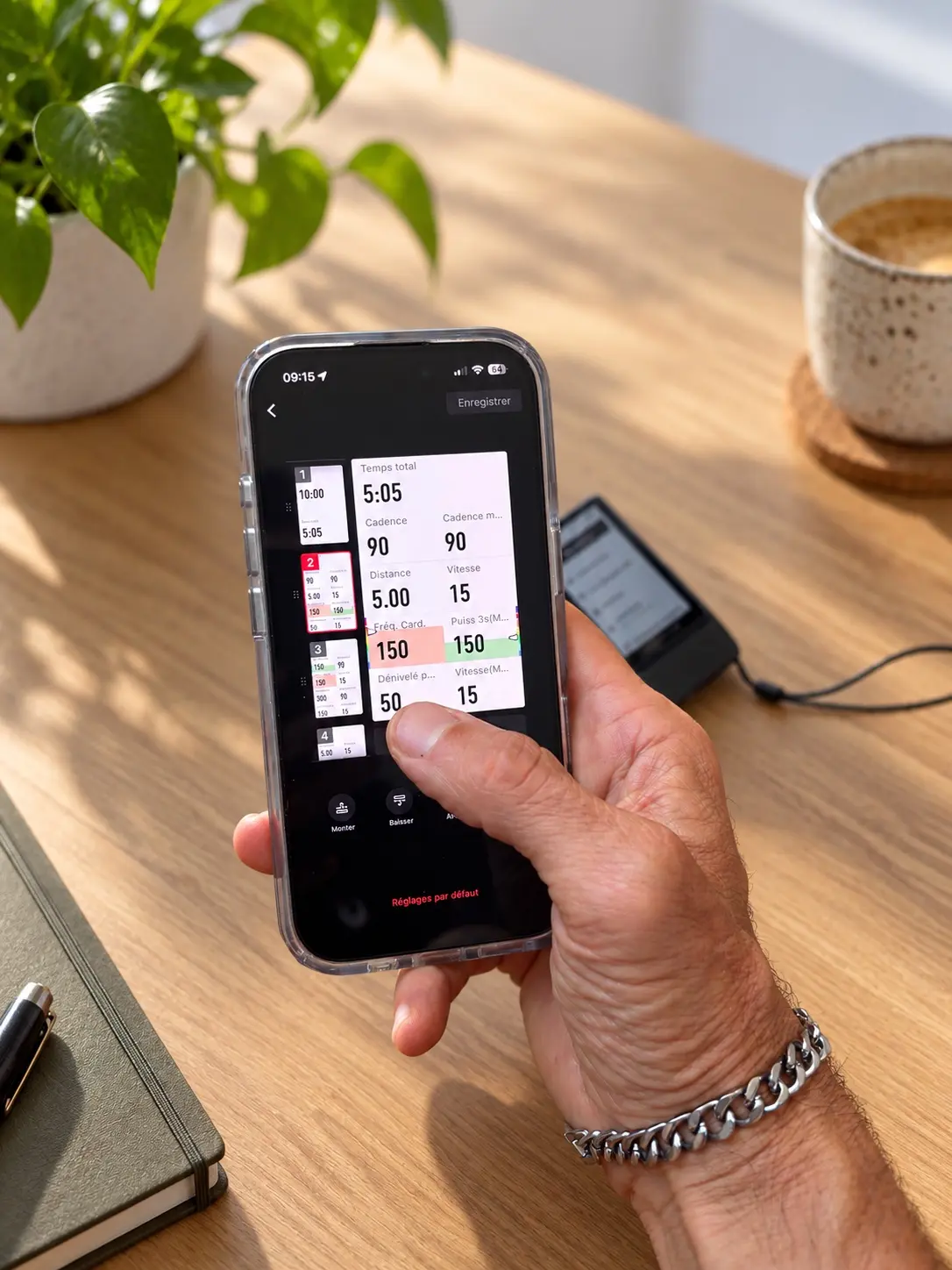
The first genuine joy of this test came during setup. We chose to configure everything from our smartphone rather than spending the evening scrolling through settings on the device itself. Through the COROS app, you access all profiles, data pages, and available screen layouts. We were able to sit back and thoughtfully organize our metrics, move screens around, swap data fields, and customize distinct layouts for every discipline. What used to feel like a tedious chore becomes an almost enjoyable task.
Our screenshots also highlight an intuitive map manager alongside clear storage allocation split across maps, workouts, and routes. The distinction matters: it’s not just about having endless data at your disposal, but controlling how and when that data appears. Your needs during a 300-watt interval, an all-day endurance ride, or a technical mountain bike descent are vastly different. A dedicated power and cadence screen shouldn’t look like a navigation map, and vice versa. On the app, setting up this hierarchy is effortless thanks to the comfort of a smartphone display. COROS certainly didn’t invent customization; what we appreciate is how smoothly it flows within their software ecosystem.
What’s more, this customization isn’t confined to your phone. The DURA 2 also allows you to edit data fields directly on the screen simply by long-pressing a field to modify it. This added flexibility doesn’t shake our preference for app-based setup, but it saves you from having to pull out your phone for a quick on-the-fly tweak. COROS is also planning to push things further with dedicated multi-bike profiles announced for November, making it easier to manage distinct sensor setups. It’s an update we eagerly anticipate, as we regularly switch between the Colnago, the gravel rig, and the mountain bike. Because having multiple bikes is already hard enough to justify at home—the least your computer can do is keep them straight!
On the Colnago V4RS: where watts don’t lie
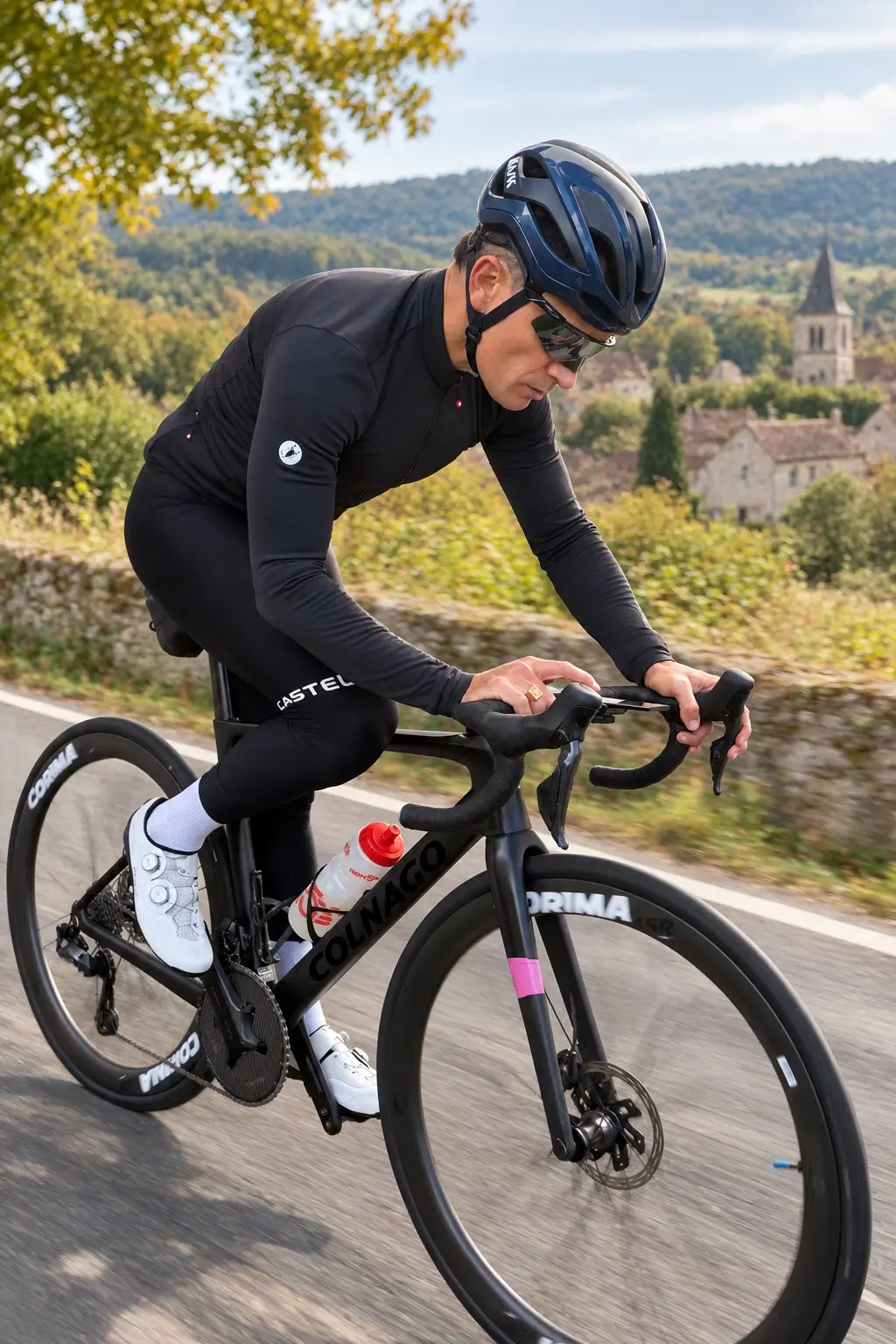
Our Colnago V4RS is arguably the testing ground where we are most demanding. It is equipped with a Shimano Ultegra Di2 12-speed groupset and a left-side 4iiii power meter crank arm. This is our go-to machine for fast group rides, races, and structured workouts where power numbers dictate effort. We regularly hover around 300 watts for threshold intervals, or hit punchy 400-watt repeats. At these intensities, you don’t want to flick through three pages just to find the critical metric.
The left-side 4iiii measures one leg and doubles the value to estimate total power: the computer displays this figure accurately, though it won’t magically turn a single-sided unit into dual-sided data. The benefits of pre-ride customization in the app become immediately obvious: a single screen can highlight power, cadence, lap time, and heart rate. You don’t need a dozen extra fields to know whether you are sticking to the plan. The DURA 2 blends seamlessly into our training routine without altering the core workout. We don’t expect it to make us faster. We expect it to help us execute the right effort at the right time, with minimal distraction. The rest is up to the legs.
Shimano Di2: the little details that smooth out prep work
On the Colnago, the Ultegra Di2 groupset introduces an element we sometimes take for granted: electronic shifting is an integral part of the bike’s tech setup. Nowadays, we charge our computers, phones, lights, power meters, and derailleurs. At this rate, pre-ride prep will soon require a power strip the size of a mechanic’s toolbox. Being able to check battery levels at a glance on the head unit is genuinely useful, especially before an all-day epic or a race.
The COROS app includes dedicated data fields for electronic drivetrain battery life, as well as levels for various compatible sensors and accessories. Our screenshots clearly show these customization options. However, one caveat applies: seeing a data field in a menu does not guarantee that every component on the market is supported, and a generic “100%” placeholder in a preview screen doesn’t always reflect a live reading. Available features vary depending on specific hardware and supported transmission protocols. This question of compatibility would soon return to haunt us on our gravel bike.
Our COROS arm heart rate monitor: the link between all our devices
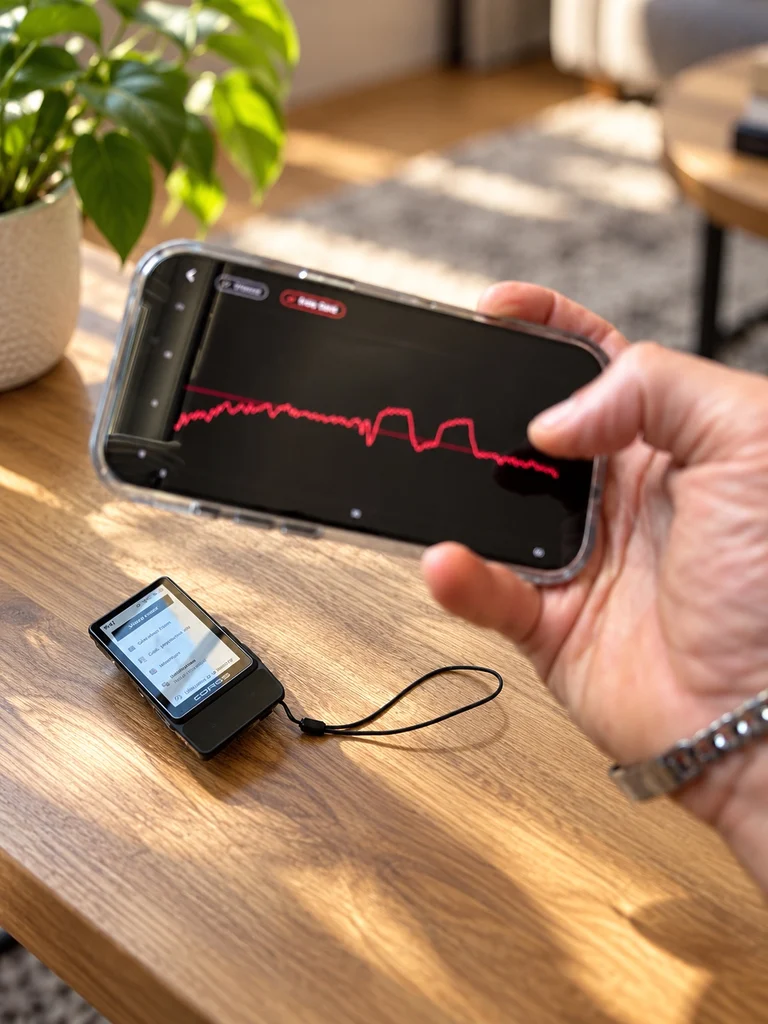
There is one accessory we naturally paired with the new computer: our COROS optical heart rate monitor worn on the arm. This wasn’t an impulse buy for the occasion. We had already been using it with our Decathlon GPS 900 by COROS watch, and—worth noting—it worked flawlessly with our Garmin Edge as well. We simply kept our routine going. Same sensor, new head unit, consistent physiological data: no need to replace your entire kit just because you changed your bike computer.
The appeal of an optical armband goes beyond brand loyalty. Worn on the bicep or forearm, the optical sensor does away with the restrictive squeeze of a chest strap for those who find them uncomfortable, while providing reliable heart rate tracking throughout your session. We aren’t claiming it will always match the instantaneous accuracy of an ECG chest strap during explosive sprint efforts—we didn’t run a lab-grade sensor benchmark. But it has been a staple in our gear bag for a long time, and we trust its comfort and reliability. COROS claims 38 hours of continuous tracking and three simultaneous Bluetooth connections. The armband does not use ANT+: it communicates with Garmin units purely via Bluetooth. That cross-compatibility proves an ecosystem can be well integrated without locking users inside a walled garden.
On the Tacx NEO 2: when seconds feel like minutes
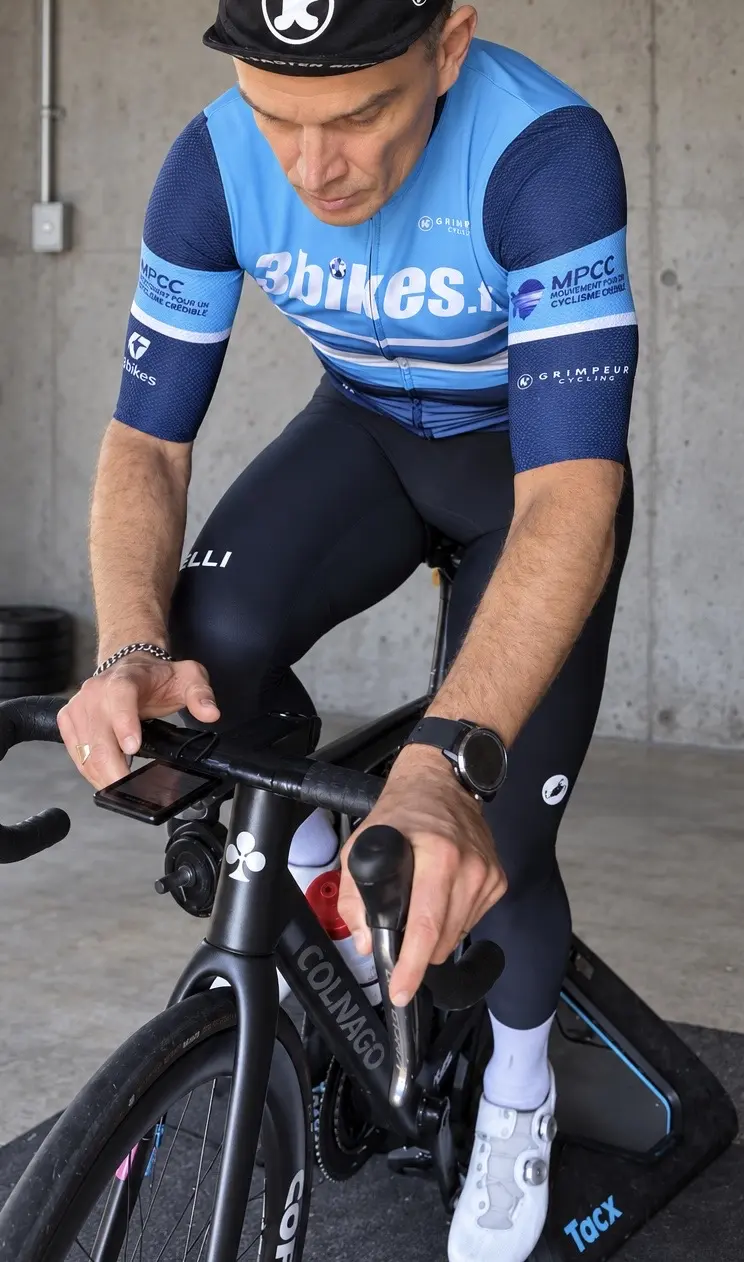
The Tacx NEO 2 provided a different testing ground altogether. The indoor trainer is an unforgiving judge: no scenery, no descents to catch your breath, no convenient red light to save you at the end of an interval. There’s only raw resistance, and a clock that seems to stand still. During these sessions, power, cadence, and heart rate are the primary metrics that command our attention.
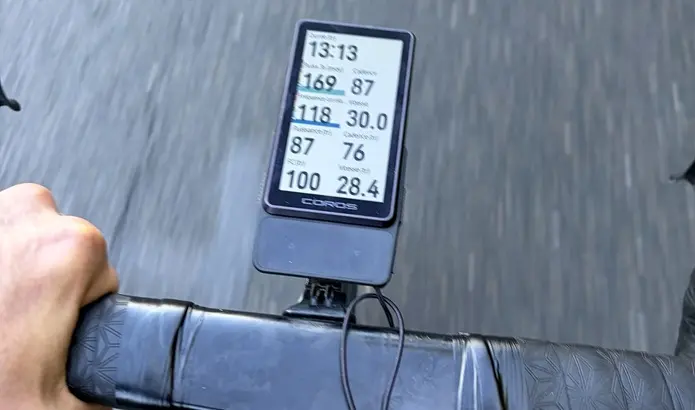
We used the DURA 2 Solar in this indoor setting, appreciating the familiar data layouts we had set up for outdoor rides. Above all, we loved how effortlessly we could mark intervals (laps) using the left button on the computer in our test setup. When grinding through repeats of 30 seconds at 400 watts followed by 30 seconds of recovery, triggering laps with a crisp, tactile click is immensely satisfying. COROS also plans to make this button customizable in a future update, including the ability to undo an accidentally triggered lap. Because between two hard efforts, you’d rather focus on recovering than fumbling for the right button!
It is worth making an important distinction, however: reading power from a smart trainer is not the same as actively controlling its resistance, and displaying a workout target does not necessarily equal the full control capabilities of dedicated indoor platforms. Our assessment centers on the computer’s consistency across both indoor and outdoor training routines. That continuity is invaluable when your training doesn’t stop at the garage door.
Another welcome update: you can now start a structured workout midway through an ongoing ride, or pause the workout temporarily without stopping the overall activity recording. Red lights, technical descents, regrouping with riding buddies… COROS seems to understand that structured training must adapt to the unpredictable nature of real-world riding!
In gravel riding, priorities shift entirely
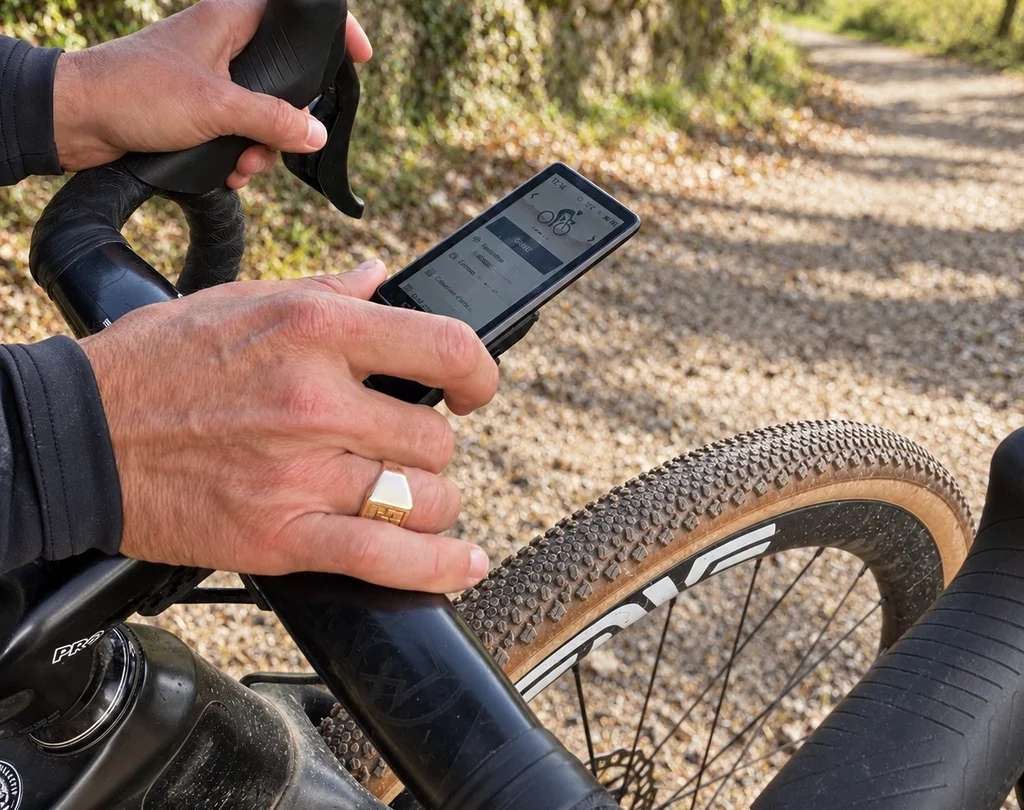
Next up: the LYTI, our gravel rig, and a completely different style of riding. On tarmac, we often ride routes known down to the exact meter. In gravel, following a GPX track can lead you down remote logging roads, faint trail forks, or paths that only reveal themselves once your tires hit the dirt. Navigation suddenly takes center stage. Your most vital metric is no longer current power; it’s the fork in the trail coming up in one hundred meters.
This is where a bike computer must be judged on more than just map density. An ultra-detailed cartographic display might look stunning while stationary, but quickly becomes unreadable clutter when your bike is rattling over washboard gravel. Conversely, an oversimplified display lacks crucial landmarks. We appreciated being able to dedicate specific screens to navigation and organize routing cues around our needs. We will leave direct GPS accuracy face-offs against the Edge 1040 to side-by-side file comparisons. Our perspective here is that of a rider who wants turn-by-turn guidance without having to glue their eyes to the handlebars.
This is precisely where COROS introduces a standout feature: offline route recalculation without an active cellular connection. Do note the technical nuance: the head unit doesn’t recalculate the route natively on its own; rather, the COROS smartphone app reroutes the track and pushes it seamlessly to the device, provided you’ve downloaded the regional maps in advance. It’s a game-changer when exploring deep in cellular dead zones. Another smart addition: the DURA 2 Solar can detect upcoming climbs even without a pre-loaded route or active internet connection. This lets you pace upcoming gradients without having planned everything in advance. COROS can now warn you that a steep wall is coming, even when you deliberately avoided looking at the elevation profile. A thoughtful touch… that our legs might occasionally curse!
ROTOR UNO: the unwelcome surprise of this test
It was on this LYTI gravel bike that we ran into the single major frustration of our test period. The bike is equipped with the ROTOR UNO electronic groupset, an innovative system we’ve previously covered on 3bikes and whose technical nuances we know well. While it features wireless connectivity, the DURA 2 Solar failed to recognize or pull gearing data from this drivetrain in our setup. We would have loved to view gear selection and battery status on screen as you can with mainstream electronic drivetrains. In this instance, the two systems simply refused to communicate.
Just because two electronic devices communicate wirelessly does not mean they speak the same dialect. Bluetooth and ANT+ are not magic wands: they require shared device profiles and specific data fields to work together. The outcome is frustrating, even if it’s not a dealbreaker. We can still shift gears without needing visual confirmation from a screen. But on a modern high-end computer, we expect broader compatibility with boutique or alternative component makers. ROTOR is an established player in the industry. This limitation deserves to be called out clearly, with the hope that a future firmware update might bridge the gap. At this stage, no such update has been confirmed.
The S-Works Epic: when the best screen is the one you don’t look at
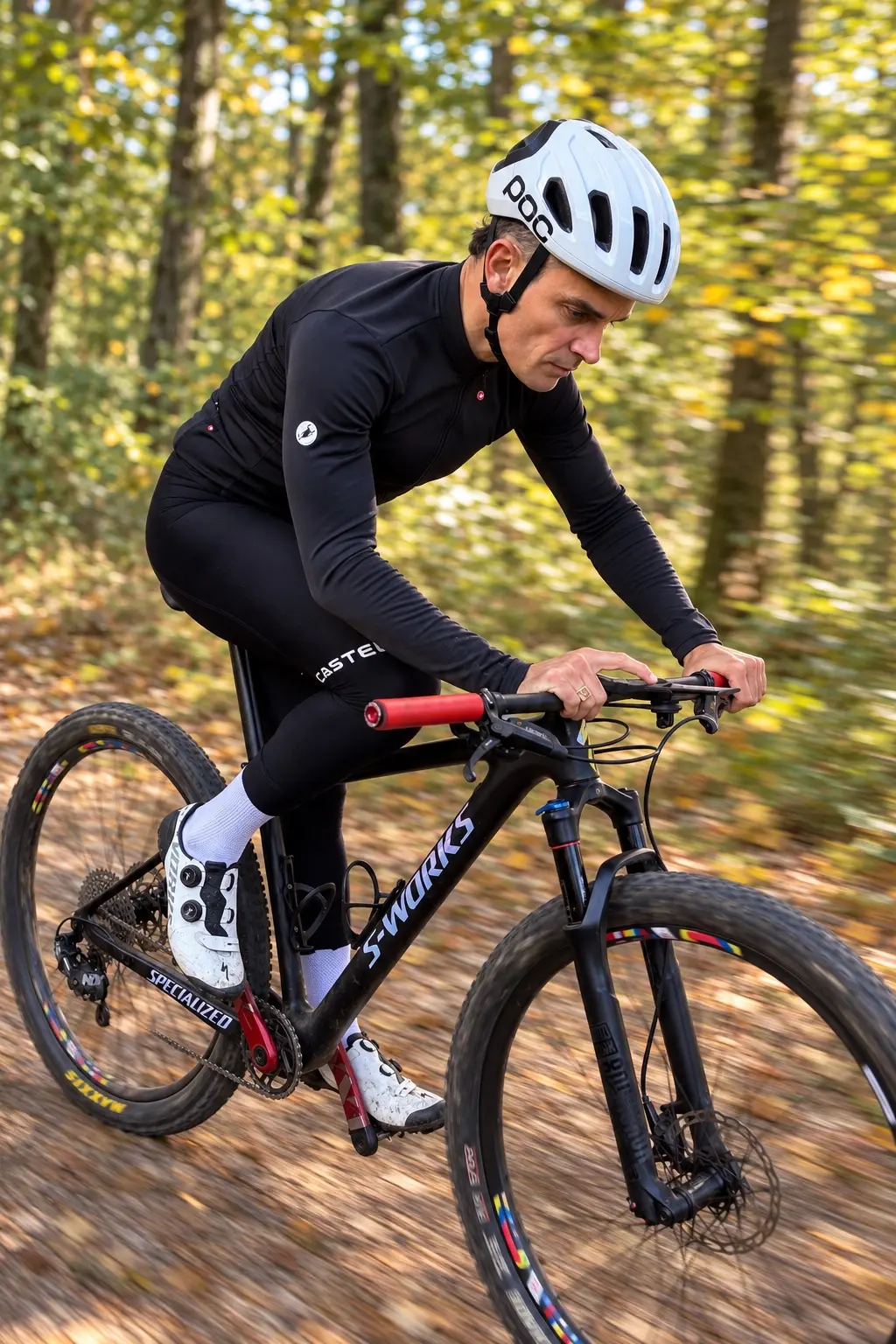
Switching to our Specialized S-Works Epic, the scenery—and the riding demands—changed abruptly. An exposed root, loose rocks, a sudden off-camber corner: in mountain biking, a split second of distraction is all it takes to remind you that line choice always trumps technology. The ability to build a clean, minimalist data screen displaying only vital stats proves its worth here. You don’t want your road-interval layout staring back at you in the middle of a technical singletrack descent.
The DURA 2 Solar shines with its tailored sport profiles. You don’t expect an XC bike to handle like a time trial rig; why force your computer to show the same metrics? On demanding trails, knowing when not to look at your screen is paramount. That’s a quality standard spec sheets simply cannot quantify.
Battery life: COROS’s real masterstroke against Garmin
To truly appreciate what COROS is disrupting, look back at the original DURA. The company claimed up to 120 hours of standard GPS tracking on a single charge, plus up to two additional hours of runtime gained for every hour of riding under direct sunlight. For context, Garmin quotes up to 35 hours for our standard non-solar Edge 1040, outside of battery saver modes.
The exciting news is that COROS quotes the same massive 120 hours of battery life for this DURA 2 Solar, along with up to two hours gained per hour of direct sun exposure under optimal conditions. Compared to the 35 hours of our standard Garmin Edge 1040, the difference on paper is staggering. However, keep in mind: manufacturer claims must always be tested against real-world riding under identical conditions.
During our time with the DURA 2 Solar, that endurance was striking: you quickly get used to the freedom of a computer that rarely asks for a wall charger. Above all, the unit tops itself up as you ride, powered by the sun. It almost feels like a rebellion in an era when your bike carries more batteries than a consumer electronics shop: Di2, power meter, front and rear lights, phone, smartwatch, heart rate strap… A dedicated power strip will soon be an essential travel accessory. The appeal is undeniable for bikepacking, ultra-endurance racing, and gravel adventures, where battery anxiety is replaced by peace of mind.
That said, we have neither timed a 100% to 0% discharge cycle on the DURA 2, nor laboratory-measured the exact milliwatts harvested by the solar panel. Solar efficiency hinges heavily on sun intensity, season, angle of incidence on the bars, navigation usage, and satellite constellation settings. You won’t harvest the same energy under blistering July skies as you will riding under dense forest canopy in late October. Our takeaway is definitive without relying on artificial metrics: battery endurance and solar harvesting are headline strengths of its design philosophy, but we will need a few hundred more miles to confirm whether those claimed 120 hours hold true across all conditions.
True weatherproofing: reading between the technical lines
The quick-start guide included with our test unit lists USB-C charging (5 V / 1 A), Bluetooth and Wi-Fi connectivity, alongside an IP67 rating. For gravel and mountain bikers, that rating offers real peace of mind: it certifies dust-tight protection and survival against temporary water immersion down to one meter for up to thirty minutes under test conditions. This isn’t a license to take it scuba diving or blast it with a pressure washer, but it means you can tackle downpours and muddy trails without breaking a sweat. A solar-charging computer is a wonderful thing. Provided it survives the days when the sun refuses to show its face!
With its claimed 99-gram weight, 3.5-inch touchscreen, and 120-hour battery life quoted by COROS, the DURA 2 Solar boasts an enviable spec sheet. Our independent measurement of roughly 100 grams with the tether confirms its lightweight credentials. What remains is to verify real-world solar gains against the marketing claims. Because a proper gear test isn’t just about what a screen displays, but verifying what the manufacturer promises.
What Garmin still does brilliantly, and where COROS breaks new ground
Put up against the Edge 1040, the DURA 2 Solar competes on more than just raw telemetry. Our Garmin remains a polished, deeply mature unit, and we won’t crown the COROS superior in pure GPS accuracy, mapping fidelity, or rerouting speed without direct, synchronized dual-recording tests. Yet COROS wins us over with its companion app, seamless compatibility with our watch and heart rate strap, clean page customization, and an approach to battery management that changes how you plan your rides. Garmin leans on its deep heritage and comprehensive data fields; COROS feels like it cuts through the clutter to streamline the user experience.
It isn’t flawless. The ROTOR UNO remains unsupported as a smart drivetrain, the lower mounting point demands careful attention to out-front mount length, and deeper performance capabilities still need long-term evaluation. We prefer to say it plainly. An impressive initial test is not a clean bill of perfection, especially for an electronic head unit meant to serve you for years, where future firmware updates matter just as much as launch-day promises.
There is another encouraging element: the DURA 2 Solar is built to evolve significantly post-launch. COROS has already announced upcoming multi-bike profiles, expanded memory for up to 32 paired sensors, and future compatibility with select Campagnolo electronic transmissions. The brand is also working on customizable climb alerts and refreshed training screens. These updates are slated for November, indicating that the product roadmap extends well past its retail debut. Yet a promised update is not an existing feature, and we evaluate gear based on what’s in our hands today. Because in sports technology, much like bike racing, promises of improvement are great, but results on the road are what count.
And seeing this vast battery reserve and its ability to harvest solar energy simply while riding in the daylight, we couldn’t help but think of ultra-cyclists like Steven Le Hyaric. And by extension, all those long-distance adventurers for whom a ride doesn’t simply wrap up at dusk. When you head out for three hours, battery life is a convenience. When you head out for three days, it becomes a crucial tactical asset. Every avoided charge stop, every saved cable, every preserved battery percentage matters. Naturally, the sun doesn’t shine 24/7 and solar panels can’t work miracles. But for riders churning through hundreds or thousands of self-supported kilometers, a head unit that recharges itself while moving is invaluable. COROS might have built the ultimate companion for riders who never quite know when to stop: a computer that doesn’t want to stop either.
The 3bikes Verdict: less screen time in your head, more focus on the ride
We started this review with a prototype unit in hand, a tight testing window, and relatively sparse preliminary documentation on this new generation. What we walked away with was a renewed appreciation for the importance of a refined user experience. On tarmac, focus on watts. On the indoor trainer, focus on intervals. In gravel, follow the track. In mountain biking, keep your eyes on the trail. In every scenario, customizing screens via the COROS smartphone app was a standout highlight. Because at the end of the day, the best technology isn’t necessarily the one that does the most. It’s the one that demands the least from you while you ride.
Not everything is perfect, of course. Our COROS heart rate armband pairs just as smoothly with our trusty Garmin as it does with this new DURA 2 Solar, while our ROTOR UNO drivetrain serves as a reminder that cross-brand connectivity still has room to grow. As for the solar charging, it represents the unit’s most compelling feature, even if we reserve definitive judgment for long-term endurance testing. We genuinely enjoyed the DURA 2 Solar—a lot, in fact—without handing it a blank check. Because an honest gear review isn’t about regurgitating press releases; it’s about holding a product accountable to real road miles.
Furthermore, something unexpected happened during testing: this computer made us want to talk more about how we ride than how we configure settings. After years of cluttering screens with endless metrics, you realize a great display isn’t the one that crams in the most numbers. It’s the one that gives you the mental bandwidth to focus on your pedal stroke, pick your line through a turn, enjoy the scenery, or simply forget, if only for a moment, that your every move is being tracked.
That leaves the question we asked at the beginning. DURA. A catchy name or a genuine promise? After logging hours across road, gravel trails, indoor intervals, and forest singletrack, we understand why COROS chose those four letters. Stellar battery life, passive solar charging on the move, and the liberating feeling of no longer planning rides around your next charging outlet. Naturally, long-term testing will tell us how this second generation holds up over time. But one thing is clear: COROS didn’t pick the name DURA by accident.
The DURA 2 Solar hasn’t yet proved it is the indisputable king of GPS bike computers. What it has done is remind us what we actually value in one: a device that lasts forever, stays out of your way, and lets you enjoy the ride to the fullest. DURA, indeed. And for once, we hope the ride just keeps going.
The Pros
- Impressive battery life and on-the-go solar charging: completely changes how you manage power
- Futuristic aesthetic with a distinctive visual identity
- Remarkably intuitive COROS app, which we personally prefer over Garmin Connect
- Effortless data screen setup and customization directly from the smartphone
- Seamless learning curve thanks to our three-and-a-half-year experience with the Decathlon GPS 900 by COROS
- Outstanding versatility: road, gravel, MTB, and indoor trainers
- Seamless pairing with our 4iiii power meter and COROS heart rate armband
- COROS armband also connects with our Garmin Edge, avoiding forced brand lock-in
- Ability to monitor battery levels across multiple connected components
- Clean in-app management of maps, structured workouts, and route files
- Certified IP67 dust and water resistance
- A genuine challenger to our Garmin Edge 1040, built on a distinct design philosophy
- Offline route recalculation via phone app and preloaded maps
- Automatic climb detection even without a preloaded route
- Haptic controls, voice commands, and refreshed touchscreen navigation
- Structured workouts can be started or paused mid-ride without interrupting activity tracking
The Cons
- ROTOR UNO electronic groupset not recognized on our LYTI gravel bike
- Lower-positioned mount projects the unit further forward, requiring careful out-front mount selection
- On our Colnago V4RS, a short mount caused the body of the computer to contact the handlebar
- Removal of the original DURA’s right-side dial may divide long-time users
- Real-world solar gains remain difficult to quantify without extended long-term testing
- Advanced hardware compatibility lists could be better documented
- Not enough comparative data yet to scientifically measure GPS accuracy against the Garmin Edge 1040
- Smartphone battery drain can be high on select beta app builds; patch incoming from COROS
TECH SPECS
| Specification | COROS DURA 2 Solar |
|---|---|
| Brand | COROS |
| Model | DURA 2 Solar |
| Official Launch | Thursday, October 22, 2026 at 3:05 PM (CET) |
| Retail Availability | Tuesday, October 27, 2026 (TBC) |
| Type | GPS cycling computer with solar charging |
| Display | 3.5-inch touchscreen, display panel technology TBC |
| Claimed Weight | 99 g |
| Actual Weight (3bikes) | Approx. 100 g with tether (indicative measure) |
| Construction | Carbon composite and anodized aluminum |
| Design | Vertical layout, futuristic profile, integrated solar charging |
| Controls | Two physical buttons, haptic keys, touchscreen, and voice control |
| Charging | USB-C – 5 V / 1 A |
| Claimed Battery Life | Up to 120 hours according to COROS |
| Solar Harvesting | Up to 2 hours of runtime gained per hour of sun exposure under optimal conditions |
| Water Resistance | IP67 |
| Connectivity | Bluetooth, 2.4 GHz Wi-Fi |
| App | COROS, on smartphone |
| Navigation | Offline mapping, smartphone app recalculation without cell signal, climb detection without loaded route |
| Customization | Via companion app or on-device interface |
| Multi-Bike Profiles | Announced for November 2026 |
| Power Meter Tested | 4iiii, left crank arm |
| Road Groupset Tested | Shimano Ultegra Di2 12-speed |
| Gravel Groupset Tested | ROTOR UNO electronic, unsupported |
| Heart Rate Monitor | COROS Heart Rate Monitor, arm-worn |
| Turbo Trainer Tested | Tacx NEO 2 |
| Bikes Tested | Colnago V4RS, LYTI gravel, Specialized S-Works Epic |
| Mount | Quarter-turn, mounting disc located in the lower third of the body |
Battery life and solar charging figures are claimed by COROS and do not represent verified laboratory measurements from our test.
PRICING AND OPTIONS
| Product | Indicative US Price |
|---|---|
| COROS DURA 2 Solar (standalone unit) | 499 € |
| COROS DURA 2 Solar + mount | 549 € |
| Aluminum Standard Mount | 79 € |
| Aluminum Out-Front Mount | 79 € |
Indicative prices provided by COROS for the US market in USD. These do not represent official French retail prices and may vary from final European MSRPs. Euro pricing remains to be confirmed at the time of official launch.
One detail worth highlighting: COROS offers two dedicated mounts—one designed for round standard handlebars and another tailored for integrated one-piece cockpits. A significant distinction, especially given our clearance issue with the short mount on the Colnago V4RS!
FAQ – COROS DURA 2 SolarWhen is the COROS DURA 2 Solar officially released? On Thursday, October 22, 2026, which marks its official media launch, with retail availability expected on Tuesday, October 27. We were fortunate to receive the head unit early and kick off testing in early October. It was a tight timeline to evaluate such a feature-rich device, but ample time to put it through its paces across all terrains: road, gravel, MTB, and indoor turbo training. It certainly didn’t need to wait for its commercial release to start racking up serious mileage! Does the COROS DURA 2 Solar truly beat the Garmin Edge 1040 on battery life? On paper, COROS claims up to 120 hours of battery life for the DURA 2 Solar, compared to 35 hours for our standard Garmin Edge 1040 under manufacturer testing standards. That’s a massive gap, further widened by solar recharging capable of recovering up to two hours of runtime per hour of direct sunlight under optimal conditions. However, manufacturer claims never substitute for real-world miles. We have yet to conduct an identical side-by-side run-down test. The promise is impressive; time will tell just how far the sun can really take us! Can you use the COROS heart rate monitor armband with a Garmin? Yes, and that’s precisely what we were already doing! Our arm-worn COROS optical sensor has been our go-to monitor alongside our Decathlon GPS 900 by COROS watch, but it paired just as seamlessly with our Garmin Edge. The armband broadcasts via Bluetooth and works smoothly with compatible third-party head units. Great news for riders who don’t want to replace all their sensors when upgrading their computer. Does the DURA 2 Solar support all electronic drivetrains? No, unfortunately. While COROS supports several major electronic systems, our ROTOR UNO groupset on the LYTI gravel bike was not recognized. It was a genuine disappointment, as we hoped to view gear telemetry right on the screen. Here’s hoping future firmware updates expand compatibility, though nothing has been officially confirmed at this stage. Why does the DURA 2 Solar sit further out in front of the handlebars than an Edge 1040? Simply due to the placement of its quarter-turn mounting disc. Unlike our Garmin Edge 1040, which features a mount placed centrally on the back of the case, the COROS mount is positioned in the lower third. Using the same mount, a much greater portion of the unit extends forward. Take extra care with your cockpit clearances: on our Colnago V4RS, the out-front mount we used was too short, causing the computer housing to rub against the bar. Proof that even with a premium bike and a futuristic GPS, a few missing millimeters can still ruin your day! Is it better to set up the DURA 2 via the computer or the mobile app? For us, the answer is clear: use the COROS app. It proved to be one of our favorite aspects of the unit. Arranging data screens, picking data fields, managing navigation, maps, and activity profiles is far more convenient from your phone. And if you already use a watch within the COROS ecosystem, like our Decathlon GPS 900, the user experience feels entirely natural. It is intuitive, logical, and remarkably efficient. Should you ditch your Garmin Edge 1040 to switch to COROS? Not necessarily. The Garmin Edge 1040 remains a stellar, incredibly comprehensive, and mature cycling computer. Yet the COROS DURA 2 Solar presents a compelling case: distinctive futuristic styling, solar integration, an enjoyable software platform, and effortless configuration that we love. For our daily use, we already prefer the COROS app experience over Garmin Connect. Ultimately, the right choice comes down to your current sensors, must-have features, and personal workflow. The best computer isn’t necessarily the one with the longest feature list. It’s the one that enhances your actual time on the bike. |
=> Discover the COROS DURA range on the official website
Product provided on loan by COROS for an independent review conducted by the editorial team at 3bikes.fr
See all our articlesEquipmentShare the post "COROS DURA 2 Solar bike computer review: the sun eclipses Garmin"