Share the post "Review of the Scicon Aerocomfort 3.1 Gravel Bike Case: The Bike Gets Some Fresh Air"
We’d left Scicon in an airport parking lot, along with three Camo bags and one conviction: the Italian brand had understood that travel is part of a cyclist’s life. But the most important thing was still missing. The bike. The one you maintain, tune down to the millimeter, and devote hours of training and some of your savings to—before eventually having to entrust it to an airline. With the Aerocomfort 3.1 Gravel, Scicon offers a particularly appealing solution: traveling with your bike without having to completely disassemble it first. Just two wheels to remove, an integrated mounting system, and enough protective features to make travel a whole new experience. So we’ve dedicated this second chapter to this unique bag that promises to simplify what many cyclists still consider the least enjoyable part of traveling. And one thing interests us in particular: at what point does a bike bag stop being mere packaging and become actual cycling gear?
By Jeff Tatard – Photos: ©3bikes.fr
A few days ago, we published our first review dedicated to the Scicon Camo collection. The Rain Pro 35L accompanied us on bike rides, to work, and to competitions. The Luggage 80L 4WD had found its place in our travels. And the small Electronics Travel Pouch had become one of those accessories you end up taking with you without even thinking about it. Three different products, but one common idea: spend less time managing your gear and more time enjoying what you’re carrying it for. However, there was a fourth item that we had deliberately chosen to cover separately: the Aerocomfort 3.1 Gravel Bike Travel Bag.
Why devote an entire article to it? Because a bike isn’t just any piece of luggage. And because we’re capable of spending an entire evening comparing two sets of wheels to save a few watts, only to lose our cool at the check-in counter simply because our bike has to travel in the cargo hold. There’s something rather absurd about protecting your frame from even the tiniest pebble for thousands of kilometers, only to then have to entrust it to a conveyor belt. That’s precisely where the story of this Aerocomfort begins.
A bike case isn’t just a big suitcase
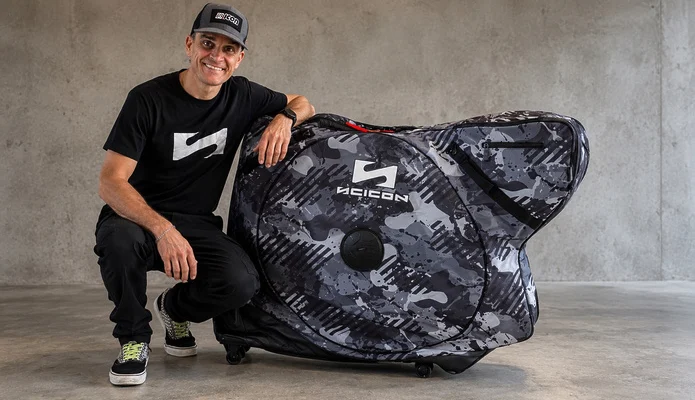
On paper, the Aerocomfort 3.1 Gravel is a 10.7 kg transport case, measuring 119 cm wide, 100 cm long, and 25 cm deep according to the manufacturer’s specifications. It features an integrated base frame, wheel compartments, padded protection, swivel wheels, and a system designed to securely hold the bike in place. The version we tested is part of the Grey Camo collection—the same one featured in the three products from our first article. But to reduce this Aerocomfort to just its dimensions would be a bit like describing a Colnago by simply saying it has two wheels and handlebars. Technically accurate. Not exactly thrilling.

Its appeal lies primarily in the way it was designed. Scicon states that the handlebars, stem, saddle, seatpost, and pedals can remain in place, provided the bike’s dimensions are compatible. Normally, all you need to do is remove the two wheels, secure the frame to the interior mount, and install the protective covers. This is a significant promise in an era when integrated handlebar assemblies, hydraulic hoses, and carbon components make certain disassembly tasks much more complicated than they used to be. The idea, then, isn’t just to transport a bike. It’s to transport a bike while interfering with it as little as possible.

The real luxury: not having to set up your bike all over again when you arrive
We all have our little obsessions. Saddle height. Reach. Stem angle. Handlebar angle. Those few millimeters that, after several hours in the saddle, can make the difference between a perfectly natural riding position and a discomfort that just won’t go away. On our gravel bike as well as our road bike, these adjustments didn’t happen by chance. They’re the result of rides, tweaks, sometimes pain, and often a lot of patience.
With a traditional bike bag that requires disassembling the handlebar and stem, traveling sometimes means undoing some of that work. You have to loosen, protect, reposition, and then tighten again. And above all, you have to do it correctly. With the Aerocomfort, maintaining your riding position is almost a bigger advantage than the time saved. Because once we arrive at our destination, we’d much rather explore the trails and get to know the route than search for a torque wrench in a hotel room. Of course, there’s nothing stopping you from checking the tightness of the bolts and the bike’s overall condition after transport. In fact, that would be a very good habit to get into. But checking isn’t the same as reassembling.

The Frame Defender: The Real Ingenuity Is Inside
From the outside, you immediately notice the size and the Grey Camo pattern. But the most interesting part is probably the one you can barely see once the bike is installed. Scicon calls it the Frame Defender. It’s an integrated mount that secures the frame to a structure attached to the rolling base. Adapters are included for various axle systems, including thru-axles found on most modern gravel bikes.
This design changes the whole approach to transport. In a simple padded bag, the bike relies heavily on being wedged against the sides. Here, the frame has its own mounting points. Straps limit movement, and the wheels are stored separately. The bike is therefore not simply placed in a large bag. It is secured on a support designed specifically for it. And this distinction becomes particularly important when you consider the sudden accelerations, changes in direction, or rough handling the bike undergoes between the check-in counter and the cargo hold of an airplane.
However, we must keep our feet on the ground. A securing system, no matter how well-designed, does not make a frame invulnerable. It limits certain movements and helps manage stress. It does not eliminate all risks associated with a violent impact or significant compression. We prefer this mechanical interpretation—which is far more credible—to the idea that a cover could guarantee that no incident will ever occur. The Frame Defender remains, nonetheless, the element that gives this Aerocomfort its true technical identity.

Two wheels to remove. And much less improvisation required
The main step, then, is to remove the wheels. On a modern gravel bike equipped with thru-axles, this is a relatively simple process, provided you have the right tool. Scicon provides the necessary components for securing the bike to its stand, as well as adapters for various standards. The wheels are then placed in two dedicated interior pockets. The frame remains in the center, secured to its support structure, while the rest of the bag wraps around the entire assembly.
This is where we’d add a few personal precautions. Shims between the brake pads, extra protection for the rotors, and special attention to the rear derailleur seem essential to us for traveling with peace of mind. Even though the bag has dedicated spaces, a slightly warped rotor can be enough to ruin the first few kilometers of a trip. And given the cost of some modern drivetrains, we’d much rather spend a few extra minutes on preparation than a few hundred euros on repairs.
Scicon also provides protectors for the handlebars, top tube, saddle, and brake levers. There’s even a small pump included among the listed accessories. The package as a whole shows that the brand didn’t simply set out to expand an existing bag. It thought through the areas likely to experience stress and the small tasks involved in traveling. Ultimately, it’s the same reasoning that won us over with the Rain Pro 35L: everything has its place, and every place addresses a specific problem.

A carrying case—and practically a mini-workshop included
There’s a rather amusing moment when you unpack the Aerocomfort for the first time. You thought you’d received a carrying case. And then you start taking out the accessories. A bag. Then another. Protective covers. Straps. Adapters. A pump. A small box full of metal parts. At this point, you almost start to wonder if Scicon hasn’t also planned to provide you with a mechanic. More seriously, this is probably one of the most interesting aspects of the Aerocomfort: the brand didn’t just make a protective case—it also thought of everything needed to properly prepare the bike.
Specifically, Scicon includes no fewer than fourteen types of items, in addition to the cover itself: a TSA-approved lock, an accessory bag, a storage bag for the cover, a padded shoulder strap, a chest strap, four quick-release adapters, two thru-axle adapters, a padded protective tube, two handlebar protectors, a saddle cover, two front and rear wheel locks, two internal brake lever protectors, and even a micro-pump. All of this, of course, comes with the Aerocomfort itself. It’s a particularly generous package, which explains why setting it up requires a bit of care the first time you use it. There are a lot of parts, but more importantly, a lot of potential issues that have been anticipated.

We particularly appreciated this thoughtful design. The handlebar and brake lever protectors are tailored to the demands of the cockpit. The padded tube protects part of the frame. The adapters allow for compatibility with different mounting standards. The straps make handling easier, and the storage bag takes over once the trip is over. As for the micro-pump, it’s a smart addition to the set, even if it obviously won’t replace our usual pump for precisely adjusting tire pressure before a race. Scicon has clearly understood that a bike doesn’t just travel with its frame and two wheels. It also travels with a multitude of small details that are best anticipated before departure.
This doesn’t mean you have to use every accessory on every trip. But having the right items from the start prevents you from having to improvise with bubble wrap, towels, or three pieces of foam scavenged from the garage. And while this “family photo” might look a bit like the inventory of a miniature workshop, it actually captures the product’s philosophy quite well. With the Aerocomfort, Scicon isn’t just selling us a way to transport our bike. The brand also gives us everything we need to get it ready for the trip. And, at this price point, that’s exactly what we expect.
Why a version specifically designed for gravel?
Just a few years ago, the distinction between a road bike bag and a gravel bike bag might have seemed minor. After all, both bikes have a frame, two wheels, and handlebars. But today’s gravel bikes have evolved considerably. Their handlebars are wider, sometimes very flared. Tires can reach 45, 50 mm, or even wider. Some geometries are becoming particularly generous, and drivetrains sometimes feature bulky derailleurs.
So Scicon has adjusted the available storage space accordingly. The Aerocomfort 3.1 Gravel notably features an expandable area around the handlebars—advertised as compatible with widths up to 58 cm—as well as more generous space on the rear derailleur side. These two features are of particular interest to us. This is because these are precisely the areas where a modern gravel bike can quickly become bulkier than a conventional road bike.
On our Lyti, as on any other gravel bike, compatibility must nevertheless be verified before setting out. A heavily flared handlebar may have a width at the ends greater than that measured at the stem clamps. And the frame’s overall dimensions don’t always tell the whole story. A cover labeled “Gravel” isn’t automatically compatible with absolutely every gravel bike. It’s less of a selling point than a universal promise, but much more useful for the reader.

Protection: fabric, yes, but not just a simple sock
This is probably the most obvious objection when you first see the Aerocomfort. Why entrust a carbon bike to a soft cover rather than a large, rigid case? It’s a perfectly legitimate question. A rigid shell can offer better resistance to certain types of compression and direct impacts. So Scicon chose to combine several solutions rather than trying to exactly replicate the behavior of a hard plastic case.
Scicon uses a construction called 3D-Padding, combining a tear-resistant CrossGuardTex outer fabric, a layer of high-density ImpactSafe foam, and a technical DuraTex 20D lining. But the protection doesn’t stop there. Rigid Durashield shells reinforce the most exposed areas, while a double rubber edge protects the corners from abrasion. Inside, the Frame Defender secures the frame to a dedicated structure. The design thus combines several approaches: stabilizing the bike, absorbing certain stresses, and protecting vulnerable parts. It’s a particularly interesting design, without claiming to turn this soft case into a full-size hard case.
This solution offers clear advantages in terms of space savings and ease of storage. It also has its limitations. A padded lining cannot guarantee the same resistance as a rigid shell against all forms of crushing. That’s why we consider the Aerocomfort to be a highly sophisticated transport system, but certainly not a reason to neglect preparing the bike. The day an airline agrees to handle bikes systematically with the same care as a WorldTour mechanic, we may reconsider our position. In the meantime, a little extra protection never hurts.

Four wheels and a certain sense of dignity
We really appreciated the four swivel wheels on the Luggage 80L 4WD. On a large suitcase filled with clothes and accessories, they made it easy to maneuver the whole thing through an airport terminal. The Aerocomfort follows a similar philosophy with its Twin Wheel system, whose 360° swivel wheels feature a suspension designed to dampen vibrations and minor bumps encountered on the ground.
This is far from a minor detail. After all, a bike bag isn’t just carried across the perfectly smooth floor of an airport. There are parking lots, curbs, elevators, automatic doors, ramps, and changes in surface texture. And above all, there’s that strange tendency of counters reserved for oversized luggage to be almost always located very far from where you’ve just arrived.
A good set of wheels doesn’t reduce the weight of the bag. It simply saves you from having to carry it all the time. The Aerocomfort also features handles and straps that allow you to move it in various configurations. Still, with a bike inside, you’re dealing with a bulky package. Scicon makes maneuvering easier, but hasn’t yet figured out how to fit a gravel bike into an elevator like carry-on luggage. We’ll give them a few more years to solve that problem.
10.7 kg empty: Newton’s laws apply to the WorldTour, too
Now we need to address a slightly less romantic topic: weight. At 10.7 kg empty, the Aerocomfort isn’t an ultralight bag. Add a 9- or 10-kg gravel bike, some protective gear, and transport accessories, and you’ll quickly approach 21 kg. If the airline has a 23-kg baggage allowance, the margin becomes tight. And even then, you’ll need to be sure that this allowance actually applies to sports equipment, since rules vary by airline.
This means you’ll probably want to avoid turning the bag into a second suitcase meant to hold shoes, clothes, and your entire bike repair kit. Much of this gear will fit much more naturally into the Rain Pro 35L or the Luggage 80L that we presented earlier.
However, this weight comes at a cost. It’s due to a wheeled frame, a securing system, protective features, and a construction designed to withstand repeated handling. So you don’t buy the Aerocomfort to save a few hundred grams. You buy it to reduce the hassles that come with transporting a bike. Still, you need to factor its weight into your travel plans.

A closure that also deserves attention
Even before closing the cover, we discovered another well-thought-out little detail: an interior pocket clearly labeled “TRACKER,” designed to hold a tracking device. This accessory doesn’t directly protect the bike, but it can help track it down when a trip doesn’t go exactly as planned. Obviously, it’s neither insurance nor a guaranteed permanent geolocation system, but it’s an extra precaution that we particularly appreciate.
Among the advertised features is the TwistZip closure, a double-spiral zipper that Scicon claims is resistant to forced-opening attempts. The Aerocomfort also comes with a TSA lock. This allows authorized officials to open the bag without having to break the lock when an inspection is necessary.
As with the Luggage 80L, we appreciate the inclusion of this accessory. However, it would be an overstatement to suggest that a combination lock transforms a fabric duffel into a safe. It helps secure the closure and deter opportunistic tampering. It obviously does not offer absolute protection against theft or damage.
What we find particularly relevant is the coherence of the design as a whole. The closure system, the frame support, and the interior padding address three distinct issues: keeping the bag closed, securing the bike, and limiting its exposure to external stresses. Good design is precisely about not confusing these functions.

And once you arrive, what do you do with that huge cover?
It’s a question we often overlook when choosing our luggage. Yet it can become a major concern when we arrive at a hotel or vacation rental. A bulky hard-shell case takes up almost as much space empty as it does full. But not everyone travels with a support truck and a room reserved for equipment.
The Aerocomfort has a clear advantage here: its design allows it to be folded up when it’s no longer holding the bike. Scicon also provides a storage bag for keeping it between uses. The structured base naturally remains in place, but the whole unit takes up less space than a hard case of comparable size.
This is an important feature for those who travel regularly. Whether in a hotel room, an apartment, or even a garage at home, being able to reduce the bulk of your luggage really makes a difference. Once again, we see that same pragmatic approach we noticed in the Camo collection: thinking not only about the journey itself, but also about what happens before and after.
This Grey Camo is starting to become a signature
You could almost forget about the aesthetics, given how many technical features there are. That would be a shame, though. Because we still love this Grey Camo finish just as much. Black, white, gray, and that graphic pattern—it has enough personality to be instantly recognizable without making it seem like you’re carrying military gear through the terminal.
With the Rain Pro 35L, the Luggage 80L, and the small electronics pouch, we’d already noticed the consistency of the line. The Aerocomfort adds another dimension. It’s clearly the most spectacular product in terms of size. And when you put all the pieces together, the whole set has that distinct look of professional team gear that’s sure to bring a smile to your face.
It’s also hard not to think of UAE Team Emirates and Tadej Pogačar, given how recognizable Scicon has become in this world. We’re still a long way from the support truck, the mechanics, and WorldTour logistics. But with the Camo and our gravel gear, we’ve at least started working on the style. As for results, we’ll probably have to keep pedaling.

€1,249: Peace of mind does come at a price
At the list price, the Aerocomfort 3.1 Gravel is priced at €1,249. Suffice it to say that we’re clearly in the realm of premium luggage. This isn’t an accessory you just toss into your shopping cart between two inner tubes. It’s a real investment that requires careful consideration and must be weighed against how often you travel.
But, as with the other Camo products we tested in September, promotions can significantly change the equation. When we checked Scicon’s European website, the listed price was €624.50—a 50% discount. This price is subject to change.
At €1,249, the decision is therefore worth serious consideration. At €624.50, it becomes much more appealing for someone who regularly travels with a valuable bike. Naturally, you’ll want to compare it with rigid solutions, airline baggage allowances, and potential bike rentals at your destination. But you also need to factor in something that product spec sheets often overlook: the cost of the time spent disassembling, reassembling, protecting, and checking your equipment. For a cyclist who takes several trips each year, this factor can end up tipping the scales.

What Scicon Has Really Understood
We ended our first article with the impression that Scicon didn’t view luggage as merely a collection of accessories. With the Aerocomfort, this philosophy becomes even more compelling. The brand isn’t just trying to make a bag big enough to hold a bike. It’s aiming to eliminate some of the constraints that travel usually imposes on cyclists.
The Frame Defender provides genuine mechanical support. The wheel compartments organize the interior. The padding and protective features round out the support. The wheels make it easier to move the bag around. And most importantly, the fact that most of the bike’s settings can be kept in place fundamentally changes the way you prepare for a trip.
Of course, not everything is perfect. It’s quite heavy, the list price is high, and a soft case remains vulnerable to certain stresses that a hard shell can better withstand. Nor should we confuse a compelling design with a proof of durability after dozens of flights. That assessment would require more time to evaluate.
But the product is particularly well-thought-out. And it brings us back to a fairly simple idea. When we travel to go cycling, we don’t set out with just any old object. We set out with an extension of our training, our habits, and sometimes our ambitions. Protecting it is obviously essential. Avoiding having to rebuild it upon arrival is almost as important.
Deep down, this may be where Scicon came up with its best idea: reminding us that the journey should begin when we close our suitcase, not when we finally finish reassembling our bike.
And in our case, the goal remains exactly the same as with the Rain Pro or the Luggage 80L: arrive, open the bag, find your belongings right where you left them, and quickly get to what we came for. Riding.
Pros
A design that minimizes the need to disassemble the bike
Handlebars, stem, saddle, seatpost, and pedals stay in place depending on compatibility
Built-in Frame Defender to stabilize the frame
Two interior compartments dedicated to the wheels
Adapters for various axle systems
Additional protective padding provided for several sensitive areas
Triple-layer 3D-Padding fabric construction
Expandable section for handlebars up to 58 cm
Space designed to accommodate the rear derailleur
360° swivel wheels with suspension
Multiple carrying options
Foldable cover for storage after use
TwistZip closure and TSA lock
Stylish Grey Camo design
Particularly attractive promotional price when available
Cons
Particularly high list price of €1,249
Weighs 10.7 kg when empty—a significant weight for some airline baggage policies
Substantial size even with good portability
Crush resistance should be considered differently from that of a rigid shell
Compatibility should be verified on gravel bikes with atypical geometries or handlebars
Additional protection for the derailleur and rotors is always recommended
Handling the bike requires some practice during the initial setup
Durability over multiple air trips remains to be confirmed through long-term monitoring
TECHNICAL SPECIFICATIONS
| Specifications | Scicon Aerocomfort 3.1 Gravel |
|---|---|
| Part Number | TP057100544 |
| Type | Carrying bag for gravel bike |
| Empty Weight | 10.7 kg |
| Listed Dimensions | 119 × 100 × 25 cm (width × length × depth) |
| Color Tested | Grey Camo |
| Main materials | CrossGuardTex / ImpactSafe / DuraTex 20D |
| Internal structure | Frame Defender |
| Advertised Compatibility | Gravel and cyclocross |
| Handlebar setup | No disassembly required, subject to compatibility |
| Listed handlebar width | Up to 58 cm |
| Wheel wells | Two dedicated compartments |
| Protection system | 3D-Padding, Durashield hard shells, and abrasion-resistant reinforcements |
| Specific protections | Handlebar, saddle, top tube, and brake levers |
| Wheels | 360° swivel, with suspension |
| Closure | Double-spiral TwistZip |
| Lock | TSA lock included |
| Storage | Collapsible design |
| Included accessories | Axle adapters, straps, protective covers, storage bag, and mini-pump |
| List price* | €1,249 |
| Current promotional price* | €624.50 |
Prices taken from Scicon’s European website on October 10, 2026; subject to change.
FAQ – Scicon Aerocomfort 3.1 GravelDo I need to remove the handlebars to transport my bike? No, that’s precisely one of the Aerocomfort’s key advantages. Scicon states that you can leave the handlebars, stem, saddle, seatpost, and pedals in place. Both wheels must be removed. However, you should check that your bike’s dimensions are compatible, especially for gravel bikes equipped with very wide or heavily flared handlebars. Does a soft cover provide sufficient protection for a carbon bike? The Aerocomfort doesn’t rely solely on its fabric cover. It combines a Frame Defender support structure, padded protectors, wheel compartments, and localized reinforcements. This system is designed to limit movement and protect the bike during transport. However, it does not guarantee the same level of resistance as a rigid shell against all types of compression or impact. Can you travel with a gravel bike equipped with disc brakes? Yes. The bag is listed as compatible with bikes equipped with disc brakes. It’s still recommended to use transport spacers between the brake pads, protect the rotors, and ensure that components won’t come into contact with the frame or other parts during the trip. Is the 10.7 kg weight a problem when flying? It may be, depending on the airline and its policies for transporting sports equipment. With a gravel bike weighing 9 to 10 kg, the total weight is already around 20 kg before adding accessories. You should therefore check the applicable baggage allowances and weigh the loaded bag before departure. Can you actually store the bag in a hotel room? The Aerocomfort features a foldable design that reduces its bulk once the bike is removed. However, its rolling base and support frame remain in place. This makes it easier to store than a large rigid case, without being as compact as a simple fabric bag. What is the main advantage over a traditional bike case? For us, the biggest benefit is that it minimizes the need for disassembly. Being able to travel while retaining most of your bike’s settings and handlebar setup is particularly valuable on modern bikes, where integrated components can sometimes make mechanical adjustments complicated. Added to this are the bike’s secure hold within its internal frame, the organization of protective gear, and ease of transport. Is the Aerocomfort worth the price? At €1,249 list price, it’s clearly aimed at cyclists who travel enough to justify the cost of specialized gear. With current promotions bringing the price down to around €624.50, the investment becomes much more affordable. The decision, however, depends on how often you travel, the value of your bike, and the level of protection you’re looking for. Does the Aerocomfort 3.1 Gravel truly round out the Camo collection? Yes, and that’s actually what gives this series its cohesion. The Rain Pro 35L accompanies the cyclist in daily life and during competitions, the Luggage 80L carries the essentials for longer trips, the Electronics Travel Pouch organizes accessories, and the Aerocomfort takes care of the bike itself. Four very different products, but a shared philosophy: organizing your travels so they don’t become an added burden. |
=> In France, find Scicon Sports luggage and eyewear at Alternativ Sport
Share the post "Review of the Scicon Aerocomfort 3.1 Gravel Bike Case: The Bike Gets Some Fresh Air"