Share the post "Bike Check #008 | Yann Payen: Built to Go the Distance"
A former elite runner who competed in road racing and was already very strong in time trials in the 1990s and 2000s, Yann Payen has never really stopped striving for peak performance. A multiple qualifier for the Ironman World Championships in Hawaii, a champion among firefighters all the way to the world level, a former unit commander of the 5th Company in the Paris Fire Brigade, and now an officer in Monaco in charge of the training and sports office, Yann is one of those who have built their lives around effort, precision, and passing on knowledge. As he embarks on new adventures in ultra-cycling and trail running, he gives us a glimpse into a machine that sums up his philosophy quite well: a Cervélo P5 worth nearly 14,000 euros, a 55-tooth chainring, and—even before the watts—a riding position fine-tuned to the millimeter.
By Jeff Tatard – © Photos: Yann Payen
There are bikes you buy just for fun. And then there are bikes that demand something in return. Yann Payen’s Cervélo P5 clearly belongs to the second category. “What annoys me the most? When my legs don’t give it what it wants.” That pretty much says it all.
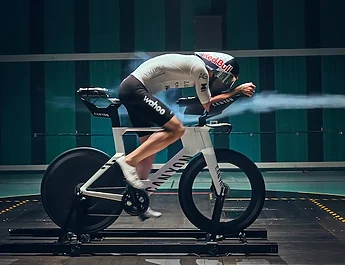
Because a P5 traveling at 40 km/h isn’t really designed to negotiate with its owner. It demands speed, a precise riding position, and enough leg power to turn all that carbon and aerodynamics into kilometers per hour.
When it comes to this, Yann has a few credentials to his name. A former elite road cyclist in the 1990s and 2000s, he made his mark on the road before switching to triathlon—a sport he’s been competing in for about fifteen years, notably qualifying several times for the Ironman World Championships in Hawaii. On top of that, he leads another athletic life, closely tied to his career as a firefighter, with several French championship titles and even a world title to his credit.
After about twenty years with the Paris Fire Department and then three years with the local fire department, Yann is now head of the sports training office for the Monaco Fire Department.
And now? Ultra-distance cycling is starting to appeal to him, particularly the Race Across France. Trail running is also on the horizon. Because after a lifetime of chasing performance, Yann now seems eager to add something else to the mix: discovery, nature, and simply the joy of pushing his limits. But before that, there’s still this P5. Welcome to 3bikes’ Bike Check #008.
What? What kind of bike do you have?
A 2025 Cervélo P5, size 54. And there’s no doubt about its purpose: this is a true triathlon machine, designed around aerodynamics and the ability to maintain very high speeds for long periods.
The groupset is a full Shimano Dura-Ace, paired with 170 mm cranks. This is far from a trivial detail for Yann. “For years, as a former cyclist, I rode with 172.5 mm cranks. I switched to 170… and maybe one day I’ll switch to 165.”
The cockpit is the stock setup. On his feet, Yann remains loyal to Look pedals.
For the wheels, several configurations are possible depending on the course and the time trial: Reserve 88 mm in the rear and 67 mm in the front—a combination directly inspired by setups found at the highest level—with the added option of using a DT Swiss lenticular wheel when the course and conditions allow.
The bike weighs about 8.8 kg without full water bottles, for a price that ranges, depending on the configuration, between 13,000 and 14,000 euros. But amid all this carbon and aerodynamics, Yann’s favorite part is much easier to spot. It has 55 teeth.

Why? Why this bike?
Because Yann wasn’t looking for a road bike made more aerodynamic. He wanted a true triathlon bike. And for him, the P5 remains the benchmark today. “I think it’s one of the best time-trial bikes currently on the market.”
Yann readily cites Canyon—which he considers excellent but heavier—or Specialized among the top time-trial bikes. But he specifically distinguishes these machines from his Cervélo. His P5 is, above all, a triathlon bike. That means embracing a different philosophy than that of a road bike: here, a few hundred extra grams matter less than the ability to slice through the air for hours on end. “A time trial bike isn’t meant to be light. It’s meant to ride.”
Yet Yann points out something that the P5’s massive silhouette doesn’t necessarily suggest: the bike handles hills quite well and is particularly dynamic on accelerations. But its true element begins when the speed increases. 35 km/h. 37 km/h. And beyond. That’s where the investment in aerodynamics really starts to pay off. Because once it’s up to speed, the P5 doesn’t want to be stopped.

How? How did you set it up?
Let’s start with those 55 teeth. Originally, the P5 was set up with a 54/41 chainring setup and an 11-34 cassette. Yann replaced the large chainring with a 55-tooth round Rotor chainring. “That’s really the part I like the most. A 55-tooth chainring really shines in time trials.” So much for the visible parts.
But the choice that Yann ultimately values the most is almost impossible to capture in a photo: his riding position. And on this point, his perspective is particularly interesting. “There are a lot of cyclists and triathletes who buy state-of-the-art bikes for 10,000 or 15,000 balles, but who balk at spending 200 balles on a posture analysis. ” He did exactly the opposite. Or rather, he figured that one made no sense without the other.
A 14,000-euro bike that’s poorly adjusted is still a poorly adjusted bike. On a machine like the P5, where most of the performance gain comes precisely from the cyclist’s ability to maintain an aerodynamic position for a long time, a few millimeters can matter more than an extra carbon component. And Yann isn’t just talking about performance. “Beyond performance, it mainly helps prevent injuries. And old-timers like me—well, these days we have to take a little better care of our bodies.” The remark brings a smile. But behind it lies what is probably the smartest choice in his entire setup.
The 170-mm cranks, the height and reach of the aerobars, the support on the forearms, the narrower hip angle—everything must allow Yann to generate his watts without wearing down the body that still has to keep going. And perhaps, in the future, those cranks will even be shortened to 165 mm. The equipment is evolving. So is the riding position.

So what? How does it actually perform out on the road?
First, you have to get it going. Then, things get interesting. “Once it’s up to speed, honestly, if you’re in the right position, you gain watts compared to a more traditional position on a road bike. ” That’s obviously the whole point of the P5. Not to beat a 6.8-kg bike in a mountain sprint. But to allow the rider to maintain a high speed while expending as little energy as possible fighting the air. And Yann emphasizes this concept of minimum speed. “It’s a bike you need to ride at a minimum of 35 to 37 km/h to get good efficiency.” Below that, the magic wears off. And when your legs give out, there’s no way to cheat. “When you’re struggling, you feel it, too.”
This is perhaps the most interesting flaw in a bike that Yann ultimately finds little to criticize: the more capable the machine is, the more brutally it reminds you of the days when you’re not at your best.
On climbs, it holds its own. On accelerations, it surprises. But when the road opens up and the speedometer starts hitting the high tens, the P5 really comes into its own. Yann gives it a score of 8 to 9 out of 10. And coming from a man who spent part of his life chasing a few seconds on a bike before spending fifteen years chasing them in Ironman races, that score is probably not just a polite gesture.

Will someone steal it from you tomorrow? Would you buy the exact same one again?
Probably. “I think I’d get another P5 because it’s a safe bet. ” But the reason Yann gives is particularly interesting, because it has nothing to do with aerodynamics. Resale value. “For me, bikes are a bit like cars. When I buy a bike, I’m always thinking about resale.”
A Cervélo P5, like a high-end Specialized Tarmac, has—in his view—an advantage that spec sheets often overlook: a name, a reputation, and a used market.
Yann therefore prefers to invest in a bike he knows will retain a certain desirability rather than in a lesser-known model that might be harder to resell.
That doesn’t mean he doesn’t look elsewhere. He specifically mentions Van Rysel among the brands whose progress and equipment quality he follows with great interest. But what if his garage were empty tomorrow morning? He’d probably go back to a safe bet: another P5. With a 55-tooth chainring up front, of course.
Yann’s Bike Check
A quick note from Yann: “What annoys me the most is when my legs don’t give it what it wants.” That’s probably the best way to sum up this Cervélo. A bike that doesn’t mess around. At 35 or 40 km/h, properly positioned on the aerobars, Yann gets the full benefit of everything the P5 was designed for. On off days, the bike simply reminds him that a 14,000-euro bike has never been a substitute for his legs. And after a career spent chasing performance on the road, followed by fifteen years of triathlon, Yann is now starting to look further ahead: ultra-distance cycling, Race Across France, trail running, and new adventures close to nature. In the end, the P5 may not be the ultimate goal. Just a new way to go the distance. |
Share the post "Bike Check #008 | Yann Payen: Built to Go the Distance"