Share the post "Inner tubes: Latex and TPU—what are the advantages over butyl?"
Although often overlooked when it comes to optimizing a bike, inner tubes do have a measurable impact on weight and rolling resistance. Switching from butyl to latex or TPU can save a few dozen grams per wheel and, depending on the tire-tube combination and test conditions, several watts per pair. It’s a relatively inexpensive upgrade, but its benefits need to be viewed in context.
By Guillaume Judas – Photos: depositphotos.com, DR
When a cyclist seeks to improve their bike, tires and wheels usually top the list. The inner tube is much less often considered a performance component. Yet, on a tube-type setup, it is an integral part of the tire-wheel system, and its material influences both weight and losses due to deformation.
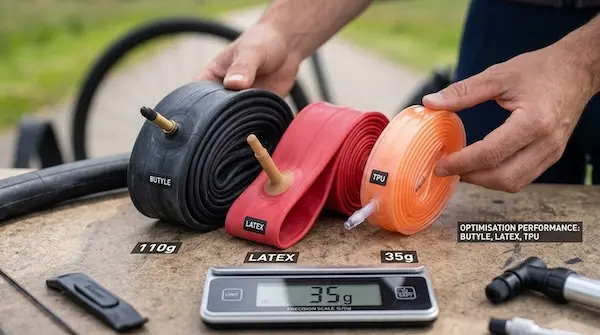
Butyl remains the most common choice. It is economical, durable, and relatively easy to install. A standard road inner tube weighs around 100 g, although some lightweight versions are already down to 70–75 g. In contrast, latex tubes generally weigh between 60 and 80 g depending on the model, while the lightest TPU models can weigh less than 30 g.
Butyl, latex, TPU: What are we talking about?
Butyl: a synthetic rubber that has been used for decades in inner tubes. Inexpensive, durable, and relatively airtight, it is the most common—but also the heaviest—option. Latex: a natural rubber that is much more flexible and elastic than butyl. This flexibility enhances performance and comfort, though it comes at the cost of faster air loss and a more delicate installation process. TPU: Thermoplastic polyurethane is a synthetic material used to make extremely thin and lightweight inner tubes. Very compact and relatively airtight, it offers a balance between low weight, performance, and portability, though it comes with specific challenges for installation and repair. |
Several dozen grams lighter on the wheels
The first benefit is therefore very tangible: reduced weight. By replacing two 100-gram tubes with two 25- to 30-gram models, the weight savings can reach approximately 140 to 150 grams per pair of wheels. Compared to lightweight butyl tubes weighing 70 to 75 g, the difference is, of course, smaller.
This weight is located in the wheels, which makes it potentially more significant than a simple weight reduction on the frame. However, the effect of inertia should not be overstated. At these weight levels, the change remains modest, and the improvement felt during acceleration does not fundamentally alter the bike’s handling. On the other hand, the weight reduction is very real and may be felt more on a bike intended for competition with frequent changes in pace, or on hilly routes.
Rolling Resistance in Question
The main advantage of latex or TPU tubes, however, is not their weight. Their mechanical properties differ from those of butyl, as they deform more easily and experience less energy loss due to internal friction between the tube and the tire.
Available laboratory tests clearly show an advantage for latex over butyl, but the extent of this advantage varies greatly depending on the tire, pressure, and speed. In a test conducted on three road tires, for example, Bicycle Rolling Resistance measured 10.6 W of rolling resistance at 80 psi and around 29 km/h for a Vittoria latex tube, compared to 13 W for a Continental Race 28 butyl tube. At 60 psi, the difference reached 3.2 W for the tested setup.
Other tests have yielded even greater differences under different conditions. AeroCoach, for instance, measured a 7.1 W gain for a pair of wheels traveling at 45 km/h when comparing Vittoria Competition latex tubes to Continental Race 28 butyl tubes. With Schwalbe Aerothan TPU tubes, the difference reached 5.6 W under the same test protocol.
These figures show, above all, why it’s important to avoid claiming a fixed gain. At a cyclist’s actual training speed, the benefit will generally be lower than that measured at 45 km/h. It also depends heavily on the tire used.
Latex or TPU?
Latex generally remains the benchmark when the primary goal is the lowest rolling resistance. In Bicycle Rolling Resistance tests, an 80-gram latex tube outperformed several very lightweight TPU models. TPU, however, comes very close to this benchmark in certain setups, with the advantage of being significantly lighter.
The choice between the two materials is therefore partly a matter of compromise. Latex prioritizes flexibility and efficiency, while TPU allows for an extremely lightweight and compact tube. A 26-gram Tubolito S-Tubo Road, for example, weighs only slightly more than a quarter of the weight of a 100-gram butyl tube.
This compactness is also an advantage for a spare tube. A folded TPU tube takes up much less space in a saddle bag than a traditional butyl tube.
A gain of a few watts, but not a revolution
However, it would be an exaggeration to present this inner tube as a direct alternative to a pair of aerodynamic wheels or other high-end equipment. Aerodynamic gains depend primarily on speed, position, and the entire wheel-tire system. They therefore cannot be directly compared to a rolling resistance gain measured in a laboratory.
On the other hand, the cost-to-benefit ratio is attractive. A pair of inner tubes generally costs much less than a new pair of wheels and can help reduce the weight of the wheels while lowering their rolling resistance.
Butyl inner tubes are available starting at 4 or 5 €. You’ll need to budget 10 or 12 € for a lightweight butyl inner tube (around 74 g). Latex inner tubes start at around 10 €. Finally, expect to pay around 15 euros or more for a TPU inner tube.
Latex requires more attention
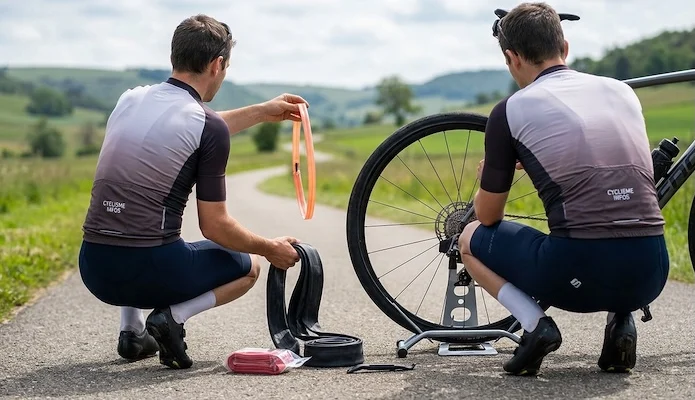
The main drawback of latex is well known: it gradually loses more air than butyl or TPU. In practice, this means it’s especially important to check the pressure before every ride. Installation also requires greater care, as the tube must be positioned perfectly to prevent it from getting pinched between the tire and the rim.
From this perspective, TPU offers a better compromise. It is very lightweight, compact, and retains pressure better than latex, but ultra-lightweight models also require careful installation and cannot necessarily be repaired with standard butyl patches.
A simple optimization—provided you know what you’re looking for
Swapping out your inner tubes won’t turn an ordinary bike into a race machine. However, on a setup that’s already performing well, it’s a relatively simple optimization that lets you fine-tune both weight and rolling resistance. Latex remains particularly appealing for those seeking efficiency and comfort, while TPU stands out for its light weight and compact size. In both cases, the benefit will depend on the tire used, the inflation pressure, and the riding speed.
Therefore, rather than focusing on a single figure in watts, it’s better to look at the overall trend. With comparable setups, high-performance latex and TPU tubes can reduce rolling resistance compared to a standard butyl tube, while saving several tens of grams per wheel. For just a few dozen euros, this is a subtle, measurable, and easy-to-implement improvement.
Share the post "Inner tubes: Latex and TPU—what are the advantages over butyl?"