Share the post "Tubeless: Where Does the Technology Really Stand?"
Long considered difficult to install, high-maintenance, and sometimes disappointing on the road, tubeless tires have come a long way in recent years. Wider tires, lower pressures, compatible rims, more effective sealants, and improved compatibility standards have changed our perspective on this technology. Here’s a look at what has actually improved in 2026—and what still warrants attention.
By Guillaume Judas – Photos: depositphotos.com, ©Etienne Schoeman, ©3bikes.fr
Tubeless tires are no longer a novelty in the world of road cycling. The first systems appeared nearly twenty years ago, but their adoption has been particularly slow. I first tested this technology in 2008 with Hutchinson, but I wasn’t 100% convinced—far from it. For a long time, tubeless even gave the impression of being a promising technology, but not necessarily mature enough to win everyone over. Installation that’s sometimes complicated, unreliable sealing, sealant that dries out, punctures that are hard to repair, and tires that are difficult to remove: there were plenty of reasons to stick with tubulars or inner tubes.

Even among professionals, the transition to tubeless has been gradual. For a long time, tubular tires retained their advantages in terms of handling, weight, and reliability—notably the ability to continue riding for a few hundred meters on the rim in the event of a flat during a race. Then, over the past five or six years, things have accelerated. Tubeless tires have become more efficient, rims have evolved, tire widths have increased, and tire pressures have decreased. Most importantly, manufacturers have put a lot of effort into optimizing the interaction between the tire and the rim. This has made a huge difference. Modern tubeless systems therefore bear little resemblance to the first systems we saw—or even to what was available just a few years ago. Tubeless has now become the standard in the professional road racing peloton.
Early Struggles
I have to admit, I wasn’t exactly a staunch advocate of tubeless tires on the road. And with good reason. It was the same story with disc brakes. But my opinion has evolved over time, in step with the new innovations introduced by manufacturers.
My early experiences with tubeless tires were sometimes a struggle. First, you had to find the right combination of tire and rim, successfully mount the tire, seat it properly, ensure a lasting seal, and remember to reapply sealant regularly. And even when everything worked, certain combinations could prove disappointing in real-world conditions.

On top of that were the flat tires. The theory, however, was appealing: no inner tube, meaning less risk of a pinch flat, and a sealant capable of automatically sealing small punctures. In practice, a large cut may still require repair—often a very delicate procedure on the side of the road—and it can sometimes be extremely difficult to unclip the tire before slipping an inner tube into it. And a dried-out sealant or a clogged valve can turn a simple check into a full-scale maintenance operation. In short, tubeless tires have been around for a long time, but you sometimes have to put up with more hassles to enjoy their benefits.
Wider Tires and Lower Pressures
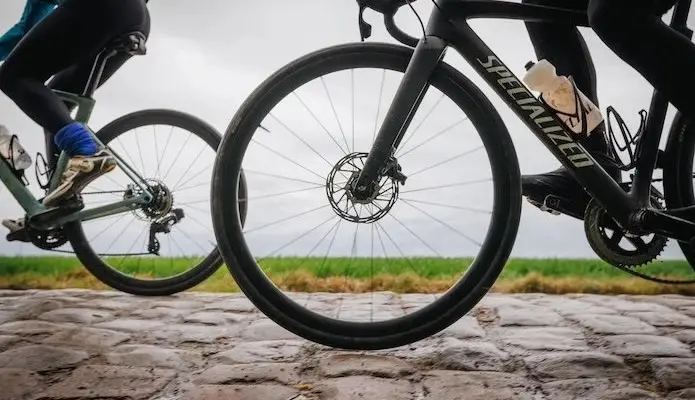
One of the most significant developments probably concerns tire widths. The 25 mm has long been the standard on the road. Then the 28 mm became the norm, before 30, 32, and sometimes even wider sizes became perfectly acceptable, even on high-performance road bikes.
This evolution isn’t just a matter of comfort. Provided the rim is suitable, a wider tire can run at a lower pressure, allowing it to better conform to road surface irregularities. The wheel thus maintains more contact with the ground, and vibration-related energy loss is reduced. On real-world road surfaces, a more appropriately adjusted tire pressure can therefore improve comfort, traction, and efficiency.
However, one should be wary of oversimplified conclusions. Systematically fitting the widest possible tire and lowering the pressure as much as possible is not a one-size-fits-all solution. The rider’s weight, the rim’s internal width, the tire used, the type of road, and the riding style must all be taken into account. Bigger does not automatically mean better, especially since a larger tire section also means more weight.
The rim has evolved alongside the tire
Advances in tubeless technology aren’t limited to the tire alone. The entire industry has evolved around it. Modern rims are wider than before, and their design is tailored to contemporary tires. The relationship between the rim’s internal width and the tire’s actual cross-section has become a key factor in the overall performance of the assembly.
Hookless rims have also contributed to this evolution. By eliminating the inner hook designed to hold the tire bead in place, they simplify the rim’s construction and can help reduce its weight. Their outer shape can also provide a smoother transition between the tire and the rim, with potential benefits for aerodynamics. However, hookless rims also require greater precision in tire selection and adherence to recommended pressures. Here again, modern tubeless systems work well as long as the entire system is properly maintained.
I, too, approached this technology with caution at first. My initial experiences were inconclusive, due to tires that weren’t fully compatible. But I must admit today that by following the manufacturers’ recommendations and selecting the right tires, the system works very well—in terms of efficiency, traction, and comfort alike.
Standards That Have Improved Tire Installation
Another less visible but essential development: standards for dimensions and compatibility have advanced. ETRTO recommendations and standards have provided a clearer framework for the relationship between tire and rim sizes. Manufacturers have also improved the precision of their production processes.
This may seem trivial, but it’s crucial to the user experience. How many people have struggled with tires that are extremely difficult to mount on a particular rim? A tire that can be mounted by hand, sits correctly on the rim, snaps into place without requiring excessive pressure, and remains airtight represents a considerable improvement over earlier generations. Obviously, not all tires are that easy to mount, but tire-rim compatibility has become much more predictable. It’s also much more reassuring in the event of a problem on the road, when you might need to slip on an inner tube just to make it home.
The Rise of Puncture-Prevention Fluids
Early generations of sealant could be very runny, and their effectiveness depended heavily on the size of the puncture and the situation. Not to mention the state of the bike and your clothes after a puncture where sealant spills out—which also requires a lot of cleanup afterward.
Nowadays, new sealants use various particles designed to improve the liquid’s ability to seal holes. Of course, this doesn’t turn a large cut into an invisible puncture. Puncture sealant is still primarily intended for small punctures. But its effectiveness and lifespan have improved—provided you remember that it’s a consumable. And this also reminds us that a tubeless system isn’t maintenance-free.
Tires That Can Also Last Longer
Another interesting consequence: with better-controlled pressures and improved casings, some modern tubeless tires offer a particularly impressive lifespan. Of course, this isn’t true across the board. The rubber compound, the casing, the rider’s weight, riding conditions, and the number of kilometers traveled all have a significant impact on wear. But with wider tire profiles and lower operating pressures, the tread may also be subjected to less stress from road irregularities. This is also what makes certain current models much easier to use on a daily basis.

A technology that requires attention
However, it would be wrong to conclude that tubeless tires have become completely hassle-free. You need to monitor the sealant level, periodically check the tire’s condition, inspect the valves, and prevent them from clogging with dried sealant. You also need to keep an eye on the sidewalls and the tire’s overall condition. After a few months, even a setup that’s working perfectly may require maintenance. Dirt can accumulate, the sealant can dry out, a valve can become difficult to use, and a tire may eventually lose its airtightness.
And when a puncture exceeds the sealant’s capabilities, you must always be able to get back home. A suitable plug kit usually allows you to quickly repair a puncture out in the field, while a spare inner tube remains a particularly reassuring backup solution for long rides. Tubeless tires therefore require a bit more attention than a setup with a traditional inner tube.
Avoid risky combinations
Advances in tires and rims do not mean that all combinations are possible. The tire manufacturer’s recommendations must be followed, as must those for the rim. The same applies to tire pressure. Lowering the pressure very low simply because a chart or calculator indicates that low pressure is possible isn’t necessarily appropriate in all situations. A tire that bottoms out, touches the rim when compressed, or becomes too unstable in turns is not being used correctly, even if it is theoretically possible to ride at that pressure. Tubeless systems work best when the tire, rim, tire pressure, and rider’s weight are considered as a single system.
Furthermore, a tire designed for tubeless mounting generally performs better when used in a tubeless setup. This may seem obvious, but it’s important to remember that many manufacturers still ship their new bikes with tubeless tires mounted with inner tubes. This results in a heavier setup that performs differently from how the tire was designed to function.

A tubeless tire can indeed be heavier than a model designed solely for use with an inner tube, particularly due to its reinforced casing and sealant. But adding a heavy butyl inner tube can further increase the system’s weight significantly. I regularly install a TPU inner tube in a tubeless tire for emergency repairs or special setups. Weighing about 35 g, it adds a weight comparable to that of the sealant.
Independent rolling resistance tests also show that, when the system is properly selected, a tubeless setup can offer excellent efficiency—better than with an inner tube.
So, where does tubeless technology really stand in 2026?
Tubeless systems still have a few drawbacks, but things are clearly moving in the right direction. Today’s tubeless systems are more comfortable, perform better, and are easier to use than they were five or six years ago. This is probably why it has ultimately become the standard on most high-end road bikes and in the professional peloton. The entire ecosystem has advanced enough for its advantages to be truly noticeable in real-world riding. On the other hand, you have to accept a minimal amount of maintenance and a few additional challenges during installation or in the event of a major flat.
Tubeless tires thus seem to have reached a new milestone. They are now a mature solution, yet one that continues to evolve. And it may be precisely this constant evolution that explains why the tubeless tires we use today impress us much more than those of the first generations.
Share the post "Tubeless: Where Does the Technology Really Stand?"