Share the post "Bike Check #006 | Nico Neves: His Trail Bike"
Some encounters begin over coffee. The one with Nico Neves took place—much more fittingly—at the edge of a field, somewhere in our lovely Vexin region, last spring. A few words, a bike that immediately catches the eye, and the impression that neither the rider nor the machine is quite there by chance. His TITICI Revo is Italian through and through: a frame made in Italy, a mechanical Campagnolo Ekar groupset, Levante wheels, and Deda components. But behind this almost obsessive consistency lies, above all, a certain vision of gravel riding: going far, riding anywhere, and never having to wonder if the path ahead is still really a path.
By Jeff Tatard – © Photos: Nico Neves
There’s something rather amusing about our encounter with Nico. It was last spring, somewhere in the Vexin region. Not at a trade show, not in front of a bike shop, not even on a beautiful, perfectly paved road. At the edge of a field.
All things considered, it’s hard to imagine a better place to meet the owner of the bike you’re about to discover. Because Nico used to own a road bike. Back in 2020. Not for very long. “It frustrated me not to be able to get even deeper into nature and to be stuck on the road.”
So he switched to gravel. And when he talks about freedom today, Nico knows full well that the word has become a bit of a cliché in our world. He uses it anyway, because he can’t find a better one. “Gravel riding really is synonymous with freedom. I don’t worry at all about the condition of the trail. Whether it’s a mountain bike trail or a smooth road, this bike goes anywhere.”
His bike, in fact, comes from a small Italian brand that’s still obscure enough to regularly prompt the same question: “What is that?” A TITICI Revo 2026. And for Nico, the Italian influence certainly didn’t stop at the frame. Welcome to 3bikes’ Bike Check #006.
What? What kind of bike do you ride?
“I ride a bike that’s completely Italian—all carbonara, all margherita pizza.” There you go. Normally, our job could almost end right here.
Nico’s bike is a TITICI Revo 2026, a carbon gravel bike made by the small Italian company. And rather than mixing influences, Nico decided to take the idea all the way. An Italian bike deserved an Italian build.
So the drivetrain features a mechanical Campagnolo Ekar, with a 42-tooth chainring and a cassette whose largest sprocket is also 42 teeth. The wheels are Campagnolo Levante, though Nico is already planning to switch to Bora X wheels, which have a wider profile.
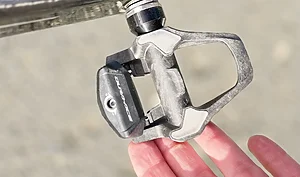
The components are all Deda, the pedals are Shimano XTR, and the whole bike weighs in at about 8.8 kg. But Nico’s favorite detail lies elsewhere. Look at the top tube. Very thin. Almost surprisingly thin.
It’s one of TITICI’s visual hallmarks and probably what immediately gives the Revo its distinctive silhouette. Nico particularly enjoys owning a bike that not everyone recognizes at first glance. “Every time, people ask me where I got it.” And he really likes that.

Why? Why this bike?
Because Nico wanted, first and foremost, a bike capable of disappearing with him for several days. Not just a fast machine. Not just a competition gravel bike. A bike he could load up, take on bikepacking trips, throw onto unlikely trails, use in races, and then ride to work afterward. “I chose it because it’s perfect for heavily loaded bikepacking. When you ride it, you can feel that it’s a bike that can take a lot of abuse. But I can just as easily take it to a race: it’ll be just as responsive.”
It’s precisely this dual personality that appeals to him. Nico didn’t leave road cycling because he no longer enjoyed riding fast. He left it because it imposed limits on him.
With the Revo, the question “Can I get through here?” has practically disappeared from his vocabulary. Mountain bike trails, dirt tracks, farm roads, perfectly smooth asphalt: it doesn’t matter. And even with 50-mm knobby tires, Nico finds his TITICI particularly fast on flat terrain. The Ekar system’s small 9-tooth sprocket obviously plays a big part in that. A 4×4 that knows how to pick up speed. That’s already a pretty good definition.

How? How did you build it?
Perhaps the most interesting thing about Nico’s build isn’t what he has. It’s what he deliberately chose not to have: electronics. “Above all, I wanted a modern bike with cable shifts. When traveling, I’d rather have an extra cable than have to recharge batteries.” That’s probably one of the most revealing choices in this entire Bike Check.
At a time when electronic drivetrains are gradually taking over the high-end gravel scene, Nico chose a mechanical Campagnolo Ekar precisely because his bike needs to be able to go far and remain easy to fix on the road. There’s a downside, though. “What annoys me the most is the Ekar’s precision. The bike always has to be adjusted to the millimeter; otherwise, it works really poorly.” Then he adds almost immediately: “But hey, that’s kind of why I love Campa, too. When it works, it’s just magical.”
Very Italian, after all. There’s also one much more obvious adjustment he still hasn’t decided to change: the height of the handlebars. Nico has simply never cut the fork steerer tube since he got his bike. And the more time passes, the less he seems to want to do it.
This relatively high position gives him a great deal of comfort, and—contrary to what one might imagine—he even finds it easier to maintain an aerodynamic position for long periods of time when set up this way.
There’s still one problem: the 42 × 42 gear ratio. In the Pyrenees this summer, some climbs eventually got the better of him. “I had to push the bike. That frustrated me a bit. I want my bike to be able to climb up to the trees!” So the next step is already clear: switch to a 40-tooth chainring or find a higher gear ratio in the rear. Because a workhorse that has to be pushed up the mountain—obviously—that really gets under Nico’s skin.

So what? How does it hold up in the field?
“This bike is a real 4×4.” ” That’s probably the phrase that best sums up the Revo’s performance. Nico uses it for bikepacking, racing, and sometimes just to ride to the shop. Loaded up, it holds its own. Unloaded, it regains enough responsiveness to take on a race. On the trails, its wide tires let the terrain roll right past under the wheels with that feeling Nico values above all others: “What I love most is the feeling of being really well-planted on it. Everything goes under my wheels without me even feeling it.”
Perhaps that’s where his choice really makes sense. His gravel bike isn’t built around a single measurable performance metric. It’s built around the confidence it gives its owner to keep going. Does the trail get rough? Keep going. Does the road disappear? Keep going. Is the trip lasting several days? Keep going. Is there a race coming up? Take off the luggage… and keep going a little faster. In the end, he has only one goal left to achieve: to truly be able to “climb trees.” We suspect that the 40-tooth chainring won’t be far behind.

Will it get stolen tomorrow? Will you buy an exact replacement?
No. But first and foremost: “I’d cry.” Only then would Nico pull out his credit card. And rather than buying the exact same Revo, he’d stick with TITICI but step it up a notch with the Relli Pro. “It looks even more fun to ride than the one I have. ” It’s an interesting response because it doesn’t call his Revo into question at all. On the contrary. Nico likes TITICI’s philosophy enough to stay with the brand, but his curiosity drives him to discover what the brand can do at the next level.
In the end, there’s perhaps only one thing more important than owning a bike capable of going anywhere: still wanting to discover what comes next.
Nico’s Bike Check
A quick note from Nico: “My gravel bike is kind of like my workhorse.” It’s hard to imagine a better conclusion. Not a thoroughbred you only take out on Sundays, nor a workhorse doomed to carry luggage: a machine you set off on without necessarily knowing what you’ll encounter. And deep down, that’s probably the definition of gravel biking that Nico had been searching for ever since he decided, in 2020, that road biking alone had become far too limiting for him. |
Same concept. A different bike.
One bike. Four photos. Four questions. Four answers. Bike Check, the 3bikes series that’s less interested in what a brand says about a bike than in the reasons why its owner chose to ride it.
=> To learn all about the components on Nico’s bike: HERE
=> And here, if you want to check out all our other Bike Checks: All Our Bike Checks
Share the post "Bike Check #006 | Nico Neves: His Trail Bike"