Share the post "Boris Carène: When a Champion Becomes an Island"
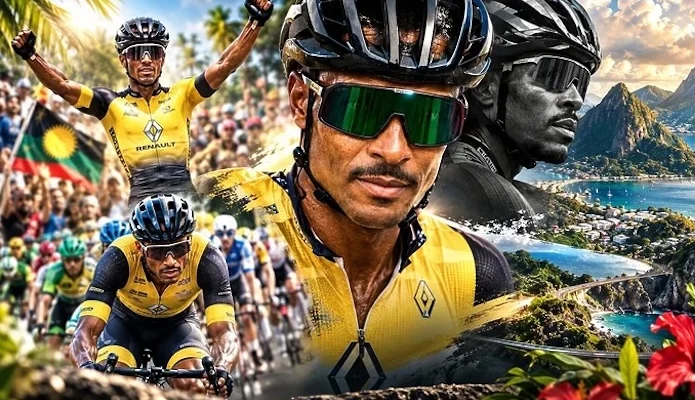
There are champions we admire for their victories. And then there are those who, one day, surpass their own record. For more than twenty years, Boris Carène raced on the roads of Guadeloupe until he became much more than just one of its greatest cyclists. A three-time Tour winner, he above all forged a bond with the public that he himself sums up in one word: “fusion.” In August 2026, when he competed in his final Tour de Guadeloupe, people had come for more than just to watch a champion race. They had come to thank one of their own. Guadeloupe didn’t simply say goodbye to a cyclist. It said goodbye to a part of its history.
By Jeff Tatard – Photos: © Boris Carène and credited photographers
The Day the Standings No Longer Mattered
August 2026. Boris Carène is racing in his final Tour de Guadeloupe. He is 40 years old, with more than twenty years of competition behind him and a list of achievements that almost everyone already knows. Yet what’s happening along the roadside has little to do with the overall standings anymore. No one really expects Boris Carène to win anymore. People simply need to be there one last time.
They call out to him, applaud him, and seek his gaze. Some are crying. He, too, quickly realizes that this Tour is unlike any other. For years, he had been the one everyone expected to attack, win, turn a race around, or simply inspire dreams. This time, the result becomes almost secondary. He is no longer just the rider Guadeloupe watches go by. He is part of its own history.
When we talk about it on the phone, Boris tells me about those last few days with undiminished emotion. He translates for me into French what he heard in Creole: “Don’t forget what you’ve done for us. Thank you. Thank you, son of the land.” I almost cut him off. I got goosebumps. Not so much because of the word “thank you.” Because of the two words that came right before it: “for us.”
Perhaps the whole story of Boris Carène is contained right there. He had started out running for himself. Somewhere along the way, without really deciding when or how, the champion’s “I” was gradually absorbed by the crowd’s “we.”

Before he became a hero, he was just a kid who wanted to play soccer
To understand how we got here, we have to go back well before the Tours de Guadeloupe, the yellow jerseys, and the crowds. Boris was born in mainland France to a Guadeloupean father and a Martinican mother. He spent part of his childhood in Essonne. And his first love in sports had nothing to do with two wheels: Boris wanted to play soccer.
Then his knee got in the way. An injury, a stay at Saint-Vincent-de-Paul Hospital in Paris, and the feeling that something wasn’t quite working the way it used to. When he returned to live in Guadeloupe around age 14, soccer no longer gave him the same thrill. The pain was still there. So another passion—one that had been secondary until then—began to take center stage: biking. Not competitive cycling just yet. Not the kind that leads to podiums. A mountain bike. Friends. The beach. Freedom.
A mountain bike, a beach, and a three-kilometer climb
In Guadeloupe, Boris used his mountain bike to ride to the beach with his friends. They’d ride, go for a swim, spend time together, then hop back on their bikes. He recounts this matter-of-factly, almost as if it were a mundane teenage memory. But his competitive spirit is already evident: as soon as someone is riding beside him, he has to know which of the two is faster.
One day, the small group tackles a hill about three kilometers long. Boris picks up speed. The others fall behind. Behind him, a car belonging to a cycling club slows down and stays alongside him. Its occupants watch this kid climbing the hill on his mountain bike. When they finally turn off, Boris simply waves to thank them.
Two days later, his father came to see him: “Would you be interested in riding a bike?” Boris agreed, but almost immediately set a condition. He wanted to ride on the road. “Where I really got a kick out of it was on the road with my mountain bike. I wanted to be on the road, not in the woods.”
He still knows next to nothing about competitive cycling. Some of the boys he’d meet had been racing since they were five. He had to learn the racing lines, positioning, techniques, and the unwritten rules. But he already possessed something no one could teach him: the desire to see what would happen when he pedaled harder than the others.
Sometimes, legends start just like that. Three kilometers. A mountain bike. A car that won’t pass.

Guadeloupe loves cycling without necessarily making it part of daily life
This is one of the paradoxes that Boris explains best to me. Guadeloupe isn’t necessarily an island where people bike every day. The heat, the terrain, the roads, and the traffic don’t always make it easy to use bikes for everyday travel. Yet, when it comes to competitive cycling, everything changes completely.
“It’s really a family thing. ” That sentence is key. In his own family, uncles and cousins have participated in what Boris calls the “courses marrons”—those unofficial local races that have long existed on the fringes of federation-sanctioned events and through which many riders have made their mark.
Cycling is passed down through families, communities, and stories. And above all, through an event that, every year, turns the island’s rhythm upside down: the Tour de Guadeloupe. Boris tells me this with disarming matter-of-factness: “No matter what you do for a living in Guadeloupe, you know that in August, there’s the Tour de Guadeloupe. You have to take your vacation or figure out a way to make it work.”

The stadium that comes right to your doorstep
Boris offers a very simple explanation for this enthusiasm. To watch soccer, you usually have to decide to go to the stadium—buy a ticket, make the trip, and enter the venue. Cycling works the other way around. The event comes to you.
The Tour passes through towns, goes right past people’s homes, winds past shops, and almost physically enters the lives of the residents. A mother can step out in front of her house. A child can wait by the side of the road. An employee plans his day around watching the peloton go by. The spectacle is right there—free, accessible, noisy, and lively.
The Tour is broadcast, covered by the media, and accompanied by motorcycles and cameras. Boris calls it a “mini Tour de France.” But its true power may not lie in the resources deployed. It lies in this sense of closeness. The Tour de Guadeloupe doesn’t ask people to come out and watch the event. It becomes part of people’s lives.

An island needs its heroes
Boris quickly realized that running here isn’t quite the same as running elsewhere. The best local runners are well-known. People call out to them, ask for a photo, and want to “capture the moment.” Sports rivalries sometimes become geographical, familial, almost cultural. One town supports one rider, another supports the other. And every year, the Tour provides a stage for these stories.
Boris won the junior Tour de Guadeloupe in 2003. The following year, he made his debut in the senior Tour. A mechanical issue cost him a tremendous amount of time on one stage. By 2005, he was already closing in on the leaders in the overall standings. His progress was spectacular, and with it came something far less comfortable: the wait.
“When you don’t have much experience, it’s a burden. ” The stronger Boris became, the more Guadeloupe expected of him. And the moment when those expectations peaked was no small matter: since 1991 and Molière Gène’s victory, no Guadeloupean had won the Tour.
Boris will arrive at exactly the moment when Guadeloupe needs to have one again.

Twenty Years of Waiting
Boris also tried his luck away from the island, however. Notably, he joined UC Nantes Atlantique in 2007 and 2008. Later, he also gained continental experience with Differdange-Losch. These stints introduced him to a different side of cycling, a different organizational structure, and new possibilities. But they also made him realize what ties him to Guadeloupe.
Then came 2011. Twenty years after Molière Gène, Boris Carène won the Tour de Guadeloupe. We could recount the stages, the time gaps, the rivals, the seconds gained and lost. All of that obviously matters in explaining the victory. But to understand Boris, the key verb isn’t “to win.” It’s the one he chooses himself: “to set free.”

“I had liberated them”
“I deliver… I liberate Guadeloupe twenty years later.” The phrase might seem excessive if it came from someone else. But Boris isn’t speaking here of his own greatness. He’s trying to describe what he saw around him.
In Saint-Claude, he remembers a massive crowd. He himself puts the number at around 80,000 people. It’s impossible to reduce such a memory to a precise estimate: what he describes to me above all is the sensation of a human wall.
People everywhere. A euphoria that’s hard to explain to someone who hasn’t experienced it. For twenty years, people had been waiting for a Guadeloupean to win. When it finally happened, Boris realized that he hadn’t just won a race. He had set off something that was bigger than himself.
And it was the next day that this intuition became a certainty.

The Tears the Rankings Don’t Show
The day after his victory, Boris went on a tour with the regional president. They met with elderly people, some of whom were in the hospital or living in care facilities. Boris then told me about a scene he clearly has never forgotten.
“I’ll always remember… the elderly… people who were crying—crying with joy.”
Perhaps this was the moment when the Tour definitively changed in nature for him. Standing before these people—who could no longer necessarily come out to the roadside but who had followed his victory—he realized that the impact he had went far beyond the finish line.
For a few hours, he gives people a shared reason to be happy.
“We won.”
Four years later, in 2015, Boris won the Tour again. That season was incredible: the Tour de Marie-Galante, the Tour de Guadeloupe, the Tour de Guyane. Yet, once again, one of the memories that stands out from our conversation isn’t a finish line.
After the victory, he visited a correctional facility. The inmates welcomed him as if they themselves had participated in the race. The phrase that keeps coming up is extraordinarily revealing: “We won.”
Not “you.” “We.” The victory had broken through the walls. It had become a collective achievement. And Boris was perhaps beginning to understand that winning the Tour would become almost the least important part of his story.
BORIS CARÈNE: THE ESSENTIALS
All of this helps gauge a rider’s caliber. But it still doesn’t explain Boris. |
The record that tells the story of the champion
It’s still worth pausing for a moment to look at the numbers. Not because they tell the whole story of Boris Carène, but because they help gauge his stature. Three Tours of Guadeloupe, three Tours of Marie-Galante, one Tour of French Guiana, Caribbean and Guadeloupean titles, years racing in mainland France, and experience at the Continental level. An immense career, spanning more than twenty years, rich enough to secure his place among the greats of Guadeloupean cycling once and for all.
But at this precise point in his story, something becomes almost paradoxical: the more Boris’s list of achievements grows, the less it suffices to tell the story of who he has become. No ranking captures the tears of those elderly people. No result captures that “we won” heard from behind prison walls. No statistic can measure the people who returned from mainland France for just a few days simply to see him ride by, nor the children who grew up knowing his name before returning to the roadside with their own.
So the numbers tell the champion’s story beautifully. But everything that now makes Boris Carène a figure in a class of his own begins precisely where the numbers end.
They allow us to measure the rider. They still don’t explain Boris.

To Leave or to Belong
Boris has experienced life in the mainland. He has competed at the Continental level. He has known those moments when a career can veer off onto a different path. He himself speaks of this crossroads: continuing to seek opportunities elsewhere, or building something in Guadeloupe.
He made his choice. And choosing one life always means giving up others. When he speaks today about that choice, Boris uses strong words: “I sacrificed myself for Guadeloupe.” It must be understood as he explains it—not as a martyr’s posturing. He knows that other paths were possible. But at some point, he decided that his career would not be measured solely by the highest position he could reach on his own. To become Boris Carène, he perhaps had to accept not becoming someone else.

The Mission
This is where our conversation takes a turn I hadn’t anticipated. I thought we’d be talking about ambition, performance, and the pressure from the public. Boris tells me something else.
“There comes a point when, as an athlete, you sometimes lose sight of yourself—you’re no longer doing it for your own enjoyment. You want to make people happy.”
The statement strikes me immediately. Because it almost reverses the usual definition of a champion. We imagine elite athletes as entirely focused on their own success. Boris describes the moment when that success is no longer enough.
People trust him. They’re counting on him. Some plan their vacations around the Tour. Others come back from the mainland specifically to see him. He’s even received screenshots of flight tickets from fans showing that they arrived just before the race and left right after.
Over time, this trust creates a debt. Not a sad debt. A happy one.
A champion seeks to accomplish something. A hero, on the other hand, eventually comes to see that what he accomplishes must serve someone else.

When the Runner Becomes an Artist
During our conversation, I tell him that what he’s describing ultimately resembles an artist’s relationship with their audience. An artist can technically deliver a successful performance. But when they step onto the stage, they also know that people have come looking for something.
Boris immediately understood the comparison.
The audience has sometimes told him, in essence: “Boris, it’s complicated, but we’re not asking you to win. Make us dream.”
That sentence changes everything. Because it separates the result from the performance. You can lose and still have given something. You can fail to win and still have left a lasting impression. You can choose to give.
And that’s precisely when Boris utters the word that will become, for me, the key to his entire story.

Merge
“What the crowd has given me is exactly what I want to give back. Until you’ve fused with your crowd… that little something is what allows you, when you’re at home… to be at your strongest.” Fusing. That’s the word.
Not being loved. Not being popular. Not even being supported. Merging means that at some point the line between the two sides becomes blurred. The runner gives to the crowd. The crowd gives back to the runner. At some point, it becomes impossible to tell who is carrying whom.
That’s what the elderly people who were crying were already talking about. That’s what that “we won” was all about. That’s what those fans who cross the Atlantic for a few days in August are talking about.
And ultimately, this is what Boris Carène’s entire career tells us: the champion’s “I” was gradually absorbed by the crowd’s “we.”

A Strange Kind of Celebrity
Boris shares a wonderfully mundane anecdote. One day, at a restaurant, a woman and her daughter came up to ask him for a photo. He agreed. Forty-eight hours later, at a reception, he ran into them again. They approached him once more, and the woman seemed surprised: “Didn’t you recognize me?” Of course not.
But the story perfectly captures what it means to be a local celebrity. To Boris, this woman is just one of the thousands of people he’s crossed paths with over the years. For her, Boris is part of her story. She’s watched him race. She knows his victories. She may even have vivid memories of stages that he himself has forgotten. His own career is thus brought back to him through someone else’s memory.

The children have grown up
This is perhaps one of the most mind-boggling aspects of such a long career. Boris has raced long enough to see the audience grow older alongside him.
The children who used to wait for him behind the barriers have become adults. Adults have become parents. Some return with their own children. Elderly people followed his Tours until they were no longer able to travel to see him.
A twenty-year career, then, produces more than just results. It builds a presence.
And when such a long-standing presence disappears, the athlete isn’t the only one retiring. In a way, the audience loses something, too.

This time, it was his turn to receive
That’s why the images from 2026 take on a whole new meaning when you know the whole story. For years, Boris had tried to give. To give a breakaway, a victory, a thrill, a reason to step outside and wait for the peloton.
For his final Tour, he had almost nothing left to give.
He had to receive. Receive the applause. The glances. The tears. The thanks. Hear people remind him of what he had meant to them. And perhaps discover that all those years during which he had believed he was carrying a part of Guadeloupe had actually produced the opposite effect. They, too, had carried him.

What He Wants to Pass On
Boris doesn’t just want to leave behind trophies. He talks a lot about young people—about what he’d like them to understand—about that ability to keep going when you’re falling behind, when your legs are burning, when the race seems over.
His message is almost brutally simple: “If you don’t do it for yourself, do it for the people of Guadeloupe.”
What he wants to convey, then, isn’t just a training method or the science of running. It’s understanding who you’re running for.
To understand that an audience can become a source of strength. That a relationship is built. That it requires giving before receiving. And that, if it becomes strong enough, it can produce what Boris calls “that fusion.” His record of victories made him a champion. Generosity did the rest.

Thank you, Boris
If we could go back for a few seconds to that 14-year-old boy hopping on his mountain bike to head to the beach, we’d obviously have to be careful not to tell him everything. We wouldn’t tell him about the three Tours de Guadeloupe. Or about Marie-Galante. Or French Guiana. Or the jerseys. Or the podiums.
We could simply point out the car trailing behind him on this three-kilometer climb and tell him to keep pedaling.
One day, thousands of people will know your first name. Veterans will shed tears when they see you. Men deprived of their freedom will celebrate one of your victories by saying, “We’ve won.” People will fly across the Atlantic just to watch you go by. Children will grow up with you, then come back to see you with their own children.
And one day, people will cry again. But this time, not because you’ve won. Because you’re leaving.
Then perhaps they’ll already understand something that the rankings will never be able to capture. They can count the victories, tally the seconds, catalog the jerseys, and archive the results. But they won’t be able to measure the moment when an athlete stopped asking only what he could win and started asking what he could give.
They won’t be able to measure the day the crowd stopped saying “Boris won” and started saying “we won.” They won’t be able to measure those elderly people in tears, those families standing in front of their homes, those children who’ve grown into adults, or those final words of thanks shouted from the roadside.
At that precise moment, winning the Tour would almost become the least important part of his story.
When I ask him what he’d like people to remember, Boris doesn’t single out any victory. He doesn’t mention any jerseys. He simply replies, “What I want people to remember is my love for Guadeloupe.” In the end, that was it all. That was the fusion.
Boris Carène had started out racing on the roads of Guadeloupe. Then he had won for her. After that, he had wanted to make her people happy. And when it was time to leave, it was they who reminded him of what he had come to represent. Thank you, Boris. A champion who wanted so badly to make his people happy that he became one of their heroes. And that, after twenty years, he may not even have been running just in Guadeloupe anymore. He belonged to Guadeloupe.

=> To read Boris Carène’s Wikipedia page
=> And here, if you’d like to explore all our other profiles: All our “Portraits” articles
Share the post "Boris Carène: When a Champion Becomes an Island"