Share the post "Bike Check #004 | Hugo Foulon: Built to Ride Fast"
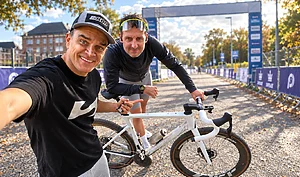
He didn’t start cycling until he was an adult. A decade later, Hugo Foulon has made cycling a major part of his life. A fixed-gear world champion, an international gravel racer, a Cinelli athlete, and now one of the four men behind the Gravel Crit Series, he belongs to a generation that navigates the worlds of competition, cycling culture, and new formats. His Cinelli King Zydeco II perfectly encapsulates this journey: a 7.9-kg gravel bike priced at 12,000 euros, equipped with Dura-Ace Di2, with one idea driving nearly every choice: to ride fast. Very fast.
By Jeff Tatard – © Photos: Hugo Foulon / Tanguy Gall / Tristan Hobson
“I’m a racer.” That’s it. Hugo Foulon has probably just summed up his Bike Check in four words. For him, gravel isn’t necessarily synonymous with huge tires, tiny gear ratios, or contemplative adventure. It’s first and foremost a racing discipline.
A 52/36 chainring, an 11-32 cassette, a 38 cm handlebar, Fulcrum Sharq wheels, and a Dura-Ace Di2 groupset: his Cinelli is almost a road bike that’s decided asphalt just isn’t enough anymore.
And when asked what he loves most about cycling, his answer fits into two words: “Riding fast.” Welcome to 3bikes’ Bike Check #004.
What? What kind of bike do you have?
A 2026 Cinelli King Zydeco II, size Large, built for competition.
Hugo has been riding this model for two years, with different color schemes depending on the sponsorship deals. Cinelli has also made him one of its official athletes and features him alongside the King Zydeco in its presentation of its riders.
His setup is decidedly unconventional at a time when single-chainring setups dominate much of gravel racing: Shimano Dura-Ace Di2, a 52/36 double chainring, and an 11-32 cassette. The cranks measure 170 mm.
The wheels are Fulcrum Sharq, paired with different sizes of Kenda Crusher tires: 45 mm in the rear and 50 mm in the front, inflated to 1.9 and 1.6 bar, respectively.
Up front, Hugo chose a Columbus aero cockpit just 38 cm wide, with a 110 mm stem. The Wahoo Speedplay pedals feature built-in power measurement.
The result: 7.9 kg for a build valued at around 12,000 euros. That’s a substantial figure. But above all, it’s a build with no ambiguity: this bike wasn’t built for leisure rides.

Why? Why this bike?
Because after five years of racing at the highest level of gravel racing, Hugo simply believes it’s the best gravel bike he’s ever ridden.
He knows the King Zydeco particularly well. Two seasons on the same model have allowed him to test it in different setups and on a wide variety of terrain.
His verdict always comes down to the same three factors: reliability, comfort, and performance. “It’s the best bike in the Cinelli lineup. Comfortable, lightweight, and responsive.”
The logic behind his build is therefore much less romantic than David Hamou’s in our previous Bike Check. Hugo didn’t start with the color or a whim.
He started with a question: What will allow me to perform well in races? And the word “race” is important. Hugo doesn’t use his gravel bike just to rack up kilometers. For several years now, he’s been competing in international events, and as early as 2023, Cinelli documented his participation in the Gralloch, a round of the UCI Gravel World Series, where he described himself as a true road racer, drawn to fast courses rather than very steep climbs.

Three years later, his bike has become an extension of that identity. A gravel bike for a road racer.
How? How did you build it?
This is probably where this Bike Check gets the most interesting. Because Hugo went against the current trend.
He used to ride with a SRAM single-chainring drivetrain. He’s gone back to a double chainring with Shimano. “It’s a little more complex to manage, but I have a much wider range of gear options.”
And when you look at the numbers, you immediately understand why: 52/36 up front, 11-32 in the rear. Those are almost road bike gear ratios. Hugo’s perfectly comfortable with that. “I’m a road rider and I tend to compete in fast-paced races. The Dura-Ace is light and responsive, which lets me ride fast on flat sections and slight uphill gradients.”
The choice of cockpit follows exactly the same philosophy. 38 cm wide, 110 mm long: a position that prioritizes aerodynamics and efficiency over mountain-bike-style control.
His favorite component? The aero cockpit. The Fulcrum Sharq and Kenda Crusher tires, meanwhile, address another obsession: maintaining performance without sacrificing reliability. And Hugo has also taken on a small personal mission regarding his tires: to introduce people to Kenda, a brand he feels is still not sufficiently associated with top-tier gravel cycling. “The efficiency is incredible, as is the puncture resistance. And I want to introduce a brand that, at first glance, isn’t necessarily the one people think of when they’re looking for a high-end gravel tire. ” 45 mm in the rear. 50 in the front. A choice that maintains efficiency in the rear while gaining grip and shock absorption in the front. It’s all about balance. Or rather, for Hugo: balance at high speeds.

So what? How does it perform out on the trail?
“It’s a blast.” We could almost end the review right here. On fast-rolling gravel, the King Zydeco II delivers exactly what Hugo wants from it: to pick up speed and keep it.
On the road? “A blast. It rides like an aero road bike.” ” On more technical sections, the answer becomes more nuanced. The bike remains capable, but it’s the setup Hugo chose that starts to show its limitations. On very steep sections or those that are downright rough—like mountain bike trails—you have to be more careful with the bike and choose your lines wisely.
And that’s important: Hugo doesn’t claim to have built the universal gravel bike. He built his own gravel bike—one that matches his riding style and the races he chooses.
He sums it up in three words: reliability, comfort, and efficiency. Its greatest strength? Its versatility. Its main flaw? Tire clearance limited to a maximum of 50 mm. It’s almost amusing: after David Hamou and his 45 mm rear tire, here’s yet another rider who’d like to push the limits a bit further. Even among those who prioritize speed above all else, modern gravel bikes are trending toward larger tire volumes.
Hugo gives it an 8 out of 10, with the two missing points stemming mainly from that tire clearance limit. But when asked how it feels when he really goes for it, two other words come to mind: “Responsiveness and sturdiness.”
And coming from a man who won the 2022 Fixed42—the unofficial fixed-gear world championship held in Berlin—the concept of speed isn’t exactly theoretical.
His most spectacular demonstration, in fact, is quite recent.
In late August, Hugo lined up for the Balaton Gravel Derby, whose long course covers about 370 km around Lake Balaton in Hungary, with some 4,000 meters of elevation gain.
Hugo tells us he won it with a lead of over an hour, averaging nearly 29 km/h, and—perhaps an even more interesting detail for a Bike Check—without a single mechanical issue.
370 kilometers. Nearly 29 km/h. On gravel. With a 52/36 gear ratio. Suddenly, the setup becomes much easier to understand. It’s much better this way: all the real-world testing is consolidated in one place, and the Balaton serves as the ultimate proof of everything we’ve just discussed about the bike.

Will someone steal it from you tomorrow? Will you buy an exact replacement?
His answer starts with a laugh. “I’ll ask for another one, hehe.” Of course: it’s a sponsored bike. So we press him. This time, with his own money. Yes. Without hesitation. “It’s the best gravel bike I’ve had since I started racing at the highest level five years ago.”
And that answer might be more revealing than any spec sheet. Because Hugo isn’t confined to a single cycling world. He’s raced on fixed-gear bikes, gravel bikes, and road bikes. He’s ridden different bikes, tested different drivetrains, and evolved his setup. And yet, if he had to start over tomorrow, he’d choose the same frame. Not necessarily because it’s perfect.
But because, in his eyes, today, its strengths outweigh its limitations.
Hugo’s Bike Check
Hugo’s take: “It’s a blast.” Hugo gives it an 8/10, mainly because he’d like the tire clearance to be even more generous. What does he love about it? Its ability to ride fast, anywhere, and for a long time. What annoys him? Mechanics in general more than his Cinelli in particular. And unlike David Hamou in our #003, there’s no question of looking elsewhere here: if he had to do it all over again tomorrow, Hugo would choose the same one. |
Same concept. A different bike.
One bike. Four photos. Four questions. Four answers. Bike Check, the 3bikes series that’s less interested in what a brand says about a bike than in the reasons why its owner chose to ride it.
=> Learn all about the Cinelli lineup
=> And here, if you want to check out all our other Bike Checks: All Our Bike Checks
Share the post "Bike Check #004 | Hugo Foulon: Built to Ride Fast"