Share the post "Peloton Café: In Viana, a Different Way to Ride Together"
By Jeff Tatard – © Photos: Jeff Tatard & Peloton Café & Cycling
It all began, however, far from here—with a cup of coffee discovered in 2017, followed by a much more life-altering decision: to leave a settled life in Andorra and return to Viana, Márcio’s hometown, to open the first cycling café there. More than two years after opening, the outcome leaves him with a feeling he himself describes as “bittersweet.” Foreign visitors immediately get the vibe of the place, get excited about it, and sometimes even come back just to say thank you. The local crowd, however, remains hard to win over. So the question arises: how can you get people to embrace a new idea without giving up what makes it unique?

To understand what’s happening at Peloton, you might want to observe a Sunday morning. Cyclists arrive separately in front of the café. A few hours later, they return together. They’ve shared a route, a climb, sometimes a tough moment, and then their impressions over a cup of coffee. They were customers, visitors, or simply strangers. They’re already starting to look like a group. Because behind the cycling café, the rides, and the carefully selected beans lies a broader promise: to no longer ride alone.

We met before I knew about his café
To describe Peloton Café, I could start with its facade on Rua do Poço, in the historic center of Viana do Castelo. With the black-and-yellow sign. With the bike parked in front of the entrance, almost like a period. With the water bottles lined up, the clothing in the café’s colors, the cycling magazines, or the mugs where the Giro and the Vuelta meet specialty coffee. That would make sense. But it wouldn’t quite do justice to the story, because I met Márcio before I knew about his café.
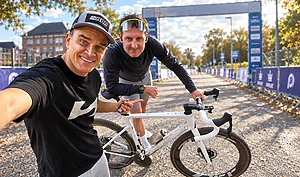
It was a Sunday morning, on a bike. Olavo, my cousin, had put us on the same route. We rode together and shared a steady climb—the kind that gives you time to talk between breaths without completely interrupting the effort. At that point, I didn’t really know the world that Márcio and Soraya had built. I’d simply met a local cyclist who could show me his region without acting like a guide, who could share his route without giving the impression that he owned it.
The next day, I walked into Le Peloton with my family. And looking back, the order of events already says a lot. Before discovering the concept, I had encountered the spirit behind it. Before seeing the bikes in the café, I had ridden with the man who had brought them there. For some, cycling is a decorative element added to a place to give it an identity. For Márcio, it was there before the walls, before the sign, and even before the project.
When asked if the spirit of Le Peloton begins on the road, his answer is almost self-evident: “Yes, the spirit of Le Peloton is exactly that: a relaxed, open-minded place.” ” Just a few words. Yet everything is already there. A place where you can show up with your skill level, your bike, your accent, your habits, or your lack of knowledge about specialty coffee. A place where what we share matters more than what might divide us.

In the beginning, there was Soraya
It would be easy to tell this story by starting with Márcio—the cyclist, the man who returned to his hometown, the one who accompanied me on the roads of Minho and who speaks of the Peloton as a natural extension of his passion. That would be simpler. It would also be incomplete. Because when asked where the idea came from, Márcio doesn’t try to take credit for it. He starts by mentioning Soraya Borlido, his partner.
“The creation of Peloton Café was my partner Soraya’s idea. She’s the one who introduced me to specialty coffee. Cycling, on the other hand, was already a passion that was part of our lives. We brought these two worlds together, just as has already been done in countries like Belgium.”
Coffee entered their lives in 2017. Not as a new drink, of course, but as a discovery. A first cup of specialty coffee, followed by flavors that were nothing like what they thought they knew. Then came the reading, the training, the tasting sessions, the workshops, and visits to international trade shows. The most genuine projects don’t always stem from a brilliant idea. Sometimes they begin with the sudden realization that you knew almost nothing about something you thought you understood.
In countries like Belgium, the connection between cycling culture and coffee culture is long-standing, almost second nature. In Viana do Castelo, however, a space for it still had to be created. Soraya may have introduced specialty coffee into Márcio’s life. Together, they decided to give it a home.

Leaving Andorra to Return Home
An idea becomes serious when it starts to cost something. Time, money, comfort, or a sense of security. For Márcio, the Peloton was never a spur-of-the-moment decision made one evening between conversations. He had to weigh what this project truly required: leaving his life in Andorra and moving back to his hometown.
“It was an idea that had been maturing for a long time, not a spur-of-the-moment decision. It meant giving up my life in Andorra to return to Viana do Castelo. We also chose this city because I think it has enormous potential and there’s still a lot to be developed there.”
Viana do Castelo and the Minho region seem tailor-made for a cyclists’ café. The flat terrain is perfect for those who want to ride for long stretches. The climbs begin without the need to organize an expedition. The Serra d’Arga offers one of the rides that Márcio considers a must. And if you venture further toward the Peneda-Gerês National Park, the choices become almost overwhelming: superb roads, vast landscapes, and climbs challenging enough to make the coffee stop on the way back all the more worthwhile.
“Viana do Castelo and the Minho region offer the perfect conditions for cycling. We have both flat terrain and climbs. Starting from here, climbing the Serra d’Arga is a must. And if you head into Peneda-Gerês National Park, there are endless possibilities. Everything is magnificent, with challenging climbs.”
Some places market themselves as destinations for cyclists. Le Peloton, however, is already right in the heart of the destination. You can start a ride there, return there, share your experiences, or plan what you’ll explore tomorrow. The café isn’t just a break in a cyclist’s day—it can become both the starting point and the finishing point.

A “cyclist’s café” isn’t just a café with a bike on the wall
The term “cycling café” has become familiar. It’s also appealing enough to sometimes be stripped of its meaning. A few framed photos, an old jersey, a wheel, two posters, and a menu where the drinks are named after famous mountain passes might be enough to create a certain aesthetic. But culture can’t be dictated by furnishings. It doesn’t arise from a decorating strategy.
Márcio offers a much more demanding definition of the term: “For me, a cycling café must become a hub where any cyclist can stop by and immerse themselves in cycling: talk with others, exchange ideas, and forge new friendships.”
The difference between a cycling-themed decor and a cycling culture likely lies in this: in the former, objects tell the story of cycling; in the latter, people continue to write it. At Le Peloton, the bicycles parked out front matter, of course. They signal the place and give its façade that look that every cyclist recognizes immediately. But they aren’t the true indicator of success. A bicycle never proves that a community exists. A new connection, perhaps.
Márcio explains it with a simplicity that precludes any marketing spin: “A true culture is built on the genuine presence of people. You have to walk in with an open mind, take in your surroundings, and show interest in what someone has truly created. Then, the rest comes naturally.”

Coffee couldn’t just be an afterthought
The risk, in a place so strongly associated with cycling, would have been to make coffee a mere afterthought. A decent drink served in a beautiful setting would likely have been enough for many visitors. Not for Márcio and Soraya. Their slogan, “Fuel your ride. Fuel your soul with good coffee,” places both passions on equal footing. You fuel your ride. You also fuel something deeper within. But the contents of the cup must live up to that promise.
“None of this would make any sense without specialty coffee. We work with several micro-roasters, who in turn collaborate with small coffee farms, paying a fair price and cutting out the middlemen. That’s often what lies behind the term ‘direct trade.’”
Le Peloton selects its beans and works with independent roasters. It offers a variety of brews, from espresso to pour-over coffee, as well as artisanal pastries and open-faced sandwiches made with carefully selected ingredients. But consistency doesn’t come from simply offering a wide range of products. It lies in the refusal to ask others to respect the project if the project itself does not begin by respecting those who make coffee possible.

Ride Together, Return Together
Social Rides are the most visible part of the Peloton community. On paper, the concept resembles that of many group rides: a meeting spot, a route, a group, and a few hours of cycling. However, Márcio immediately emphasizes what they are not.
“These rides aren’t just about taking people for a spin. They’re much more than that. What we’re trying to do is build a community.”
At Peloton, we start and finish together. This organizational detail actually encapsulates the entire philosophy. “The idea is to start and finish the ride with the group, precisely so that people can share their impressions and talk about their experiences at the end.”
Setting off together is easy: you just need to set a time. Coming back together, however, requires a certain sense of community. In between, the ride brought out everyone’s differences. Some climbed faster. Others descended better. There were the chatty ones, the quiet ones, those who knew every turn, and those who were discovering everything for the first time. But on the way back, the sporting hierarchy loses some of its importance. Everyone can recount the same ride from a different perspective.
Márcio loves seeing bikes in front of his shop. What owner of a cycling café wouldn’t? Yet when asked what makes him most proud, he immediately looks away. “What truly fulfills us—and the goal of these rides—is to forge new friendships and find new riding buddies.”
That’s probably the most beautiful definition of a business when it becomes a community hub. Customers, of course, continue to pay for their coffee. The business has to stay afloat. But something else is circulating that won’t show up in any cash register or balance sheet: exchanged phone numbers, a proposal for the next ride, someone we’ll be waiting for next Sunday. Revenue keeps the café open. The connections formed explain why it deserves to stay that way.

Changing Habits
It would be tempting to end the story here. The passionate couple, the specialty coffee, the magnificent roads of Minho, the Social Rides, and the visitors who become friends. All the elements of an inspiring story are there. But that would be like photographing a building’s facade: carefully choosing what fits within the frame.
The reality for Márcio and Soraya is more challenging. When asked what the main obstacle has been since opening, the answer has nothing to do with the quality of the coffee, the organization of the rides, or the long workdays. “The biggest challenge is changing people’s habits and helping the locals understand this business model. And yes, I’m definitely talking about both passions: cycling and coffee.”
Creating something new isn’t just about offering something that didn’t exist before. Sometimes you have to teach others to desire what they didn’t yet know to look for. This phase is probably the most thankless. The project exists. Its quality is recognized. Visitors who understand its ethos embrace it immediately. But geographical proximity doesn’t automatically lead to cultural affinity.
On March 28, 2024, Peloton Café & Cycling opened its doors. Two years later, Márcio had envisioned that the place would become a go-to spot for cyclists and anyone who loves the world of coffee. He doesn’t say the dream failed. Nor does he claim it came true exactly as planned. He chooses a taste-related image—almost inevitable when talking about a café—“I have a bittersweet taste in my mouth.”

Those who come from far away sometimes understand things more quickly
The bitter part comes from the local and Portuguese public, whom Márcio doesn’t yet feel are sufficiently committed to the project. The assessment is blunt. It may even be painful when one remembers that he left Andorra specifically to return and build something in his hometown. He believed in Viana do Castelo’s potential. He still does. But believing in a place never guarantees that it will immediately repay the trust you’ve placed in it.
Then comes the sweet part. Foreign visitors walk in, look around, and seem to understand. They discover a place they didn’t necessarily expect to find here. They taste the food, chat, and, very often, take a few seconds before leaving to thank Márcio and Soraya.
“Foreign visitors are delighted and grateful to find a place like this. Every day, we receive compliments before customers leave the restaurant. That gives us the strength to keep going and makes us feel good, because we know we’re creating something worthwhile.”
This recognition doesn’t replace the local roots Márcio dreams of. It helps him hold on in the meantime. All pioneering projects eventually experience this disconnect between their value and the time it takes for their surroundings to recognize it. Being ahead of the curve rarely feels like a head start when you’re still waiting for others to catch up.

The Customer Who Came Back
Among all the memories accumulated since the opening, Márcio doesn’t mention a big party, a spectacular event, or a record-breaking day. He tells the story of a customer who had already left the café. A few minutes later, the man came back. Not because he’d forgotten his phone, his glasses, or his keys. He came back solely to thank Márcio for the flat white he’d just been served.
“A customer had already left the café, and a few minutes later, he came back to thank us for the fantastic flat white we’d made for him.”
Another time, a young woman sat down at Peloton. When she left and Márcio came to clear the table, a message was waiting for him on a napkin: “The best coffee in Portugal… Have a nice day. ” The best coffee in Portugal. Have a nice day. A few words left behind on a piece of paper destined to disappear.
Great ambitions are sometimes sustained by very small gestures. A customer who comes back. A napkin that you probably won’t throw away right away. A phrase that doesn’t pay any bills but restores meaning to the work when the day has been long or the expected support is slow in coming. The Peloton website states that every cup tells a story and that every pedal stroke creates a memory. These two scenes show that the slogan isn’t just a clever catchphrase. Some cups truly leave a story behind.
Márcio sums it up: “I think this kind of moment defines Le Peloton.” ” He’s right. The Peloton is perhaps never more clearly itself than when someone feels the need to leave a mark before moving on.

The Driving Force and the Direction
It’s easy to talk about passion when money isn’t involved. Yet a business venture can’t survive on nothing but meaningful encounters, shared outings, and messages scribbled on napkins. Márcio certainly isn’t trying to perpetuate that romanticized view. He knows that economics isn’t the enemy of the project. It’s the condition for its continuity.
“The economic factor is very important. To be realistic, it’s the driving force that makes all of this possible.”
As for the direction of the project, it remains guided by its original identity. “We opened with a specific goal, and I think it’s important to stay true to what we’ve created.” Márcio would like Le Peloton to become a benchmark. He wants greater recognition, more foot traffic, and stronger local support. But not at the cost of a transformation that would make the place more profitable and less authentic.
The challenge, then, isn’t choosing between loyalty and success. It’s building a success that doesn’t force you to betray the very thing that deserved to succeed in the first place. Many projects fall by the wayside not so much because they fail as because they end up resembling everything they were originally conceived to oppose. Márcio and Soraya are aware of this risk. Their ambition is not to keep Le Peloton frozen in nostalgic stagnation. A living space must evolve. But it must be able to grow without becoming unrecognizable.
When asked what he would never want to lose in five years, Márcio replies immediately: “Identity.” ” Just one word, but probably the most important answer of our entire conversation. In a café filled with signs, colors, bicycles, and objects, identity doesn’t correspond to any of them taken separately. It lies in the coherence among everything else: the chosen café, the way people are welcomed, the connections made, the outings we begin and end together, the fair price paid upfront, and the rejection of prejudice once we step through the door.

So, what is a peloton?
Let’s go back to that Sunday morning. To that shared climb before I even knew about the café. To Márcio on his bike, to the roads of Viana do Castelo, and to that natural way of discovering a region by riding alongside someone. Let’s then return to the façade on Rua do Poço. To the bike parked out front. To my family gathered around the table. To the two passions that Soraya and Márcio decided to bring together. To specialty coffee, to micro-roasters, to small producers, and to this commitment to serving a cup whose story begins long before it arrives in Portugal.
Only then can we revisit the question from the beginning. What is a “cyclist’s café”? A café frequented by cyclists? A décor inspired by cycling? A great spot nestled among beautiful roads? Le Peloton is a little bit of all of that. But its true essence probably lies in its name.
A peloton doesn’t erase differences. It brings together stronger and weaker riders, regulars and beginners, those who talk a lot and those who listen, those who know the road and those who are discovering it. Each person continues to put in their own effort. Yet everyone moves forward differently because the others are there. A peloton isn’t a group of identical people. It’s a group in which differences no longer condemn anyone to being alone.

That’s what Márcio and Soraya are trying to build in Viana do Castelo. Not just a place where cyclists drink good coffee. Not merely a specialty coffee shop steeped in cycling culture. A place where you walk in alone, unsure if you’ll leave exactly the same way. Where the quality of the coffee sometimes sparks a conversation. Where a conversation can lead to a ride. Where a ride can become a habit. And where a habit sometimes ends up becoming a friendship.
Perhaps it will still take some time for the local community to understand the project. Perhaps Le Peloton will have to continue being celebrated more by those who come from afar before being fully embraced by those who live right nearby. Sincere ideas aren’t always rewarded as quickly as they’re conceived. But they have one immense advantage: when they know exactly what they refuse to lose, they can weather doubt without losing their way.
Márcio would like the Peloton to become a benchmark one day. He’s been talking about this goal since the beginning of our conversation. Listening to him, one might think he’s still waiting to achieve it. Yet a French cyclist has already discovered Viana through him. Every day, visitors from abroad express their gratitude for having found this place. A customer retraced his steps just to talk about a flat white. A young woman jotted down a few words on a napkin. And strangers sometimes set out on a ride from in front of the café before returning with something in common.
So perhaps Le Peloton hasn’t yet become the go-to spot that Márcio envisioned. Or perhaps it already is for those who needed it. Because a go-to spot isn’t just one that everyone knows. It’s the one certain people think of when they’re looking for a place to return to.
The day we met, I thought I was simply sharing a climb with a Portuguese cyclist. I didn’t yet know that he and Soraya were trying to accomplish exactly the same thing down the road: to create a place where people could move forward together. The next day, I discovered their café. But the most important part, in the end, had already come to light on the bike.
Le Peloton takes its name from what Márcio and Soraya still dream of bringing to life around them. And perhaps also from what they’ve already begun to create: not just a place to stop, but a reason to set off again together.
=> To discover Peloton Café & Cycling, its café, its Social Rides, and its world: peloton-cafe.com
=> And here, if you’d like to explore all our other profiles: All Our “Portraits” Articles
Share the post "Peloton Café: In Viana, a Different Way to Ride Together"