Share the post "Mathieu Legal: Another Path to Success Through Cycling"
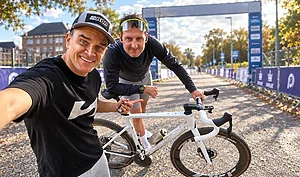
There are cycling stories that are told through a list of achievements. Mathieu Legal’s story could have been one of them. At 18, he was one of the top young riders from the Île-de-France region, ranked among the best French juniors in cyclocross, racing alongside some of those who would go on to turn pro, and he saw himself, without a doubt, one day riding the Tour de France. Then he quit. Almost overnight. And that question could have haunted him his whole life: How far would he have gone if he’d kept going? Thirty years later, however, it seems almost secondary. Because Mathieu has returned to cycling in a different way. For nearly ten years now, at US Maule, he has been supporting, advising, driving, reassuring, sometimes scolding, and crying when “his kids” win. None of them are his sons. Yet he devotes a considerable amount of his time to them and, above all, gives them something that goes far beyond cycling. So another question eventually replaces the first: what if Mathieu Legal had ultimately succeeded in cycling? Just not in the way he’d imagined at age 18.
By Jeff Tatard – © Photos: US MAULE CYCLISME 78 & Mathieu Legal
When the Tour de France Seemed Possible
To understand Mathieu Legal, you have to start by forgetting the man we see today on the sidelines of races. Forget for a moment about US Maule, the club van, the kids, the road trips, and the weekends devoted to others. You have to go back nearly thirty years, to a time when Mathieu wasn’t carrying anyone else’s dreams. The kid we were there for—that was him.

He was part of a particularly talented generation from the Paris region. Médéric Clain, Loïc Lamouller, Lénaïc Olivier, Vincent Alonso, Erwan Lollierou, Jean Christophe Lorgeou… Some of these young riders would go on to compete professionally, while others would become among the best French amateurs. Mathieu wasn’t watching them from the sidelines. He was racing alongside them. “I was pretty good. I was just as good as they were, especially in the cadet category.” The statement is made without arrogance and without that temptation—so common thirty years later—to reconstruct the career one never had. It simply sets the bar.
Cyclocross even became his specialty. Mathieu joined CSM Persan, one of the top teams of the era, and progressed to the point of ranking ninth among French juniors. He was then competing alongside riders like Miguel Martinez. At that age, Martinez wasn’t yet the Olympic champion that everyone would come to know a few years later. He was first and foremost a fellow rider of his generation, a rival Mathieu would face on the circuits. So when I ask him how far he thought he could go, his answer doesn’t try to sound reasonable with the benefit of thirty years’ hindsight. “I was hoping to make it big, though. Back then, when I stopped racing in my first year as a junior, I saw myself riding the Tour de France.” The Tour de France. Not just a few good years as an amateur. Not just the first category. At 18, Mathieu envisioned the pinnacle. And that’s important for understanding what came next, because his entire story may hinge on that initial definition of success: when you’re a kid who’s really good on a bike, success naturally means going faster, higher, and farther than everyone else.

Jersey No. 5
There are memories that, on their own, sum up the fragility of a sporting career. Mathieu has one that makes him smile today, but which must have been far less amusing at the time. Back then, the various national cyclocross races established a pecking order among juniors and, in particular, determined the bib numbers assigned for the French National Championships. Mathieu arrived at the French Nationals with bib number 5.
The number alone almost tells the whole story. This wasn’t just a teenager dreaming bigger than his legs could handle. Mathieu was right there, among the top contenders. But on race day, a mix-up regarding the start time threw everything into disarray. He was still scouting the course, all the way at the bottom, when he heard them start calling out the bib numbers.
He immediately realizes what’s happening and sprints back up the course. “I got to the starting line—my heart rate was at 200.” Even before the race began, he’d likely just put in one of the most intense efforts of his day. His bib number was supposed to let him start at the front; but his legs had already paid part of the price. “I kind of messed that up. It’s a regret, sure, but hey, it was my mistake.” What stands out when he recounts this episode is the absence of an excuse. Mathieu isn’t looking for whoever might have given him the wrong information. He doesn’t turn this French Championship into a victory that history supposedly stole from him. He simply says he messed something up and that he bears his share of the responsibility.
Nearly thirty years later, the man who now plans young riders’ trips several weeks in advance probably knows better than most that a sports career can sometimes hinge on incredibly ordinary things: a misunderstanding about a time, poor preparation, a decision made too quickly. Or something you discover and can no longer accept.
The Day He Said “Enough”
Mathieu was barely of legal age when his story took a far more significant turn. His first year as an U23 rider. A French Cyclocross Championship. The kind of event that should normally mark another step forward in a career that’s beginning to take shape. But something snapped. Mathieu remains deliberately cautious when recounting how he felt that day. He doesn’t name names, doesn’t generalize, and certainly doesn’t claim that everyone who has succeeded has taken the paths that troubled him. He simply recounts his experience, his perspective as an 18-year-old, and the sudden disconnect between his idea of cycling and certain realities he felt he was discovering at the time. “I saw things in the cycling world that I didn’t really agree with. That’s what made me quit.”
On the way home, he turned to his father and told him his decision: “I’m quitting cycling.” ” He was barely 18 years old. Just a few months earlier, he still saw himself riding in the Tour de France. He was among the top French junior cyclocross riders and raced alongside boys who would go on to continue their rise to the top. And suddenly, he called it quits.
Looking back, however, Mathieu refuses to rewrite history. He doesn’t claim that he would necessarily have turned pro. “Realistically, there’s no way to know if I really would have made it. Of course, deep down, you feel a bit envious. You think to yourself: ‘They made it—why not you?’” That’s probably the most accurate answer. No bitterness, no feigned indifference. There’s inevitably that question familiar to anyone who’s ever turned off a path before knowing where it led: what if? What if I’d kept going? What if I’d made a different choice? What if I’d gone as far as they did? No one will ever be able to answer that. But thirty years later, maybe that’s not even the right question anymore.

What His Father Had Taught Him
When Mathieu put his ambitions on hold, he certainly didn’t imagine that he’d one day spend his weekends accompanying teenagers on races. A new chapter begins. Yet cycling never truly disappears. And when he finally returns through a different door—in late 2017 and early 2018—the path he chooses bears a striking resemblance to the one another man had shown him long ago.
His father. For some thirty years, Mathieu’s father volunteered in the world of cycling. First with his own sons, Mathieu and Jérôme—the latter also reaching a very high level. But not just them. “My dad—he drove around a lot of kids who weren’t even his own.” Training sessions, races, packed cars, weekends devoted to other people’s children. Mathieu grew up watching all this without necessarily imagining that one day he’d follow in his footsteps exactly.

His father passed away eighteen years ago. Mathieu doesn’t present his commitment as a conscious tribute. Yet, when you listen to him, the connection becomes clear. Some parents pass things on less through what they say than through what their children have watched them do for twenty years.
When Mathieu, in turn, decided to get involved, choosing Maule was instinctive. “Maule will always be my town. ” He grew up there. He went to school there. His mother lived there. A significant part of his history is rooted there. So he returns. And almost without realizing it, the boy his father used to take to the races becomes the one behind the wheel.
More of a mentor than a coach
Mathieu is quick to clarify something important: he doesn’t really consider himself a coach. He doesn’t try to pretend to have scientific expertise he doesn’t possess and very frankly acknowledges his limitations when it comes to physiology, analysis, or modern training methods. Watts, zones, and power curves aren’t his natural language.
Some young riders, however, ask him for training plans. He then suggests workouts based on his own experience: a few rides during the week, sprints, and exercises he knows and used to do himself. But the essence of what he wants to pass on can’t be captured in a training plan.

Mathieu talks about behavior. About respect. About how you represent your club when you wear a jersey. About what you do and what you don’t do. Above all, he talks about values. “My goal and my desire are to instill good values.”
One day, a parent came to thank him. Not for a victory. Not for a spot on the team. Not because his son was now riding faster. For something else. “He told me: ‘What you’re doing for the kids is great. But I have my son, and he’s become a man thanks to you. He hasn’t just become an athlete—he’s become a man.” Those words stuck with him. Because they probably convey better than any result what Mathieu has been trying to do for nearly ten years. Helping a runner improve is one thing. Helping shape a teenager is another. And Mathieu knows this special role well. He’s been on the other side himself.
What You Don’t Tell Your Parents
When he was young, certain coaches played a profound role in shaping him. Mathieu mentions Jean-Pierre Fraoli in particular, with whom he still maintains a close bond decades later. They continue to see each other and have meals together, even though the races that brought them together are long gone. “He taught me how to ride a bike. But he also taught me a lot about myself.” Then Mathieu adds something much more important: “I told him things I didn’t tell my parents.”
This is perhaps the most accurate definition of the role he plays today with his own young riders. At fifteen or sixteen, the coach is neither a father, nor a teacher, nor really a friend. Yet he can become a little bit of all of those things. He sees the teenager when he wins, when he loses, when he doubts himself, when he’s tired, or when he’s bursting with joy. He spends hours with him in a car. And sometimes, their conversations go far beyond cycling.
These days, Mathieu’s kids talk to him about school, their personal problems, and sometimes even their love lives. “They tell me things they wouldn’t necessarily tell their parents. ” Of course, he isn’t replacing anyone. He simply becomes that outside adult to whom certain things are sometimes easier to confide.
This role takes on even greater meaning when Mathieu talks about the social differences among the young people. Some come from very affluent families; others, not so much. These are backgrounds that might never have crossed paths elsewhere. But behind the same jersey, the hierarchy changes. “No matter what social class you’re from, when you’re on a bike, we’re all the same.” Cycling obviously doesn’t erase all differences. But for a few hours, it can create a space where those differences matter less.
Those in whom you see something special
Mathieu is, after all, a competitor. And when asked if he can quickly spot a kid who has “something,” examples come to mind immediately. Robin Segala, for starters. When he first arrived in Maule, Robin was mostly familiar with mountain biking. Road cycling was still largely uncharted territory for him. His physique, on the other hand, didn’t exactly go unnoticed: about 1.85 m tall and 75 kilos. Mathieu sums it up: “He’s a machine.”

Results follow very quickly: victories, podium finishes, and impressive progress—even though the young rider still has very little road racing experience. Mathieu takes him to compete in higher-level races and observes something he hasn’t often seen in his time as a coach. “Honestly, he’s the kid who’s impressed me the most in eight years.”
Then there’s Matéo Brito Fernandes. One day, Matéo came to see Mathieu with a simple hunch: “Mathieu, I feel like I’m training the wrong way.” ” Mathieu puts together a few training sessions for him—three outings a week, sprints, drills—but begins by telling him something that sums up his coaching style quite well: “I can’t promise you’ll be the French champion.”
Matéo makes progress. He wins. He ends up being selected for a French Championship. Others came before or after them: Arthur Levasseur, the Marchand brothers, and several boys whose skill level suggested a bright future.
Some continue. Some move on to higher-level programs. Others quit. Because at 17 or 18, life begins at exactly the same time as a sports career. A chance encounter, school, a different passion—and the path can change as quickly as a race. Mathieu knows this all too well.
First, let them fall in love with cycling
That’s probably why he refuses to immediately turn every talented kid into a future pro. Modern cycling, however, pushes for performance at an increasingly early age. Teams scout juniors, sometimes even in the lower age groups. Young riders know about watts, nutrition, recovery, and concepts that many adult riders didn’t even know existed twenty years ago.

Mathieu watches all this with interest but also with the detachment of someone from a different era—a time when nutritional preparation sometimes took a slightly different form. “Before a race, I’d sometimes go grab a double cheeseburger. My dad was furious!”
Today, some U17s could probably explain to him exactly how many grams of carbs he should have eaten instead. But Mathieu remains convinced of one thing: before learning how to optimize a passion, you have to first take the time to love it.
So, even with the most promising young athletes, his message remains simple: “The main thing is that they have fun.” To Robin, he repeats: “You’ve got time. Enjoy yourself. I’ll take you to some great races, we’ll go on trips, you’ll ride with friends. Discover it first.” Discover it first. Two almost mundane words that take on a whole new meaning in a sport where teenagers are sometimes expected to already know what they want to become.
Nicodem and the Victories Nobody Counts
Not all the young athletes who make an impression on Mathieu, however, are the ones whose potential is immediately obvious. He mentions Nicodem Cornu, for example. Nicodem has made significant athletic progress. But when Mathieu tells his story, it’s not his skill level that he highlights. “His demeanor, how he’s blossomed… He used to be someone who didn’t dare speak up. Today, he’s becoming a man.” Again. Becoming a man. The phrase comes up so often in our conversation that it eventually becomes the true thread running through the story.
Nicodem may never become a champion. So what? Perhaps the problem with sports is that we’ve gotten into the habit of recognizing only the progress that can be measured. A place. A second. A watt. A title. But how do you measure the confidence a teenager has gained? His ability to speak up? To get along with others? To accept losing? To understand that he may be less strong than his teammate without being any less valuable?
Years later, Mathieu sees some of the answers. His first group of kids are now 21 or 22 years old. A few of them still call him, catch up with him, and sometimes share things with him that they still don’t tell everyone else. Cycling isn’t even necessarily the focus of the conversation anymore. And it’s probably at that moment that you realize something more important than just a training session took place.

Staying with the pack
Above all, there’s one quote from Mathieu that sums up almost everything. A quote that might even be worth posting in some cycling schools. “A kid who’s never kept up with the pack—when he does it for the first time, that’s an achievement.” That says it all.
We’ve come to associate performance so closely with victory that we sometimes forget it simply means succeeding today at something we were incapable of doing yesterday. For Robin, performance might mean winning. For someone else, it might mean finishing a National race. For a third person, it might simply mean not giving up after ten kilometers. And all three deserve to have their achievements recognized. “When a kid goes to run a national race—even though it’s already tough for him in the Île-de-France region—and he pulls it off, that’s a performance. And you have to tell him ‘well done.’”
Mathieu doesn’t try to make all his riders believe they’re at the same level. The kids aren’t stupid. They know very well who’s the strongest. They know who can win and who’s probably going to suffer all day. But they can still be part of the same team. A team of riders, of course. And above all, Mathieu insists, a team of friends.
He’s sometimes taken in boys who couldn’t stand each other and watched them learn to race together. With Arthur Levasseur and the Marchand brothers, this dynamic even led to a regional team title—a title Mathieu himself had won when he was young. That day, he cried. “I cry when my kids win. They manage to make me cry.” The 18-year-old competitor is, after all, never far away. It’s just that it’s no longer his own victories that make him cry.

While They Sleep
On Sundays, we see the riders. The jerseys. The bikes. The start. An hour and a half later, the results. What we see much less of is everything that happened before. For Mathieu, a trip sometimes begins a month or a month and a half earlier. He has to find a place to stay, pick up the club’s vehicle, get it ready, clean it, schedule appointments, pick up the young riders, load the bikes, plan a reconnaissance of the course, and anticipate everything that can be anticipated. He very rarely stays in hotels. “At a hotel, everyone is in their own room. ” So, in about 95% of cases, Mathieu prefers to rent a house or an Airbnb. Not just to sleep. Because he believes the trip itself is part of the learning experience. We eat together. We talk. We laugh. We learn to live with others.
The day before the race, the kids scout the course. Then morning comes. They’re still asleep. Mathieu gets up. He makes breakfast. He starts loading the car. He checks that everything is ready so that all they have to do is focus on their race. “The main thing is that they arrive relaxed.” The image is probably one of the most powerful in his entire story. A man in the kitchen of a rented house somewhere in France, early in the morning, while other people’s children are still asleep upstairs.
A few hours later, maybe one of them will win. Maybe another will simply manage to stay with the pack. And no one will realize that their day began even before they woke up.

“Thanks? You know what I think of those.”
The kids thank Mathieu. Often. But he doesn’t care much for thanks. “Thanks? You know what I think of them.” What he wants in return is actually much simpler: for them to have fun—and to give it their all. Not that they win every time. Not that they have to earn every kilometer run with a podium finish. Simply that they respect the team effort by doing their very best.
Mathieu, in fact, can be much less forgiving when that’s not the case. For him, kindness has never meant telling teenagers that everything is great no matter what they do. When a race goes well, he offers praise. When it’s a bad one, he’s not afraid to say so. And sometimes very clearly. “Today, you guys screwed up. What you did today was crap.”
At least no one goes home wondering what Mathieu thought of the race. This candor is also part of the relationship. Because respecting a kid isn’t just about encouraging him. It’s also about recognizing that he’s smart enough to know when he’s made a mistake.
Sharing what you’ve gotten wrong
His own past inevitably comes to mind in moments like these. Mathieu sometimes reminds his young riders that before he was the one giving instructions from the side of the road, he was exactly where they are now. A cadet. A junior. Among the best. With the same ambitions, the same impatience, and probably the same certainties.
His experience serves him just as much through what he’s achieved as through what he’s missed out on. “It’s important… the things we might have missed out on and trying to make up for them through them.” ” The statement could be misunderstood. Mathieu isn’t trying to live vicariously through the career he never had. On the contrary. When a young rider shows great promise, he tells him to take his time. He isn’t trying to make up for his past with their legs. Instead, he tries to protect their future with his experience. The man who dreamed of the Tour at age 18 knows what it means to want to go very fast. The man who gave it all up at the same age also knows that nothing is set in stone. So he passes on both: ambition and the possibility of remaining free.

None of them is his son
Then comes a detail, near the end of our conversation. One of those that slightly changes the way we view everything that came before. Parents sometimes ask Mathieu which of the kids is his son. The question seems logical. After all, why would a man devote so many weekends to driving teenagers across France if he didn’t have his own child somewhere in the group? The answer is simple. None. Mathieu has a 29-year-old daughter and a 26-year-old son. Neither of them has ever ridden a bike.
Suddenly, the hours take on a different significance. The early mornings. The trips. The booked accommodations. The breakfasts. The vehicles getting ready. Loaded bikes. Rainy Sundays. None of this has ever been an indirect result of his own child’s passion. A parent once pointed out to him: “Not a single one of them is your own kid. I’d never do what you do, Mathieu.” ” There’s nothing extraordinary about that statement. That’s precisely why it strikes a chord. None of them are his children. Yet, from the very beginning of our conversation, Mathieu has been calling them “my kids.”
The One Who Hates Bikes
There’s still one person we haven’t talked about, though. At the end of our conversation, I ask Mathieu what I’ve forgotten. The question I hadn’t asked. The one that sometimes reveals what the interviewee truly considers essential. Mathieu could have brought up his father. His career. A kid. Instead, he talks about his wife.
They’ve been sharing their lives for thirty years. And in a story almost entirely dominated by cycling, she has one rather remarkable trait: she hates cycling.
She almost never comes to the races. That world isn’t hers. Yet, all these years, she’s accepted that Mathieu devotes a considerable amount of time to it.
Whole Sundays. Early departures. Late returns. And entire weekends when the kids head off to race farther away. “My wife has never told me to stop. I’ve never gotten any complaints, never had any arguments about it.” ” Then he laughs: “She’s a great woman—you just don’t see her around because she hates cycling. She hates cycling!” And right after the joke comes the important line: “Thanks to her, because without her, I wouldn’t have been able to do this either.”

That’s also something we sometimes forget when we think of volunteers who give so much of their time. There’s often someone on the other side who accepts that a part of that time will never belong to them.
So, Mathieu, did you make it big in cycling?
Let’s go back to the boy from the beginning. 18 years old. Among the best French junior cyclocross riders. Wearing bib number 5 at the French Championships. Boys around him who would go on to reach the highest level. And this certainty: “I saw myself riding the Tour de France.”
Now let’s imagine that the Mathieu of today could sit down next to him for five minutes. The young man would probably ask the questions in the wrong order. So? Did we make it? Did we turn pro? Did we ride the Tour? The answer would start with “no.” Then we’d have to explain. Talk about Robin. Matéo. Nikodem. Arthur. The Marchand brothers. All the others whose names will never appear in this article. The kid who didn’t dare speak up. The one who finally kept up with the pack. The one who moved on to a higher-level team. The one who quit but still calls years later. The one whose father came by one day to say: “Thanks to you, he didn’t just become an athlete—he became a man.”
We should talk about the rented houses rather than the hotels. The breakfasts prepared while everyone else was asleep. The loaded bikes. Sundays. The arguments. The tears when one of “his kids” wins. We should talk about his father, who, long before him, was already driving other people’s kids around. And about his wife, who hates cycling but has allowed him all these years to love other people’s cycling just as much. Only then could we ask the right question. So, Mathieu, have you succeeded in cycling? “Yes… in a way, I’m proud.” At 18, Mathieu Legal probably thought that succeeding in cycling meant getting somewhere before everyone else. Thirty years later, his definition has changed.

Sometimes, success means staying behind. Loading the car while someone else rests. Making breakfast while they sleep. Waiting by the side of the road. Cheering for a victory that will never bear your name. Seeing it as an achievement simply because a kid who’d never kept up with a pack finally managed to stay on their wheels.
And sometimes, success also means watching the best move on to other things. Because that was precisely the goal. Mathieu Legal has never ridden the Tour de France. But for nearly ten years now, he’s been helping kids cover a distance that’s probably much greater: the one that separates the children they once were from the adults they’re beginning to become. So perhaps the real question was never how far Mathieu could have gone. Perhaps we simply needed to look at how many young people have gone a little further thanks to him. At 18, he wanted to become a cyclist. He became the one cyclists remember. And in the end, perhaps young Mathieu had gotten the essentials right. He was indeed going to succeed in cycling. He’d just picked the wrong finish line.
=> And here, if you’d like to explore all our other profiles: All Our “Portraits” Articles
Share the post "Mathieu Legal: Another Path to Success Through Cycling"