Share the post "Lise Ménage: from cycling to doubt, then back to the top"
Some portraits begin with a victory, a line on a palmarès, or a tricolor jersey. That of Lise Ménage began around a table, a few hours before the Crito’Star in Choisy-le-Roi. We were having lunch together when a young woman appeared, quite different from the image one spontaneously forms of a cycling champion: brilliant, curious, interested in others, capable of talking about cycling without giving the impression that cycling was her whole world. Then I learned that she was studying at Sciences Po and I better understood this almost instinctive way of looking elsewhere, of questioning, of wanting to learn. A few hours later, she won the Crito’Star with Baptiste Veistroffer, but it’s almost not that victory she remembers today. A few weeks later, forty-five minutes of phone conversation further illuminated the person: behind the two-time French Espoirs champion, the former professional with Cofidis, and the junior international, hides above all a young woman who had to learn very early on that success does not prevent one from getting lost. A young woman who romanticizes neither high-level sport, nor depression, nor the comeback. And above all, a cyclist who, when asked why she rides, answers neither « to win » nor « to perform ». She answers differently. She defines herself as an explorer.
By Jeff Tatard – © Photos: @lisenmenage & GUIGUI PHOTOGRAPHE
IT ALL STARTED AROUND A TABLE
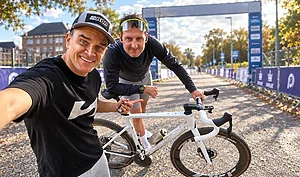
There are encounters one quickly forgets, and then there are those where, without knowing exactly why, something immediately catches your attention. With Lise Ménage, it happened even before she got on her bike at the Crito’Star in Choisy-le-Roi. Éric Ramos had once again brought together this very special small world where former champions, professionals, young talents, and enthusiasts come to give back to cycling something that high-level competition sometimes takes away: proximity. Lise was paired with Baptiste Veistroffer, fresh from the Tour de France. The duo would win a few hours later. In hindsight, one might even wonder if Éric Ramos’s choice was truly a coincidence: two young racers capable of performing, certainly, but above all two personalities much broader than their simple status as cyclists.

Yet it wasn’t their victory that gave birth to the idea for this portrait. It was the lunch. Lise spoke, but above all, she listened. She asked questions. She seemed genuinely interested in what was happening around her. Interesting, yes. But above all, interested. In a high-level athlete, often confined very early on to the training-race-recovery routine, such curiosity stands out. Then came this detail: Sciences Po. Suddenly, something clicked. This young woman didn’t seem built to live in a world comprising only watts, gels, hotels, and neutral starts. She needed something else. To learn. To understand. To explore. That day, without yet knowing it, the portrait had already begun.
A few weeks later, I ask her to close her eyes and mentally return to the Crito’Star. What comes back first? Not the finish line. Not the victory with Baptiste. Not the spectacle of the dernys. The children. « I think the thing that struck me the most was all the children who came to see us, who asked for photos, autographs, who were super happy to be there. Even those who rode with us. That’s kind of the goal of this type of criterium: to please children who dream of cycling. » This memory already says a lot. The champion won, but what remains a few weeks later are not her own legs. It’s the eyes of those who watched.
Lise deeply loves this kind of event for this reason. She doesn’t try to invent a sporting importance for it that it doesn’t have. « It’s not the performance that’s important. It’s more about showcasing riders who were important in the Tour, people with distinctive jerseys, champions… We, the riders, come to small towns that aren’t necessarily used to having this kind of race. Anyone can come into the street, watch, get interested. I think that’s really cool. It’s a cycling celebration. » The Crito’Star brings champions down to a child’s level. Perhaps that’s precisely why Lise belonged there.

THE LITTLE PINK MOUNTAIN BIKE
To understand Lise Ménage, one must then go back a long way. Not to a victory. Not to a national talent scouting event. Even less to a professional team. One must go back to a little pink mountain bike, probably bought in a supermarket, and to a six or seven-year-old girl arriving at a velodrome.
Her father rode. In the family, cycling was part of the scenery. Yet, no one needed to convince Lise. « I always wanted to do that. I said: no, no, I want to cycle. » During her first club session, she discovered a track and this slope which, at a child’s height, seemed almost vertical. So she climbed. Again. Always higher. To the top of the banking. Then came the problem: she no longer knew how to get down. « I had climbed all the way to the top of the track with my little pink mountain bike and I didn’t know what to do anymore. Someone had to come and help me get down. »
The anecdote would bring a smile to any portrait. Here, it will almost become a metaphor. Because the rest of Lise’s life would strangely resemble this first scene: climbing very fast, sometimes higher than expected, then having to learn to descend without breaking. But at the time, of course, no one knew any of this yet. Moreover, Lise is not an early phenomenon. She insists on clarifying this. « I was really very bad at the beginning. I finished last in almost all my cycling school races. Sometimes, I was even a lap behind. »
This disrupts the classic narrative of the champion. We always like to explain that there were signs, that the child was already winning everything, that the talent was obvious. With Lise, talent was not immediately visible. Perhaps because the equipment was mediocre. Perhaps because she was still riding mostly for fun. Perhaps also because her main motivation was not yet competition.
Before cycling became serious, her parents had actually found a nickname: Bulldozer. Lise was a ball of energy. « When I came home from school, I would run around the kitchen table for ten minutes to let off steam. » Later, cycling would simply take the place of the table. She would come home from middle school, get on her bicycle, and go do sprints. Not because a coach had sent her a calibrated session. Not because a file had to turn green. Because it amused her. « For a long time, cycling was mostly an outlet. »
THE DAY HER FATHER STUNG HER TO THE QUICK
The turning point came around twelve or thirteen, with a better bike and especially with a phrase uttered by her father. Until then, Lise trained more but was far from dominant. Then one day, her father told her she wasn’t capable of getting on the podium at the Ille-et-Vilaine championship. She took it badly. Very badly. « That annoyed me. All the previous years, I was really behind. And that year, I set my mind to getting on the podium. I finished third. » That day, pride became fuel. Lise discovered something that would never really leave her: she performs particularly well when her place isn’t guaranteed. When she has to prove herself. When she has to go after something she’s not promised. « When I have to prove I belong, that’s when I go for results. When everyone trusts me and, on paper, I’m supposed to win, I find it more difficult. »
This is fundamental information for understanding her competitive psychology. Lise doesn’t necessarily like to be the hunted. She likes to hunt. The underdog status feeds something that the favorite status sometimes weakens. Later, when she competes as a professional, this relationship with trust and pressure will become even more important.

2022: THE YEAR EVERYTHING HAPPENS
If one wanted to tell her breakdown in a simplistic way, one would start in 2024 or 2025. Lise, however, immediately corrects the chronology. To understand what really happened, one must go back to 2022.
She is then in her final year of high school. The baccalaureate is coming. So are the entrance exams. She is preparing for Sciences Po. At the same time, cycling explodes. French junior national team. World Cups. European Championships. World Championships. Professional teams start calling. Everything a young cyclist can dream of happens at the same time.
« That year, everything happened at once, but only positive things. I had a crazy season, much better than I could have imagined. I finished sixth in the European Championships, I was selected for the World Championships… »
The problem is precisely there: when everything is going well, no one thinks about slowing down. She leaves home early, comes back late, then trains. Some days start at five in the morning to be able to study before classes. « I would leave around 7:30 AM, come back at 6 or 7 PM, and then go train. Sometimes I would get up at 5 AM to study. I had a completely crazy pace of life. »
But the results came in. So the adrenaline masked the rest. She missed classes because she was racing for the French national team. She still succeeded. She moved forward. Always faster. Always higher. Up to the World Championships in Australia, in September 2022.
Then she returned. Massive jet lag. Accumulated fatigue. And almost immediately, higher education. Nancy. A 12-square-meter room. She missed orientation week. Groups were already formed. Everyone knew each other. She arrived alone after experiencing one of the strongest sporting moments of her young life on the other side of the world. And the body presented the bill.
« I WAS A ZOMBIE »
From September to December 2022, Lise went through what she now recognizes as a first real psychological breakdown. At the time, she spoke little. She isolated herself. « I went to class but I was a zombie. I went straight home. Sometimes I ate more, sometimes I ate anything. I really isolated myself. »
In the evening, she scrolled on her phone. For a long time. Too long. She sometimes slept four hours. In the morning, she struggled to get up. Days lost their structure. And above all, she no longer found in cycling what she found there as a child.
Autumn normally arrives with the resumption of training. A two-hour ride remains bearable. Four hours are sometimes enough to break the desire for the next day. « I would ride for four hours, come home, and no longer want to ride the next day. I was annoyed, frustrated that I couldn’t manage to train anymore. »
One must measure the symbolic violence of this shift. Cycling had always been the place where Lise released energy. It suddenly became something that demanded more than she could give.
At that moment, however, she didn’t tell herself she was going to stop. The prospects were still numerous. Professional teams were following her. A career seemed ahead of her. She didn’t dream of giving everything up. She simply wanted to rediscover the desire.

SCIENCES PO, BECAUSE CYCLING IS NOT ENOUGH
Lise nevertheless continued her academic path. Sciences Po accepted certain arrangements to allow reconciliation with high-level sport. She would notably complete her first two years at an adapted pace. But adapting doesn’t erase the demands. « I had more authorized absences than others, but I still had to go to class. They were understanding, but it remained demanding. »
Later, she would go for a year on Erasmus in Gorizia, Italy, a few kilometers from Slovenia. A place where she found a different balance. Beautiful training grounds, but also a university life, a city, things to see. That mattered enormously.
Because for Lise, studies are not just a Plan B. They are a mental necessity. She needs to think about something else. To be stimulated differently. To have conversations that don’t solely revolve around recovery, weight, tactics, or the next trip. Gradually, one understands that this intellectual dimension of her life is not external to her identity as a cyclist. It is part of it.
2023: THE YEAR A MEETING CHANGES THE LIGHT
Then came 2023. Lise almost hesitated before mentioning it. And finally let slip, with a smile one could guess over the phone: « I don’t know if I should say it, but I fell in love. And suddenly, all my problems disappeared. » So yes, it must be said. Because life is not a series of power curves and results. And because at eighteen, falling in love can sometimes alter a balance more profoundly than any training program.
Sportingly, the season wasn’t bad. Lise won, performed well, but felt she was stagnating compared to 2022. She stayed with Breizh Ladies, before joining Cofidis. Contacts already existed. Despite this less spectacular year, the team continued to believe in her. And in 2024, Lise Ménage turned professional.

COFIDIS: THE DREAM AND THE OFF-SCREEN
At nineteen, turning professional seems like the obvious culmination of everything that came before. Yet, Lise doesn’t recount her arrival at Cofidis as a shock. She had already rubbed shoulders with professionals. She knew the codes. She hadn’t idealized the environment to the point of suddenly discovering a totally different reality.
But she insists on one point: a rider’s life seen from Instagram has almost nothing to do with the totality of that life. « If you only look at social media, it gives a very positive image. You see the good moments, the hotels, the races, the fun stuff. But that’s just a few seconds. »
Curiously, it’s not necessarily the race she finds the hardest. A race hurts, obviously. But it also provides adrenaline, the group, the support, the immediate goal. « In races, even when it’s hard or the weather is horrible, you’re in a team. There’s adrenaline. The hardest part is really training alone at home. »
And beyond training, there’s this permanent repetition of competition. « In cycling, we race every weekend, sometimes more. It’s good because it gives short-term goals, but having to always prove something, every weekend, is truly mentally exhausting. »
Professional sport also demands sacrifices often less visible than those we fantasize about. Nutrition control, weight, daily rigor exist, of course. But Lise talks mostly about the rest. « The real sacrifices, I find, are social life and family life. Going to bed early every day, not being able to go out, missing birthdays, weddings, always being here or there. As a cyclist, you’re quite isolated. »
Perhaps this is the first real conflict between Lise the professional cyclist and Lise the person: high-level sport demands her to narrow her world at the precise moment her temperament calls for her to broaden it.
2024: THE FIRST TRICOLOR JERSEY
And yet, 2024 also holds one of the most beautiful memories of her career. Altkirch. French Espoirs Championships. Her entire family made the trip. Without telling her. Lise went on a breakaway and, lap after lap, suddenly heard familiar voices. « I was in a breakaway for almost the entire race and I heard them shouting every time I passed. They were overjoyed. » Then the line. The victory. The blue-white-red jersey. And her father. « I think it was my dad who hugged me first. And then there was really my whole family. They had surprised me by coming in such numbers. It was great. »
First French Espoirs champion title. A perfect image. A happy family. A young professional who wins. And yet, it was precisely after this that everything began to unravel.

WHEN SUCCESS NO LONGER PREVENTS FALLING
Lise insists on the chronology. The real shift occurred after this first national title, in 2024. Anxiety attacks became more frequent. More violent. Something that still resembled exhaustion began to take on another dimension. « That’s when it really escalated. I was having more and more anxiety attacks and I really entered a depression. »
The word is important. Because she precisely refuses to call everything « burnout » for convenience. Burnout might have existed before. Here, she describes something deeper. « Nothing appealed to me anymore. No future prospects. You don’t know why you get up in the morning because nothing appeals to you. You just tell yourself: what’s the point? Everything is worthless. »
Depression is not just fatigue. It is sometimes the disappearance of desire itself. Lise explains this nuance with almost clinical precision. She consults. Psychologists. General practitioners. Finally, a psychiatrist. In December 2024, she began antidepressant treatment that she would follow for about a year.
In 2025, she hardly raced anymore. Her absence eventually raised questions. She didn’t really try to lie, but she also didn’t want to immediately expose what she was going through. Then when she returned to a French Espoirs Championship, journalists asked. Where had she been? Why had her name almost disappeared?
So she answers. « At one point, I told everything. For me, there wasn’t much point in hiding it. I know it happens to a lot of people. »
NO, DEPRESSION DID NOT « MAKE HER STRONGER »
This is undoubtedly one of the most remarkable moments of our exchange. In sport, we love to create neat narratives. You suffer, you fall, you learn, you come back stronger. Each ordeal would therefore end up hiding a virtue. Each injury would have a meaning. Lise refuses this version.
When I ask her if this depression was ultimately useful to her, she almost cuts off the logic of the question. « I would have preferred it never happened. I don’t tell myself: luckily it happened. » This is a rare answer because it refuses to give suffering a noble function. Yes, she learned things. « Now, I’m going to pay more attention to myself. I’m going to take more time. I’m going to be careful not to do too much. »
But these lessons don’t turn the episode into a gift. « It mostly made me lose a lot of time and a lot of energy. I have big memory gaps for certain periods. I had lost a lot of concentration. I couldn’t read a book anymore. And it took an enormous amount of time to come back. » The phrase is worth remembering: one can have learned something from an ordeal without being obliged to thank the ordeal for having existed.
COFIDIS, THE END WITHOUT ANGER
At the end of 2025, Cofidis did not retain Lise. Again, the narrative could easily become accusatory. A weakened young woman, a professional team deciding not to renew her contract: all the ingredients would be there to create an antagonist. She doesn’t do that. « I didn’t hold it against them. In their place, I might have made the same decision. »
Her future is uncertain. No one really knew at that moment if she would regain the necessary level, or even if she would want to continue. « Keeping a girl when you don’t even know if she’s going to continue cycling is complicated. I understand their decision. » And above all, Lise recognizes another truth: she herself didn’t necessarily want to stay. « I didn’t really want to do another season with Cofidis. For me either, it might not have been good. »
There is neither trial nor revenge. Only astonishing lucidity. She is capable of looking at this moment from her own point of view and from that of the team. It’s not spectacular. It’s simply very mature.

ABADIE-MAGNAN: LESS COMFORT, MORE CONNECTION
Lise then joined Abadie-Magnan. On paper, obviously, the change looks like a step down. Less budget. Less logistics. Less comfort. A structure that doesn’t offer the same resources as a professional team. But she found something else there. « This year, there was really a very good atmosphere among us. »
At Cofidis, she says without animosity, relationships were more like those of colleagues. Here, the operation is different. More artisanal sometimes. More restrictive too. But cycling began to feel like something to be shared again.
Her 2026 year, moreover, remained far from perfect preparation. A concussion kept her off the bike for several months. Other small problems disrupted training. By the end of August, she had only accumulated about 12,000 kilometers, an almost surprising figure for a rider of this level. But precisely: she no longer wants to go back to how things were before. She is rebuilding differently.

2026: TWO IDENTICAL JERSEYS, TWO DIFFERENT WOMEN
Then came July 2026. In Chantonnay, Lise Ménage once again became French Espoirs champion. In a database, the result looks almost exactly like that of 2024. French Espoirs Champion 2024. French Espoirs Champion 2026. Two lines. Two titles. Almost the same information. But absolutely not the same woman.
Between the two are anxiety attacks, depression, antidepressants, months without racing, loss of concentration, questions, the end of Cofidis, and then reconstruction.
I ask her what distinguishes the Lise of 2024 from that of 2026. « The Lise of 2026 is much more mature. And above all, much more detached from the cycling world. In 2024, cycling was my whole life. Today, it’s no longer my priority at all. »
This sentence is immense. Because it could be mistaken for disengagement. It means exactly the opposite. Lise doesn’t love cycling any less. She has simply stopped asking it to contain her entire life.
« I FOUND MYSELF AGAIN »
I then ask her if she thinks she found herself during this journey. She corrects me. « I think rather that I found myself again. » Before 2022, she felt good. Then something gradually faded away. « Between 2022 and 2025, I was really very withdrawn. Today, I am more confident. I own my choices and my person more. »
The word Bulldozer returns almost naturally. The hyperactive, enthusiastic little girl who ran around the table had probably disappeared under a pile of demands: classes, training, selections, pressure, professionalism, results, recovery, permanent justification of her place. She may not have gotten lost because she lacked will. She got lost because she demanded too much of herself for too long.

ADVICE TO 19-YEAR-OLD LISE
I then propose an imaginary scene to her. The Lise of 2026 sits next to the 19-year-old Lise who is about to sign with Cofidis. What does she tell her? The answer is in a few words. « Rest. Calm down. Come back down. Sit down for a bit. Take your time. » Come back down. That word again. Like the first day at the velodrome. But what would she choose not to tell her above all? This time, she smiles. « I wouldn’t tell her that she’ll come back in 2026 to win a French champion title. That, you absolutely shouldn’t know in advance. You savor it. »
That sentence almost sounds like a philosophy of life. Some things are precisely valuable because we don’t yet know they’re going to happen.
PARIS-ROUBAIX AND THE TOUR, BUT NO LONGER AT ANY PRICE
Lise has not given up on the very highest level. She still dreams. Paris-Roubaix. The Tour de France. She would like to rejoin a professional team one day. But the nuance is now enormous. « My mental health and my happiness are more important than a cycling career. I’m not going to turn professional again at any cost. » Above all, she wants to know if she can regain a level that allows her to truly enjoy the professional world. « I don’t want to go back to the pros just to suffer through all the races. You still need to have a sufficient level to enjoy yourself. »
Lise isn’t looking for status. She’s looking for the ability to exist sportingly in this environment. « I know very well that I will never be the best in the world. But if I cycle, I still want to win races from time to time. I don’t want to have a ten-year career just to be the arbin and win one 1.2 race in my entire career. » Then comes the fundamental question: What must be sacrificed to reach this level? She enjoys her studies. They open up other perspectives. She loves her life when it contains something other than cycling. « Do I have to sacrifice everything for that? The answer is no. » So she moves forward tentatively. This word, in the mouth of a former professional and two-time French Espoirs champion, is almost liberating. One can be extremely talented and not yet have decided exactly on one’s destination.

THE MISSING QUESTION
At the end of our conversation, I ask her the question I like to save for ending this kind of portrait. What question would you have liked me to ask you? Long silence. Then Lise finds it. « Perhaps: what are your true deep motivations for cycling? » Very well. Why do you cycle, Lise Ménage? And her answer changes almost everything we’ve just read. « In fact, it’s not really about competition. »
Two-time French Espoirs champion. Former professional. Junior international. And yet: it’s not really about competition. She talked about it with her psychologist. They looked for a word to define what truly drives her to get on a bicycle. First: adventurer. Then a more precise term. Explorer. « What makes me get on my bike, fundamentally, isn’t to do 30/30 intervals or win a race. It’s to discover the world around me, to go see new places. To go far. Because with a bike, you can go far. »
Suddenly, everything makes sense. The pink bike. Bulldozer. Her studies. Erasmus in Italy. Sciences Po. Her need to fill her afternoons with something other than recovery. This difficulty in enduring a life exclusively focused on performance. And even the Crito’Star. Lise Ménage loves cycling because it opens up the world, not because it narrows it down to a finish line.
NOT SPENDING YOUR LIFE WAITING FOR THE NEXT SESSION
There remains a question rarely asked of athletes: can one have the necessary qualities to be professional without possessing the temperament to sustainably endure professional life?
For Lise, the answer is still open. « Me, if I only cycle, I get bored. » This is perhaps the most subversive sentence of the interview. Not because she rejects cycling.
Because she refuses for it to become the only possible content of her day. « It’s not necessarily going to train in the morning that bothers me. It’s that afterwards, in the afternoon, you have to rest because you have to go again the next morning. Me, I need to go visit something, to concentrate on a task, to do something else. »
That’s Lise. She wants to ride. And read. Learn. Travel. Visit. Study. Meet people. She needs a life big enough to contain all her curiosities.
LISE MÉNAGE’S TRUE TALENT
So perhaps her true talent is not only the one measured on a bike. Of course, she knows how to race fast. One doesn’t become two-time French Espoirs champion by chance. One doesn’t compete in junior World Cups, World Championships, international races, and a professional season simply by luck.
But the most interesting thing about Lise might lie elsewhere. In her ability to remain curious in a world that values obsession. In this desire to continue Sciences Po when abandoning her studies would have been infinitely more comfortable sportingly. In this way of not blaming Cofidis. In her refusal to turn depression into a pretty story of rebirth. In this intelligence that allows her to recognize that a second tricolor jersey can tell a very different story from the first.
And above all, in this new conviction: career must find its place within life, and not life within career.
RETURNING TO THE LITTLE PINK BIKE
I finally return to that first image. A six-year-old girl. A little pink mountain bike. A velodrome. She climbs all the way to the top of the banking. Then realizes she no longer knows how to get down. Someone has to come help her. Almost twenty years later, the scene seems almost written for her. Because Lise Ménage continued to climb. French National Team. European Championships. World Championships. Sciences Po. Cofidis. French Champion. Always higher. Always faster. Until, once again, the question was no longer how to keep climbing, but how to descend without falling.
This time, an adult at the edge of the track was not enough. It took loved ones. Doctors. A psychiatrist. A psychologist. Treatment. Time. Another team. And above all, the acceptance of an idea that, in sport, sometimes still resembles blasphemy: descending is not necessarily losing. Sometimes, descending simply allows one to find the place from which one truly wanted to start again.

THE EXPLORER
So this is what I had probably glimpsed without being able to name it around that Crito’Star table. This way of listening. This desire to understand. This need to reach out to others.
This impression that a conversation about the world could interest her as much as a conversation about cycling. Lise Ménage is a cyclist, but above all, she doesn’t want to be only a cyclist.
Perhaps she will return to the professional ranks. Perhaps one day she will compete in Paris-Roubaix. Perhaps she will start the Tour de France. Perhaps one day, ultimately, another path will seem more beautiful to her.
And what is striking today is that all these possibilities now seem acceptable. At nineteen, Lise was probably trying to find out how high she could climb. At twenty-two, she begins to ask a much more complex question: where do I truly want to go?
And perhaps that is what changes everything. Because deep down, Lise Ménage doesn’t just pedal to reach a line before others. She pedals to see what’s after the next bend. To discover a place she doesn’t know. To meet someone. To understand something. To go further. Because deep down, she may not be a cyclist who loves to explore. She is an explorer who has found in cycling a formidable way to see the world.
=> And here, if you want to discover all our other portraits: All our Portrait articles
Share the post "Lise Ménage: from cycling to doubt, then back to the top"