Share the post "Bike Check #001 | John Saccomandi’s Swiss Army Knife"
A bike for everything, really. Gravel, road, cyclocross, commuting: at 45, John Saccomandi, a former world champion and bronze medalist in the tandem event at the Beijing Paralympics, continues to race—and win—with a simple philosophy: fewer bikes, more possibilities. To kick off our Bike Check series, he gives us a look inside his Cannondale SuperX, a bike designed to be a true Swiss Army knife: one frame, two sets of wheels, and twelve months of nonstop cycling.
By Jeff Tatard – © Photos: John Saccomandi
“My bike is a Swiss Army knife!” There you have it. John Saccomandi has probably just summed up his Bike Check better than we ever could have. Because behind his Cannondale SuperX 1 lies more than just a beautiful €7,500 gravel bike. Above all, there’s an idea: what if a single bike could replace almost every other one?
Two sets of wheels, a few adjustments, and four very different uses. Welcome to 3bikes’ Bike Check #001.
What? What kind of bike is that?
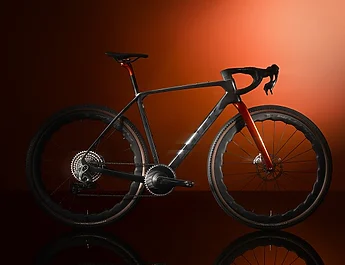
The base is a size 54 Cannondale SuperX 1, a decidedly race-oriented gravel bike whose geometry is very similar to that of the SuperSix EVO. That’s a detail that matters, especially since John had no intention of limiting his bike to trails.
The setup centers around a SRAM Force XPLR groupset, paired with an aerodynamic 46-tooth single chainring and a SRAM AXS power meter. Up front is the Cannondale SystemBar R-One handlebar-stem combo, developed in collaboration with Momo Design. A 145 mm Bontrager Aeolus RSL serves as the saddle, while John mostly uses Shimano Ultegra pedals.
For gravel riding, the SuperX is equipped with DT Swiss GRC 1400 wheels, fitted with 700 × 42 mm tubeless Trek Girona RSL tires, and a 13-speed SRAM Force XPLR cassette in a 10-46 range. The whole setup weighs about 8.2 kg, with an original price of around 7,500 euros.
But it only takes a few minutes to transform the bike. For road riding, John swaps in ENVE SES 4.5 wheels, Continental GP5000 tires in 700 × 28 mm with Pirelli TPU tubes, and a 12-speed Force cassette in 10-36. “I’m not a fan of tubeless setups with road tires.” Two wheels off, two others on, and the SuperX changes its role.

Why? Why this bike?
You might imagine a long, rational thought process centered on versatility. In reality, before reason came into play, there was love at first sight. “I fell in love with this bike the moment I saw it at the Cannondale presentation. I told myself I had to have it.” The desire came first, but behind it lay a sound logic: John wanted to simplify his gear without simplifying his riding.
From February to September, he races nonstop on both road and gravel. From September to January, it’s time for cyclocross. And all year round, the Cannondale also serves as his commuter bike. So a single bike must be capable of living four different lives. “One bike, two sets of wheels, and endless possibilities! That way, there’s no downtime.” That’s where the project gets particularly interesting. The SuperX isn’t just a gravel bike that John occasionally asks to do something else. He designed it as a single platform around which several configurations revolve.
This extends all the way to the commuter setup. Front and rear lights, a radar, fenders, and even a speaker for some background music are added to the race bike. John readily admits that this setup isn’t the sexiest. It doesn’t matter: on Sundays, he races with it. On Mondays, he rides it to work. That’s exactly what it is—his Swiss Army knife.

How? How did you set it up?
Doing everything with a single bike inevitably requires some compromises. John rides mainly with his Shimano Ultegra pedals, even on gravel, but switches to MTB pedals when mud makes walking unavoidable. The same logic applies to the cranks. Accustomed to 175 mm on the road, he opted for 170 mm here to strike a balance between road, gravel, and cyclocross. For saddle height and setback, he sticks with his tried-and-true measurements. Up front, however, the years have brought a few adjustments. “As for the handlebar setup, I’ve been adjusting it over the years… The more time passes, the higher the stem goes!”
That’s also what we love about a Bike Check: a bike isn’t set in stone in a configurator. It evolves with the rider. As for the drivetrain, the 46-tooth chainring is probably the most significant compromise in the setup. Paired with the 10-46 cassette, John finds it ideal for gravel riding. On the road, however, the 46 × 10 can be too short for certain Open-category races. For cyclocross, he’s considering dropping down to a 42-tooth chainring.
Tire pressures also vary depending on the terrain. On gravel, John generally starts with 1.6 bar in the front and 1.7 bar in the rear, with the option to go up to 2 bar on very clean trails. On the road, he keeps tire pressures between 3.5 and 5 bar depending on the road surface and humidity. He also makes no secret of his loyalty to SRAM. “I love the SRAM groupset for the ergonomics of the shifters and the brake feel. It’s a joy!”
But if he had to pick a single favorite component, his eyes would turn to the ENVE SES 4.5 wheels. “They’re just fantastic. Agile during accelerations and through a series of turns, fast with insane momentum on the straights. And I have to admit, they’re also very aesthetically pleasing.”

So what? How does it perform out on the trail?
Put the DT Swiss wheels and 42 mm tires back on. Head out onto the trails. That’s where the SuperX returns to its true calling, and where John almost stops finding faults with it.
“For gravel, it’s a pure Gravel Race! Aero, comfortable, and dynamic. Everything you could ask for in a gravel race bike.”
The verdict is clear: 10/10 for gravel. Cyclocross follows with a 9/10, while the commuter version earns a solid 8/10. Then comes the road, where John drops it to a 6/10.
Not because the SuperX performs poorly there. Its geometry, similar to the SuperSix EVO, and the ENVE wheels allow it to remain very efficient. But as the level of competition rises, compromises become apparent: the 46 × 10 gear ratio can become too short, and the 8.2 kg weight eventually makes a difference when up against pure road bikes.
But judging this Cannondale solely on that basis would be missing the point of the project. Its success isn’t about being the best bike in four disciplines. It’s about being good enough in each one to allow John to ride them all on the same bike.
Gravel racing, road racing, cyclocross, or the commute to work: a few adjustments are all it takes, and the adventure continues.

If someone stole it tomorrow, would you buy the exact same one again?
That’s the question that wraps up each of our Bike Checks. No spec sheets, no marketing spiel: someone steals your bike tonight, and tomorrow morning, you have to start from scratch. Would you buy the exact same one again? For John, the answer is no. But certainly not because the experience was a failure. “I’d do the same project again, but with a gravel race bike from another brand. I really like the Orbea Terra Race!”
And that might be the greatest compliment he could pay his SuperX. He’d switch bikes, but he wouldn’t change the concept at all. One bike, two sets of wheels, four uses, and a season that never ends. He’d simply switch bikes to start playing all over again.
John’s Bike CheckJohn’s Cannondale SuperX 1 weighs 8.2 kg and costs around 7,500 euros—a bike designed around a simple idea: to be high-performing and versatile enough to handle everything from gravel to road, cyclocross to commuting.
A quick note from John: “My bike is a Swiss Army knife!” John rates it 10/10 for gravel, 9/10 for cyclocross, 8/10 for commuting, and 6/10 for road riding. What does he love about it? Its versatility. What bothers him? The constant compromise on gear ratios. And if he had to start all over tomorrow, John would switch bikes but stick to exactly the same philosophy. |
Same concept. A different bike.
One bike. Four photos. Four questions. Four answers. Bike Check, the 3bikes series that’s less interested in what a brand says about a bike than in the reasons why its owner chose to ride it.
=> Learn all about the Cannondale lineup
=> And here, if you want to check out all our other Bike Checks: All Our Bike Checks
Share the post "Bike Check #001 | John Saccomandi’s Swiss Army Knife"