Share the post "UTMB 2026: Why Did They All Drink Pickle Juice?"
You may have noticed this during the UTMB coverage on L’Équipe: on several occasions, runners drank the brine from an ordinary jar of pickles. It wasn’t just a trail runner’s whim after twenty hours of exertion. Behind this gesture lies a particularly interesting scientific approach to preventing cramps. And cyclists—especially those who ride gravel and ultra-distance races—would be well advised to take note.
By Jeff Tatard – Photos: DR
We certainly weren’t the only ones who spent a few hours watching the 2026 UTMB this weekend. And what a race it was. In the men’s race, Ben Dhiman delivered an extraordinary performance: 174 km and 9,900 m of elevation gain in 18 h 16’29’’, under 19 hours and setting a new course record for the 2026 route. Behind him, our friend Baptiste Chassagne took a magnificent second place, two years after finishing second in Chamonix and a few months after his victory at the Diagonale des Fous.
And as we write this, we simply must also highlight Blandine L’Hirondel’s incredible race. After 127 km, the French runner was in the lead, about 35 minutes ahead of Rachel Entrekin. She still has a ways to go, so let’s not count her victory before she crosses the finish line. But with less than two hours to go until her estimated finish time, she’s in the midst of achieving something truly remarkable.
But between two mountain passes, something else caught our attention. Why on earth are we seeing riders drinking… pickle juice?
THE PICKLE IS NO JOKE
Not the pickle itself. The liquid in the jar. The first explanation seems obvious: it’s salty. After fifteen hours of exertion, liters of sweat, and just as much lost sodium, you might imagine that this brine helps quickly replenish some electrolytes. Except that’s probably not its main benefit.

A frequently cited study showed that after drinking pickle juice, an experimentally induced cramp disappeared on average in 84.6 seconds, compared to 133.7 seconds with water. That’s a gain of nearly 50 seconds. Most importantly, the researchers observed virtually no change in blood electrolytes five minutes after ingestion. That’s too fast for the salt to have actually had time to do its job. So what’s going on?
CRAMPS ALSO OCCUR IN THE NERVOUS SYSTEM
Pickle juice contains, among other things, vinegar and therefore acetic acid. Its very pungent taste stimulates receptors in the mouth and oropharynx, particularly the well-known TRP channels. This stimulation could trigger a neurological reflex that reduces the excitability of the motor neurons involved in the cramp. In other words, it doesn’t necessarily “recharge” the muscle—it primarily sends a signal to the nervous system.
To provide a medical perspective, we consulted Dr. Laurent Aumont, a physician at IMS Préfontaine who is himself a runner and a finisher of several marathons, having previously worked for over ten years at PSG alongside players such as Neymar and Kylian Mbappé. “For a long time, muscle cramps were simply attributed to a loss of water and sodium. It’s much more complex than that. During very long periods of exertion, neuromuscular fatigue plays a significant role: the muscle is fatigued, but the entire nervous control system eventually becomes disrupted as well. That’s what makes this pickle juice theory particularly interesting: its effect seems too rapid to be explained solely by electrolyte intake.”

This is a crucial point because our old equation “cramp = lack of salt” is far too simplistic today. Neuromuscular fatigue is another major factor, even though the mechanisms behind cramps remain complex and likely multifactorial.
And Laurent Aumont immediately tempers the enthusiasm: “Above all, we mustn’t treat this as a miracle cure. While the effect is real, it’s more of a temporary solution to use when a cramp occurs or is about to occur. It will never replace training, proper hydration, sufficient energy intake, and good effort management. But in an ultra—whether running or cycling—having this type of solution as part of your strategy can make sense.”
AND WHAT ABOUT US CYCLISTS?
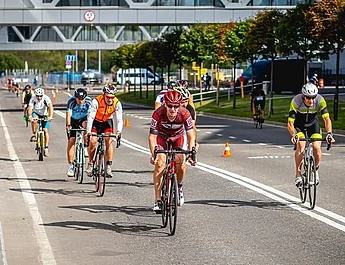
This is precisely where the topic becomes interesting for 3bikes. Imagine the 160 km mark of a gravel race, after six or seven hours in the saddle. Thousands of muscle contractions, power-intensive sections, accelerations, vibrations, heat, and significant neuromuscular fatigue.
Your calves start to twitch. Your quadriceps are on the verge of giving out. A small shot of brine might then make more sense than another handful of salt swallowed in a rush. In fact, there are now anti-cramp shots based on this same idea of sensory stimulation, using vinegar, ginger, or even capsaicin.
Be careful, though: the available scientific studies are still limited, and some use cramps artificially induced in a lab. Pickle juice is therefore neither a magic potion nor a substitute for proper preparation, adequate hydration, and a consistent nutritional strategy.

For Laurent Aumont, it’s precisely in very long-distance events that this approach deserves closer attention: “In a marathon, an ultra-trail, or a long-distance cycling race, you reach a level of fatigue where the neuromuscular system is pushed to its limits. If a few centiliters of a product can act quickly on this neural loop and help defuse a cramp, that’s obviously interesting. But it should be viewed as a backup tool, not as a standalone strategy.”
And that’s probably the real lesson to take away from that odd sight at the UTMB. Pickle juice doesn’t eliminate the causes of cramps. It might simply help block the signal when a cramp threatens to bring everything to a halt. Whether running or cycling, when you’re pushing your limits for six, ten, or twenty hours, that alone can make a huge difference.
So, the next time a friend pulls out a few centiliters of pickle juice at the 150-kilometer mark of a gravel race, don’t make fun of him. He might even be the one laughing a few kilometers down the road.
=> To learn more and better understand nutritional balance for athletes, check out Benoît Nave’s clear and accessible resources
Share the post "UTMB 2026: Why Did They All Drink Pickle Juice?"