Share the post "Chasing Flags: the hardest part might not have been inventing the game"
Twelve years of playing among friends, nearly 45,000 euros invested, hundreds of hours of work, and an application launched on the eve of the Tour de France. When we first told the story of Chasing Flags in July 2024, Gildas’s project still resembled what many great ideas are: an intuition, a passion, and the desire to see how far they could go. Two years later, the game truly exists. It has 347 registered users, 273 of whom have already played, the rules have been transformed into lines of code, and the flags once exchanged between friends on Messenger have become a real platform. But once the product is built, perhaps the most difficult part begins: finding its audience. We went back to see Gildas. Not just to talk about his game, but to understand what it costs, in money, time, convictions, and sometimes disillusionment, to transform an idea among friends into a real entrepreneurial project.
By Jeff Tatard – Photos: CHASING FLAGS
Some projects are born around a table with a business plan, a market study, a few perfectly aligned slides, and three-year growth forecasts. And then there’s Chasing Flags. It was born almost in reverse. Before the developers, there were friends. Before the algorithm, there were discussions. Before the application, there was Messenger. And before the approximately €45,000 invested, there were twenty-five guys who wanted to add a little spice to their way of watching the Tour de France.
Before Chasing Flags, there were the Drapeaux Parieurs (Betting Flags). That was twelve years ago. At the time, no one talked about business models, user experience, API scrapers, or acquisition strategies. We chose nations, counted points, teased each other a lot, and, most importantly, improved the game. A rule here, a restriction there, a joker to add a bit of disorder to what the players had come to understand too well. Year after year, almost without realizing it, twenty-five friends did what companies today call testing, iterating, and improving a product. They probably called it preparing for the next Tour.
This is perhaps where this story truly begins. Because when you open Chasing Flags today, everything seems relatively simple. A few flags, choices to make, points, a ranking. And this simplicity could almost make us forget the essential: it took more than a decade to achieve something that precisely gives the impression of being obvious.
Two years later
We first met Gildas in July 2024. At the time, we told the story of this funny game imagined around the nations of the peloton. The principle immediately appealed to us because it approached cycling from an unusual angle. You didn’t necessarily choose Tadej Pogačar, Jonas Vingegaard, or Remco Evenepoel. You chose a flag. And behind it, a whole field of possibilities: a nation capable of winning, accumulating places, benefiting from a breakaway, or simply being much better represented on a particular terrain than one might have imagined.
This was already what made the game interesting: Chasing Flags forces you to look at a race differently. To observe not only the men but the depth of the teams, the profiles, the nationalities, the opportunities, and that shifting geography of the peloton that we sometimes stop seeing when we only focus on the favorites. Two years later, many things have changed. Not the idea. Everything around it.
“The famous article you dedicated to the game dates back to July 2024, already two years ago. It was the beginning of Chasing Flags, which we had known for ten years among friends, twenty-five players, under the name Drapeaux Parieurs.”
In the meantime, the Drapeaux Parieurs left Messenger. And Gildas pulled out his credit card.
€45,000 to see how far an idea can go
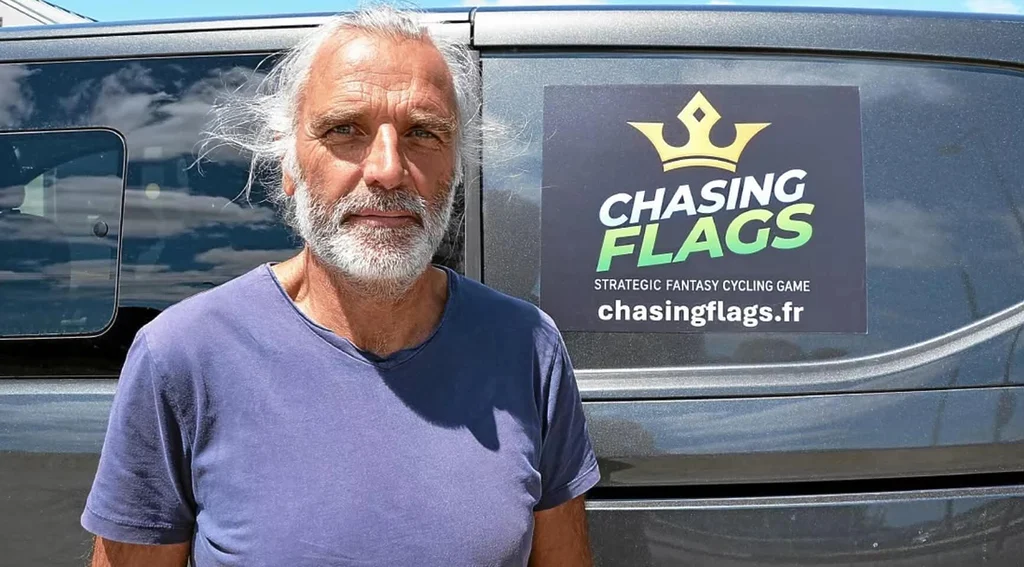
Talking about money is never the most romantic part of an adventure. Yet it is often what allows us to measure the distance between someone who says they believe in their idea and someone who truly decides to believe in it. In the case of Chasing Flags, this distance today represents approximately €45,000, entirely self-financed. No investors, no major partner taking a stake, no fundraising. Gildas financed the development of his project himself.
The budget of approximately €40,000 dedicated to development does not only correspond to a first fixed version of the application. It also covers the corrections and evolutions undertaken since: leaderboards page, reward attribution, feature adjustments, and everything that real usage reveals once players start doing things a developer couldn’t necessarily anticipate. In addition, there are approximately €3,000 per year for maintenance and hosting. Paid communication, for its part, has remained almost non-existent so far: a few flyers, at a cost Gildas considers negligible.
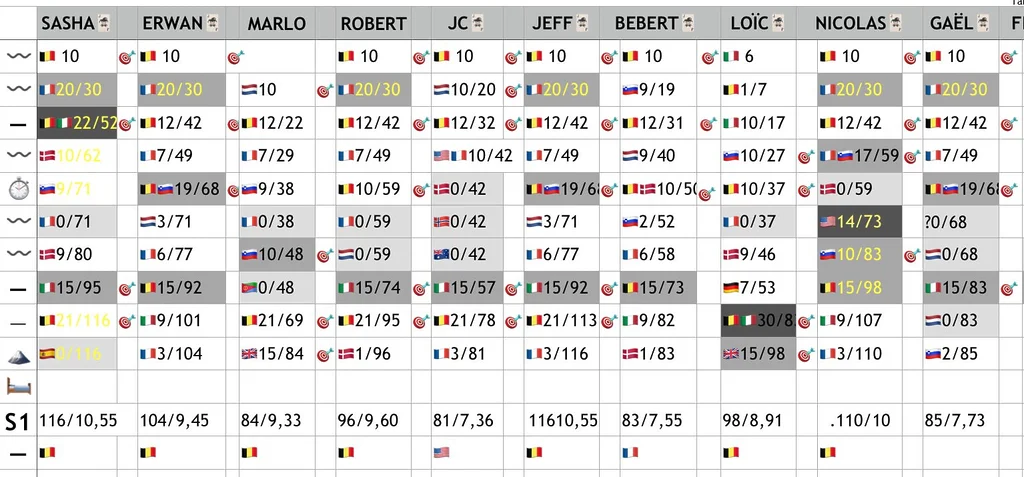
But there is an investment that invoices don’t show: time. When Yield Studio, the Parisian agency in charge of development, truly joined the project in mid-March, the instruction was clear: it had to be ready by early July. For the Tour. The window was tiny, and Gildas estimates he dedicated about 25 hours per week to the project during this period. Emails, exchanges, verifications, explanations, and above all, a considerable amount of arbitration to transform twelve years of habits among friends into rules precise enough for a machine to apply them without knowing anything about cycling, their discussions, or their years of playing.
Twelve years of algorithm… without an algorithm
One might imagine behind Chasing Flags a few mathematicians locked in a room, whiteboards filled with equations, and a clever formula capable of translating cycling into numbers. The reality is more interesting. The original algorithm of Chasing Flags is twelve years of games among friends. Twelve years of specific cases, refined rules, restrictions added because a mechanic became too easy to exploit, jokers imagined to reintroduce uncertainty, and situations that worked perfectly on paper but much less so in the middle of a Tour de France.
“All previous editions of the Drapeaux Parieurs helped explain the project, which was already solid. Cycling being much more complex than it seems, it was necessary to explain why certain points were interesting.”
This is probably one of the most interesting things about this story: technology didn’t invent the game; it industrialized an experience. Yield Studio’s role was to transform this empirical accumulation into an application usable by someone who had never participated in the historical discussions. The Product Manager quickly understood the subtleties, which obviously made the task easier. Because behind a few flags displayed on a phone lies a much finer mechanism: mandatory alternation of choices, diversity rules, restrictions, jokers, point attribution, inability to select certain nations based on what has already been played… It even had to automatically gray out flags that the player no longer had access to for a given stage or for the rest of the race.
All of this must work without the player needing to think about it. This is probably the best indicator of a successful interface: the more complex the work behind it, the less the user in front of it should feel it.
An application delivered… on the eve of the Tour
Then July arrives. And with it, that scene probably familiar to anyone who has ever launched something: where the deadline that seemed distant suddenly becomes tomorrow. The web application is available on the eve of the Tour de France. Not three months before. Not three weeks. The day before. While the peloton prepares its bikes and teams fine-tune their last details, Chasing Flags is still finishing its own. A test race is even still running at the time of the first stage. This gives a fairly precise idea of the comfort level during the launch.
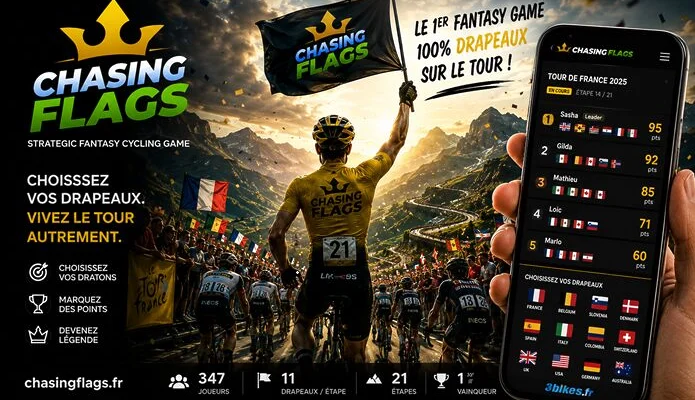
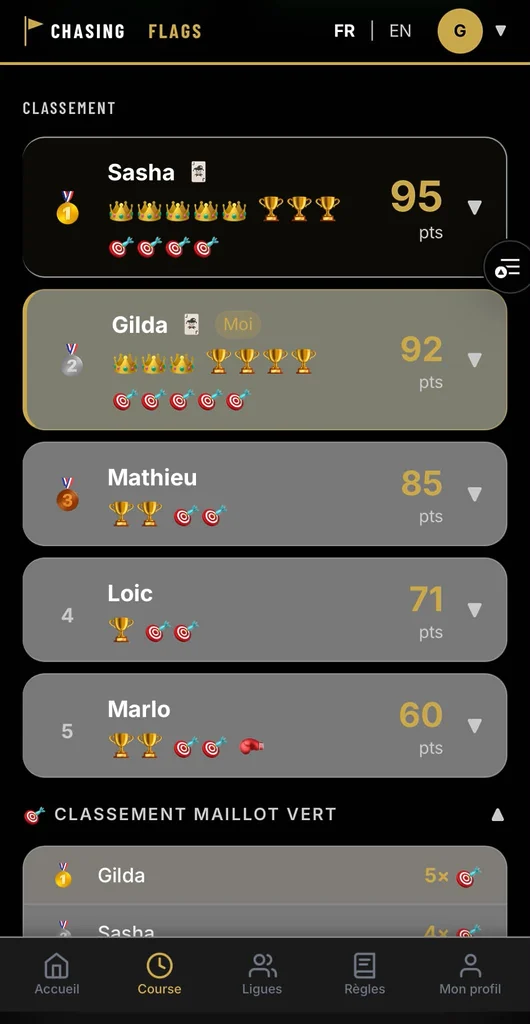
And yet, players arrive. Just under 300 people sign up. More than half remain loyal throughout the three weeks of the Tour. The Tour de France Femmes then gathers just under a hundred participants. Today, Chasing Flags has 347 registered users and 273 players who have participated at least once. It’s not yet a crowd. But it’s definitely no longer a game among twenty-five friends.
The initial behaviors are almost as interesting as the numbers. Players sometimes forget to validate their choices before the daily deadline, but many return the next day or the day after. To prevent a forgotten choice from ruining three weeks of play, Chasing Flags has devised default choices: predefined flags take over when a player doesn’t make a prediction. Another one of those little rules that one might think was born in a large design workshop, when it probably owes a lot to twelve years spent watching a friend forget to play.
When automation still needs Gildas
Perhaps the most amusing thing is that after €45,000, twelve years of experience, and several months of development, there is still one place where craftsmanship takes over: the finish line. Chasing Flags uses a Scraper API to automatically retrieve results published on ProCyclingStats. On paper, the mechanism should run by itself. In real life, cycling clearly retains a slight resistance to automation.
“It works so-so. I have to check at each finish and often correct.”
So while players quietly wait for their points to drop, Gildas still keeps an eye on the official standings to ensure the machine hasn’t decided to rewrite the race. An almost anecdotal detail, but one that ultimately tells quite well where Chasing Flags stands today: big enough to function thanks to technology, but still young enough to need its creator behind the screen. And somehow, that might not be so bad.
The hardest part begins when the product exists
When you carry an idea for so long, you inevitably imagine the moment it will finally be available. And in this projection, there is a fairly universal temptation: to believe that a good product will naturally find its audience. Gildas believed it. Not naively, but enough to discover today that reality works differently.
“I was a bit mistaken. I imagined that by talking about it on social media and in sports and cycling media, the game would have generated more natural interest. It was a mistake; nothing happens naturally.”
This sentence says a lot. Above all, it marks a change of profession. For twelve years, Gildas wondered how to make his game better. For several months, he wondered how to make it technically possible. Now, he must learn to make it visible. And that is absolutely not the same thing.
He recounts, in particular, having obtained, about two months before the Tour, the contact of a very popular cycling commentator. He presented the project to him. The response was warm: come back to me when the application is available, and I can talk about it on my shows. Then the application arrived. Gildas went back to him. And nothing. He doesn’t tell this anecdote with bitterness. He says he understands. And that’s precisely what makes it interesting: no one needs to brutally close a door on you for a project to remain invisible. Often, it’s enough for thousands of other things to also demand a few seconds of attention.
Creating something interesting never guarantees that someone will look at it. This is probably the first great lesson of Chasing Flags’ new life.
From 347 to 7,000
This is where the numbers take on another dimension. 347 registered users. 273 active players. And, according to Gildas, probably 5,000 to 7,000 regular players are needed for Chasing Flags to start finding a real economic balance. The road is therefore long. Very long, even. But at least we now know the approximate distance.
The envisioned economic model is nothing revolutionary. Eventually, the platform could be financed by advertising. Ad placements are already planned in the interface, with the desire to remain as unintrusive as possible, but they are deliberately not yet open to advertising agencies. The urgency is not to monetize a few hundred people. The priority is first to build a community large and loyal enough for monetization to make sense.
One thing, however, should never change: the game’s free access and fairness. Gildas does not want a mechanism where the one who pays buys an advantage. No premium option giving more points, no shortcut allowing easier winning. Money may one day finance Chasing Flags. It should never buy the ranking.
And this position perhaps says more about the project than any business plan.
Learning cycling without realizing it
There is also an effect that Gildas may not have fully anticipated. Some users are not passionate about cycling. Some knew almost nothing about it. And they play. Then they watch. Then they start to understand that a mountain stage does not favor the same nations as a sprint, that a breakaway changes the value of a choice, that the depth of a country can sometimes count more than its superstar, and that cycling is infinitely more subtle than simply naming the best rider before the start.
“We have testimonials from people who explain that it’s the first time they’ve been interested in cycling and that after a few stages, they understand its different aspects much better. They learn without realizing it.”
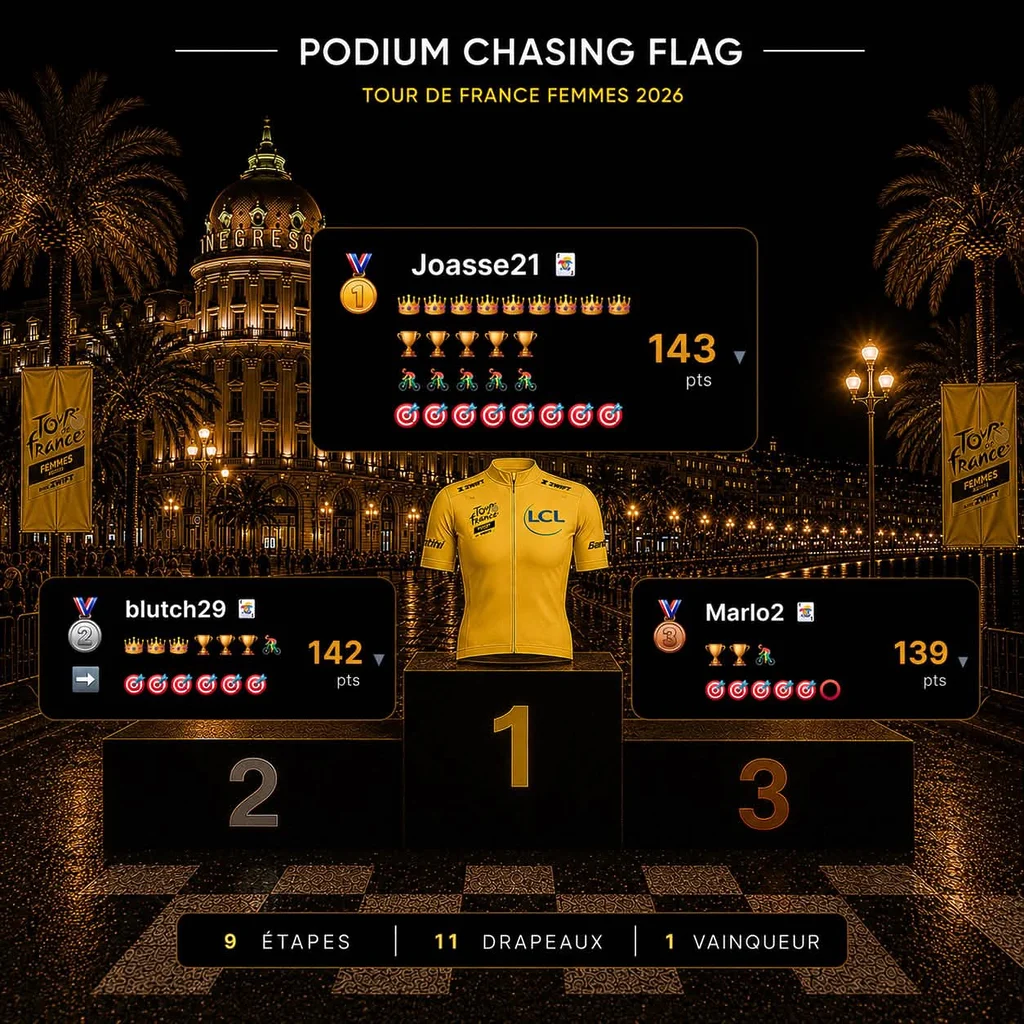
This is perhaps where Chasing Flags becomes more interesting than a simple prediction game. It provides an additional reason to watch the race and, by watching it, teaches you to read it better. Gildas cites the Tour de France Femmes. Some new players imagined a peloton essentially dominated by French and Dutch women. At the finish, nine different nationalities were represented in the top ten of the general classification. The game forces you to see these kinds of things, because suddenly a jersey is no longer just a jersey. It also becomes a flag, and therefore a possibility.
There is another small victory that Gildas cherishes. During the Drapeaux Parieurs years, the group had never really managed to attract female players. With Chasing Flags, things are changing. Women play, and, clearly, some quickly understood how it works. Katia, France, and Christel regularly appear in the daily results and rankings. This detail might seem secondary. Yet it tells exactly what the transition from a private group to a platform can produce: opening an idea to those who would never have joined the original circle.
Flyers, bike shops, and a first lesson in commerce
To recruit more, Gildas also tried something much less digital. He took his flyers and went to see bike shops. The idea was quite good: suggest to stores that they create their own league, gather their customers around an event during the Tour, and possibly offer some rewards. The shopkeepers he met were curious, interested, and welcoming. And yet, it didn’t really take off. Not really.
Gildas could have concluded that the idea was bad. He concluded, above all, that the method needed to be better. For 2027, Chasing Flags is therefore working on a real kit for shops: a large poster to write down the winner of each stage, flyers, stickers, and various promotional materials. The shop organizes its league for free, can offer some goodies to its customers, and creates an event around the race. Chasing Flags, for its part, reaches new players. A kind of win-win deal, but above all a way to reconnect a digital game to something very physical: a shop, a counter, people talking about bikes.
“It’s also an approach I like: mixing digital and face-to-face.”
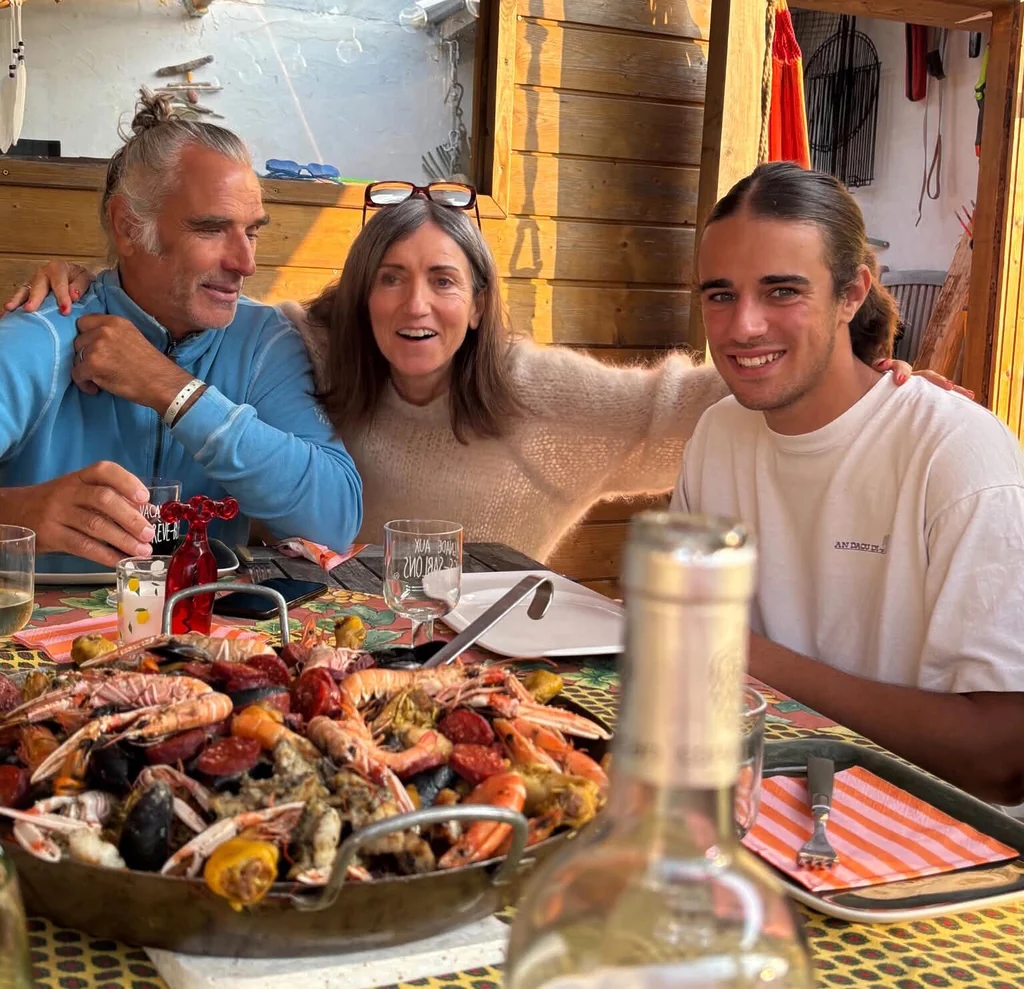
This story about shops brings back a particular memory for Gildas. In 2011-2012, he participated in the market launch of a young outdoor running shoe brand. Five agents, two models to present: the Mafate and the Bondi. The brand was called HOKA. We know the rest.
He obviously doesn’t claim that Chasing Flags will become the HOKA of fantasy cycling. The comparison would be as easy as it is absurd. But he remembers what it felt like to present something almost no one knew yet, and that sensation comes back to him today when he talks about his application. He has already seen a small thing become big. That doesn’t mean all small things do. Simply that before being known, every success necessarily went through a time when it wasn’t.
The game continues to invent itself
While Gildas searches for his audience, Chasing Flags continues to evolve. One of the recent innovations is called Flash Start. The idea addresses a simple situation: you discover the game after a race has already started, your friends have been playing for several stages, and you’d like to create a league with them. Problem: they already have points. Flash Start allows you to create a new league where everyone starts from scratch, regardless of their individual general classification.
And ideas keep coming. Sasha, Gildas’s son, involved from the beginning and notably in charge of Instagram, organized a brainstorming session with his high school friends. Among the proposals is a joker that allows you not to select any flag for a stage and automatically gain ten points. The idea may be adopted, modified, or abandoned. What matters is elsewhere: twelve years later, Chasing Flags continues exactly as the Drapeaux Parieurs began, by discussing the rules with those who play.
Gildas rather nicely summarizes the human structure of the project when asked who is really behind Chasing Flags: “I am both alone, but above all well accompanied.” His son participates, his wife assists him notably with the image, logo, and communication, and Gildas still considers the historical participants of the Drapeaux Parieurs as part of the project. The cement of Chasing Flags is therefore not only made of lines of code. It is made of twelve years of discussions, disagreements, sometimes brilliant ideas, and probably some much less good ones.
13 races and 141 days to move beyond the Tour
The next step is now to move Chasing Flags beyond its immense dependence on the Tour de France. For the next season, the project envisions 13 races and 141 days of competition, from February to September, including the three major women’s Tours. The Tour de Pologne, used as a laboratory over seven stages, yielded sufficiently convincing results to confirm that the concept can thrive elsewhere than during three weeks in July.
However, not all races are suitable. Chasing Flags needs duration, evolving strategies, different profiles, and nations whose value can change from one day to the next. Too short events do not necessarily provide this depth. The game, on the contrary, finds its richness in what stage cycling possesses that is almost unique: the same men compete day after day, but the qualities needed to win can be radically different twenty-four hours later.
Gildas even considered cyclo-cross to extend the season. He loves the discipline and misses few races, but the more restricted international field and the recurrence of the same favorites limit the strategic interest. The same reflection applies to biathlon or motorsports. And it is ultimately by mentally trying to transport Chasing Flags elsewhere that one understands how ideal stage road cycling is as material: dozens of nations, sprinters, climbers, rouleurs, breakaway riders, leaders, domestiques, different courses, and a balance of power that can be completely overturned overnight.
“It’s a bit like if, in athletics, all athletes had to do all events at a rate of one or two per day.”
The image summarizes quite well the singularity of stage cycling: the same actors, but a terrain, required qualities, and power dynamics that can change every day. And that is precisely what makes Chasing Flags so rich… as much as it makes it difficult to imagine the same game elsewhere.
What if players also had their World Tour?
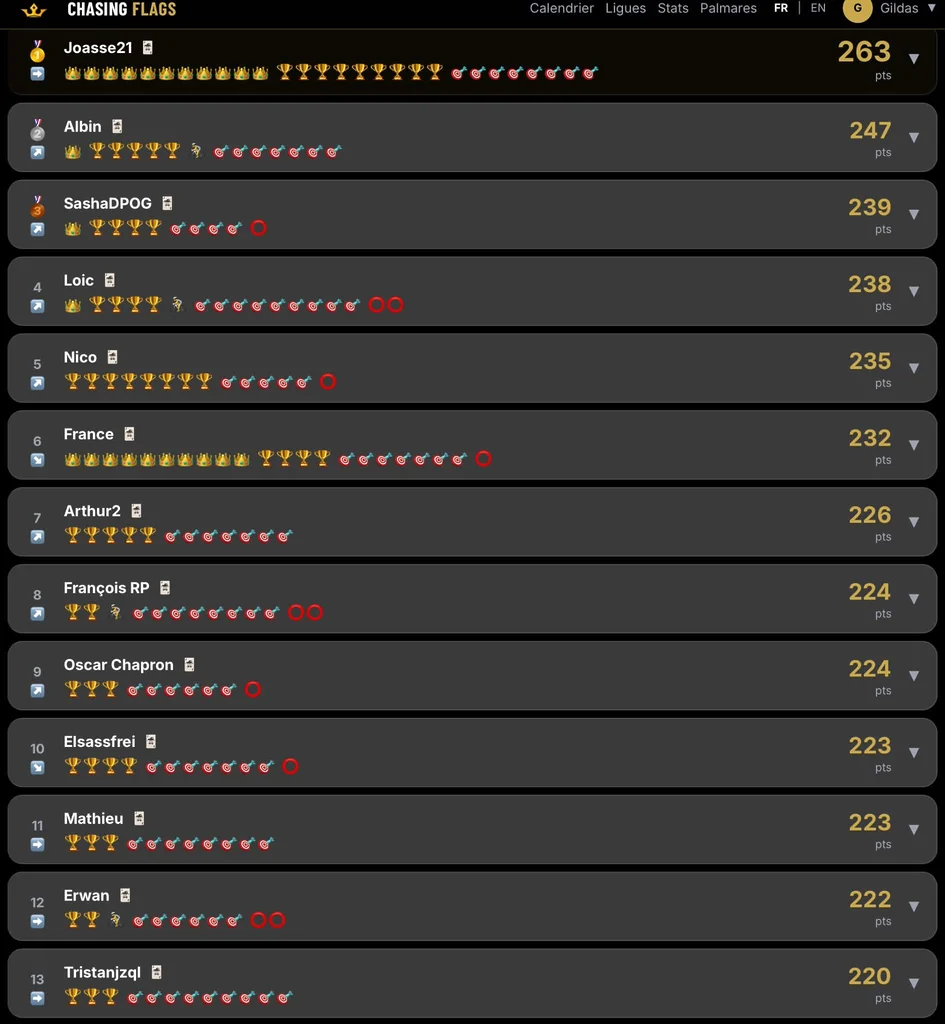
Among all the planned evolutions, one idea could further enhance loyalty: creating two super-leagues, a World Tour and a ProTour, each composed of thirty players. The first would bring together the thirty best cumulative scores from the previous season, the second the next thirty. After each race, five players would be relegated and five promoted. Like in a championship.
The idea seems almost incidental when you first hear it. Yet it could be one of the most powerful, because it gives memory to the game. Suddenly, Chasing Flags would no longer be just a succession of independent predictions. It would create its own hierarchy, its promotions, its relegations, its rivalries, and perhaps, over time, its stories. Players would no longer return just because a new race begins, but because the previous one would still have a consequence on the next.
And this is probably where one of Chasing Flags’ biggest challenges lies. The Tour de France is a formidable gateway, but three weeks in July will never be enough to build a lasting community. The real challenge is to transform the Tour player into a cycling player, and then the occasional player into a regular. To make sure that the flag chosen today makes you want to come back and choose tomorrow’s.
And now, a 3bikes league
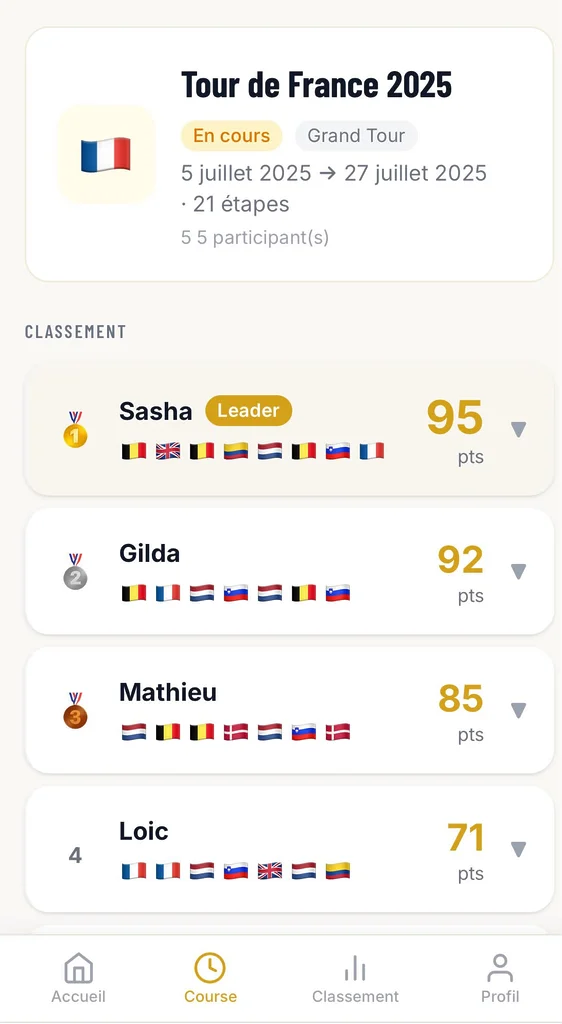
This is also the objective of the new partner and event leagues. Classic private leagues are limited to thirty players and designed for families, friends, colleagues, or club members. Event leagues work differently: they are created directly by Chasing Flags for a media, a brand, a store, or a community. A code is then transmitted to the partner, who decides how to distribute it and how to run their competition.
A first attempt took place with Actu Cyclisme Féminin during the Tour de France Femmes. The proposal was very well received and relayed on social media, but the number of participants did not follow as much as hoped. Gildas speaks of a mixed but promising result. The platform was new, it was early August, and the experience mainly confirmed something he had already discovered: he would have to persist rather than wait for users to arrive on their own.
This time, he thought of 3bikes. Firstly, because we were the first specialized media to cover Chasing Flags, but also because our readers know cycling quite well. And that’s precisely what interests him: beyond the number of new participants, to gather the perspective of players who already understand the mechanisms of cycling and observe how they appropriate this other way of reading a race.
So we’re going to play. Not to do Gildas a favor, nor because we’ve suddenly developed an inexplicable passion for flags. But because, two years after telling the birth of this funny idea, we want to see what it becomes once it’s in your hands. And knowing slightly the degree of bad faith that can accompany a cycling prediction, we’re not sure Gildas fully measures what he has just provoked.

The hardest part may be starting now
Ultimately, Chasing Flags finds itself in a strange position today. The game exists. The first players are there. The feedback is good. The rules have twelve years of experience behind them. The technology works. Improvements continue. And yet, almost everything still remains to be done.
Going from 347 registered users to 5,000 or 7,000 regular players is not a simple progression. It’s a change of scale. Going from a completely self-financed project to a platform capable of covering its own costs is not either. Gildas now knows better than anyone: building the product was one race. Finding its audience will be another.
And perhaps that is precisely why his story interests us more today than it would have if everything had worked immediately. He is not telling us a carefully reconstructed success story after the fact. It doesn’t exist yet. There are the right intuitions and the mistakes, the 25 hours per week, the €45,000, the bike shops that find the idea great but ultimately don’t create their league, the enthusiastic commentator who doesn’t call back, the scraper that still needs to be monitored at each finish, and that somewhat irrational but essential conviction that the game will eventually find those for whom it is intended.
Because ultimately, entrepreneurship perhaps closely resembles the cycling that Chasing Flags is trying to teach us to watch. You can have the best strategy, know the course, have prepared your equipment, studied your opponents, and identified the favorites. That never exempts you from pedaling.
Getting back on his feet
We asked Gildas to project himself. In three years, if we come back a third time to tell the story of Chasing Flags, what would he like to be able to announce that he cannot announce today? He could have answered 100,000 players. A fundraising round. An international application. A major partner. A six-figure turnover. In short, all those indicators with which we like to measure success when we sometimes forget to ask the project leader what success truly means to them.
His answer is elsewhere. “That the game has found its audience, that I have financially gotten back on my feet, that people are talking about it. That I can invite the participants of the Drapeaux Parieurs to a sunny weekend to thank them.”
And ultimately, perhaps everything is there. We can add chats to leagues, improve algorithms, perfectly automate results, invent divisions, create event leagues, welcome 5,000, 7,000, or perhaps one day many more players. We can activate advertising, balance the books, and perhaps eventually make Chasing Flags an economically viable activity. But there will always remain, somewhere behind the screen, twenty-five friends who played on Messenger.
They simply didn’t know it yet. While they were choosing their flags, discussing a joker, counting their points, and rewriting a rule because one of them had found a loophole, they were perhaps already building an application. Without market research. Without investors. Without even really having decided to make it a project.
And that’s probably what we prefer about this story. Chasing Flags wasn’t born because someone was looking for a business idea. It became a project because a group of friends had found a good reason to keep playing together. The nuance seems small. Yet it explains many things: the free access Gildas wants to preserve, the historical players he still considers part of the project, his son who thinks about the next jokers, his wife who contributes to the image, and that funny dream of success that ends neither with a fundraising round nor a sports car, but with a sunny weekend offered to the friends from the beginning.
Twelve years and €45,000 later, Chasing Flags is now looking for a few thousand more friends.
And this time, we might just be able to introduce him to some.
IN BRIEF: HOW TO PLAY?
=> Your turn to play: chasingflags.fr |
=> All our Magazine articles
Share the post "Chasing Flags: the hardest part might not have been inventing the game"