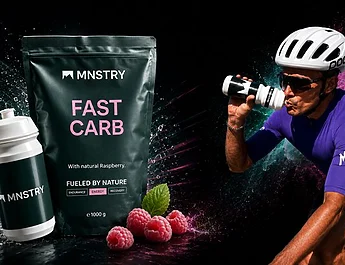
Share the post "MNSTRY Test: Remco Evenepoel’s Nutrition Put to the Test"
For three weeks, we replaced a large part of our sports nutrition with MNSTRY products. Not just for one ride, or even a competition weekend, but at the heart of a real training block of nearly twenty hours of weekly training under the Portuguese sun. The idea was not to taste a few references and then pile up impressions, but to subject an entire nutritional strategy to what cycling knows to be the most difficult to mask: repetition, heat, long hours in the saddle, accumulating fatigue, and a body that always ends up telling the truth. Three weeks later, it’s time to tell what this experience really taught us.
By Jeff Tatard – Photos: DR
There are two ways to test a sports nutrition product. The first is to open the box, taste it, ride two or three times, note a few sensations, and then publish a verdict. The second requires more time, a few hundred extra kilometers, and above all a little more humility. Because nutrition is probably the only “equipment” for cyclists that continues to work even after the bike is put away. It supports the effort, of course, but it also influences recovery, sleep, the ability to string together sessions, and sometimes even that data impossible to find on Garmin: the desire to go out again the next day.
It is precisely this second path that we chose. Not because it is more spectacular, but because it is more honest. A bar can be excellent on the first bite. A drink can seem perfect for an hour. But after four or five hours in the saddle, several consecutive days of training, and heat that begins to erode lucidity, the artifices disappear. All that remains is what the product truly brings to the athlete.
Why MNSTRY?
We regularly receive requests from brands wishing to introduce us to their new products: helmets, wheels, bikes, textiles, power meters… and of course, nutrition. The scenario is often quite classic: a few products, a few rides, a few comparisons, then an article. With MNSTRY, we quickly understood that we had to do things differently.
Throughout our discussions with the German team, one idea constantly recurred: performance does not begin with the quantity of energy absorbed, but with the quality of what the body is asked to process. The brand has built its entire philosophy around three pillars: performance, digestive tolerance, and long-term respect for the body. No artificial sweeteners, a priority given to natural ingredients, close attention to the osmolarity of drinks, glucose-fructose ratios, and the quality of raw materials, with a clear ambition in the background: to fuel performance without asking the digestive system to pay the price.
This is where MNSTRY becomes more interesting than a simple collection of gels and bars. The brand thinks in terms of a system. A drink is not designed in isolation. Neither is a bar. Each product addresses a specific moment, intensity, duration, energy need, or recovery requirement. Even products dedicated to sleep or immune support fit into this global logic.
In other words, MNSTRY doesn’t just seek to nourish the cyclist while they are riding. The brand seeks to support everything that allows them to start riding again the next day. And it is precisely this promise that we wanted to put to the test.

A brand born from the highest level
The name MNSTRY remains relatively discreet in France. Yet, behind these five letters lies a brand that has chosen to build its credibility where approximations are costly: with some of the most demanding endurance athletes in the world. Born in Germany, MNSTRY developed around a simple conviction: sports nutrition should not only provide calories, it should enable the athlete to absorb them, use them, and start again the next day without making their digestive system the collateral victim of their performance.
This philosophy owes much to Robert Gorgos, a renowned nutritionist in professional cycling and long involved with BORA–hansgrohe, now Red Bull–BORA–hansgrohe. His experience at the highest level helped shape an approach where performance and digestive tolerance are not considered as two competing objectives, but as two sides of the same problem. Because successfully putting 80, 100, or sometimes more grams of carbohydrates per hour on a nutritional label is one thing. Still being able to absorb them after four hours of effort is another.
This is where the MNSTRY philosophy becomes interesting. The brand works notably on glucose-fructose ratios, 2:1 or 1:0.8 depending on the products and desired intake levels, but also on the osmolarity of its drinks, their electrolyte content, and the selection of ingredients. The objective is therefore not only to put more energy into a bottle, but to consider how the body can actually process it under stress. A nuance that may seem technical in front of a computer and suddenly becomes much more concrete after four hours in the saddle under 30 °C.
MNSTRY also claims a rather radical choice: no artificial sweeteners in its range, especially no sucralose, acesulfame-K, aspartame, or saccharin. The brand prioritizes real fruits, natural sources of carbohydrates, and selected raw materials, with batch-by-batch Informed Sport control. Caution should be exercised with certain physiological interpretations advanced by MNSTRY regarding sweeteners, as scientific literature is more nuanced than a brand’s discourse might sometimes suggest, but the guiding principle is perfectly clear: performance, tolerance, and long-term respect for the body.
MNSTRY’s philosophy could ultimately be summarized in one sentence: it is not up to the athlete to tolerate their nutrition to perform, it is up to their nutrition to become intelligent enough not to limit their performance. And after three weeks spent using eight of the brand’s products, this notion of tolerance will, as you will see, take on a much greater importance than we initially imagined.

Credibility built on the field
One only needs to look at the fields where MNSTRY has chosen to confront reality. Red Bull–BORA–hansgrohe in professional cycling, Laura Philipp at the highest level of long-distance triathlon, Rosa Klöser in gravel, but also various triathlon and ultra-endurance specialists: the brand has deliberately gravitated towards disciplines where a nutritional error can destroy several months of preparation in a few kilometers.
This choice is not anecdotal. In a modern endurance effort, the difference is no longer built solely on a few extra watts of FTP. It also lies in the ability to absorb a lot of carbohydrates without turning the stomach into a limiting factor, to maintain hydration, to recover quickly enough, and to repeat the effort when days follow one another. Nutrition is no longer simply what you slip into your pockets before starting: it has become an integral component of preparation.
And that’s probably where MNSTRY interested us most. Champions make a formidable showcase, but a list of ambassadors, however prestigious, has never constituted a test at 3bikes. Red Bull–BORA–hansgrohe, Laura Philipp, or Rosa Klöser have their proving grounds. We now had ours: three weeks, nearly twenty hours of weekly training, four to five-hour rides, and the Portuguese heat.
It was time to let the kilometers decide if the science described on the packaging truly stood up to the road.

Why 3bikes?
When MNSTRY offered us the opportunity to discover almost its entire range, a question immediately came to mind: why 3bikes? The answer obviously belongs to the brand, but we like to think it also stems from our way of working. At 3bikes, we have always preferred kilometers to press releases and the long haul to verdicts written after three rides. We ride, we compare, we sometimes revisit our initial impressions, and above all, we accept that a product may need several weeks to truly reveal its qualities… or its limitations.
With sports nutrition, this requirement makes even more sense. You can quickly judge the taste of a bar or how easily a powder mixes in a bottle. But digestibility after four hours, food fatigue after several days, recovery, or simply the desire to take the same product the next day are not discovered around a table. You have to ride. For a long time. And do it again.
We therefore accepted this proposal with one non-negotiable condition: to retain our complete freedom of judgment. Receiving products, even in exceptional quantities, creates no obligation of results. MNSTRY provided the tools; the Portuguese roads, our bodies, and the following three weeks would deliver the verdict. It is this independence that guides 3bikes’ tests, and there was never any question of abandoning it here.
A package that immediately sets the tone
And then the package arrived.
We knew that MNSTRY wanted us to discover its range. We simply hadn’t imagined how much the brand would enable us to do so. Upon opening the box, the first reaction was quite unusual: we were genuinely impressed by the quantity of products sent. Not three bars, two gels, and a drink sample to write a few lines. Practically the entire nutritional universe of the brand was laid out before us.
Inside were notably:
- Power Carb 1:0.8
- Power Carb Heat
- Fast Carb Heat
- Race Carb X
- Electrolyte Shot
- Anti Cramp Shot
- Gel 40 (several flavors)
- Gel 40 Caffeine
- Chew 40
- Jelly 40
- Performance Bars
- Intensity Bars
- Porridge Bars
- Protein Bars
- Recovery Shake
- Pre Sleep Mix
- Immune Stick
- several Tacx bottles
- a shaker
- preparation accessories.
At first glance, it almost looked like an inventory. In reality, it was probably the best way to understand MNSTRY: not product by product, but as a complete nutritional strategy. Fast or progressive carbohydrates, solid and liquid, different glucose-fructose strategies, hydration, electrolytes, recovery, sleep, immune support… Each reference seemed to address a different situation.
And it was precisely in front of this package that we probably made the most important decision of this entire test: not to test everything.
The temptation was immense, however. To open everything. To taste everything. To take everything to Portugal. To multiply the references and return three weeks later with a gigantic catalog of sensations. That might have made for a spectacular article. It would have primarily made for a bad test.
So we did the exact opposite: closed some of the boxes, selected eight products, and deliberately left the most competition-oriented products to await their turn.
Because after all, to respect a product is also to agree not to test it until the right conditions for judging it have been met.

Why we chose… not to test everything
We could have tried the entire range. We chose to do the exact opposite. Because a good test is not about accumulating products, but about using each of them in the context for which it was designed. Testing a competition gel for two easy hours would have produced one impression. Observing for three weeks how a nutritional strategy supports nearly twenty hours of weekly training seemed much more interesting to us.
We therefore divided this report into several episodes. For this first phase, eight products accompanied our long Portuguese days, from nutrition during effort to nocturnal recovery:
- Power Carb 1:0.8 – The liquid core of our protocol for long rides of three to five hours.
- Performance Bar (Natural Cocoa) – A solid option used during long endurance hours.
- Intensity Bar (Dates & Cluster Dextrin) – 40g of carbohydrates in a 2:1 ratio, with a texture designed to remain digestible during effort.
- Intensity Bar (Apricot & Cluster Dextrin) – The same logic, with a second flavor that became valuable when food fatigue appeared.
- Protein Bar (Peanut & Cranberry) – Our end-of-ride bar, deliberately placed at the frontier between the last kilometers and the first recovery actions.
- Recovery Shake (Natural Cocoa) – The post-ride ritual, with a simple mission: to start preparing the legs for the next day.
- Immune Stick – The daily support chosen to accompany the body during this period of high load.
- Pre Sleep Mix – The last action of the day, about thirty minutes before bedtime, to fully integrate the night into our recovery strategy.
The rest of the range: Gel 40, Gel 40 Caffeine, Race Carb X, Power Carb Heat, Fast Carb Heat, Electrolyte Shot, Anti Cramp Shot, Chew 40, and Jelly 40, was deliberately left aside. Not for lack of interest, but precisely because these products deserve better than an out-of-context test. They will constitute the next part, this time in intensity and competition.
Because a product designed for moments when a race is decided deserves to be judged at the moment when a race is decided.

Our protocol
To limit bias as much as possible, we decided to modify only one parameter: our sports nutrition. Same bike, same equipment, same daily diet, same organization, and above all, the same training program. For three weeks, MNSTRY would therefore have to blend into our preparation without us adapting it to the products. An important nuance: it was not our training that had to serve the test, but the test that had to survive our training.
We observed ease of use, taste, digestibility, the ability to continue eating after several hours, energy sensations, recovery, sleep, and the freshness felt upon waking. But we had deliberately added a much less scientific and perhaps much more revealing indicator: did we spontaneously want to take the same product the next day? After three weeks, this criterion proved particularly interesting. Because when a product gradually leaves the status of “product under test” to become the one you naturally grab before going for a ride, something has already happened.
Why eight products… and not more?
When packing our bags, bringing the entire range would have made no sense. Not just because it would have meant carrying several kilos of nutrition, but especially because testing twenty products in three weeks would have yielded many sensations and ultimately very few certainties. So we stopped thinking in terms of products and started thinking in terms of needs.
How to fuel four or five hours of effort without eventually getting tired of it? How to maintain a regular carbohydrate intake when the heat and elevation gain start to take their toll? How to initiate recovery even before getting home? And how to create, once the bike is put away, the conditions to start again the next day? Our eight products were therefore not meant to be a collection, but a chain. Three weeks later, it is precisely this complementarity that constitutes one of the most interesting lessons from our test.
1. Performance Bar: building endurance, bite by bite
The Performance Bar Cocoa spent much less time in its packaging than we imagined. With its 40g of carbohydrates, its 2:1 glucose-fructose ratio, and 200mg of sodium, it quickly became one of our solid solutions for four to five-hour rides. Its date and oat flour matrix primarily provides something that numbers don’t convey well: the sensation of actually eating, without feeling like you’re making your stomach work instead of your legs.
And that’s probably where our verdict becomes interesting. After four hours of cycling under the Portuguese heat, we still wanted to eat it. No significant digestive heaviness, none of that feeling of saturation that some bars eventually cause, and enough consistency to break the monotony of an essentially carbohydrate-based diet. It was never just a snack enjoyed before leaving for us: it traveled in our pockets, endured the heat, climbed hills, and waited for the kilometers to give it the right to be judged.
And after three weeks, it was still one of those we spontaneously chose before a long ride. For an energy bar, that’s perhaps the most interesting compliment one can give.

2. Power Carb 1:0.8: the product around which everything was organized
If we had to choose just one product to understand what MNSTRY is trying to do differently, it would probably be this one. For three weeks, Power Carb 1:0.8 accompanied almost all our long rides and gradually established itself as the backbone of our nutritional strategy.
The technical logic is interesting: up to 80g of carbohydrates per 500ml bottle, a glucose-fructose ratio of 1:0.8 theoretically allowing for very high intakes, up to 120g/h in combination with other suitable products, and a hypotonic formulation when properly prepared. On paper, everything is designed to solve one of the major equations of modern endurance: to take in a lot of energy without turning the stomach into a limiting factor.
But our verdict was built elsewhere. In the Portuguese heat. After three, four, then five hours in the saddle. And it was precisely its long-term digestive tolerance that convinced us the most. When bottles followed one another and the body normally begins to negotiate with what is imposed on it, the Power Carb remained surprisingly discreet. Not discreet energetically. Discreet digestively.
At first, it’s just powder in a bottle. Four hours later, it becomes part of the ride’s story. And the best compliment we can give it is probably this: by using it so much, we eventually stopped thinking about the fact that we were testing it.

3. Intensity Bar – Dates & Cluster Dextrin: when the stomach also starts to vote
With its 40g of carbohydrates, 2:1 glucose-fructose ratio, 200mg of sodium, and a formulation deliberately low in fiber and fat, the Intensity Bar theoretically has everything one expects from a bar designed for effort. But a nutritional label never tells what happens at the fourth hour.
This is precisely where we primarily used the Dates version. When the legs have already worked hard, the heat has set in, and chewing sometimes becomes an additional constraint, its texture and digestibility were its main qualities. The blend of puffed rice, various carbohydrate sources, Cluster Dextrin, and isomaltulose also provides that interesting sensation of solid food without becoming heavy.
And above all, we continued to want to eat it. That sounds almost trivial. On a five-hour bike ride, it’s absolutely not. Because after a certain number of kilometers, the best nutritional product in the world is no longer much use if you start putting off the moment of taking it out of your pocket.

4. Intensity Bar – Apricot & Cluster Dextrin: the detail that was not one after all
Why carry two versions of a bar whose nutritional function is almost identical? Three weeks later, the answer lies in two words: food fatigue.
On a short ride, alternating date and apricot is almost a comfort. Over four or five hours, and when these rides are repeated several times a week, it becomes a real component of the strategy. The Apricot version allowed us to break this gustatory repetition that sometimes makes sports nutrition sickening.
Technically, we find the same 40g of carbohydrates, the 2:1 ratio, and 200mg of sodium. But our lesson is elsewhere: the best carbohydrate strategy is the one you can actually follow until the last kilometer.
And sometimes, performance also comes down to something as simple as still wanting to open the next bar.

5. Protein Bar: when recovery begins before the shower
This is probably the product whose classic use we most intelligently diverted. With 35.7g of carbohydrates, 14.7g of protein, including 2g of leucine, and 200mg of sodium, the Protein Bar Peanut & Cranberry can be consumed before, during, or after training. We chose a fourth way of looking at it: as a bridge between two worlds.
We regularly saved it for the last part of our four or five-hour rides. At that point, we still needed to fuel the final kilometers, but our thoughts were already shifting towards recovery. Its combination of carbohydrates and plant-based proteins—peas, peanuts, almonds, and essential amino acids from fermented vegetables—then made perfect sense. It thus became less our last bar of the ride than our first act of recovery. And we really liked this logic. Because it erases that somewhat artificial boundary between “during” and “after.” When four hours are already behind you and another big day awaits you tomorrow, there’s no reason for recovery to wait until Garmin displays “Save Activity.”

6. Recovery Shake: when Strava stops, preparation continues
The Recovery Shake was one of the products we were most looking forward to. It also became one of the most systematic. After big days, the shaker was almost as much a part of the ritual as putting the bike away and taking off our shoes.
The formulation explains part of its appeal: 24g of protein and 3.15g of leucine per 50g, combined with carbohydrates and 320mg of sodium. MNSTRY uses several plant-based sources supplemented with amino acids to obtain a protein profile designed to support muscle protein synthesis and recovery.
We obviously won’t claim that a shake scientifically isolates the quality of the legs the next day. Too many variables are involved. But our field experience is much simpler: we particularly well tolerated the succession of long days, and the Recovery Shake naturally found its place in this mechanism.
The most difficult thing in a training camp is not always finishing five hours on the bike. It’s waking up the next day with the desire and the legs to start again. Strava might consider the session over. For our bodies, the work had just begun.

7. Immune Stick: the one it would be dishonest to talk too much about
This is probably the most difficult product to evaluate seriously. And it is precisely for this reason that we prefer not to attribute powers to it that our protocol cannot demonstrate.
The Immune Stick combines zinc, ElderCraft elderberry extract, and lemon powder, among other ingredients. MNSTRY developed it to support periods of high load or physical stress, when immune function may be more challenged. Our context checked almost all the boxes: nearly twenty hours weekly, heat, travel, and repeated long rides.
So we used it daily. We went through these three weeks without interruption due to an infectious episode or a bout of fatigue forcing us to stop the program. Is it thanks to the Immune Stick? Impossible to say, and we won’t. A field test does not allow for establishing this causal link.
But its interest in the MNSTRY philosophy becomes evident: thinking about performance is not just about trying to produce more watts. It’s also about trying to create the conditions to continue training.

8. Pre Sleep Mix: the product that forced us to look at training differently
This one is probably the most atypical of the eight. Because it is consumed neither before an ascent, nor during a ride, nor when Garmin displays 300 watts. It is taken when everything is finished. About thirty minutes before sleeping, the Pre Sleep Mix notably combines 3g of glycine, PeptiSleep™, CherryCraft® tart cherry extract, and a small amount of carbohydrates, with a formulation designed to support sleep and nocturnal recovery. MNSTRY does not present it as a sedative, but as a product intended to act on mechanisms associated with sleep and recovery.
Over the three weeks, it became a ritual. And again, let’s refrain from a conclusion that our test would not allow: we cannot attribute the quality of a night to a sachet consumed thirty minutes beforehand. Sleep depends on too many factors.
Our lesson is ultimately more interesting than that. The Pre Sleep Mix forced us to integrate sleep into the protocol with the same attention as nutrition during effort. With the bike put away, bottles washed, and Garmin on the table, the athletic day was not completely over. Because you don’t only progress during the hours you pedal. Part of the training may begin exactly when you turn off the light.

Eight products, one single strategy
That was the initial hypothesis. It is probably the main lesson of these three weeks.
Taken separately, none of these products overturn the fundamentals of sports nutrition: carbohydrates, a drink, bars, proteins, a product dedicated to sleep, another to immune support. But once used day after day, they gradually cease to exist as eight independent references. They become a sequence.
Power Carb and the bars fuel the hours in the saddle. The Protein Bar begins to shift the focus towards recovery. The Recovery Shake takes over once back home. The Immune Stick supports the loading period. The Pre Sleep Mix closes the day. And that’s ultimately where MNSTRY convinced us the most: less by a miracle product, there isn’t one, than by the consistency with which each product finds its place around training.
Why we are keeping some products for later
Three weeks later, we absolutely do not regret our decision to leave part of the package unopened. The Gel 40, Gel 40 Caffeine, Race Carb X, Power Carb Heat, Fast Carb Heat, Electrolyte Shot, Anti Cramp Shot, Chew 40, and Jelly 40 address a different set of challenges. Some allow for particularly high carbohydrate intakes, others respond to heat, intensity, or the very specific demands of competition. Testing them casually during our endurance block would have told us if they were good. Not if they were performant.
They will therefore have their own proving ground: Gravel Crit Series, FFC races, and preparation for the UCI Gravel World Series. Where the pace changes, where eating becomes more difficult, where heart rates rise, and where a bad nutritional decision no longer simply costs a few unpleasant sensations. It can cost the race. This second part will therefore no longer seek to know if MNSTRY helps build performance. It will seek to know what remains of it when the time comes to deliver it.
What we actually measured
We had the watts, the kilometers, the heart rate, and the training hours. But three weeks later, these are paradoxically not the most interesting data from this test. We primarily observed digestibility as the hours accumulated, the desire to continue eating, taste fatigue, the ease with which the products integrated into our daily lives, our perceived recovery, and this deliberately very simple question: tomorrow, if no one forces us to test anything, which one will we spontaneously choose again?
This is probably where MNSTRY scored the most points. Several products, over the days, ceased to be products we had to test and simply became ones we wanted to use. And in a long-term trial, this change of status is sometimes worth more than a score.
A philosophy more than a simple range
Before leaving, we thought that MNSTRY’s main strength lay in the coherence of its catalog. Three weeks later, our perspective has slightly changed. Its true strength is its coherence of use. The brand talks about performance, tolerance, and long-term respect for the body. On our terrain, it was especially the second word that struck us. Because as the hours in the saddle accumulated, nutrition rarely became a problem. And when you string together big days, nutrition that you don’t suffer through is already nutrition that does its job correctly.
None of these products gave us free watts. No shake replaced a night’s sleep. No bar turned a bad day into a great day. And that’s perfectly fine. Because intelligent sports nutrition has probably never been intended to create performance for us. Its role is to ensure that the body can continue to create its own. Three weeks and dozens of hours in the saddle later, that’s probably the best definition we can give of this first MNSTRY test.


Share the post "MNSTRY Test: Remco Evenepoel’s Nutrition Put to the Test"