Share the post "Gravel: What a Champion Carries Under His Saddle"
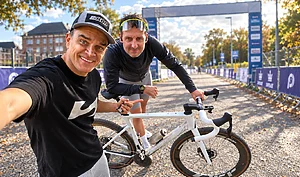
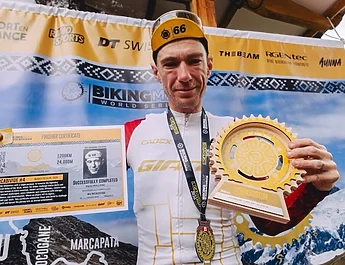
A flat tire on a gravel ride should be nothing more than a minor setback. In a race, however, it can—in a matter of seconds—become the difference between staying in contention and watching the others pull away. So, what should you actually bring when you line up at the start of a long race? An electric pump, CO₂ cartridges, repair patches, an inner tube? Rather than piling on gear “just in case,” we asked Maximilien Andréo, a cyclocross specialist, multiple-time French Masters champion, winner of two Gravel Crit Series races, and a frequent qualifier for the Gravel World Championships. His answer is almost a philosophy: fix it fast, get back on the bike even faster… and still plan for that last-ditch option.
By Jeff Tatard – Photos: DR / Maximilien Andréo
In gravel racing, flat tires are part of the game
There are questions you ask yourself calmly while sitting at your computer, and others you’d rather never have to answer while standing on the side of the road, your heart racing at 170 beats per minute, as fifty competitors pass you by. What do you really need to have under your saddle to save your race?
That’s exactly the question we asked Maximilien Andréo (Max to his friends). Not someone preparing for their first Sunday ride, mind you, but a guy who knows what it means to lose thirty seconds when the others aren’t waiting. His first choice, in fact, is quite revealing. “An electric pump—a safe bet, but you’ve lost the race, that’s for sure… Personally, I use the CO₂ cartridge for racing and the electric pump for training.”

That immediately sets the stage. A mini electric pump can be extremely practical for training: reusable, controllable, and reassuring. But when every second counts, CO₂ still has a considerable advantage: its speed. A cartridge, a compatible valve, and a few seconds can be all it takes to quickly restore pressure.
=> Buy a mini electric pump for €79.99
For gravel riding, pay attention to the cartridge size
You still need to carry enough gas. A gravel tire obviously has a larger volume than a small road tire. Maximilien therefore emphasizes a detail that can turn a successful repair into a second problem: “Be careful with CO₂ cartridges—you have to use the large ones. Otherwise, your tire won’t inflate properly. 25 g.”
However, this advice deserves some qualification: a 25-gram cartridge is a sensible option for ensuring a substantial reserve on a gravel tire, but the amount needed depends on the tire’s volume, the desired pressure, and the situation. And “re-inflating” a tire that has completely come off the rim is never guaranteed with just one cartridge.
Another precaution: CO₂ isn’t compatible with all tire sealants. Some manufacturers claim full compatibility; Pirelli, for example, allows CO₂ with its Cinturato Sealant only for emergency repairs and recommends replacing the sealant afterward, as CO₂ accelerates its coagulation. You should therefore check the recommendations from the manufacturer of your own sealant.

Before inflating, you still need to patch the hole
Because CO₂ obviously doesn’t fix anything. It just puts air back into a tire that you first need to seal. And that’s where Max told us about a little tool that many gravel riders should probably know about: the Dynaplug.
=> Buy the Dynaplug for €55.99
The principle is similar to that of a tubeless plug, but it works particularly quickly. A small plug made of viscoelastic rubber is attached to a metal tip; you push it directly into the puncture and then remove the tool. Dynaplug states that there’s no need to ream the hole beforehand, add any adhesive, or wait for anything to dry.

“Check out their system. It’s really great. It works like a plug, but it saves you a lot of time. ” And for once, the phrase “saving time” isn’t just a marketing gimmick. A recent comparison of tubeless repair kits actually singled out the Dynaplug Racer Pro specifically for competition, particularly because multiple plugs can be preloaded and are immediately available.
Small hole, big hole… and the last-resort plug
Not all punctures, however, tell the same story. Dynaplug offers several tip sizes and plug volumes. The brand specifically recommends the fine tips for small or angular punctures and the Megaplugs for larger holes. Multiple standard plugs can also be combined when the puncture is particularly stubborn.
Max sums up this last option with far fewer technical terms: “It’s really for very big holes. It’s the last-resort plug!” And we really like that expression.
Because in gravel riding, the best repair kit isn’t necessarily the one that perfectly handles a single flat. It’s the one that offers multiple levels of solutions. The preventative plug handles small punctures without you even having to get off the bike. If the hole is too big, the plug comes into play. If a standard plug isn’t enough, a larger plug or multiple plugs can save the day. And only then do you need to reinflate the tire.

The Smart Kit Instead of a Mobile Workshop
So, what should you actually pack under your saddle before a World Series race, a Gran Fondo Gravel event, or simply a long adventure far from home? A readily accessible puncture repair kit, several repair patches (at least one for larger punctures), a CO₂ inflator, one or two cartridges suited to the volume of your tires, and—for a very long ride—a lightweight inner tube as a last resort make for a particularly solid foundation. On a ride where a few minutes don’t matter, a small mechanical or electric pump provides added peace of mind.
And above all: learn how to use all of this before race day. Figuring out how a tire repair kit works with shaky hands, sealant everywhere, and the group disappearing into the distance is a rather poor way to learn. Max sums up his system in one sentence: “That, plus a CO₂ cartridge, and nothing can happen to you. A pit stop takes less than a minute!”
Well, in gravel riding, we might want to avoid promising that nothing can happen to you. A sidewall cut, a damaged rim, or a completely torn tire will always find a way to remind you that nature has more imagination than our saddle bag. But the principle is excellent: don’t carry everything you need to rebuild your bike. Carry exactly what you need to keep riding. Because at the end of the day, a good repair in gravel riding isn’t the one you can proudly boast about at the finish line. It’s the one that got you there.
In short: Max’s kit for gravel racing
No need to turn your saddle bag into a mobile workshop. Here’s what Max actually brings along for races:
The philosophy: fix it fast, inflate it fast, get back on the road fast. The best kit isn’t the one that can fix everything—it’s the one that lets you save your ride without lugging around a toolbox. |

Share the post "Gravel: What a Champion Carries Under His Saddle"