Share the post "Can cycling replace squats?"
A study conducted by researchers at the University of Murcia suggests that specific strength training performed directly on the bike could produce gains comparable to those achieved in the gym with heavy squats. Does this call into question the role of weight training in cycling preparation? Not so fast.
By Guillaume Judas – Photos: depositphotos.com
In recent years, heavy weight training has become an essential part of training for elite cyclists. Exercises such as squats are regularly recommended to improve maximum strength, power, and pedaling efficiency. But a new study published in the *European Journal of Applied Physiology* offers a different perspective: according to its authors, specific strength training performed directly on the bike could yield very similar adaptations.
A simple but very demanding protocol
Researchers at the University of Murcia (Spain) followed 37 trained cyclists for ten weeks. The participants were divided into three groups: the first group followed a heavy squat program, the second performed strength exercises on the bike, while the third simply continued their usual training.

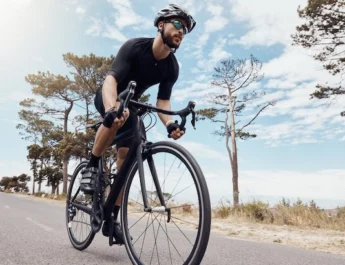
The cycling protocol was intentionally very specific. Twice a week, the riders had to perform between five and eight sets of seven explosive pedal strokes while standing, on a slope of approximately 6%, using a gear ratio high enough to maintain a cadence close to 40 rpm. Each set was separated by three to five minutes of full recovery.
The goal was to generate maximum force on each pedal stroke, replicating the muscle recruitment sought during a heavy strength training exercise.

Gains comparable to squats
At the end of the ten weeks, the two groups that followed a strength training program achieved very similar results. The researchers observed an increase in muscle strength, improved cycling-specific performance, and comparable adaptations in the quadriceps and patellar tendon. In contrast, the control group showed virtually no progress.
According to the authors, the very low cadence combined with a high gear ratio allows for the recruitment of motor units at a high threshold—similar to heavy-load squat exercises—while remaining perfectly specific to the cyclist’s motion.

An attractive option for cyclists
These results could appeal to cyclists who have limited time or lack easy access to a gym. A full workout takes only about 30 minutes, including warm-up and cool-down.
Furthermore, the exercise has the advantage of being perfectly tailored to the pedaling motion, which could make it easier to translate strength gains into cycling performance.
Strength training remains irreplaceable in certain areas, however
The study’s authors caution, however, against drawing hasty conclusions. The participants were exclusively men who were already well-trained. The results therefore cannot be generalized to women, beginners, or older cyclists.
Above all, this study focuses solely on adaptations related to pedaling-specific strength. It does not call into question the numerous benefits of strength training demonstrated by other scientific studies: improved bone density, prevention of sarcopenia, development of overall strength, reduced risk of injury, and maintenance of muscle mass with advancing age.
In fact, several meta-analyses published in recent years show that a well-designed strength training program also improves maximum power, pedaling efficiency, and time trial performance when combined with endurance training.
Key Takeaways
This study offers an interesting insight: when the goal is solely to improve the force applied to the pedals, very short, high-intensity exercises performed on the bike could be a viable alternative to heavy weight training.
However, this does not spell the end of strength training for cyclists. The two approaches seem to be more complementary than competitive. Strength training sessions on the bike offer a practical solution that is highly specific to the cycling motion, while strength training continues to play an essential role in health, injury prevention, and the overall development of physical abilities.
Sources: Romero-Arenas S. et al., European Journal of Applied Physiology (2026)
Share the post "Can cycling replace squats?"