Share the post "Why Van der Poel Won… on the Downhill"
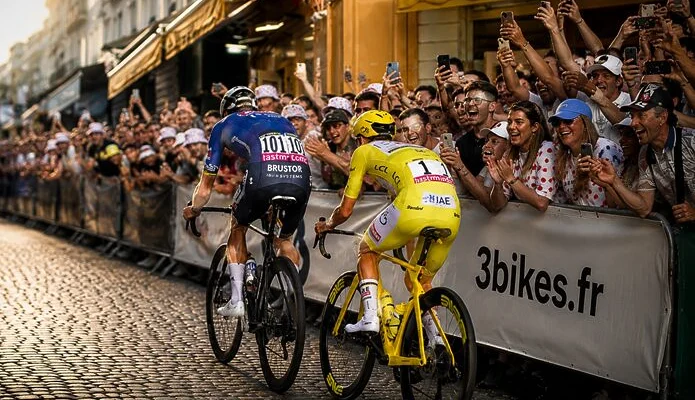
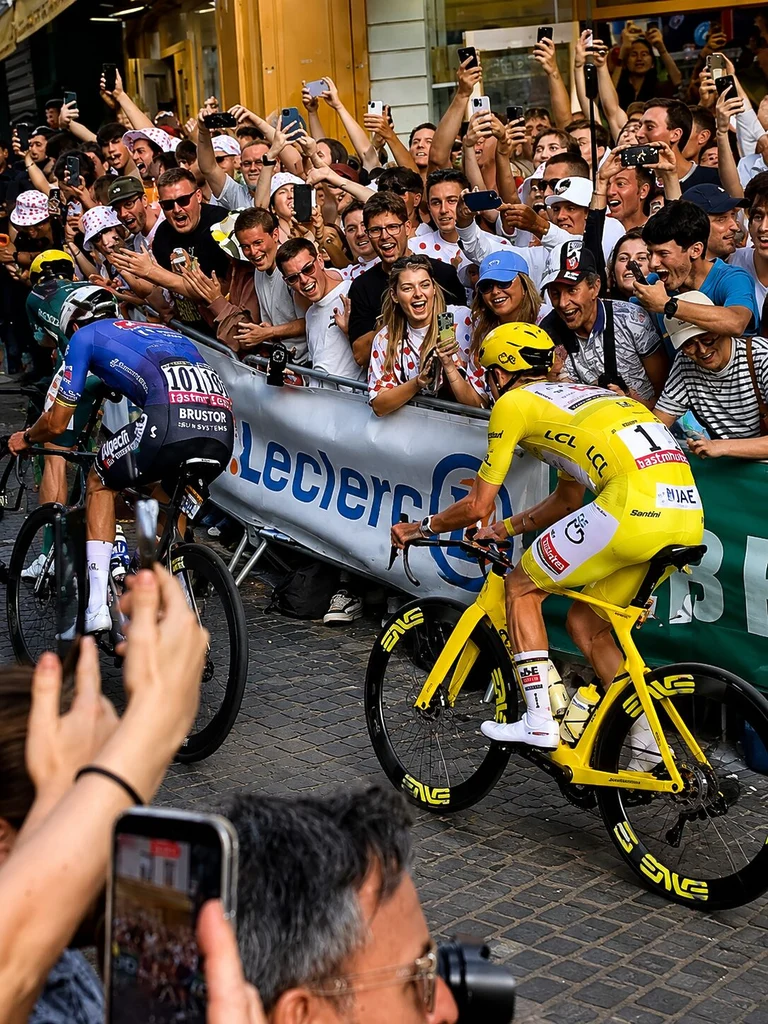
Everyone will remember two images from this final stage of the Tour de France: Mathieu van der Poel breaking away from the peloton with Tadej Pogačar on Rue Lepic, then the yellow jersey resigning himself to letting him go in the final 200 meters of the Champs-Élysées, as if he knew victory had already been decided. Yet, a few days after this display of dominance, the Dutchman’s greatest feat may lie neither in that legendary climb nor in that triumphant finish. It lies between the two, on a descent where the laws of physics should normally have given the peloton a decisive advantage.
By Jeff Tatard – Photos: ©3bikes
The Real Moment the Race Was Decided
At 3bikes.fr, we had some fun looking at the Strava data from several riders… The numbers alone are enough to make your head spin. Nearly 35 km/h on the 5.9% gradient of Rue Lepic on the cobblestones, then over 43 km/h on the final climb up the Champs-Élysées. On Sunday, Mathieu van der Poel delivered one of the most impressive displays of power in recent years.
Naturally, it was that surge up Montmartre that captured everyone’s attention. The footage was magnificent. The gaps were widening, the peloton was shattering, and only Tadej Pogačar still seemed capable of keeping up with the Dutch champion.
But a few kilometers further on, another feat—a much more understated one—was unfolding.
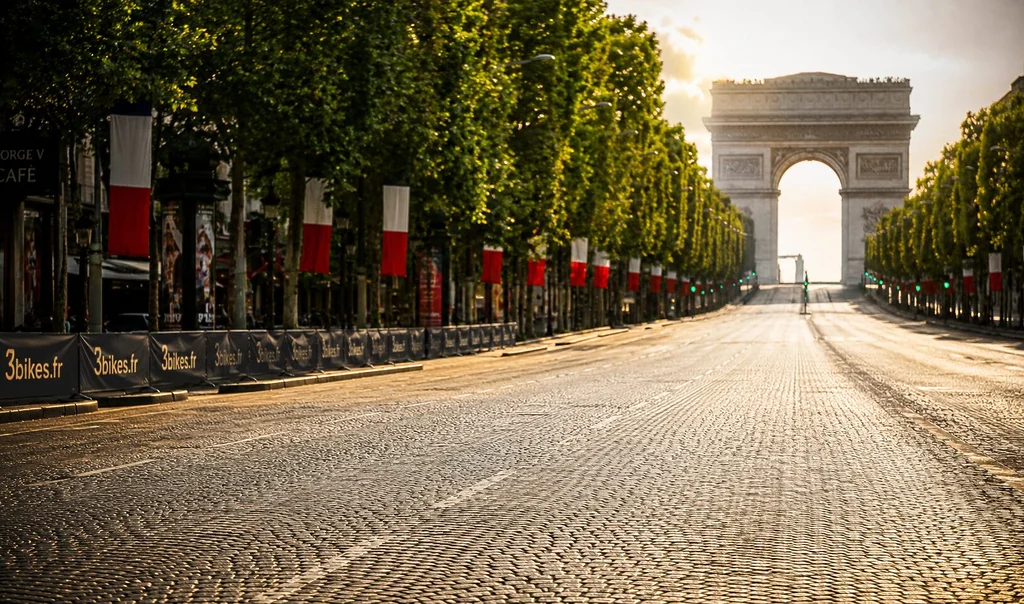
After cresting the top of Rue Lepic, the two riders plunged back down toward the Champs-Élysées, made a U-turn at the Arc de Triomphe, and began the long descent down the avenue in the opposite direction. A wide, straight, and extremely fast stretch where speeds regularly exceeded 65 km/h.
That is precisely where the race should have turned… in favor of the peloton.
When physics takes over from the legs
Intuitively, one might think that two champions of this caliber have enough of an advantage to maintain their lead on a descent. In reality, it’s almost the opposite.
At speeds of 60 km/h and above, air resistance becomes the main adversary. The faster they go, the less the difference comes down to leg strength and the more it depends on aerodynamics.
Behind Van der Poel and Pogačar, the peloton enjoys a considerable advantage. Each rider benefits from the slipstream of the rider ahead. The effort is shared, accelerations require less energy, and the energy saved by each rider adds up. Gradually, the group ceases to be a mere collection of riders and becomes a true aerodynamic machine, capable of maintaining its speed with formidable efficiency.
Studies on slipstreaming show that, in this type of configuration, a large peloton can gain an advantage of about 10 to 20 percent compared to a single rider. It’s no longer a matter of watts. It’s a matter of physics.
In other words, Rue Lepic allowed Mathieu van der Poel to open up a gap. But it was the long descent down the Champs-Élysées that should normally have allowed the peloton to close it.
The larger the group… the faster it gets
The phenomenon goes beyond the slipstream provided by the rider directly in front of you.
The larger a peloton is, the greater its aerodynamic efficiency becomes. Riders in the heart of the group are protected on all sides: by those ahead of them, but also, to a lesser extent, by those around them and even by those behind them. Turbulence is dispersed, airflow becomes more favorable, and each rider expends less energy to maintain a high speed.
This is, in fact, a sensation that all cyclists are familiar with, though they don’t always know how to explain it. Riding in the middle of a peloton is often easier than riding at the back. And the difference becomes even more striking when you find yourself alone at the front of the group.
The easiest way is to experience it for yourself. On your next ride, choose a descent you know well. Ride it once on your own, then a second time in the middle of a group. Finally, let yourself drift to the back of the pack. Just keep an eye on your speedometer and how you feel. You’ll quickly discover that the peloton is much more than just a collection of cyclists: it’s a system that naturally amplifies its own speed.
The lesson from Kipchoge’s marathon
This phenomenon is well enough known to have been exploited during Nike’s famous Breaking2 project, when Eliud Kipchoge became the first man to run a marathon in under two hours under experimental conditions.
At the time, many were surprised to see pacers not only in front of him… but also behind him. Yet this choice was by no means trivial. The pacers positioned at the front were tasked with cutting through the air. Those positioned at the back also helped improve airflow by limiting the turbulence that formed in the Kenyan champion’s wake.
This strategy, meticulously planned down to the smallest detail by engineers and fluid dynamics specialists, highlighted a simple truth: at high speeds, every athlete affects the aerodynamics of the others.
In cycling, where speeds regularly exceed 60 km/h, this phenomenon takes on an even more spectacular scale.
Why Van der Poel’s victory is even more impressive
This is undoubtedly where Mathieu van der Poel’s true feat lies.
For several kilometers, he didn’t just hold his own against the world’s best riders. He held his own against a peloton racing at full speed, propelled by its collective momentum and by the aerodynamic advantage that the laws of physics naturally grant the group.
When Tadej Pogačar finally let Mathieu van der Poel break away in the last 200 or 300 meters, the image was striking. It looked less like a defeat than a decision. It was as if the Slovenian had realized that the real opponent was no longer the Dutchman, but the peloton charging up behind them. At that moment, perhaps it was no longer a question of which of the two was stronger, but which one had to give way so that their breakaway could survive until the finish line.
But the story may have begun much earlier. It was likely written on that long descent where everything seemed to doom a man—alone, or nearly so—to being caught.
So on Sunday, Mathieu van der Poel didn’t just win a stage of the Tour de France. For a few kilometers, he achieved what the laws of physics themselves normally make nearly impossible.
=> Relive the atmosphere on Rue Lepic: where the Tour de France rediscovered its soul
=> 2026 Tour de France: Mathieu Van der Poel wins a LEGENDARY duel in Paris! Video highlights of Stage 21
Share the post "Why Van der Poel Won… on the Downhill"