Share the post "Rue Lepic: Where the Tour de France Rediscovered Its Soul"
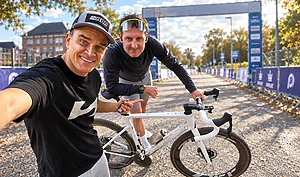
There are days that go beyond mere athletic results. Days when victory matters almost less than what it sparks around it. At 3bikes, we had the opportunity to follow this final stage of the 2026 Tour de France from the paddocks thanks to our press credentials. However, we deliberately chose a different path: to leave the backstage area and join the fans. Several hours before the riders passed by, we set up about fifty meters from the top of Rue Lepic, in the heart of this cobblestone climb that had become the setting for an already historic finish. What we experienced there almost surpassed Mathieu van der Poel’s incredible feat. We rediscovered what makes the Tour de France so much more than just a cycling race: a shared sense of excitement capable of bringing together hundreds of thousands of people united by a single passion.
By Jeff Tatard – Photos: 3bikes
We chose the street over the backstage area
The privilege of press accreditation often grants access that many dream of experiencing: the paddocks, the team buses, the technical zones, and the moments when champions prepare away from prying eyes. It’s a fascinating world, where you can observe the final adjustments, the focused faces, and the exchanges with the sports directors. We could have spent that day among the world’s best riders. Instead, we chose to experience it with those for whom they ride: the fans.

This choice was by no means a coincidence. For several days, one street had been coming up in every conversation: Rue Lepic. This cobblestone climb in Montmartre, included three times in the final stretch of this last stage, promised to offer an unprecedented spectacle. So we decided to set up about a hundred meters before its summit, at a spot offering an ideal view of the riders just as their effort was reaching its peak.
But long before the peloton came into view, something else was already happening.
As the hours passed, the street filled with an incredibly diverse crowd. Entire families had brought their lunches. Children were drawing with chalk on the cobblestones. Supporters from the Netherlands, Belgium, Denmark, Slovenia, France, and the United Kingdom naturally exchanged a few words despite the language barrier. Flags fluttered from the windows. Applause already greeted every single vehicle from the organizing committee. For a few hours, this Parisian street no longer belonged to a single neighborhood. It belonged to the world of cycling.
In an era when we often hear talk of divisions, tensions, and individualism, there was something deeply comforting about this simplicity. No one asked where their neighbor was from. No one cared about their age or occupation. We were simply brought together by the joy of waiting together for the world’s greatest champions.

When Paris Turned into a World Championship
From a sporting perspective, this final stage will go down as one of the most memorable in the modern history of the Tour de France. For decades, the finish on the Champs-Élysées followed an almost unchanging script: a long procession celebrating the yellow jersey, a few photos of the leaders, then a mass sprint to cap off three weeks of effort. Last year, Wout van Aert had already ushered in a new era by winning a final stage that was finally contested. This year, Mathieu van der Poel definitively cemented it. By retaining the route through Montmartre and its three ascents of Rue Lepic, the organizers didn’t simply modify a course—they changed the very nature of this Parisian finish. What was once merely an epilogue has become a showdown where the greatest champions can now battle it out right down to the last kilometer.
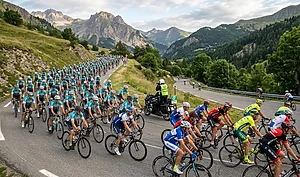
Very quickly, the tension rose a notch. Then another. Then a third. With each pass through Rue Lepic, the race intensified. The surges grew more aggressive, the gaps widened, and teammates dropped out one after another, gradually leaving the leaders alone to face their fate. And what leaders they were… Mads Pedersen. Remco Evenepoel. Tadej Pogačar. Mathieu van der Poel. Seeing them surge past just a few meters away from us will undoubtedly remain one of the greatest memories of our lives as cycling enthusiasts. On TV, we admire their talent. At the roadside, we suddenly realize just how immense they are. We hear their breathing, the metallic clatter of drivetrains under strain, the tires pounding the cobblestones, and the cheers growing louder as the group approaches. The speed is so intense that it seems almost unreal. In a matter of seconds, they appear, race past you, and then vanish over the summit, leaving behind a silence that is immediately replaced by the spectators’ awe-struck comments.

For nearly two hours, Paris ceased to simply host the Tour de France finish. Paris became a classic race in its own right. For a moment, it was hard to tell whether we were watching the Tour de France, the Tour of Flanders, or a world championship race on a demanding circuit. Each climb up Rue Lepic ramped up the intensity a little more, until the moment Mathieu van der Poel chose his moment. A burst of speed. A few meters. Then a gap that grew wider. Behind him, the world’s best riders tried to respond. Before our eyes, history was already being made. And then there was Tadej Pogačar. While no one could say for sure whether it was a matter of tactics, mutual admiration, or simply the logic of the race, it almost felt as though the Slovenian was supporting the Dutchman’s effort rather than trying to crush it. On several occasions, he seemed to maintain a pace high enough to prevent an immediate comeback by the sprinters’ group, without ever delivering the decisive blow himself. A kind of camaraderie between two great champions who respect each other as much as they challenge each other. We’ll probably never know what they said to each other… or even if they needed to say anything at all. But that impression lingered. And when Mathieu van der Poel finally turned onto the Champs-Élysées with just a few precious lengths to spare, we found ourselves thinking that this victory might also bear a bit of Tadej Pogačar’s invisible signature.
It had been nearly ten minutes since the riders had passed. Yet no one was moving. It was almost surreal. Thousands of people remained glued to their seats, their eyes fixed now on the Champs-Élysées, now on their phone screens. The networks were overwhelmed. One broadcast would cut out, another would come on. So, spontaneously, phones were passed from hand to hand. Here, we were following the race on a French channel. A few meters away, a group of Dutch people were commenting on the footage in their own language. A German fan was translating what he’d just heard. Further still, a Spaniard announced that Van der Poel was still holding on. For a few minutes, Rue Lepic became a huge open-air newsroom where everyone was their neighbor’s correspondent. We didn’t know each other. We didn’t necessarily speak the same language. But everyone was trying to make sense of the same story.
Then a roar rose from the Champs-Élysées. It swept through Paris even before the footage reached us. In a matter of seconds, the news spread from one phone to another, from one language to another, from one smile to another: Mathieu van der Poel had just won the Tour de France… in his own way. The entire Rue Lepic erupted with joy, as if everyone felt they’d been cheering him on all the way to the finish line.
A few moments later, the images appeared on the screens. Exhausted by an extraordinary effort, Mathieu van der Poel didn’t even have the strength left to celebrate his victory. His arms remained at his sides. That’s when his teammate, Jasper Philipsen, who finished second in the stage, raised his arms for him. A gesture of disarming simplicity, yet one of incredible power. As if, within a team, some victories were too great to belong to just one man. And one couldn’t help but think back to those final kilometers, where Tadej Pogačar—though we’ll never know whether it was a tactical move, a sign of respect among champions, or simply racing instinct—seemed to help maintain just enough intensity to prevent the sprinters from making a comeback. We’ll probably never know if that impression was accurate. But it spoke to something beautiful: the respect that the greatest champions have for one another can sometimes write the most beautiful chapters in sports.

At that moment, there were no longer any French, Dutch, Belgians, Slovenians, Mexicans, Ecuadorians, Spaniards, or Danes. There were no longer different jerseys, no more rivalries, no more favorites. There were only cycling enthusiasts, united by an emotion that only a great race can inspire. We all knew, without needing to say it, that we had just witnessed one of those moments that transcend the realm of sports. In twenty years, we will no doubt have forgotten the time gaps, the watts, or even the exact sequence of events in the race. However, we will remember perfectly what we felt that Sunday at the top of Rue Lepic. For the greatest moments in sports are never etched in memory for their statistics. They are etched in memory for the emotions they left in the hearts of those who experienced them.
Perhaps the most beautiful spectacle wasn’t on the road
As we left Montmartre, a thought was already on our minds. Yes, we had witnessed an extraordinary stage. Yes, we had just seen some of the greatest riders of their generation deliver a finale of exceptional intensity. Yes, we had also just witnessed yet another demonstration of what makes Mathieu van der Poel so unique in the history of modern cycling. The Dutchman is almost never content with just winning. He wins by leaving a story in his wake. His victories rarely amount to just another entry on a list of achievements. They become tales that fans continue to recount years later.
Who could forget his incredible claim to the yellow jersey at Mûr-de-Bretagne in 2021, when—after an almost superhuman effort—he clawed out the few seconds needed to honor the memory of his grandfather, Raymond Poulidor? Who could forget his daring attacks on the cobblestones of Paris-Roubaix, his feats at the Tour of Flanders, his world titles, or that almost childlike belief that, as long as there’s one meter left to go, anything is still possible? Every victory seems destined to be a feat. As if the simple act of winning were never enough to fuel his imagination.

This final stage of the Tour de France already belongs in that category. Because he didn’t wait for a sprint. Because he dared to attack the world’s best riders on a course where anyone could still believe in victory. Because he held on until the very end, driven by his talent, but also, perhaps, by that sense of mutual respect that seemed to unite the champions in the final kilometers. At the top of Rue Lepic, we obviously couldn’t have known that he would succeed. But when news of his victory came in from the Champs-Élysées, we immediately realized that we had just witnessed one of those days that enrich the collective memory of cycling.
And yet, the most vivid memory was perhaps not that of the race itself.
It was all around it. In those thousands of people willing to wait for hours for just a few seconds as the riders passed by. In those children raising their arms as if the riders were going to wave to them personally. In that applause that continued long after the last vehicle had passed. In those strangers who spontaneously shared a bottle of water, a smile, a phone screen, or a few words to describe what was happening a few kilometers further down the road.
When we spend so much time watching cycling on a screen, we sometimes forget what makes it so unique. Unlike most major sporting events, the Tour de France doesn’t separate the champions from the public. It brings them together. No stadium, no arena, no barrier can replace this almost surreal closeness between the world’s best cyclists and those who admire them. For just a few seconds, they pass within a few dozen centimeters of you. And those few seconds are sometimes enough to create a memory that will last a lifetime.

An Inestimable Treasure for Cycling Culture
We often speak of heritage when we mention legendary mountain passes, the cobblestones of Paris-Roubaix, or the switchbacks of Alpe d’Huez. But cycling’s heritage isn’t limited to its roads. It’s also built on the emotions these roads evoke. Rue Lepic has likely just joined this category. Not simply because Mathieu van der Poel achieved one of his greatest feats there.
But because hundreds of thousands of people shared a day there that they will remember for a long time. The youngest among them may one day recount that they were there. The older ones will compare this atmosphere to cycling’s golden age. Photographers will preserve magnificent images. Journalists will cover the race. But what everyone will truly take away is a sense of emotion. And it is precisely this emotion that builds cycling’s culture. It is passed down from parent to child. From a veteran to a beginner. From an enthusiast to someone just discovering the sport.
That’s why days like this have a value that far exceeds a general classification. They enrich the history of cycling. They strengthen its identity. They inspire new enthusiasts to hop on a bike. And that’s priceless.
And to conclude… On Sunday, it wasn’t just Mathieu van der Poel who won. It was the Tour de France.
History books will, of course, record the winner’s name. They’ll recount Mathieu van der Poel’s attack, his flair, his mastery, and this exceptional victory at the end of a final stage that has already become legendary. They’ll also note that the decision to route the Tour through Montmartre transformed a finish often reserved for sprinters into a finale worthy of the greatest classics. That’s what sports history will remember. But we believe something even greater happened.

For a few hours, the Tour de France reminded us that it wasn’t just the world’s greatest cycling race. It’s also one of the last events capable of evoking such intense collective emotion. In a society where people often watch sports from behind a screen, hundreds of thousands of people had chosen to be there, together, simply to share a moment that would last only a few seconds.
That day reminded us that cycling isn’t just about power, tactics, or technology. It’s first and foremost about men, women, children, tradition, and emotions. By choosing to leave the paddocks and head to Rue Lepic, we simply thought we’d find the best spot to watch the race. In the end, we found so much more. We rediscovered the soul of the Tour de France. And if, twenty years from now, someone asks us what we remember most about that final stage in 2026, we probably won’t talk about the watts produced, the time gaps, or even Mathieu van der Poel’s speed. We’ll talk about a street. A crowd. Thousands of smiles.
And of that almost reassuring certainty that as long as the Tour de France is capable of making so many hearts beat in unison, it will remain much more than a race: it will remain a living heritage, one of the most beautiful expressions of our sporting and popular culture.
=> Discover Montmartre
Share the post "Rue Lepic: Where the Tour de France Rediscovered Its Soul"