Share the post "Lactic acid: Turn that burn into power"
Can you feel it—that burning sensation in your legs? It builds up gradually. Your thighs tighten, your muscles seem to be on fire, and every pedal stroke becomes a struggle. For a few seconds, you even wonder if you’ll be able to make it to the top of the hill or to the finish line. Every cyclist knows this feeling. And for decades, a prime culprit has been identified: lactic acid. Yet the reality is quite different. Here’s what’s really happening in your body and how to learn to harness this pain to turn that famous “burn” into a real performance advantage.
By Guillaume Judas – Photos: depositphotos.com, DR
Take the finish of the final stage of the 2026 Tour de France. With just a few hundred meters to go, Mathieu van der Poel and Tadej Pogacar have only a five-second lead over a frenzied peloton hot on their heels. The Dutch rider then decides to go all out by launching his sprint from a distance, even though he’s already been on the breakaway for about ten kilometers. His lead seems sufficient, but behind him, the peloton is closing in at breakneck speed. The final meters feel endless. His legs were burning, every pedal stroke became harder, and faces tensed up. Van der Poel gritted his teeth and ultimately held on to a half-bike-length lead to win after an exceptional finish.
https://www.youtube.com/watch?v=1_uVI1PxwMw
At that precise moment, his body is producing a phenomenal amount of lactate. And yet, it’s not that lactate that’s slowing him down. On the contrary. It is precisely because Van der Poel is capable of producing so much of it, recycling it quickly, and continuing to generate exceptional power despite this buildup that he ranks among the world’s best sprinters. His ability to tolerate lactate has become one of his most formidable weapons.
For here’s the paradox: the better a cyclist performs, the more lactate he is capable of producing… and, above all, of using it effectively. Far from being a poison, lactate is now considered a true fuel, a signaling molecule, and an excellent indicator of an athlete’s physiological capabilities.
So, why do we feel that famous “burn”? What’s really happening in the muscles during a sprint or an attack? Can we learn to better tolerate these extreme efforts? These are all questions to which modern physiology now provides answers that are very different from what was still being taught just a few years ago.
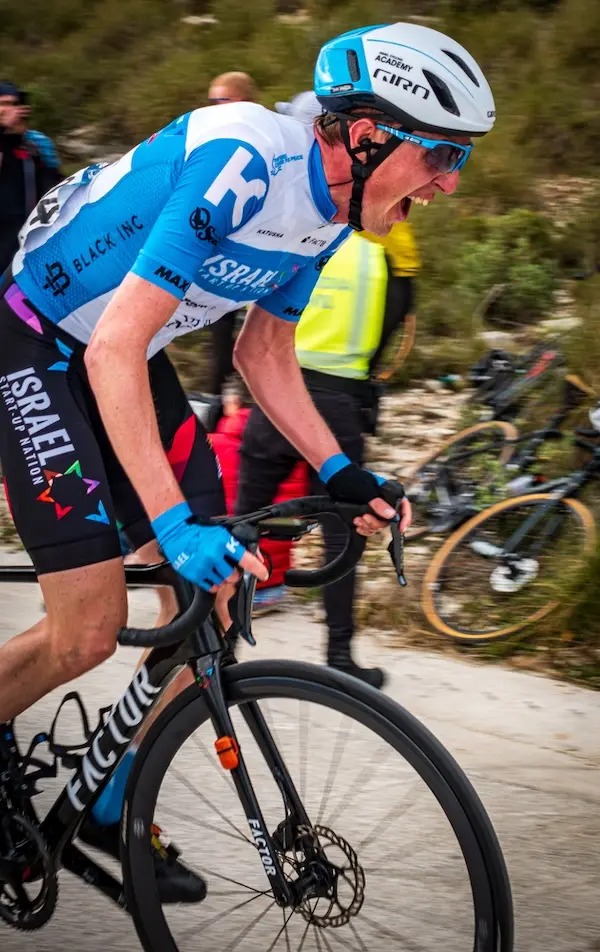
Lactate: The False Culprit That Long Took the Blame
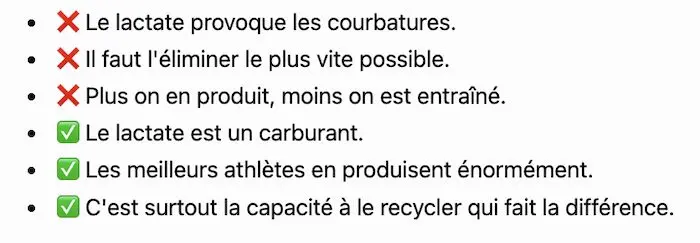
For a long time, scientists thought they had found the culprit behind that burning sensation that takes over the muscles during intense exertion. After all, the observation seemed obvious: the more intense the effort, the higher the lactate levels in the blood. Since the two phenomena occurred simultaneously, it seemed logical to conclude that the former caused the latter.
This theory prevailed for decades. Lactic acid was then viewed as a metabolic waste product that needed to be eliminated as quickly as possible. However, research conducted over the past thirty years shows that lactate is neither a toxin nor a useless byproduct, nor is it directly responsible for muscle soreness. On the contrary, it plays an essential role in energy production and in the adaptations that help you become a better cyclist.
First important point: lactic acid, strictly speaking, hardly exists in the body. As soon as it is produced, it dissociates almost instantly into two components:
- Lactate, a negatively charged ion
- Hydrogen ions (H⁺)
And it is precisely this distinction that changes everything.
Common Misconceptions About Lactate
|
Why do your legs really burn?
When you tackle a hill at full speed or launch into a sprint, your muscles suddenly demand an enormous amount of energy. This demand is so great that the aerobic system—which uses oxygen to produce energy—can no longer keep up. Your body then ramps up another process: glycolysis, a metabolic pathway capable of rapidly producing ATP, the energy currency of your muscles.
This reaction produces, among other things, hydrogen ions. When their concentration becomes high, the chemical balance of the muscle cell is disrupted. Enzymes function less efficiently, muscle fibers contract with greater difficulty, and that familiar burning sensation gradually sets in. So it’s not the lactate that’s burning. It’s simply present at the same time as H⁺ ions, which are primarily responsible for this temporary acidification of the muscle.
Lactate is, above all, a solution
Let’s take the example of Mathieu van der Poel again. When he launches a devastating surge or generates more than 1,200 watts during a sprint, his muscles consume energy at a dizzying rate. To sustain this effort, glycolysis runs at full capacity. During this process, glucose is converted into a molecule called pyruvate. When the mitochondria—the cells’ true powerhouses—can no longer process this pyruvate quickly enough, it is converted into lactate.
This conversion is not a problem. On the contrary, it is a sign of excellent adaptation. It allows for the regeneration of an essential molecule, NAD⁺, without which glycolysis would stop almost instantly. This means that lactate production allows the muscle to continue generating energy when the intensity becomes extreme. Without this mechanism, a sprint or an all-out effort lasting several tens of seconds would simply be impossible. Lactate is therefore much more of a lifesaver than a saboteur.
Energy That Isn’t Wasted
For a long time, it was thought that lactate accumulated in the muscles before being slowly eliminated after exercise. The reality is more complex. As soon as it is produced, lactate begins to be used elsewhere in the body. The most endurance-oriented muscle fibers can recover it to produce new energy. The heart also consumes it with remarkable efficiency. The liver can convert it into glucose through the well-known Cori cycle, while other muscles reuse it almost immediately.
In fact, lactate constantly circulates between the body’s various tissues like a veritable energy shuttle. This discovery has profoundly changed the way physiologists view performance. Lactate is no longer considered merely a byproduct of a reaction, but rather an extremely valuable energy currency.
Champions produce… more lactate
This may seem counterintuitive. One might think that the best riders produce less lactate than others. Often, the opposite is true. A rider like Mathieu van der Poel is capable of generating power outputs that few athletes can sustain. To reach such levels, his glycolysis operates at an exceptional intensity, leading to massive lactate production.
The difference, therefore, lies not in the amount produced, but in his ability to transport it, recycle it, and continue generating power despite its accumulation. This is due in particular to a highly developed network of mitochondria, a high capillary density, and specialized proteins—called MCT-1 and MCT-4 transporters—that facilitate the exchange of lactate between cells. To put it simply, a trained runner doesn’t try to avoid lactate. He learns to live with it. Better yet: he learns to use it.
If lactate isn’t your enemy, why does there come a point when your legs simply refuse to move forward? The answer lies in one word: balance.
The lactate threshold: the line between control and collapse
If lactate isn’t your enemy, why does there come a point when your legs simply refuse to move forward? The answer lies in one word: balance. Your body produces lactate constantly. Even during a leisurely endurance run, your muscles produce it. But at low intensity, it’s immediately consumed by muscle fibers, the heart, or the liver. The balance is perfectly maintained: what’s produced is just as quickly reused.
The problem arises when the intensity increases. Above a certain level of effort, lactate production outpaces the body’s ability to recycle it. The lactate level in the blood then begins to rise gradually. This is what physiologists call the first lactate threshold, or LT1.
- LT1: Where the Real Work Begins
For most trained cyclists, LT1 corresponds to a blood lactate concentration of about 2 mmol/L. At this intensity, you’re still perfectly capable of holding a conversation, even if your sentences get a little shorter. Your legs still feel fresh, and you can sustain the effort for a long time. This is the ideal zone for endurance rides.
It’s sometimes considered monotonous, but this is where a large part of your performance is built. The long hours spent at this intensity develop mitochondria, improve blood flow to the muscles, and increase their ability to recycle lactate. The longer you ride at this intensity, the more efficiently your body uses lactate as fuel. This is one of the reasons why professional cyclists spend a large portion of their training time at relatively moderate intensities. They don’t ride slowly just because they can. They ride slowly because they know why they’re doing it.
- LT2: When Every Minute Counts
By further increasing the intensity, we reach a second tipping point: the second lactate threshold, also known as LT2, the anaerobic threshold, or, in some protocols, MLSS (Maximum Lactate Steady State). Lactate concentration generally hovers around 4 mmol/L at this point, although this value varies from person to person.
At this level, lactate production consistently exceeds the body’s ability to recycle it. Blood lactate concentration rises rapidly. Your legs feel heavy. Your breathing quickens significantly. Your concentration is at its peak. Maintaining this intensity becomes a balancing act. For a well-trained cyclist, it can be sustained for 30 to 60 minutes, depending on fitness level and conditions.
It is precisely this intensity that often corresponds to the FTP (Functional Threshold Power) used by many cyclists equipped with a power meter. The higher your LT2, the more power you are able to generate for a longer period of time.
The Van der Poel Case
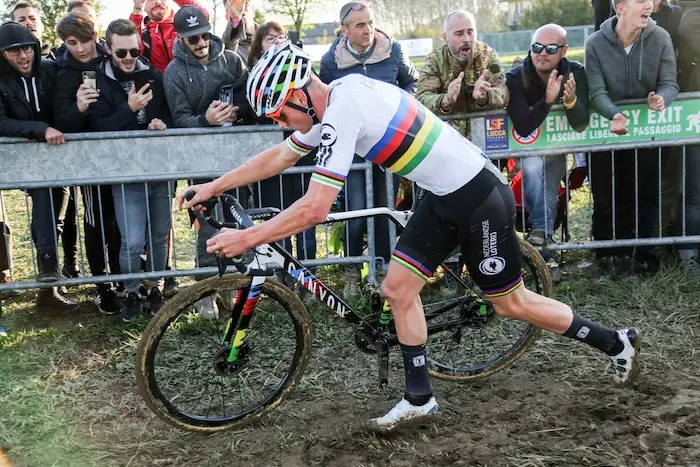
Let’s return to Mathieu van der Poel. When he attacks in a classic race or launches his sprint on the Champs-Élysées, he far exceeds his LT2. His body then produces lactate at a remarkable rate. Yet he continues to accelerate. Why? Because years of training have profoundly altered his physiology. His muscles contain more mitochondria, feature an extremely dense capillary network, and transport lactate more efficiently from one muscle fiber to another thanks to MCT transporters. His heart itself plays an active role in this recycling process.
This means that while an amateur cyclist’s legs would lock up after a few dozen seconds, Van der Poel continues to generate power because his body recycles lactate much more efficiently. This doesn’t mean he isn’t suffering, but simply that he is able to endure that suffering for longer.
When Mathieu van der Poel attacks one kilometer from the finish, he isn’t experiencing this sensation for the first time. He has repeated it hundreds of times in training. His training sessions replicate the demands of the classics: explosive accelerations, surges out of turns, sequences of bumps, and constant changes in pace. His body has learned to keep generating power even when lactate levels are already very high. This is one of the major differences between a professional rider and an amateur.
Can you raise your lactate threshold?
The good news is that yes, you can. And it’s probably one of the most important adaptations a cyclist can strive for. Pushing your lactate threshold doesn’t mean preventing lactate production. It means being able to ride faster—or generate more watts—before the buildup of lactate becomes a problem.
Let’s take an example. Two cyclists weigh the same. The first reaches their LT2 at 250 watts. The second at 300 watts. Both produce lactate. But the second can ride 50 watts harder before their body becomes overwhelmed. On a 20-minute climb, the difference can be significant. This is precisely what the world’s best riders are aiming for: not to eliminate lactate, but to push that threshold farther and farther. And this ability can be developed.
How can you learn to manage lactate better?
Unlike genetics or age, your ability to produce, transport, and recycle lactate is largely influenced by training. So you can always learn to better tolerate those efforts that, even today, make you feel like your legs are about to explode. But be careful: the method is often the opposite of what many people imagine. To better handle very intense efforts… you first have to be willing to ride slowly. That’s where the real work begins.
If there’s one mistake many cyclists make, it’s thinking they need to string together high-intensity sessions to build lactate tolerance. It’s exactly the opposite. The world’s best cyclists spend nearly 80% of their training time at relatively low intensities. This distribution, known as the 80/20 rule, involves doing about four out of every five workouts at a basic endurance level and only one out of every five at high intensity. That’s because it’s by developing your aerobic capacity that you improve your ability to process lactate.
If there’s one mistake many cyclists make, it’s thinking they need to string together high-intensity sessions to better tolerate lactate.
This may seem counterintuitive. To better handle intense efforts, you first need to learn to ride for long periods… without hurting yourself. Long endurance rides promote the development of mitochondria—the tiny powerhouses found in muscle cells. The more mitochondria you have, the better they are at using lactate as an energy source.
Endurance also increases the density of the capillaries that supply blood to the muscles, thereby improving oxygen exchange and nutrient transport. Finally, it stimulates MCT-1 transporters—specialized proteins that allow lactate to be rapidly captured and reused.
Thus, as intensity increases, your body becomes much more efficient at clearing lactate as it is produced. Professionals know this all too well. Behind the spectacular images of attacks on mountain passes or sprints at over 70 km/h lie hundreds of hours spent riding at a steady, relaxed pace. This work may not be spectacular, but it is essential.
Threshold Training: Learning to Push Your Limits
Once this foundation is built, it’s time to train around the famous LT2. The goal is no longer just to clear lactate, but to learn how to maintain high power output while staying close to your physiological limit. So-called tempo, sweet spot, or threshold sessions are ideal for this.
They involve, for example, completing two or three 10- to 15-minute intervals at an intensity between 90% and 100% of your FTP, separated by a few minutes of recovery. The effort is sustained but remains manageable. You focus on your breathing. Your legs gradually warm up. The temptation to slow down arises. It is precisely in this zone that your body learns to better manage lactate buildup. For most amateur cyclists, one session of this type per week is more than enough.
Above the threshold: getting used to the burn
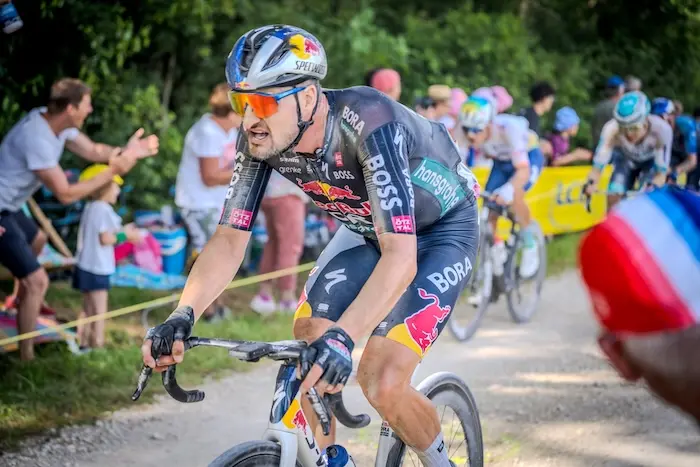
This is probably the type of training that cyclists immediately think of when they talk about lactate training. In this case, the goal is to deliberately exceed your threshold to accustom your body to functioning despite a significant buildup of lactate.
Several formats are particularly effective. Intervals of 3 to 5 minutes performed at an intensity close to your maximum aerobic power (MAP) or VO₂max develop both your cardiovascular capacity and your ability to tolerate high lactate concentrations. So-called “over-under” exercises are also very beneficial. They involve alternating a few minutes slightly above your threshold with a few minutes slightly below it, without a full recovery. Your body never has time to completely eliminate the lactate produced. It gradually learns to recycle it while continuing to exert significant effort.
Another classic: very intense 30- to 60-second intervals, with intentionally incomplete recovery periods. As the intervals progress, your legs feel heavier and heavier. It is precisely this sensation that you aim to master.
| Objective | Example |
|---|---|
| Endurance | 2 hours in Zone 2 |
| Threshold | 3 × 12 min at 95–100% FTP |
| Sweet Spot | 2 × 20 min at 88–94% FTP |
| Over-Under | 6 × (2 min at 105% / 2 min at 90%) |
| VO₂max | 5 × 4 min at 110–115% FTP |
Can you overdo it?
At this point, a question arises: if threshold training is so effective, why not do it several times a week? Because that’s precisely the best way to plateau—or even regress. Lactate is your ally. Overtraining, on the other hand, never is. A common mistake is believing that progress depends solely on the difficulty of your workouts. In reality, it’s during recovery that your body adapts. After an intense session, opt for active recovery: a few minutes of easy pedaling promotes blood circulation and speeds up the utilization of lactate.
Sleep also plays an essential role, as does nutrition. Glycogen stores must be replenished quickly after the most demanding sessions to promote adaptation and ensure you’re in good condition for subsequent workouts. In short, a workout only leads to progress if it is followed by appropriate recovery.
Understanding the role of lactate is one thing. Adapting your training is another. While it’s possible to push your lactate threshold and improve your tolerance for intense effort, trying to go too fast is often counterproductive. When it comes to training, patience remains one of the most important qualities.
In their eagerness to make rapid progress, some cyclists almost always ride at a high intensity. Every hill becomes a challenge, every ride a race against the clock. In the short term, this approach may seem to work. But as the weeks go by, fatigue sets in, recovery becomes incomplete, and performance eventually plateaus. If every ride leaves your legs aching, there’s a good chance you’re riding too fast… too often.
After age 50, recovery becomes a key factor in performance
Age by no means means your performance is doomed to decline. However, it does change some of the rules of the game. Over the years, your ability to recover gradually decreases. Physiological adaptations often take a little longer, and tissues take more time to return to full capacity after intense exercise.
This doesn’t mean you should give up on threshold training or maximum aerobic capacity (MAC) workouts. On the contrary. These sessions remain essential for maintaining power, muscle mass, and cardiovascular fitness. However, they should be spaced out more effectively. For a cyclist over 50, one intense session per week is often sufficient, supplemented by a substantial amount of endurance training and some strength-building exercises. Quality then becomes far more important than quantity. This is, in fact, a philosophy adopted by many former professionals who continue to ride at an excellent level long after their careers have ended.
Listen to how you feel as much as you listen to your bike computer
Power meters, smartwatches, and physiological analyses are remarkable tools today. But they should never make you forget one essential indicator: how you feel. Unusual fatigue, an abnormally high heart rate, heavy legs for several days, or a lasting drop in motivation should serve as warning signs. The best training isn’t the one you follow blindly. It’s the one you know how to adapt.
The indicator light of an engine running at full throttle
Mathieu van der Poel didn’t win the final stage of the Tour de France because he produced less lactate than his rivals. He won because his body was capable of producing enormous amounts of it, recycling it with exceptional efficiency, and maintaining a power output that few riders can achieve when their legs are burning. That’s the whole difference.
Lactate isn’t an enemy to be fought. It’s a sign that your engine is running at full throttle. Better yet, it’s a powerful fuel that your body gradually learns to use through training. That famous “burn” that all cyclists know will never completely go away. It’s part of the sport, the effort, and sometimes even the joy of pushing your limits. However, you can learn to delay it, cope with it better, and continue to perform effectively despite it. That’s what modern training is all about.
The next time your thighs start to heat up on a climb or as you launch into a sprint, you might not view that sensation in the same way anymore. You’ll know that your body is simply activating one of its most sophisticated mechanisms. And that with patience, a systematic approach, and plenty of kilometers, it can become one of your best allies.
Share the post "Lactic acid: Turn that burn into power"