Share the post "Tour: gels or real food, does the body tell the difference?"
For several years now, the pockets of Tour de France riders have looked more like portable laboratories than pantries. Gels, carbohydrate drinks, fruit pastes, energy bars, gummies, liquid concentrates… each intake is calculated, timed, and weighed to the nearest gram. The best are now capable of ingesting up to 120 grams of carbohydrates per hour, almost twice as much as just ten years ago. A spectacular evolution that has profoundly changed the way of racing. But behind this sophistication lies a much simpler question: does the body really differentiate between an energy gel, a banana, or a piece of rice cake? After understanding why the intestine becomes the fragile link in performance, this third part of our dossier explores what happens when energy finally arrives before it. Because between what we swallow and what the body actually uses, the gap is sometimes immense.
By Jeff Tatard – Photos: © Du Bon Sens dans Mon Assiette
The Invisible Body of the Tour de France – Part 3/4
After discovering, in the first part, who Nina Voit is and the philosophy that guides her approach to nutrition, then understanding, in the second part, why the intestine often constitutes the true limiting factor in performance, we now turn to the third episode of our series dedicated to the invisible body of the Tour de France.
This time, we are interested in a question that fuels many debates, among both professional riders and amateurs: does the body really differentiate between an energy gel and a banana? Behind this seemingly simple question lie physiological mechanisms much more complex than they appear.
For a long time, cyclist nutrition seemed relatively simple. Riders ate before the race, slipped a few bars into their jersey pockets, sometimes a banana or a sandwich during long classics, then waited for dinner to replenish reserves.
Today, everything has changed. World Tour teams have nutritionists, cooks, individualized protocols, and products developed specifically to meet the physiological demands of Grand Tours. Feed zones have become a science almost as precise as aerodynamics or training.
This evolution is based on scientific evidence: the more a rider manages to maintain a high carbohydrate intake during effort, the more they preserve their glycogen reserves and delay fatigue. But this idea is sometimes interpreted too simplistically. Because while quantity is important, it is never the whole story. As Nina Voit explained in our previous episode, the real question is not just about what we provide to the body.
The real question is much more demanding. What can it actually transform?

Gel is not energy. It is a promise of energy.
An energy gel produces no watts the moment it crosses the lips. It only becomes useful after leaving the stomach, passing through the intestine, being absorbed by digestive transporters, joining the bloodstream, and then muscle cells where it can finally participate in the production of ATP, the molecule that fuels muscle contraction.
In other words, gel is never directly energy. It only represents potential energy. Everything else depends on the body. This nuance seems almost philosophical. Yet, it is profoundly physiological. Two cyclists can swallow the exact same gel at the same time. One will continue to accelerate without difficulty. The other will feel gastric heaviness, then nausea a few kilometers later. The product is identical. The result is not. “We talk a lot about what a food contains. We talk less about the body’s ability to receive it. Yet, that’s what makes all the difference.”, reminds Nina Voit. This is why nutrition can never be reduced to a list of miracle products. The best fuel in the world is useless if the engine can no longer burn it.
Why Carbohydrates Have Become the Kings of the Peloton
During high-intensity effort, muscles primarily seek readily available fuel. Lipids represent a formidable energy reserve, but their use requires more oxygen and becomes less efficient as intensity increases. Carbohydrates, on the other hand, allow for rapid energy production. They are therefore the preferred fuel for climbs, accelerations, attacks, or sprints. The problem is that glycogen reserves are not infinite. Even perfectly prepared, a rider only has a limited amount of carbohydrates stored in their muscles and liver.
Without external intake, these reserves gradually decrease. When the level becomes critical, power drops sharply. This is what cyclists have always called hitting the wall. Today, the entire nutritional strategy consists precisely of avoiding reaching that point. Not by completely replacing internal reserves, which would be impossible, but by continuously fueling the effort to slow down their depletion.

Why are we talking about 120 grams per hour today?
Just fifteen years ago, most recommendations revolved around 60 grams of carbohydrates per hour. Then research showed that the body could absorb more… provided it used multiple intestinal transport pathways. Glucose primarily uses a transporter called SGLT1. Fructose primarily uses GLUT5. By combining the two, it becomes possible to increase the total absorbed quantity. This discovery has profoundly changed modern cycling nutritional strategies. Some teams now reach 100, 110, or even 120 grams of carbohydrates per hour during the most demanding stages. These figures are impressive. They sometimes make amateurs dream. But they are also the source of many errors.
120 grams is not a universal goal
This is probably one of the biggest misunderstandings in current sports nutrition. Because the best riders in the world sometimes absorb 120 grams of carbohydrates per hour, many imagine that this is now the new norm.
In reality, this figure corresponds to a maximum capacity developed in certain perfectly trained athletes, monitored daily, and specifically prepared for it. It represents neither an obligation. Nor even an ideal. “Just because a quantity is possible doesn’t mean it automatically becomes desirable for everyone.”, reminds Nina Voit.
The intestine also has its limits. Exceeding them does not necessarily improve performance. It can simply increase the risks of bloating, reflux, diarrhea, or nausea. In other words, more is not always better. The best intake remains what the body can actually absorb.
Does the body differentiate between a banana and a gel?
The answer deserves to be nuanced. From a biochemical point of view, what ultimately interests muscle cells are the glucose molecules that arrive in the bloodstream. Whether they come from a banana, a compote, a rice cake, or an energy gel, they will eventually follow the same metabolic pathways.
But before getting there… the path is absolutely not the same.
A banana contains fiber, more water, a solid texture that requires chewing, as well as other micronutrients. A gel essentially provides rapidly available carbohydrates in a very small volume. Digestion time, gastric emptying rate, satiety, and sometimes even hormonal response differ. “Two foods can provide a comparable amount of carbohydrates without producing exactly the same digestive experience.”, explains Nina Voit. It is precisely this experience that nutritionists seek. Because on the Tour de France, it’s not enough to provide carbohydrates. They must arrive at the right place… at the right time.

Why do professionals still continue to eat real food?
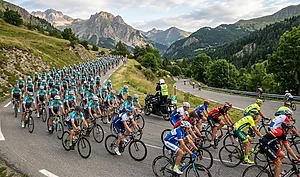
Images from the Tour de France often show riders collecting small, carefully prepared packages from musettes. Inside, there are obviously gels. But also rice cakes, small sandwiches, pancakes, mini-brioches, or other preparations made by the teams’ cooks. Why? Because eating is not just about providing carbohydrates. After several hours of effort, some riders experience genuine sensory fatigue. The sweet taste eventually becomes sickening. The liquid texture becomes monotonous. The desire to chew reappears. This chewing also plays an often underestimated role. It stimulates salivation, enhances eating pleasure, and contributes to the feeling of a meal. “The brain eats too. It doesn’t just receive nutrients. It receives a complete sensory experience.”, emphasizes Nina Voit.
Teams therefore seek a balance. Using the most effective products… without forgetting that the athlete remains a human being before being a watt-producing machine.
When Chewing Becomes a Physiological Advantage
At first glance, chewing seems almost anecdotal given the demands of a mountain stage.
Yet, it already mobilizes part of the digestive mechanisms even before food reaches the stomach. Salivation begins the breakdown of certain carbohydrates, facilitates their progression through the digestive tract, and prepares the entire system to receive what is coming. But its role extends far beyond simple digestion. Chewing is also sending a message to the brain. The taste, texture, smell, and temperature of a food contribute to what scientists call the cephalic phase of digestion. Even before the absorption of the first nutrients, the body already anticipates their arrival.
This preparation explains why many professionals continue to incorporate solid foods during certain stages, despite the undeniable practicality of gels. It’s not about opposing the two approaches. It’s about understanding that they don’t respond to exactly the same need. “Our organism doesn’t just function with calories. It also functions with sensations, habits, and signals that we sometimes forget when we reduce nutrition to numbers.”, reminds Nina Voit. The brain doesn’t just make the legs turn. It also accompanies every bite.

Amateurs Copy Professionals… Without Copying Their Preparation
This is probably one of the biggest excesses of modern nutrition. Social media is full of videos showing riders swallowing a gel every twenty minutes or announcing intakes of 100 to 120 grams of carbohydrates per hour.
The problem is not that these figures are false. The problem is that they are taken out of context. Professionals never discover their nutritional strategy on the morning of a race. They repeat it for weeks in training. They test different products, different textures, different dosages, different temperatures. They evaluate their digestive tolerance, adjust their protocols, and adapt their diet to each type of effort.
In other words, they train their digestive system with the same rigor as their legs. This is what is now called gut training, or intestinal training. For a long time, this notion seemed almost surprising. It is now perfectly integrated into professional teams. Like a muscle, the intestine gradually develops its ability to absorb carbohydrates when regularly exposed to significant intakes during effort.
Conversely, suddenly trying to absorb large quantities on the day of a sportive often constitutes the best way to cause digestive problems. “The body loves gradual progression. It hates sudden changes.”, summarizes Nina Voit. This sentence goes far beyond nutrition. It probably summarizes all training. The best product does not exist. Sports marketing loves certainties. The revolutionary gel. The ultimate drink. The most effective bar. The physiological reality is much less spectacular. No food is universal. What works perfectly for one rider can become a real digestive nightmare for their neighbor.
Differences in microbiota, eating habits, gastric emptying rate, intestinal sensitivity, and training level make each organism unique. This is precisely what explains Nina Voit‘s philosophy. She never seeks to build a perfect diet. She seeks an adapted diet. “I always prefer a strategy that the athlete can reproduce for several years rather than a spectacular method they will abandon after three weeks.” This vision contrasts with an era where everyone is looking for the miracle protocol. It reminds us that the best nutrition is the one that can actually be applied.

Real Food is Not the Enemy of Performance
Listening to some discourses, one might believe that gels have definitively replaced traditional foods. However, when observing the kitchens of Tour de France teams, the observation is quite different.
Every morning, cooks prepare rice, pasta, potatoes, pancakes, rice cakes, fruit purees, compotes, omelets, and even homemade cakes. Why so much cooking if gels were enough? Because a rider’s nutrition is never limited to the few hours spent on the bike.
Sports nutrition products respond to a very specific context: that of intense effort where rapid absorption, ease of use, and digestive tolerance become priorities. The rest of the time, everyday foods naturally regain their place. They provide much more than carbohydrates: proteins, fibers, vitamins, minerals, antioxidant compounds, and nutritional diversity essential for maintaining health.
This nutritional richness is essential. Because carbohydrates never work alone. To be properly transported, used by muscles, and participate in their regeneration, they also depend on a fine mineral balance, particularly in sodium, potassium, magnesium, and calcium. During prolonged efforts, where losses due to perspiration become significant, maintaining this mineral balance is just as strategic as the carbohydrate intake itself. Therefore, nourishing an athlete is not just about providing them with energy. It is also about giving them the means to use it effectively.
For Nina Voit, this complementarity is fundamental. “Sports nutrition products are tools. They never replace a balanced diet. They respond to a specific situation.”
This nuance perfectly summarizes her approach. Gels are not bad foods. They are simply not intended to become the foundation of nutrition. Performance arises from the balance between a rich, varied, and complete daily diet, and products specifically designed to meet the very particular constraints of effort.
Performance is Not Measured Solely in Grams of Carbohydrates
For several years, a real race for numbers has taken hold. 80 grams. 90 grams. 100 grams. 120 grams. As if performance depended solely on this progression. Yet, a rider capable of absorbing 120 grams per hour but suffering from digestive issues will always be less performant than another perfectly stable at 80 grams.
Nutrition does not reward those who eat the most. It rewards those who assimilate best. This is probably the great lesson of this series. The body does not function like a reservoir into which one simply needs to pour more fuel. It selects. It adapts. It sometimes slows down. It also protects its balance. Wanting to ignore this often leads to the opposite effect of what is sought.

The Body Never Lies
Throughout our interview, one idea constantly recurs in Nina Voit‘s words. Listening to your body. This expression is sometimes overused. Here, it regains its full meaning.
The modern athlete has a multitude of data: power, heart rate, heart rate variability, blood glucose, lactates, body temperature… But no watch will ever replace digestive sensations. A heavy stomach. A dry mouth. A loss of appetite. Nausea. A disgust for sugar. All these signals tell a story. They indicate that the body is trying to preserve its balance. Ignoring them often means postponing the problem for a few kilometers. Never solving it. “Sensations are not enemies of performance. They are often the first information the body gives us to remain performant longer.”
This approach perfectly summarizes Nina Voit‘s philosophy. Less spectacular nutrition. But infinitely more sustainable.
The Best Strategy is the One You Forget
When a nutritional strategy truly works, the rider barely thinks about it anymore. They don’t fight against their stomach. They no longer anxiously count every bite. They don’t suffer from their diet. It becomes almost invisible, naturally accompanying every kilometer, every acceleration, every climb. Intakes follow one another without disturbing the race rhythm, the digestive system remains discreet, and all attention can then focus on the effort.
This is probably the most accurate definition of nutritional performance. Not eating more. Not eating differently. But allowing the body to function without ever becoming an obstacle itself. Because when nutrition is truly mastered, it ceases to be a concern. It simply becomes the silent support of performance, allowing the body to continue doing what it does best: moving forward.
=> And here, if you want to discover all our other portraits: All our Portrait articles
Share the post "Tour: gels or real food, does the body tell the difference?"