Share the post "Gravel Crit Series: The 4 Men Who Are Reinventing Gravel"
Some stories begin in the offices of major federations. Others in the boardrooms of large corporations. And then there are those that come to life in a different way. One sweltering afternoon, the Tour de France was playing in the background as I opened a Teams video conference. A few seconds later, Hugo Foulon appeared on the screen. I thought I was about to hear the story of a new event. Instead, I ended up listening to the birth of an idea. For several hours, he told me the story of how the Gravel Crit Series came to be. An adventure that, in just a few months, convinced Breitling, Oakley, PowerBar, Kenda, and CyclingCeramic to back an idea that, on paper, seemed almost crazy: inventing a new race format. Not just another gravel race. A new way to race, to view, and to share the love of cycling. Behind the Gravel Crit Series lies much more than just a race calendar. There’s a vision, a group of friends, sleepless nights, administrative setbacks, risky gambles, unapologetic ambition, and infectious energy. As our conversation unfolds, Hugo gives me a glimpse into this adventure, never failing to remind me that this story is, above all, that of Nicolas Reboud, Nicolas Julien, Quentin Kurboucau… and all those who continue to believe that cycling can still reinvent itself. Here is the story of an idea that could have remained just a conversation… and that might well, in the future, leave a lasting mark on the French cycling scene.
By Jeff Tatard – Photos: © Gravel Crit Series | @lindetcharlotte | @aeronico | @gregorylebourdais | @henriderochephotography
There are interviews from which you walk away with a few quotes. And then there are those from which you walk away with a story. A real one. Not the kind you prepare the day before by carefully drafting a list of questions, but the kind that emerges naturally as the conversation unfolds, to the point where you forget your original plan. When I called Hugo Foulon on that hot July afternoon, I simply thought I was getting to know a new event organizer everyone had been talking about for the past few months. An hour was scheduled in my calendar. It wouldn’t be enough. Very quickly, I realized I was no longer talking about a competition schedule. I’m witnessing the birth of an idea. And ideas, when told by those who’ve championed them from day one, have that rare ability to take you much further than you ever imagined.

Outside, France is sweltering under oppressive heat. The Tour de France quietly unfolds its daily drama while footage of the stage plays on a screen next to my computer. The voices of the Eurosport commentators occasionally drift into our conversation, like a natural background soundtrack. It’s almost symbolic. While the world’s best cyclists are writing a new chapter in the history of the Tour de France, four enthusiasts, in a completely different realm, may be writing one of the most beautiful stories in French gravel cycling. For several weeks now, one name has been cropping up with surprising regularity in every conversation (and seems to have made its way into every Instagram algorithm as well): Gravel Crit Series.
At first, I’ll admit, I remained cautious. The cycling world loves new things. Every season brings its share of revolutionary concepts, formats meant to shake things up, and projects that sometimes disappear as quickly as they appeared. Yet this time, something is different. The first to catch my attention were Dany Maffeis and Max Andreo. Two guys who know their stuff inside and out, who ride a lot, and who aren’t easily impressed. On several occasions, they told me about these races held in Meudon Park. Then one day, almost as if it were obvious, they dropped this line that would set this whole journalistic adventure in motion: “Between an Elite night race and a round of the Gravel Crit Series, our choice is a no-brainer. The Gravel Crit Series in Meudon Park is the ultimate thrill.” That one sentence was enough to pique my curiosity. A few days later, Steve Chainel also mentioned the project. Social media began sharing spectacular images. Prestigious partners started coming on board one after another. From that moment on, a single question kept me thinking: what on earth had they created to generate such enthusiasm?

So I approach this interview with the idea of discovering a concept. What I end up encountering, however, is a human journey. Because even before answering my first question, Hugo Foulon insists on setting one condition—just one. It’s simple, but it already perfectly sums up the spirit behind the Gravel Crit Series. “I just want to ask you one thing. Don’t write an article about me. This story isn’t mine. It belongs to four people.” ” Then he rattles off their names almost in a single breath: Nicolas Reboud, Nicolas Julien, Quentin Kurboucau… and me. Always the four of us. At that very moment, I realize that I’m not going to be telling the story of one man, but that of a team. And that beyond the races, sponsors, or social media, it’s perhaps precisely this collective adventure that explains why the Gravel Crit Series is already carving out a unique place in the French cycling scene.
It all began long before the Gravel Crit Series
As I chat with Hugo, I naturally expect him to tell me how the Gravel Crit Series came to be. I’m wrong. He goes back much further. Long before the first routes were mapped out in Meudon Park. Long before the prestigious partners. Long before the Instagram posts that would introduce the project to thousands of enthusiasts. He goes back to the very beginning. Because, in his view, you can’t understand the Gravel Crit Series without first understanding the people who conceived it.
The first person to enter the story is Nicolas Reboud. Many know him as the founder of Shine, the neobank that became a go-to for freelancers before it was acquired. He prefers to talk about himself as a cycling enthusiast. The one who spends entire evenings watching videos of Australian, American, or British criteriums on YouTube. These spectacular races take place in parks, right in the heart of cities, where spectators can almost touch the riders as they speed by. “Nicolas would often tell me, ‘One day, we have to do that here.’” At first, the idea seemed more like a dream than a real project. But dreams sometimes have that strange ability to bring the right people together at the right time.

At his side is Nicolas Julien. Formerly the head of Moots France and now at the helm of Trust Cycle, he brings a different perspective—one focused on beautiful bikes, equipment culture, and technical excellence. Hugo speaks of him with great respect. With Julien, nothing is left to chance. Every detail counts. Every choice must make sense. This quality would quickly become essential when it came time to build an event that was credible down to the very finest details.
Then there’s Quentin Kurboucau. His background is yet another story. A former professional triathlete—winner of the prestigious Deauville Triathlon and a finisher in major international events—he knows the high level of competition inside and out, along with everything it demands. Now working in the defense sector, he nevertheless continues to coach cyclists. Here again, his background is surprising. Nothing really destined these three men to become race organizers. They come from different worlds, possess different skills, and have never put together an event of this magnitude.

Yet they’re still missing one piece. That piece is Hugo Foulon.
His story is probably the most unexpected of the four. Unlike many others in the scene, he wasn’t born on a bike. He didn’t grow up in the peloton of youth cycling teams. He truly discovered the sport in his early twenties with a goal as simple as it was practical: to find an affordable means of transportation. “I just wanted the cheapest bike possible that required the least maintenance.” It turned out to be a fixie—a choice that was almost commonplace at the time. But it would change his life.
That bike quickly became much more than just a way to get around. It opened the doors to a world he never knew existed. In Rouen, Hugo started his own bike courier company. This was long before the boom in delivery platforms that everyone knows today. His business grew rapidly. One city, then two, then three. A handful of delivery riders grew to several dozen. The venture was a success. A real one. Until the day the international giants entered the market with financial resources that were impossible to compete with. Like many entrepreneurs, Hugo realized that there are some battles best not fought. He sold his business. For many, this story would have marked the end. For him, it marked a beginning. “I asked myself what I really wanted to do with my life.”

The answer fits into three words: cycling. Always cycling. So he founded Rush Club, came up with different ride formats, created events, brought communities together, and experimented with new formats. Without necessarily realizing it, he was already learning the craft that would give rise, a few years later, to the Gravel Crit Series. Because organizing a race isn’t just about mapping out a course. You have to tell a story, create an atmosphere, and make people want to come back. Hugo understood this very early on.
At the same time, the competitor continued to improve. Very quickly. Almost too quickly. He even decided to devote an entire year to his training—a complete break from everything else, a bet on himself. His progress was meteoric—so much so that he was selected from among several thousand candidates for Alpecin’s talent scouting program, designed to give the best amateurs a chance to reach the highest level. But fate intervened. The COVID-19 pandemic brought the global cycling scene to a screeching halt. Races vanished from the calendar. So did opportunities. Many would have called it a missed opportunity. Hugo, however, prefers to call it a detour.
This detour led him to gravel racing. Then to Wish One. Next, he rode under the Cinelli colors. In the meantime, he won a world title in fixed-gear racing and gained a wealth of experiences that enriched his vision of cycling—an open, modern, and uninhibited vision. A vision in which the experience itself often matters more than the mere sporting result.
When the four men finally gathered around a table, they didn’t know it yet. But each brought a piece of a puzzle that didn’t yet exist in anyone’s mind. The entrepreneur. The equipment expert. The former elite athlete. The event organizer. Taken separately, they would likely have continued on their respective paths. Together, they would conceive of something that no one in France had yet truly dared to create.
And it was finally during an almost casual conversation that Hugo uttered the phrase that would change everything. “Why don’t we organize a criterium… on gravel?” At that very moment, without realizing it, the Gravel Crit Series was likely born.

An idea that, at first, seemed far from obvious
Today, when you see the images from the Gravel Crit Series, it all seems almost obvious. Hundreds of spectators packed along the course, a terrace overlooking Paris, prestigious partners, polished videos flooding social media… Judging by the result, you’d think all it took was a good idea for everything to fall into place. The reality is infinitely more complex. When the four founders first began brainstorming the project, no one was even talking about the Gravel Crit Series yet. It was simply a matter of organizing a criterium. A real one. Fast. Spectacular. Nicolas Reboud had been nurturing this desire for years by watching videos from Australia, the United States, and Great Britain. He loves the closeness between the riders and the crowd, that feeling that the race could turn on a dime at every turn. But very quickly, one thing became clear: creating a road criterium in France wouldn’t actually be anything revolutionary. The calendar already has plenty of them. The four men didn’t want to add just another date. They wanted to create something that didn’t exist yet.
That’s when Hugo Foulon casually suggests an idea. “What if we did this… on gravel?” A few seconds of silence follow this proposal. Then their expressions change. Because in a single sentence, everything becomes different. Gravel already has its own long-distance adventures, endurance races, and vast open spaces. However, no one has yet truly imagined applying the fast-paced, explosive, and spectacular nature of urban criteriums to this discipline. The project suddenly found its identity. The four partners then began exploring Meudon Park. They walked, rode, went back, adjusted their routes, imagined a turn here, a sprint there, a more technical section a little further on. Even before convincing partners or local authorities, they first had to convince themselves that their intuition was sound.

To prove it, they organized their first full-scale test run. No publicity. No sponsors. No staging. They simply invited about twenty friends to come ride the course they’d designed. By the end of the day, the verdict was unanimous. “We looked at each other and realized we were onto something.” Hugo utters this sentence almost modestly. Yet it’s probably the true birth of the Gravel Crit Series. Because from that moment on, the idea ceased to be just a conversation among enthusiasts. It became a project. And like all ambitious projects, the first challenges weren’t long in coming…
Where many would have given up, they simply changed course
Listening to Hugo recount this period, it quickly becomes clear that the hardest part was never coming up with a good idea. After all, many people can come up with an idea. What makes the difference is the ability to keep going when that idea collides with reality. And in the case of the Gravel Crit Series, that reality quickly took the form of permits, meetings, technical documents, exchanges with local authorities, and discussions with the National Forest Service. Weeks went by. Responses were slow in coming. Some were encouraging; others, far less so. The schedule was moving faster than the administrative approvals. At times, the project seems to hang in the balance, waiting for just a few signatures. “There were moments when we really wondered if we’d be able to pull off this first edition,” Hugo admits. Yet he never gives me the impression that the group is seriously considering giving up. The four men seem driven by an almost stubborn conviction: if it’s not possible here, then it will be possible somewhere else.
It’s probably this way of thinking that will save the project. Many would have continued to cling to their original idea. They, however, decided to look at the situation differently. They went back for a walk in the park, observed the surroundings from a different angle, and imagined new possibilities. Then their eyes fell on a spot that no one had really considered until then: the terrace of the Meudon Observatory. The location is spectacular. A vast esplanade overlooking Paris, with the silhouette of the Eiffel Tower visible in the distance. People come here to admire an exceptional panorama—certainly not to watch a gravel race. That’s precisely what appealed to the four founders. If the Gravel Crit Series wants to offer something different, then the setting must also be out of the ordinary.

They present their project. They explain their vision. They talk about a popular, family-friendly, accessible event where spectators will no longer be relegated to dozens of meters away from the riders but will be right in the heart of the action. Then comes the waiting period—one that all event organizers are familiar with. The days seem to drag on for weeks. Until, finally, the answer they’ve been hoping for arrives. The green light has been given. It may be nothing more than an administrative approval on paper. In reality, it’s much more than that. The Gravel Crit Series has just found its visual identity. Even before the first race begins, the venue is already telling a story. The images that will be shared a few months later owe as much to the beauty of the site as to the quality of the organization. In a world where social media plays a significant role, the four men have undoubtedly just pulled off one of their greatest feats… without yet fully grasping all the implications.
However, one major problem remains. Organizing a great race isn’t enough. They need partners—brands capable of believing in an event that has never existed before. Here again, one might imagine lengthy negotiations, dozens of rejections, and months spent trying to win people over. Hugo puts it much more simply. Discussions began with companies that share their vision. Not just sponsors looking to put their logo on a finish line arch, but players who understand that the Gravel Crit Series offers more than just another competition. Breitling, Oakley, PowerBar, Kenda, CyclingCeramic, Tavelo…. As the weeks go by, names are added one after another. For a first season, the list is impressive. It doesn’t just reflect the quality of the project; above all, it attests to the trust these brands place in four men who, just a few months earlier, had never organized anything together.

Hugo, however, refuses to let that trust become an end in itself. Throughout our conversation, one word comes up repeatedly: community. Long before he mentions media exposure, return on investment, or business growth, he talks about people. The riders. The volunteers. The families. The kids who come to try gravel riding for the first time. On several occasions, I almost get the impression that he’s talking more about the experience surrounding the race than the race itself. That’s undoubtedly where the uniqueness of the Gravel Crit Series lies. The four founders aren’t just looking to organize a race. They want to create an event that people want to attend, even if they aren’t wearing a race bib. It’s a subtle difference. But one that changes absolutely everything.
Want to experience it for yourself?
The next round of the Gravel Crit Series will take place on Thursday, August 20, 2026, on the Terrace of the Meudon Observatory, just fifteen minutes from Paris. Final A, Final B, women’s race, partner village, and afterparty: everything you need to discover this format that’s shaking up the world of gravel racing. Registration is open: Register for the next round of the Gravel Crit Series |

They never set out to organize a race. They wanted to create an experience.
As our conversation unfolded, one thing struck me. Hugo actually talks very little about performance. Of course, he loves competition. His career speaks for itself. He’s raced at the highest level, represented Wish One and then Cinelli, won a world title in fixed-gear racing, and dedicated part of his life to pushing his limits. Yet when he talks about the Gravel Crit Series, it’s almost never the winners he mentions. It’s the spectators. The volunteers. The families. The kids experiencing a race for the first time. The friends who stick around to chat over a beer long after the last podium ceremony. As if, deep down, the sporting result were merely a pretext for something greater.
This philosophy is reflected in every decision made by the four founders. First, the format. Two races, so that everyone can find their place. A challenging race for the best riders, and another open to amateurs who simply want to enjoy a different kind of experience. There’s also a women’s race, designed as a full-fledged event in its own right—not just a side note in the program. Nothing was designed to exclude anyone. On the contrary. Everything seems to have been conceived to break down the barriers that still sometimes exist in cycling. Gravel is often presented as an open discipline. The Gravel Crit Series simply tries to take this logic to its logical conclusion.

Then there’s this detail that, in my view, almost single-handedly sums up their approach to sports. In most competitions, the greatest rewards are reserved for the winners. The others leave with their memories. Here, the founders decided to flip that logic on its head. The biggest prize awarded during the day isn’t necessarily for the winner. It’s drawn at random from among the participants who didn’t make it onto the podium. When Hugo explains this choice to me, his answer is disarmingly simple. “The person who finishes fiftieth may have given just as much as the winner. Why should they necessarily leave empty-handed?” Behind this statement lies a genuine philosophy—a way of reminding us that cycling isn’t always just about the rankings on a results sheet.
This approach likely explains why the atmosphere surrounding the Gravel Crit Series surprises so many people experiencing the event for the first time. Spectators don’t stay behind barriers, far from the action. They experience the race firsthand. They cheer on the riders. Sometimes they run from one turn to the next so they don’t miss a thing. They chat with the riders before the start, meet them again after the finish, run into sponsors, and talk with volunteers. It’s almost like the atmosphere at Belgian cyclocross races or certain American criteriums, where the line between the riders and the crowd becomes increasingly blurred. People no longer come just to watch a race. They come to spend an entire day immersed in cycling.
As I listen to Hugo recount this adventure, I think back to that quote from Dany Maffeis that had prompted me to pick up my phone a few weeks earlier. “Between an Elite night race and a round of the Gravel Crit Series, our choice is a no-brainer.” ” At the time, I thought he might have been exaggerating a bit. Today, I understand much better what he meant. It’s not a question of athletic level. Nor even of discipline. It’s a question of emotion. Some races are perfectly organized. Others leave a lasting impression. The Gravel Crit Series already seems to belong to the latter category.

And perhaps that is precisely what explains how quickly the project found its audience. Social media didn’t create the phenomenon—it simply amplified it. A spectacular video might catch someone’s eye, but it doesn’t make them want to come back the following year. What builds loyalty is the experience itself. Word of mouth. Conversations with friends after the race. Messages sent to those who weren’t there. The famous “You should have come…” that’s often worth more than all the marketing campaigns in the world. The four founders seem to have understood this before many others: in a world where the number of events on offer is constantly growing, it’s no longer the races themselves that leave a lasting impression—it’s the emotions they leave behind.
The hardest part begins now
The Gravel Crit Series has only one season under its belt. In the grand scheme of sports, that’s nothing. A promise. A first chapter. The coming months will reveal whether this adventure will take a lasting hold in the French gravel scene or remain just a brief, memorable interlude. The four founders are fully aware of this. They know that the hardest part isn’t organizing a successful first edition. The hardest part is maintaining that high standard, that freshness, and that ability to surprise when success starts knocking on the door.
Yet, as I close my laptop after several hours of conversation with Hugo Foulon, I’m not thinking about the prestigious partners, nor the spectacular images from Meudon, nor even the international ambitions the project now harbors. I’m thinking back to that first response—to that sentence spoken even before the interview began: “Don’t write an article about me. This story is about four people.”

In an era where individuals are often celebrated over teams, this detail was far from trivial. It said it all. It told the story of an adventure built without excessive egos, where everyone contributes their skills, perspective, and experience in service of a shared vision. Perhaps this—far more than the layout of a course or the quality of the organization—is where the true strength of the Gravel Crit Series lies.
I don’t know what will become of this adventure in five or ten years. No one does. Perhaps one day we’ll see races organized in other countries. Perhaps this format will inspire other organizers. Perhaps the Gravel Crit Series will also remain a French event, true to the spirit in which it was born. But one thing already seems certain: it has reminded an entire community that it’s still possible to innovate.
In our drive to professionalize cycling, optimize performance, and search for the perfect formula, we sometimes end up forgetting what made us fall in love with this sport in the first place. The sense of wonder. The daring. The desire to try something new without knowing exactly where it will take us. That is precisely what these four enthusiasts have rediscovered. They haven’t reinvented cycling. They’ve simply dared to look at it differently.
And deep down, perhaps that is the greatest victory of the Gravel Crit Series. Long before the podiums, the sponsors, or the Breitling watches promised to the overall winners, they achieved something far rarer: they reignited in hundreds of enthusiasts that irresistible urge to say, the day after a race, “I’ll be there for the next one.”
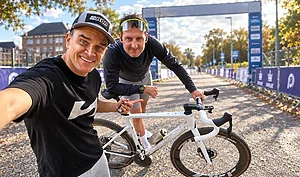
THE FOUR FACES BEHIND THE GRAVEL CRIT SERIESFour men. Four routes. Four perspectives. One shared desire: to envision a new way to experience competitive cycling. Nicolas Reboud
Nicolas Julien
Founder of Trust Cycle and guardian of the project’s technical standards Quentin Kurboucau
Hugo Foulon
To follow all upcoming races, behind-the-scenes action, and championship news: @gravelcritseries |


=> And here, if you want to discover all our other profiles: All Our Profile Articles
Share the post "Gravel Crit Series: The 4 Men Who Are Reinventing Gravel"