Share the post "Tour de France: when the gut becomes the weak link"
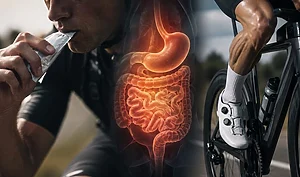
During a Tour de France stage, the legs are not the only ones to suffer. While muscles constantly demand more blood, the skin tries to dissipate heat, and the brain keeps the body on alert, the digestive system must pursue an almost contradictory mission: absorb the energy needed for the effort at the very moment the body withdraws some of its resources. Nausea, reflux, bloating, cramps, diarrhea, or inability to eat are therefore not simply a matter of bad luck. They sometimes reveal the invisible limit of an organism pushed to its last resorts. After profiling Nina Voit, founder of Du Bon Sens dans Mon Assiette, this second part of our dossier delves into the core of the cyclist’s digestive physiology. Because in the Tour de France, the intestine doesn’t just support performance: it can decide its outcome.
By Jeff Tatard – Photos: © Du Bon Sens dans Mon Assiette
The Invisible Body of the Tour de France – Part 2/4
After discovering, in the first part, who Nina Voit is, her journey, her reconstruction, and the philosophy that guides Du Bon Sens dans Mon Assiette today, we now move on to the second episode of our series dedicated to the invisible body of the Tour de France.
This time, we leave the story of the woman to delve into the heart of physiology. Because while the legs produce watts, another, much more discreet organ can sometimes single-handedly decide the outcome of a stage: the intestine. Heat, dehydration, redistribution of blood flow, digestive disorders… Behind the spectacular images of the Tour, an invisible battle is being fought that the general public rarely suspects.
For decades, cyclists’ performances were primarily explained by power, training, or cardiovascular qualities. However, in recent years, another player has gradually entered the heart of scientific research: the digestive system.
Long considered a simple organ responsible for absorbing nutrients, the intestine now appears as one of the main limiting factors in endurance performance. World Tour teams know this well. They now train their riders to eat as much as they pedal.
But why does this organ become so fragile when a rider tackles mountain passes in the July heat? And above all, what really happens inside the body during a Tour de France stage?

When Muscles Become Priority
At rest, the digestive system benefits from comfortable blood flow. After a meal, the body naturally directs more blood to the stomach and intestine to support digestion and nutrient absorption. But when the effort becomes intense, priorities change. Muscles need oxygen, the heart speeds up, and blood is redistributed to the most active tissues.
When the temperature rises, another urgency appears: dissipating heat. The skin then also demands a significant portion of the available blood flow to allow for sweating and thermal exchange. The digestive system finds itself caught between two major demands: muscles demand blood to produce power, while the skin demands it to prevent overheating. The intestine, meanwhile, must continue to absorb carbohydrates and water, but sometimes with reduced resources.
This decrease in intestinal blood flow is called splanchnic hypoperfusion. It does not automatically cause symptoms, but it weakens digestive function when the effort is prolonged, becomes very intense, or takes place in the heat. The intestine then continues to receive food, gels, and drinks while its processing capacity may begin to decrease. It’s a bit like increasing the number of packages in front of a warehouse while reducing the number of employees responsible for sorting them.

The Cyclist’s Paradox: Eating When the Body Would Prefer Not to Digest
On a long stage, a rider cannot wait until they are hungry. When they feel a clear hunger pang, the energy deficit is often already significant. Teams therefore try to anticipate by organizing regular nutrition: carbohydrate drinks, gels, bars, fruit pastes, small rice cakes, or preparations designed to be consumed while riding.
This strategy is physiologically logical. But it places the body in a permanent contradiction: it must slow down certain digestive functions to support the effort, while continuing to absorb the energy essential for that effort.
“This is the whole paradox of endurance sports. We ask the body to digest at the moment it mobilizes its resources to do something else. As long as the balance holds, everything seems simple. But when heat, stress, or intensity increase, this digestion can become much more fragile.”
The stomach can then slow its emptying. Food and liquids remain longer in the upper part of the digestive system. The rider feels a heaviness, a sensation of fullness, burping, or reflux. They may still continue to eat because their protocol dictates it or because they know they must maintain their intake. The problem is then no longer just what they swallow. The problem is what no longer goes down.
When the Stomach Becomes a Waiting Room
Gastric emptying refers to the gradual passage of stomach contents into the small intestine. It depends on many factors: the quantity ingested, the concentration of the drink, the presence of fats, fibers, or proteins, the intensity of the effort, the outside temperature, dehydration, and individual tolerance.
When everything works correctly, intake leaves the stomach at a rate compatible with its absorption. But if intensity suddenly increases, if the rider ingests large quantities all at once, or if the drink is too concentrated, the stomach can become a real waiting room. Each new intake then adds to what has not yet been evacuated. The cyclist sometimes feels a swollen stomach, a sensation of liquid rising, or the impression that no additional food can be accepted.
In the peloton, they speak of a “closed” stomach. The expression is not scientific, but it perfectly describes the sensation experienced: the rider knows they must eat, but their body tells them it no longer wants to receive anything.
“In these moments, forcing it is not always the best solution. You have to understand what has saturated the system. Is it the heat? A drink that’s too concentrated? Too large an intake? The intensity? Stress? The body isn’t throwing a tantrum. It’s expressing a limit.”

When the Intestine Finally Raises the White Flag
Exercise-induced digestive disorders do not have a single cause. They often arise from a tangle of factors: decreased intestinal blood flow, increased body temperature, dehydration, slowed gastric emptying, vibrations, the cyclist’s position, race stress, and the composition of what is swallowed.
Research now groups these phenomena under the term exercise-induced gastrointestinal syndrome. Symptoms can be upper: reflux, burping, gastric heaviness, nausea, or vomiting. They can also be lower: abdominal cramps, flatulence, urgent need to go to the toilet, or diarrhea.
In extreme cases, alteration of the intestinal barrier can promote the passage of inflammatory molecules into the circulation. This does not mean that every abdominal pain indicates significant damage. But it reminds us of one essential thing: the intestine subjected to prolonged effort is not a simple passive tube. It is a living, vascularized organ, sensitive to heat, and directly exposed to the consequences of intensity.
In a one-day race, the rider can sometimes limit the damage and reach the finish despite significant discomfort. In the Tour de France, the problem is different: you have to start again the next day.
In the Tour, Every Digestive Issue Leaves a Debt
A digestive episode is not always limited to the minutes during which it occurs. A rider who can no longer eat in the last hour of a stage finishes with a greater energy deficit. One who vomits loses not only what they have just swallowed, but also part of their hydration and electrolytes. One who suffers from diarrhea may arrive at the hotel with an irritated digestive system, decreased appetite, and a reduced ability to absorb their recovery meal.
The problem then extends for several hours. The rider finishes less nourished, refills their glycogen stores less efficiently, and recovers less well. Their sleep may be disturbed. Their breakfast the next day becomes more difficult. Today’s digestive issue can therefore become tomorrow’s fatigue.
Over three weeks, these small debts accumulate: a few hundred missing calories, incomplete hydration, a poorly tolerated evening meal, a night interrupted by abdominal pain. Individually, each of these events seems manageable. But the Tour de France is also played out in the accumulation of these invisible details. Loss of performance does not always occur in the spectacular form of a collapse. It can begin with digestion that gradually deteriorates.
Heat, the Intestine’s Great Silent Enemy
Heat disrupts physiological balance. To maintain its core temperature within a zone compatible with effort, the body increases cutaneous blood flow and perspiration. This strategy allows for the dissipation of some of the heat produced by the muscles, but it comes at a cost. More blood directed to the skin means less margin available elsewhere. When dehydration sets in, plasma volume decreases, the heart has to work harder, and the perception of effort increases.
In this context, the digestive system becomes particularly vulnerable. A drink or gel perfectly tolerated at fifteen degrees can suddenly become problematic at thirty-five degrees. Not because the product has changed, but because the body receiving it is no longer in the same state.
Heat also modifies behavior. The rider drinks more, sometimes in large quantities. They favor liquids over solids. But when the stomach is already slowed down, a massive intake of liquid does not necessarily accelerate hydration. It can simply add volume and increase discomfort.
“We sometimes think that the more water we pour in, the more we hydrate. But if the digestive system is saturated, this water is not yet available to the cells. It first remains in the stomach or intestine. Again, what goes in is not necessarily what is used.”

Drinking Is Not Yet Hydrating
Real hydration depends on absorption. For consumed water to become useful, it must leave the stomach, pass through the intestine, and enter the bloodstream. The presence of sodium and an appropriate amount of carbohydrates can facilitate this passage. But the balance remains delicate.
A drink too low in electrolytes may not compensate for the losses of a rider who sweats profusely. Conversely, a drink too concentrated in sugars can slow gastric emptying or draw water into the intestinal lumen, sometimes accentuating bloating or diarrhea.
The best drink is therefore not necessarily the one that contains the most elements. It is the one whose concentration, quantity, and frequency of consumption correspond to the rider’s capacities and the stage conditions. It’s not enough to fill the bottles. You have to build a strategy that the intestine is capable of following.
Race Stress Also Goes Down to the Gut
Digestion is never solely mechanical. The autonomic nervous system plays an essential role in its functioning. Rest promotes digestive activities. Conversely, stress and alertness prepare the body to act quickly.
At the start of an important stage, a rider may feel the effects of this activation even before the first kilometer. Tension increases, appetite decreases, the stomach tightens, and transit can accelerate in some or slow down in others. This phenomenon explains why a food perfectly tolerated in training can become difficult to digest in competition. The recipe is identical. The body, however, is not.
“The meal never arrives alone. It comes with the level of stress, the quality of sleep, the fear of the stage, the heat, and everything else the person is already carrying. That’s why a purely mathematical approach quickly reaches its limits.”
In the Tour de France, this effect can repeat every morning. A mountain stage, a decisive time trial, or a windy day is enough to alter the rider’s nervous state. The intestine then becomes the revealer of what the athlete doesn’t always say.

Can the Intestine Be Trained Like the Legs?
The answer is yes, at least in part. For several years, specialists have been talking about digestive training, or gut training. The principle is to gradually accustom the digestive system to receive, transport, and absorb the intake that will be used in competition.
A rider who trains regularly without eating, then tries to swallow 90g of carbohydrates per hour on race day, suddenly asks their intestine to perform work it has almost never repeated. Conversely, gradual exposure can improve tolerance. The cyclist learns to drink at regular intervals, tests textures, tastes, concentrations, and carbohydrate combinations, then identifies what they tolerate at low intensity as well as at race pace.
Digestive training also has a behavioral dimension. You have to learn to open packaging, chew, drink, and eat without waiting to be hungry. You need to know what to consume on a descent, in a calm section, or before the foot of a climb. The nutritional strategy must become as automatic as a gear change.
But digestive training does not transform the intestine into an invincible organ. It improves tolerance without eliminating the effects of heat, dehydration, or individual differences.
“You can train a capacity, but you must not forget to listen to the response. Getting used to eating more doesn’t mean that the maximum will always be the right amount. The goal remains to find what the body can truly use.”
Testing in Training, But Under Real Conditions
Testing a gel during an easy two-hour ride is not always enough to predict its tolerance during a mountain stage in thirty-degree heat. To be useful, digestive training must gradually reproduce the constraints of competition: long rides, sustained efforts, heat, fatigue, and equipment actually used in the race.
Lassitude must also be taken into account. A food tolerated during the first hour can become sickening after four hours. A very sweet flavor may work at first, then cause rejection. Solid products may be appreciated on the flat and much less so on an intense climb.
Professional teams therefore multiply the options: gels, drinks, semi-solid foods, savory products, small rice cakes, and preparations adapted to the riders’ preferences. This diversity is not just about pleasure. It helps to avoid saturation, vary textures, and adapt intake to the intensity of the moment. The best strategy is rarely a single product repeated for five hours.

The Microbiota, Endurance’s Invisible Partner
The intestine hosts billions of microorganisms forming the gut microbiota. Their role extends far beyond digestion. They participate in the metabolism of certain nutrients, immune regulation, and the maintenance of the intestinal barrier.
Regular exercise can promote greater microbial diversity. But extreme effort, stress, travel, dietary changes, and lack of recovery can also disrupt this balance. In the Tour de France, riders change hotels almost every day, and their bodies are subjected to a succession of constraints: variable schedules, heat, fatigue, massive carbohydrate intake, and sometimes a significant reduction in fiber during stages.
Fiber-rich foods are beneficial for digestive health, but their quantity often needs to be reduced around a competition to limit intestinal volume and the risk of discomfort. The challenge is therefore to preserve long-term digestive health while temporarily adapting the diet to the demands of the race.
An optimal diet for a Tour de France stage is not necessarily what one would recommend all year round. Performance sometimes requires temporary simplification. Health demands that it not be made permanent.
Signs Not to Trivialize
In cycling, suffering is part of the culture. Legs burn, backs stiffen, and you learn to keep going. This ability to endure discomfort can, however, lead to trivializing certain digestive signals.
A slight reflux, some nausea, or a loss of appetite may seem insignificant. Yet, when they recur, they sometimes indicate that the strategy needs to be reviewed. The rider must observe the moment symptoms appear, the intensity of the effort, the quantity consumed, the temperature, the product used, the time since the last meal, and the state of hydration.
A training log can integrate this information just like watts or heart rate. Because a nutritional protocol should never be evaluated solely based on what was planned. It must be judged on what the body has actually accepted.
“Athletes often look at what they were supposed to eat. They should also look at what they managed to digest, the energy they actually felt, and the state in which they finish. That’s where the most useful information lies.”
When the Intestine Becomes a Performance Factor
The digestive system is often spoken of as a source of problems. But a trained, tolerant, and well-prepared intestine also constitutes a major competitive advantage.
Two riders may possess comparable physiological power. If one manages to regularly absorb their carbohydrates and maintain hydration while the other develops nausea after three hours, their potential will not be expressed in the same way. The first retains more energy availability. The second begins to negotiate with their stomach at the moment the race demands their full attention.
At this level, digestive capacity becomes a performance quality just like muscular endurance. It allows for sustained intake, better recovery, and repeated efforts day after day. In the Tour de France, this repetition is essential. The winner is not just the one who can produce the greatest power for a few minutes. It’s the one who manages to maintain their abilities for three weeks.
The Impossible Equation Teams Are Trying to Solve
Team nutritionists work on an equation of extreme complexity. They must provide enough energy, limit unnecessary volumes, adapt intake to heat, altitude, intensity, stage profile, and individual preferences. They must also anticipate what the rider will still accept after four hours in the saddle.
Science provides benchmarks. Sensors allow for estimating expenditures. Protocols allow for organizing intake. But the body always has the final say. This is precisely where Nina Voit‘s vision joins modern sports nutrition without being confused with it.
She rejects neither numbers nor recommendations. She simply reminds us that the prescribed quantity only becomes useful when it is transformed. A gel remaining in the stomach does not fuel the muscles. A bottle swallowed too quickly does not instantly hydrate. A perfect strategy on paper can fail in the face of heat, stress, or fatigue. The protocol must therefore remain dynamic.
Listen Before the Body Screams
The body rarely sends its first message in the form of a spectacular collapse. It often begins more discreetly: loss of appetite, unusual burping, a drink becoming sickening, difficulty swallowing, a swollen stomach. These signals are sometimes the first cracks in a system that is beginning to saturate.
The experienced rider learns to recognize them. They temporarily reduce intensity when possible, space out intake, choose a simpler texture, cool down, or favor small sips. This adaptation does not constitute an abandonment of the plan.It represents the most accomplished expression of race intelligence.
“Listening to the body doesn’t mean doing less. It means understanding what needs to be adjusted to be able to continue.”

The Fragile Link Can Become a Strength
The cyclist’s intestine operates in a hostile environment. It receives large quantities of carbohydrates, endures vibrations, heat, dehydration, and decreased blood flow. It must function under stress and start again the next day.
It would therefore be easy to consider it solely as the fragile link in performance. But it can also become one of its most valuable allies. When trained, respected, and properly nourished, it allows the rider to prolong effort, delay exhaustion, and better rebuild their reserves.
The difference is not just in the quantity available in the pockets. It lies in the body’s ability to receive it. Because in the Tour de France, the race is not won solely with what you eat. It is also won with what you manage to digest.
=> And here, if you want to discover all our other portraits: All our Portrait articles
Share the post "Tour de France: when the gut becomes the weak link"