Share the post "Is Pogacar killing the Tour de France?"
I never would have imagined writing these words. For decades, the month of July set the pace for my days. Like so many cycling fans, I was so immersed in the Tour de France that I organized my schedule around the stages. Today, I can’t even bring myself to watch a single stage live anymore. Not because cycling no longer excites me, but because Tadej Pogacar’s unchallenged dominance seems to have taken away what makes the sport so captivating: doubt, suspense, and the unexpected.
By Guillaume Judas – Photos: depositphotos.com
Just a few years ago, I was one of those who rolled my eyes whenever an old-timer brought up the same old refrain for the thousandth time: “Ah, back in Merckx’s day… ” Eddy Merckx won everything, or so they say. The Monuments. The Grand Tours. The Classics. The time trials. The mountain stages. The Tour de France sometimes felt like a showcase. Fair enough.
But there was still one nuance that’s often overlooked. Cycling back then was nothing like it is today. The peloton was less international, training methods were incomparable, preparation was less scientific, and the competition was less intense. Comparing eras is a perilous exercise.
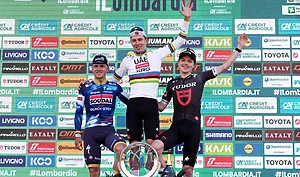
I sincerely thought we would never see dominance on this scale again. I was wrong. Because what Tadej Pogacar is accomplishing surpasses anything I could have imagined. His performance during Thursday’s sixth stage of the Tour de France is, after all, just one more episode in a series that seems never-ending. In February, he dominated one-day races. In the spring, he racked up the Monuments. In July, he turned the Tour into a formality. In the fall, he made the World Championships and the Tour of Lombardy his playground.

And the most unsettling thing is that he still seems to be improving. How is that even possible? In recent years, cycling has seen the emergence of a generation of prodigies. Remco Evenepoel, for example, rose to the top at breakneck speed. Like many, I thought these champions, who got their start so young, would quickly reach their ceiling. It made sense. But Pogacar seems to have no ceiling. Every season, he adds something new. Every season, he seems stronger than the last. Every season, his opponents—who are neither amateurs nor second-rate riders—give the impression they’re racing for second place. And that’s precisely where my unease stems from. Because it’s not Pogacar who annoys me. It’s his invincibility.
I’ve been a passionate fan of the Tour de France since my teens. For years, the month of July dictated my schedule. Vacations were planned around the stage schedules. Appointments were rescheduled. Afternoons were sacred. Then the years went by. You start to look at things with more perspective. You appreciate a great breakaway more than just the general classification. We get excited about a daring route, an unlikely stage victory, or an unexpected twist. For the past three or four years, I’d already been watching the Tour differently. But this year, something snapped. During the entire week of racing, I didn’t watch a single stage live. That’s never happened to me before.
Why? Because I feel like everything’s already been decided. The word “disgust” might be too strong. Or maybe not. When the suspense disappears, what’s left? You can admire the performance. Respect the champion. We can salute the great athlete. But get excited? Not so much. And that’s the whole paradox.
I have absolutely no reason to suspect Tadej Pogacar of anything. None. Speculation and insinuations add nothing to the debate. Perhaps we are simply witnessing the emergence of the greatest champion that cycling—or even sports in general—has ever known. This hypothesis is just as credible. And it may be even more unsettling. Because if he really is this one-of-a-kind phenomenon, what’s left for the others?
He’ll likely win a fifth Tour de France, joining Anquetil, Merckx, Hinault, and Indurain. Then what? A sixth? A Vuelta? Paris-Roubaix?
He’ll likely win a fifth Tour de France, joining Anquetil, Merckx, Hinault, and Indurain. Then what? A sixth? A Vuelta? Paris-Roubaix? At this rate, the only question is no longer what he’s going to win, but what he still hasn’t won. It’s fascinating. And deeply tedious.
I can already hear the reactions: “You’re criticizing an exceptional champion.” No. I’m criticizing the effect his dominance has on the spectacle. Take Mathieu van der Poel in cyclocross. He, too, often dominates. Yet I still take just as much pleasure in watching him. Because he adds something indefinable: technique, impossible lines, risks, the beauty of the movement. We watch the “how” just as much as the result.
With Pogacar, everything seems simple. Too simple. He accelerates. The others fall apart. The curtain falls. Again. Again. Again. Eventually, we’re no longer surprised. And when a sport stops surprising us, it loses part of its soul. Maybe in twenty years, we’ll say in turn: “Can you believe it? We lived through the Pogacar era.” Maybe then we’ll realize just how lucky we were to have witnessed the rise of the greatest cyclist of all time.
Today, however, I feel something else above all else. The strange feeling that he’s stealing from me what I loved most about the Tour de France: uncertainty. And without uncertainty, the sport isn’t quite a sport anymore. It’s a showcase. And displays of dominance, no matter how brilliant, always end up getting tiresome.
Share the post "Is Pogacar killing the Tour de France?"