Share the post "Can we really ride the same bike as the pros?"
Every time a new top-of-the-line model is unveiled—one used by professional cyclists but also available for sale to the general public—the same debate resurfaces. On one side are enthusiasts who dream of owning the same bike as their idols. On the other, those who believe that such a bike should be reserved for cyclists capable of realizing its full potential. Behind this opposition lies a question far more interesting than it seems at first glance: Is a high-end bike a performance tool… or simply an object of passion?
By Guillaume Judas – Photos: depositphotos.com
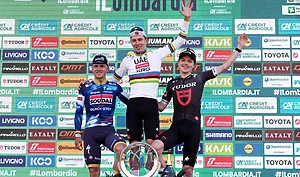
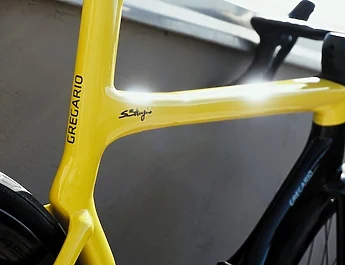
Unlike a Formula 1 car or a MotoGP bike, the bike used by professionals is, in most cases, a commercially available product. Today, enthusiasts can buy the same frame, the same wheels, the same electronic groupset, and sometimes even the same livery as those seen in the biggest races. Brands carefully cultivate this connection. They don’t just sell a carbon frame or a pair of wheels. They sell a story, a vision, and a connection to the champions. The message is crystal clear: ride the bike that has won the world’s biggest races (and “improve your performance,” they promise at the same time).
However, this marketing pitch quickly runs up against another voice, one well known on forums, social media, and sometimes even on club rides: that of the self-proclaimed guardians of merit.

“You’re not good enough for that bike.”
The phrase has become a classic. “You’re averaging 27 km/h on a €12,000 bike?” Or: “Start by getting some results before you buy a pro bike.” ” The underlying idea is always the same: a high-end bike should be proportional to its owner’s athletic ability. As if there were an invisible threshold that, once a certain average speed is reached, grants the right to buy a competition frame.
Let’s take this line of reasoning to its absurd conclusion. Why not create a National Authority for the Validation of Cycling Merit?
- Less than 30 km/h? Aluminum is mandatory.
- Between 30 and 33 km/h? Carbon is an option.
- At 35 km/h or higher? You finally earn the right to ride high-profile tires.
- Over 40 km/h? Congratulations, you’re now authorized to order the replica bike from your favorite WorldTour team.
Obviously, this idea is a bit of a joke. Yet it’s not so far off from some of the comments you see online every day.

Is a bike a tool… or an object of passion?
This view is based on a rarely articulated assumption: that a bike has value only in terms of the performance it enables. In other words, if its owner doesn’t exploit its full potential, the purchase would be unjustified. But why?
No one tells an amateur pianist that they should wait until they’re a concert pianist before investing in a high-end piano. No one criticizes a passionate photographer for buying a professional camera even though their photos will remain in the family album. And few would argue that you have to be a race car driver to have the right to own a Porsche.
In all these areas, the pleasure of owning a beautiful object is considered a perfectly legitimate motivation. Why should cycling be any different?

Pleasure doesn’t have to be measured in watts
Critics often overlook one essential point: a bike isn’t just a tool for performance. It’s also an object of desire. You might buy a bike because it’s gorgeous. Because you’ve been dreaming about that bike for years. Because you admire the rider who uses it. Because you saved up for a long time before you could finally afford it. Or simply because it makes you want to get out and ride. And that last reason is perhaps the most important of all.
If owning an exceptional bike inspires its owner to go out more often, to stay in shape, to ride more kilometers with friends, or simply to put a smile back on their face after a tough day, who could seriously argue that this purchase is irrational? After all, a bike that rarely sits idle in the garage is already an excellent investment.
A pro’s bike… but not a pro’s life
However, buying the same model used in the peloton doesn’t mean you’ll have the same experience. The frame is often identical. The rest is far from it. Professionals benefit from a riding position derived from an extremely precise postural analysis, constant mechanical maintenance, gear ratios tailored to each stage, tire pressure adjusted to the road surface, not to mention exceptional physical conditioning.
An amateur can certainly ride the same model while choosing a more comfortable riding position, more reasonable gear ratios, or tires better suited to their riding style. And they’d be wrong to deprive themselves of that. Copying a champion’s bike doesn’t mean you have to replicate every single one of their settings. The key is to adapt an exceptional machine to your own needs.
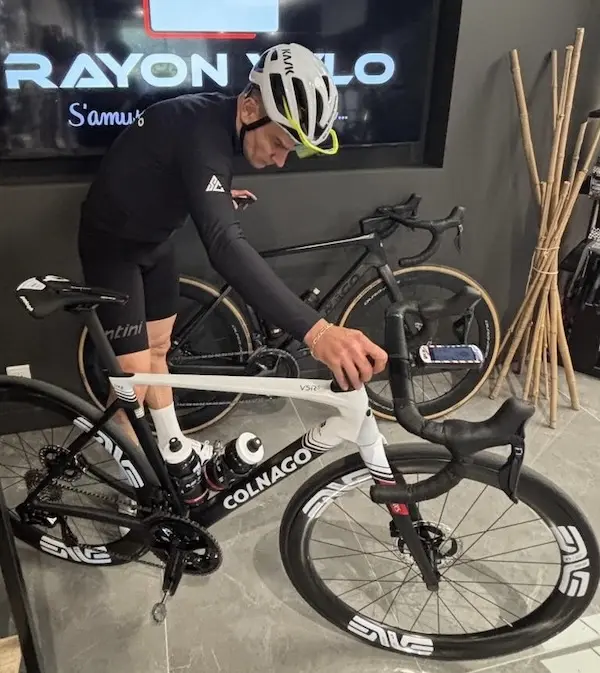
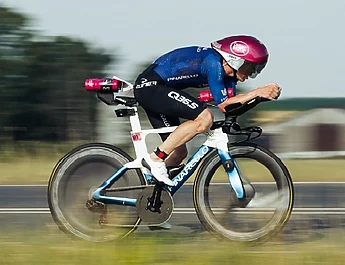
There are, however, a few exceptions. Some bikes are so specialized that they only reveal their full potential in a competitive setting or during very high-intensity riding. This is the case with modern time-trial bikes, designed above all to be as fast as possible in a very restrictive riding position. We can also mention certain highly aerodynamic road bikes, whose extreme stiffness and demanding nature don’t necessarily provide the same riding pleasure at moderate speeds as they do during sustained effort.
This is precisely where our role as specialized journalists comes into its own. Not to decide for you which bike you’re “allowed” to buy, nor to imply that a particular bike is reserved for an elite few, but to help you choose a bike that truly matches your riding style and expectations. The question isn’t whether you’re worthy of a competition bike. It’s whether it will give you the enjoyment you’re looking for.

Perhaps the real question isn’t the one we think it is
After all, no one is surprised when a tennis enthusiast plays with the same racket as their favorite champion or when a photography enthusiast invests in a professional camera. Cycling, on the other hand, seems to have developed a strange culture of material merit. As if enjoyment had to be validated by a power meter. As if a high-end bike were no longer an object of passion, but a reward that must be earned.
That’s probably where the real paradox lies. Brands spend their time making us dream about the bikes ridden by champions. Then some enthusiasts explain that once the dream becomes attainable… we should ultimately give up on making it a reality. A strange concept of pleasure, to say the least.
Share the post "Can we really ride the same bike as the pros?"