Share the post "Embargoes: Behind the Scenes of a Strange Game Between Brands and the Media"
Why do all websites publish their articles at exactly 9 a.m.? Why do some new releases seem to come out all on the same day? And why do journalists sometimes talk about “embargoes” as if it were a dirty word? Behind this somewhat mysterious term lies the entire organizational structure of the cycling industry. An essential mechanism… that sometimes veers into the absurd. A quick look behind the scenes of a profession where we spend just as much time waiting for 9 a.m. as we do riding the bikes we’re testing.
By Guillaume Judas – Photos: depositphotos.com
Tuesday, 4 p.m. You open your favorite cycling news site and, as if by chance, three new products are announced at the same time. A new road bike. An electronic groupset. A pair of wheels that are “lighter, stiffer, and even more aerodynamic.” In short, an almost ordinary morning.
You may have wondered why everyone publishes at exactly the same time. The answer can be summed up in one word: the embargo. The term might sound a bit formal. Some see it as a way for brands to control the press. Others imagine a sort of secret pact between journalists and manufacturers. The reality is much simpler… and much less dramatic.
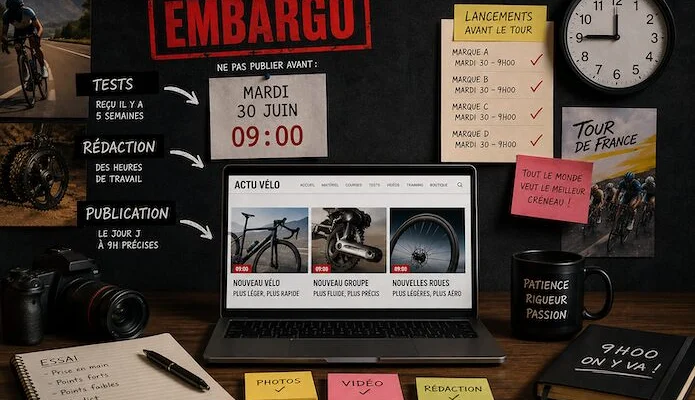
An embargo is simply a date and time before which a journalist agrees not to publish information they already have. Yes, that means they sometimes know about a new bike several weeks before you do. Yes, we may even ride it for a month—sometimes longer—before its official unveiling. And no, that doesn’t mean the article has already been written by the brand or that the journalist has abandoned their critical thinking. The embargo applies to only one thing: the timing of publication. Not its content. It’s also worth noting that there isn’t just one embargo, but several.
Not all embargoes are the same
Contrary to what many people imagine, not all media outlets receive information in the same way.
The first level is, of course, the one every specialized journalist dreams of: being selected to test a product before its launch. This sometimes means a press trip organized by the brand. Sometimes it’s a bike discreetly delivered to the newsroom several weeks before it goes on sale. That gives you time to ride it, take photos, shoot a video (for those working in that medium), write a full review, and be ready on launch day with comprehensive content. It’s also the one that requires the most work… even if, from the outside, all anyone sees is an article published at exactly 9 a.m. (or 4 p.m., or 6 p.m., depending on when the embargo officially ends).

The second scenario is more traditional. The brand sends out its press kit a few days before the embargo is lifted. A week, if all goes well. Two days, if they’re being optimistic. Twenty-four hours, if they seem to think days are forty-eight hours long. In this case, it’s impossible to test the equipment. We prepare a news article based on the official information, trying to provide some context and perspective.
Case three: the press release arrives… just as the embargo ends. At that point, the journalist sometimes discovers the information almost at the same time as the readers. It’s up to them to cover the story immediately… or whenever their schedule allows.
And then there’s a fourth scenario, one that’s much less well known. The one where we receive… nothing. The brand chooses which media outlets to approach. That’s its absolute right. For reasons of strategy, budget, product availability, or simply communication strategy, some publications are approached, while others are not. In such cases, we sometimes find out about the new product by seeing our colleagues’ articles… or because a reader sends us a message: “Have you seen the new bike?” These situations are also part of the job.
So, why all these embargoes?
If embargoes didn’t exist, journalists would discover new products at the same time as you. At first glance, that might seem like a great idea. After all, why should some people have the right to know about a new bike several weeks before others? In reality, that would probably be the worst solution for everyone.
Let’s take a very concrete example. A brand launches a new high-end road bike. This bike is the result of three or four years of development, hundreds of hours of research, prototypes, testing, and validation by professional teams… and several million euros in investment.
The launch day isn’t something you can wing. On that very day, the brand’s website is updated in all languages. The technical specifications are posted. The configurators go live. The promotional videos are released. Distributor catalogs are updated. Sales representatives can finally officially present the product. Stores are authorized to publicize it. And, ideally, the first bikes are already in shipping boxes… or even in showrooms. Journalists, for their part, publish their reviews.
Everything is synchronized. That is precisely what an embargo is for. It isn’t meant to prevent journalists from speaking out. It’s meant to ensure that, when they do speak out, everything else is ready. Because announcing a product six months before it’s available would be a nightmare for everyone.
Imagine if a new groupset were unveiled in January but didn’t hit stores until July. What happens in the meantime? Customers decide to wait. Retailers struggle to sell the current groupset. Discounts become more common. Inventory loses value. Distributors see their warehouses fill up with products that have, overnight, become last-generation models. In the end, no one wins. The embargo is precisely what prevents this situation. The day the product is announced is also the day it becomes available for order—or even in stock. Information and commerce move at the same pace.
And contrary to popular belief, honoring an embargo does not mean becoming a brand spokesperson. It simply means honoring a commitment. When a company agrees to give a prototype to a journalist six weeks before its official unveiling, it’s taking a risk. In return, the journalist agrees not to disclose any information before the agreed-upon date. It’s a relationship built on trust. Once the embargo is lifted, everyone regains their freedom. The journalist can write that the bike is excellent. Or that it’s disappointing. Or that it doesn’t justify its price. The embargo doesn’t protect the reviews. It only protects the timeline.
However, there is an increasingly common confusion. Sometimes certain media outlets publish a few days before the embargo is lifted, hiding behind a phrase that has become almost magical: “According to several sources…” or “It appears that…” ” Let’s be honest: when these “sources” actually refer to the press kit received under embargo a few days earlier or to leaks spotted on social media, it’s not a scoop. It’s simply a way to circumvent a commitment.
Conversely, when a journalist spots an unreleased prototype at a race, photographs a bike that’s never been unveiled, or discovers a new development in the paddock before anyone else, that’s exactly what their job is all about. Observe. Investigate. Cross-check information. Publish. That’s the whole difference. A scoop involves uncovering information that no one has given you—not publishing a press release ahead of schedule.
When Everyone Chooses the Same Embargo
Now that you know what embargoes are for, we need to let you in on a secret. The real problem isn’t the embargo. The real problem is that, in the small world of cycling, everyone seems to have had exactly the same idea. Every year, as the Tour de France approaches, marketing departments wake up with a deep conviction: this is THE time to launch a new product. And, taken individually… they’re not wrong. For three weeks, all eyes are on cycling. The mainstream media covers it more extensively. Social media goes wild. Enthusiasts follow the stages, comment on the riders’ gear, and scrutinize every detail of the bikes.
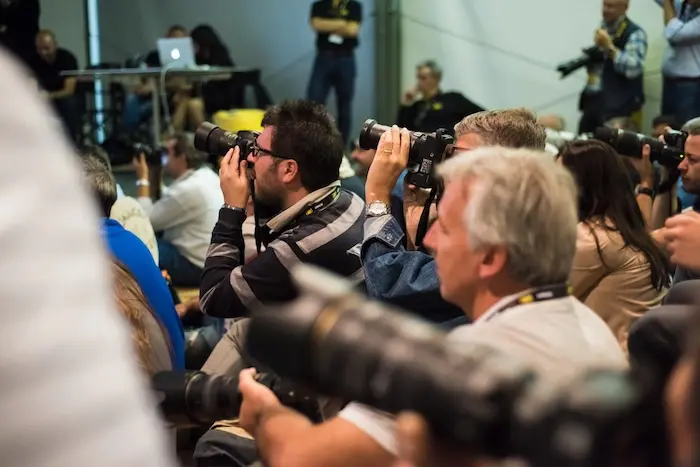
If you’re a brand, it’s hard to imagine a better time to unveil your new bike, your new groupset, or your new set of wheels. The only problem… is that your competitors are thinking exactly the same way. As a result, it’s not uncommon for several major new releases to drop on the same Tuesday or Thursday—sometimes even at the exact same time. And that’s when things get downright comical.
Imagine the scene for a moment. It’s 3:55 p.m. The articles have been proofread. The photos have been exported. At exactly 4:00 p.m., the first embargo lifts. Then a second one. Then a third. And sometimes a fourth. While readers quietly discover these new stories as they browse, the newsroom looks more like a control tower than a specialized magazine.
Because publishing an article isn’t just about clicking a button. You have to check that everything displays correctly. Share the article on social media. Schedule posts. Respond to the first comments. Sometimes send out a newsletter. For some media outlets, upload a video. Correct the inevitable minor typos that are discovered… once everything is published. And meanwhile, another brand is already asking why the article about ITS new product (understandably) isn’t online yet.
What’s quite amusing is that everyone is convinced their launch is the event of the week. From the editorial team’s perspective, it’s sometimes the fourth must-cover launch of the year… or even of the day. The most ironic part of this story is that the first victims of these scheduling conflicts aren’t always the journalists. Sometimes it’s the brands themselves.
Because when a new €15,000 bike, a brand-new electronic groupset, and a new line of wheels are unveiled within a 30-minute span, they inevitably end up overshadowing one another. A launch that’s been carefully prepared for months ends up lost among the rest. No one really wins. Not the brands. Not the media. And certainly not the readers, who are bombarded with an avalanche of new products without always having time to appreciate them.
Added to this is another reality, one that’s much less visible. Not all embargoes require the same level of investment from a media outlet. When a brand entrusts us with a bike a month and a half before its release, that involves hundreds of kilometers of test rides, photo shoots, sometimes a video, measurements, and hours of writing and layout work. Conversely, a press release received 48 hours earlier obviously requires work, but it doesn’t represent the same level of investment.
When multiple embargoes are lifted simultaneously, we have to make choices. Not because one product is more important than another. But because it’s physically impossible to highlight three major pieces of content at the same time. A website has only one top spot on its homepage. A Facebook page can feature only one post at a time. A newsletter can’t tell three stories in one issue.
And, contrary to what some people might think, publishing three important articles in 20 minutes is generally not good news for anyone. The work done over several weeks disappears almost immediately behind the next post. That’s the paradox of our profession. News embargoes are supposed to give everyone an equal chance at visibility. But when they overlap, they sometimes produce exactly the opposite effect.

At the end of the day, that’s also what our profession is all about
Don’t get me wrong. The purpose of this article wasn’t to tug at your heartstrings about the plight of specialized journalists. There are far more difficult jobs than testing bikes before their official release. However, we thought it would be interesting to show you what goes on behind the scenes. When you see a review published at exactly 4:00 p.m., it didn’t just appear at 3:59 p.m. It’s often the result of several weeks of work, hundreds of kilometers traveled, photos taken sometimes at dawn to capture the best light, verified measurements, and texts that have been proofread and edited. The publication date gives the illusion of immediacy. In reality, it’s the culmination of a long process of preparation.
Is the system perfect? Certainly not. You only have to look at the days leading up to the Tour de France to see that. Every brand is convinced (often rightly so) that it has chosen the best moment to unveil its new product. But when everyone chooses the best moment… there really isn’t one anymore.
So yes, we sometimes smile (or roll our eyes) when we see three or four embargoes lifted at the exact same time. Yes, we sometimes spend a morning juggling multiple posts, social media platforms, and contacts, hoping no one will be surprised that they aren’t the first to be featured. It can be a bit absurd at times. But that’s just how the game is played.
For our part, we’ll continue to honor the embargoes we agree to. Not because brands ask us to, nor because we’re their communication channels, but because a relationship of trust only works both ways. A promise binds the one who makes it.
In return, we’ll also continue to do our job as journalists. Testing products as thoroughly as possible. Highlighting their strengths, but also their flaws when they exist. And when we discover a new product on the side of the road, in the paddocks at a race, or on a rider’s bike before it’s officially unveiled… rest assured that we won’t hesitate to report on it. Because that, on the other hand, isn’t breaking an embargo. It’s simply doing our job.
Share the post "Embargoes: Behind the Scenes of a Strange Game Between Brands and the Media"