Share the post "The 6 Mistakes That Are Holding Back Your Progress as a Cyclist"
Between the myriad devices and apps available for tracking and analyzing training data, advice from professionals, and performance metrics shared on social media, it’s never been easier to get lost in your cycling training. Yet improving your cycling doesn’t necessarily require more technology or complex methods. Here are the most common mistakes to avoid so you can continue to improve your performance while still enjoying the ride.
By Guillaume Judas – Photos: depositphotos.com
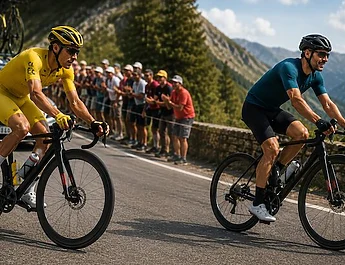
Many amateur cyclists try to replicate the training methods of the world’s top riders. However, the main difference between a professional and an amateur isn’t just physical ability, but mainly the time dedicated to training. Consequently, trying to compare yourself to a professional rider is a big mistake.
While a professional rider can rack up dozens of hours in the saddle each week, most amateur cyclists have to juggle a busy schedule. In this context, copying the exact intensity distributions used at the highest level often makes no sense. An approach tailored to your personal constraints is generally much more effective than simply imitating professional training plans.
We have often mentioned the ideal “80-20” split, which involves combining 80% of your training time at low intensity with 20% at high intensity. This rule applies mainly to athletes who can devote more than ten hours a week to their training. For others, going slightly beyond the 20% threshold can be more productive.
Social media rarely shows reality
Spectacular rides, personal bests, and dreamy landscapes flood your Facebook, Instagram, or TikTok feeds every day. This constant exposure can create a sense of frustration or the feeling that you’re never doing enough.
Yet the reality of training is often much less glamorous. The hours spent riding in the rain, facing the wind, or on the same roads usually don’t generate likes or comments. Yet it is precisely these unassuming sessions that build performance over the long term. Staying focused on your own goals is far more beneficial than comparing your efforts to those of others.
Data is useful, but it doesn’t tell the whole story
Power meters, heart rate monitors, heart rate variability, and analysis platforms now offer an impressive amount of information. These tools are invaluable for structuring your training, provided you don’t place blind trust in them.
Measurements always involve some degree of uncertainty, and performance naturally fluctuates from day to day. A target power output easily achieved on a Tuesday may seem unattainable the following Friday. Fatigue levels, stress, sleep, and diet all strongly influence results. The numbers should therefore be interpreted as indicators, not as absolute truths.

During our various tests, we observed significant measurement differences between multiple power meters, and sometimes even with the same meter. Since this type of device has become relatively widespread (with prices dropping by a factor of 5 or 6 over the past 25 years), reliability is no longer as high as expected. It’s nothing serious, strictly speaking: learn to interpret multiple signals, and don’t get hung up on a value that’s off by 5 watts.
Learn to listen to your body’s signals
In their eagerness to follow a plan to the letter, some people end up ignoring the warning signals sent by their bodies. A persistent feeling of fatigue, a lack of energy, or slower recovery must be taken into account.
Rest is an integral part of progress. It is during recovery periods that the body processes the effort expended and adapts to the training load. Stringing together intensive sessions despite significant fatigue can, on the contrary, slow progress and increase the risk of injury or illness.
Strength training remains an often-overlooked ally
Many cyclists are reluctant to devote time to strength training, especially when they have limited hours to train. However, regularly incorporating off-bike exercises offers benefits that go far beyond simply improving performance. And not just for those over 50.
Working on core strength, stability, and overall strength helps improve pedaling efficiency, limit muscle imbalances, and reduce the risk of injury. In the long term, it also helps preserve muscle mass and overall health. Even a single weekly session can produce significant results.
Scientific studies must be put into context
New research in sports science regularly fuels discussions within the cycling community. While it helps us better understand certain mechanisms of performance, it does not provide universal solutions.
Results observed in a laboratory or on a small group of athletes do not necessarily apply to all cyclists. Age, experience, training level, or personal circumstances can significantly alter responses to the same method. Before adopting a new trend, it is therefore essential to evaluate it in the context of your own practice.

Take, for example, a new nutrition method that involves consuming more and more carbohydrates during exercise. Outside of elite-level competition, we remain fairly cautious about its value for a purely amateur athlete who rides solely for fun or to compete in a few races each year.
Simplicity is often the best strategy
With the proliferation of tools, methods, and information available, it’s easy to assume that progress necessarily requires greater complexity. Yet the fundamentals remain unchanged: ride regularly, recover sufficiently, vary your intensity, and stay consistent in your training.
Cyclists who make lasting progress aren’t always those with the most advanced technology, but often those who manage to maintain good habits over the long term.
Share the post "The 6 Mistakes That Are Holding Back Your Progress as a Cyclist"