Share the post "Long-Term Test: 15,000 km with the Neutron Crankset and Cassette"
Carbon components from the Asian market are playing an increasingly prominent role in the cycling world. Highly visible on the Internet and social media, they attract attention as much for their competitive prices and promises of lightness as for the questions they raise. Among these products, carbon cranksets remain a particularly sensitive topic: the weight savings are appealing, but reliability remains an essential criterion for a component under such heavy use. After riding more than 15,000 km with Neutron Components cranksets, we wanted to find out how they really perform in the field. Are they simply a lightweight alternative to traditional high-end groupsets, or a truly credible option for daily, intensive use?
By David Polveroni – Photos: DR
Neutron Components: A Chinese Brand Specializing in Drivetrains
Neutron Components is a Chinese brand founded in 2018 and based in Guangzhou. Originally, its first product was an oversized pulley system, better known as OSPW, comparable in concept to what CeramicSpeed offers. Since then, the brand has gradually built its product lineup around drivetrain components: pulleys, cranksets, chainrings, cassettes, and soon, chains. The idea is clear: to offer a cohesive lineup focused on efficiency, weight, and drivetrain optimization.
The company remains modest in size, with a team of about ten people composed almost exclusively of engineers. Sales are managed directly by the product managers and the founder, without a dedicated sales team. This approach differs from that of established players, but it allows Neutron to emphasize a highly product-oriented development process.
The brand designs its components in-house, using its own tooling, while relying on a small number of trusted industrial partners for manufacturing. Neutron does not necessarily wish to highlight carbon fiber grades such as T700 or T800, believing that cyclists are primarily looking for a reliable, lightweight, and efficient component.
A Shimano-compatible carbon crankset
The Neutron Components crankset tested here follows a simple philosophy: to offer a lighter alternative to Ultegra or Dura-Ace cranksets, as well as SRAM models, while ensuring easy integration into an existing build. It uses a 24 mm axle and a Q-factor identical to Shimano’s, at 148 mm.
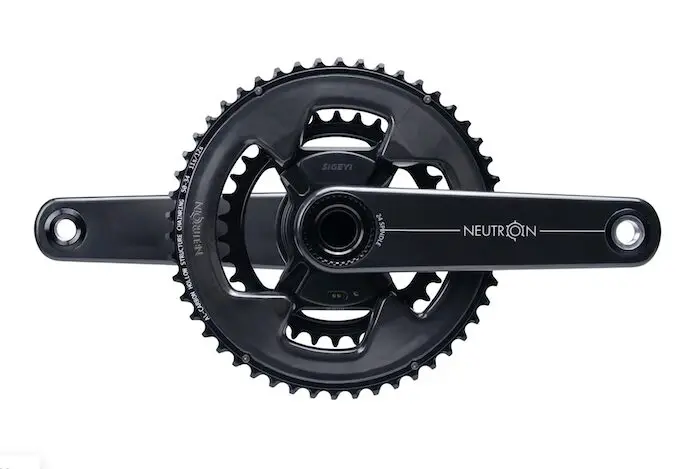
This is one of its strengths: installation is virtually plug-and-play compared to a Shimano setup. You can remove the original crankset, install the Neutron, keep the 52/36 Shimano Dura-Ace chainrings, and continue using the drivetrain without having to completely redesign the bike.
For a cyclist already equipped with Shimano, this is a significant advantage. We’re not talking about an exotic setup that requires changing everything, but rather a solution that replaces the stock crankset with a fairly straightforward approach: same function, lower weight, and an integrated power meter via Sigeyi.
A very noticeable weight reduction
One of the main selling points of these cranks is, of course, their weight. In my setup, the Neutron Components cranksets paired with a Sigeyi power meter and an SL axle weigh 437 g. With Shimano Dura-Ace 52/36 chainrings, the total weight comes to about 580 g. By comparison, a Shimano Dura-Ace R9200 crankset with a power meter weighs around 745 g. The weight savings are therefore about 160 g, which is far from negligible on a performance-oriented build.
Of course, weight isn’t everything. When it comes to a crankset, stiffness, build quality, the reliability of the interface, and long-term durability are just as important—if not more so. It is precisely on these points that this type of component is put to the test.
The Sigeyi sensor: a real standout
The crankset was paired here with a Sigeyi power meter. And this is clearly one of the standout features of this setup. The sensor’s accuracy has proven excellent in the comparisons I’ve read and conducted, with consistent and stable readings. This is an important point, because a lightweight crankset is only worthwhile if the associated sensor is reliable, repeatable, and usable in both training and racing.
In this regard, the Sigeyi inspires more confidence than the current Shimano power meter, which unfortunately continues to be criticized for its lack of accuracy and consistency based on real-world use and field comparisons. In contrast, the Sigeyi comes across as a simple, stable, and effective sensor, capable of providing consistent power data day in and day out. For a cyclist who structures their training around watts, this is a major selling point. The weight savings do not come at the expense of data accuracy, and that’s essential.
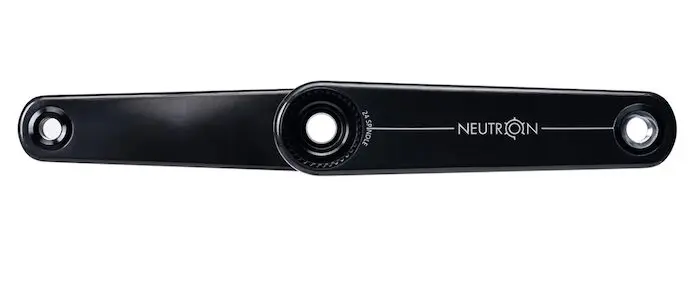
The selection of crank lengths is also noteworthy, with options ranging from 155 to 172.5 mm. We’ve also noticed that there are increasingly more options available in smaller sizes, which is excellent news for riders with smaller frames.
A longer development process than it seems
Neutron reports that the first generation of its crankset was launched as early as 2020. The concept of a crankset paired with a power meter was reportedly conceived as early as the summer of 2019, in collaboration with the founder of Sigeyi. The brand acknowledges, however, that development was not straightforward. The screw-clamping interface, patented by SRAM, required a great deal of work—so much so that Neutron estimates it wasn’t truly finalized until 2025.
This point is telling: Neutron does not present its crankset as a generic product rushed to market. On the contrary, the brand emphasizes a lengthy development process, particularly regarding the mounting interface—a critical component for this type of part.
15,000 km in demanding conditions
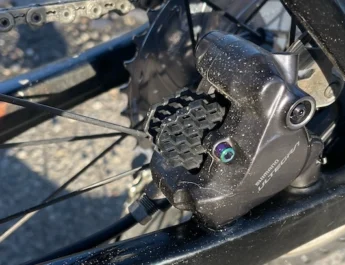
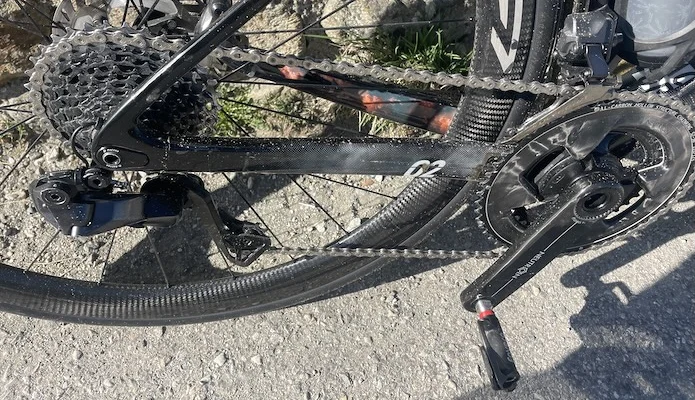
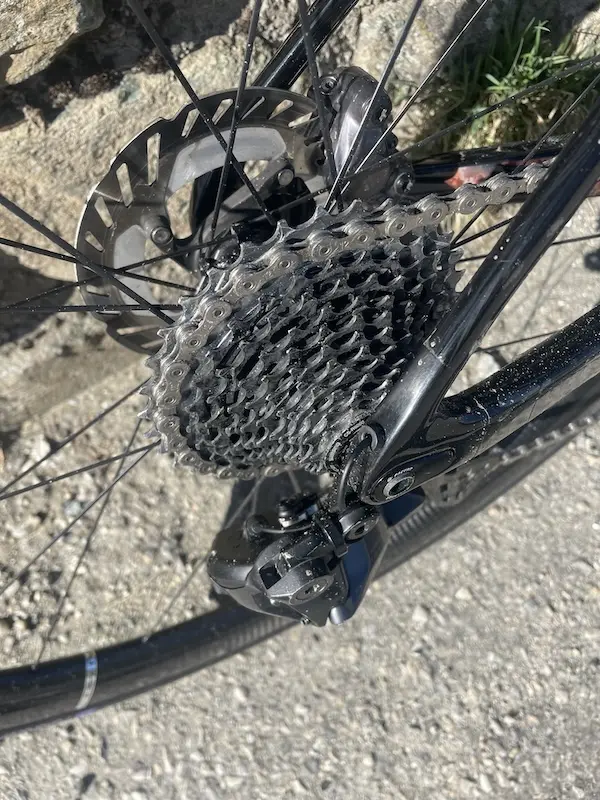
This test wasn’t conducted over a few perfectly clean summer rides. The Neutron Components crankset and cassette were used in conditions that were at times very challenging: winter roads, humidity, salt, the transition from winter to spring, and then the summer heat of recent days. In other words, real-world use, spanning several seasons condensed into a few months, with all that entails in terms of wear, mud splatter, washing, and mechanical stress.
Weighing 56 kg, I’m obviously not the type of rider who subjects a carbon crankset to the most extreme loads. But the use has been intensive and regular, with a high mileage and conditions that were far from ideal. After 15,000 km, what stands out most is the consistency of its performance. Nothing has deteriorated compared to the original setup. I simply had to re-lubricate the bottom bracket three times, which I probably would have done just as often with a Shimano crankset under similar conditions.
With a carbon component under such heavy use, the questions are simple: Does it wobble? Does it creak? Does the interface remain reliable? Does the stiffness hold up? Do you still feel confident after several thousand kilometers? After this long period of use, the conclusion is clear: the crankset has shown no obvious weaknesses. No cause for concern has arisen with the cranks, the interface, or the assembled unit.
Drivetrain: A Deliberate Compromise Compared to Shimano
When it comes to shifting quality, let’s be honest: the Neutron groupset doesn’t quite match the level of an original Shimano Dura-Ace setup. Shifting, whether between chainrings or the cassette, is slightly slower and less crisp, especially when compared directly to the precision of a complete Shimano groupset. Shimano retains that feeling of immediate, smooth, and perfectly calibrated shifting.
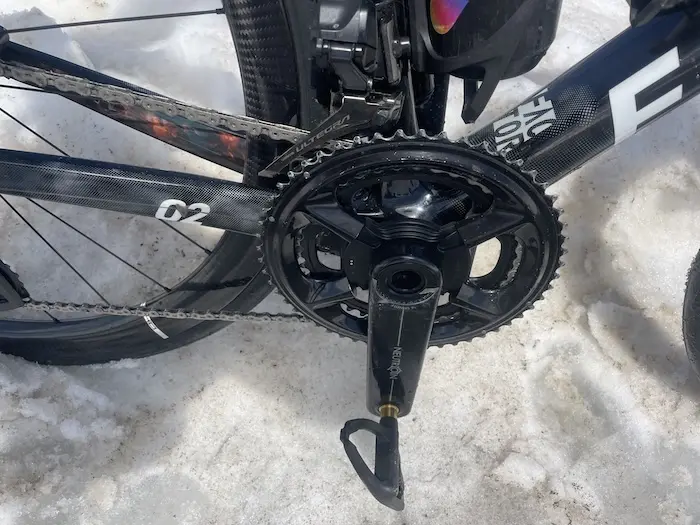
But in practice, the system has never let me down. The gears shift smoothly, the operation remains reliable, and I haven’t encountered any situation where the drivetrain has truly held me back. It shifts a bit slower, but it shifts very well. This is where the concept of compromise really comes into play. By choosing this type of component, you accept sacrificing some of Shimano’s ultra-precise feel in exchange for weight savings, a lighter build, a more original design, and a very attractive aesthetic.
A Lightweight and Well-Balanced Cassette
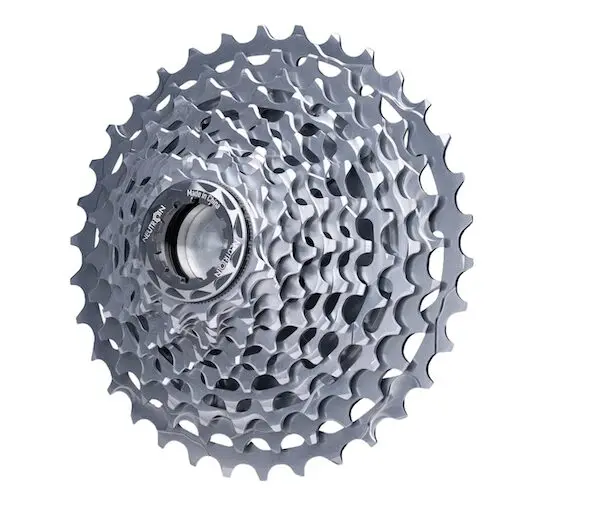
The Neutron Components cassette follows the same philosophy as the crankset: significant weight savings. The 11-34 version weighs about 180 g, while the 11-30 version comes in at around 160 g. With equivalent gear ratios, this represents a weight savings of about 60 g compared to a Shimano Dura-Ace cassette and up to 160 g compared to an Ultegra cassette. For a cassette, this weight savings is far from negligible, especially when you consider the cost involved in achieving such weight savings on the frame or wheels.
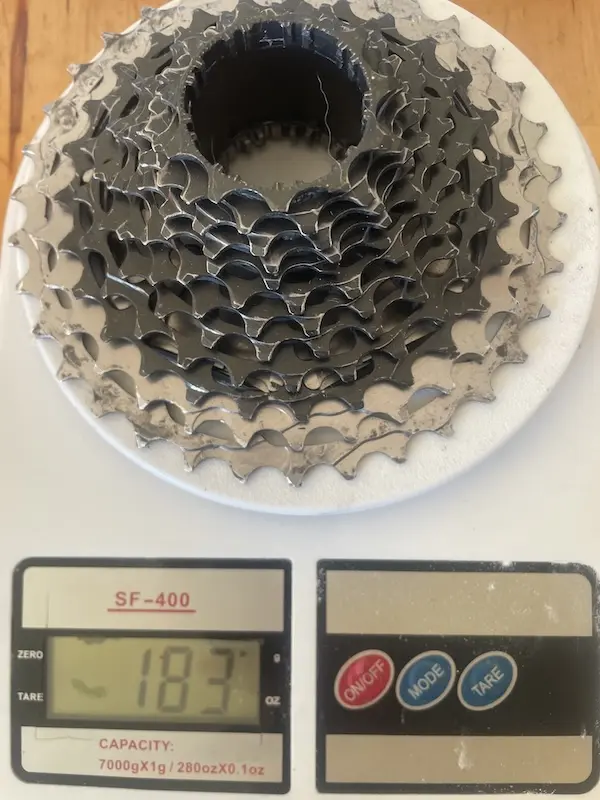
The design largely accounts for this low weight. Only the last two sprockets are made of aluminum; the rest are steel. It’s primarily the one-piece design that allows for weight savings, in a manner quite similar to what SRAM offers. Installation and removal are also a breeze with these one-piece cassettes.
DLC or PVD: Two Coatings, Two Philosophies
Neutron offers its cassette with two types of coatings: DLC and PVD. The DLC (Diamond-Like Carbon) coating offers a low coefficient of friction. It is designed to promote quick shifting and efficiency under load. On the other hand, it can produce a slightly more noticeable engagement noise. The PVD coating, meanwhile, sacrifices a small amount of that smoothness to offer better wear resistance. It therefore seems better suited for cyclists who ride a lot and are looking for greater long-term durability.
Again, the choice should be viewed as a compromise. Shimano retains the edge in terms of absolute shifting smoothness, but Neutron offers a lighter, more functional, and more reliable alternative over time.
A Credible Alternative, but Not a Whim
This type of crankset may appeal to many cyclists, but it’s not an impulse buy. The product requires a certain understanding of what you’re looking for. If the goal is to achieve the smoothest possible shifting, Shimano still has the edge. If the goal is to save weight, achieve a different setup, integrate an excellent power meter, and maintain a reliable drivetrain, then the Neutron set becomes very appealing.
The key factor remains reliability. After 15,000 km, these cranks no longer just feel like a lightweight, attractive product on paper. They prove to be a solution capable of standing the test of time—provided they’re installed correctly and used in a suitable setup.
A Rapidly Expanding Drivetrain Lineup
Neutron is no longer limited to just cranksets. The brand is now developing a comprehensive approach to drivetrains, incorporating cassettes, chainrings, pulleys, and even a chain to form a complete system. An 11-36-tooth cassette is also in production and is expected to arrive soon. The brand also confirms it is working on a 1×13-speed lineup, a sign that it aims to position itself for future market developments.
Another new product announced: a 54/40-tooth chainring combination featuring an original design. Neutron describes a carbon structure on both sides, with an aluminum chainring encapsulated in the center. The goal is to avoid exposed aluminum teeth while maintaining a good balance of weight and shifting quality.
Price and Positioning
The pricing remains competitive given the weight and level of integration offered. The complete crankset with a Sigeyi power meter and SL axle is priced at around €700. The cassette ranges from €340 to €360, depending on the coating selected.
These aren’t entry-level products, but they hold their own very well against traditional high-end groupsets, especially when you consider the weight, the power meter, and the overall consistency of the package.
Asian Carbon That Stands the Test of Time
After 15,000 km of use, Neutron Components cranksets have proven to be a credible alternative to the big names in the market, particularly for those seeking significant weight savings without resorting to the most conventional solutions. With a weight savings of about 160 g compared to a Shimano Dura-Ace R9200 groupset with a power meter, the benefits are clear on paper. The cassette also saves about 60 g compared to a Dura-Ace with equivalent tooth counts, and even more compared to an Ultegra.
But most importantly, this weight reduction does not seem to have come at the expense of reliability. After 15,000 km, the cassette still works just as well as it did when new, and the crankset has shown no cause for concern. Neutron doesn’t outperform Shimano in terms of shifting precision, and that’s probably not its goal. Shifting is a bit slower and a bit less refined, but it remains reliable and has never let me down.
This is still high-quality equipment, with a finish and stiffness that rival some of the top-of-the-line cranksets on the market. At a time when some riders are looking to shave off a few grams before the Étape du Tour or a major mountain cyclosportive, this option is definitely worth considering.
The NEUTRON COMPONENTS crankset and cassette at a glance…Pros: remarkable weight, virtually plug-and-play installation, excellent Sigeyi power meter, responsive customer service, Shimano compatibility Crank set weight with power meter: 437 g (without chainrings) – Suggested retail price: $699 More information: neutron.bike |
Share the post "Long-Term Test: 15,000 km with the Neutron Crankset and Cassette"