Share the post "In the invisible laboratory of the modern WorldTour"
Inside the invisible laboratory of the WorldTour, we share what Lidl–Trek, Visma | Lease a Bike and SRAM really say about modern cycling. And yes, we thought we’d talk about single chainrings, XPLR cassettes, gear ratios and technical choices seen in some classics. We mostly discovered a world. A world the general public almost never sees. A world made of data, intuitions, tests, trust, procedures, rider feedback, field validations, microscopic decisions and hours of invisible work. A world where a tire, chainring, cassette or wheel choice is never born by chance, but at the intersection of a sporting strategy, an equipment environment, a specific rider, a given course and a technological partner capable of transforming the race into a laboratory.
By Jeff Tatard – Photos: SRAM / Lidl–Trek / Team Visma | Lease a Bike / DR
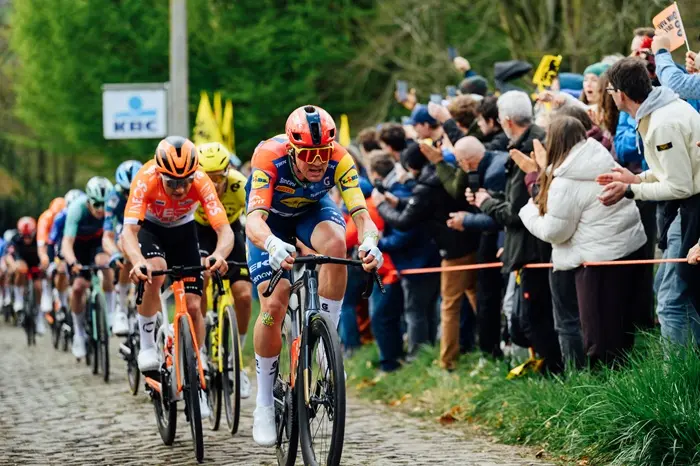
Sometimes it takes a misinterpretation to open a door. Our previous article on the single chainring and XPLR in the professional peloton started from a strong image: Mads Pedersen in the Paterberg, at the Tour of Flanders, that impression of a break in cadence, that visual sensation that something was playing out between a gear ratio, a cog, an acceleration and the violence of a Flemish climb. The analysis made sense. It was appealing. It told something many had believed they saw. But as often in modern cycling, what we see is not enough to understand what is really happening.
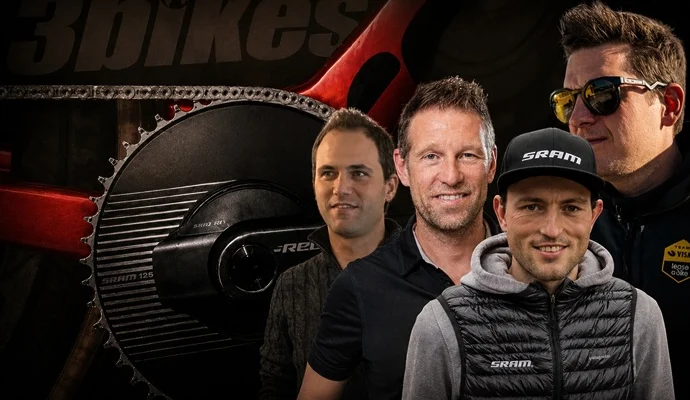
That’s where Marie Didier, at SRAM, entered the story. First to correct some technical approximations. Then, above all, to do much better than correct: to open access. Without her, this article simply would never have existed. It was Marie who made possible this series of exchanges with some of the most interesting minds in the modern peloton. It was she who coordinated the discussions, allowed visions to be cross-referenced, organized the meetings and accepted that an apparently “equipment” subject would become something else: a privileged entry into the invisible mechanisms of WorldTour performance.
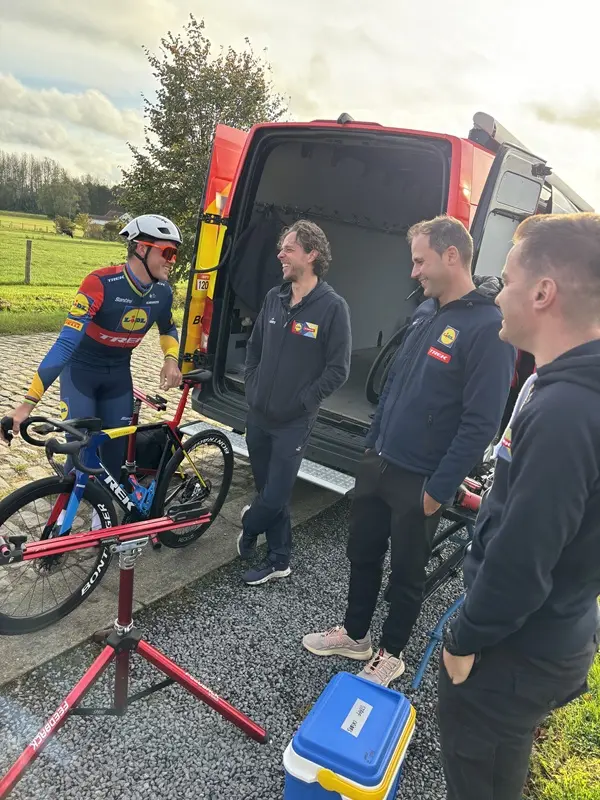
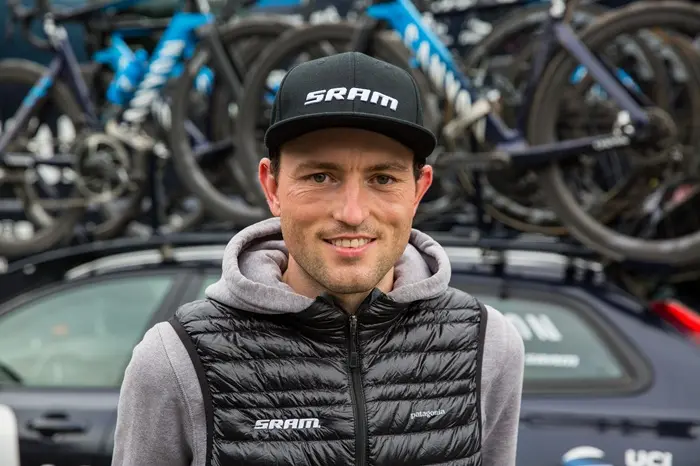
Two meetings of more than an hour were thus organized. The first around Lidl–Trek with Glen Leven, the team’s Team Support Manager, and Thorsten Wilhelms, Senior Race Technician at SRAM, to discuss how a WorldTour team works with an equipment manufacturer. The second with Jenco Drost, Head of Performance Equipment at Visma | Lease a Bike, and Sam Watts, another SRAM Senior Race Technician, to understand, this time from the inside, how Richard Plugge’s team thinks, validates and executes its equipment choices. Two meetings. Four profiles. Two performance cultures. One clear fact: modern professional cycling is never just what you see on television.
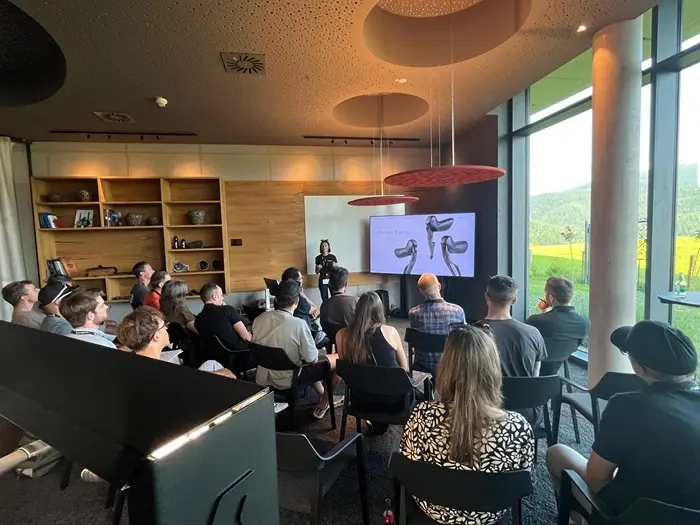
The iceberg effect of professional cycling
The best image to understand this feature is undoubtedly that of the iceberg. The public sees the visible part. A bike at the start of Paris-Roubaix. A single chainring on the cobbles. An XPLR cassette on a classic. A 54-tooth chainring one day, a 52-tooth the next. A rider changing bikes. A team choosing a different wheel. A drivetrain that seems unusual. A detail spotted in a photo. A word “prototype” printed on a pedal. A controversy born from an image. But all of this perhaps represents only 10% of the reality.
Beneath the surface, there’s everything else. Race plans. Data files. History of gear ratio usage. Each rider’s preferences. Resistance tests. Feedback from sports directors still able to ride hard. Successive validations before entrusting a product to the leaders. Discussions between technicians, mechanics, equipment manufacturers and performance managers. Trade-offs between aerodynamics, robustness, weight, feel, efficiency and safety. And sometimes, simply, this immense question: what is the best system for this rider, on that day, in that race?
That’s exactly what we wanted to understand. Not to do a product interview. Not to ask if single is better than double. Not to seek a definitive answer to a question that, precisely, calls for none. The objective was elsewhere: to understand how decisions are made, who influences them, how they are validated, what part belongs to data, what part belongs to feel, and why modern professional equipment has become a collective construction.
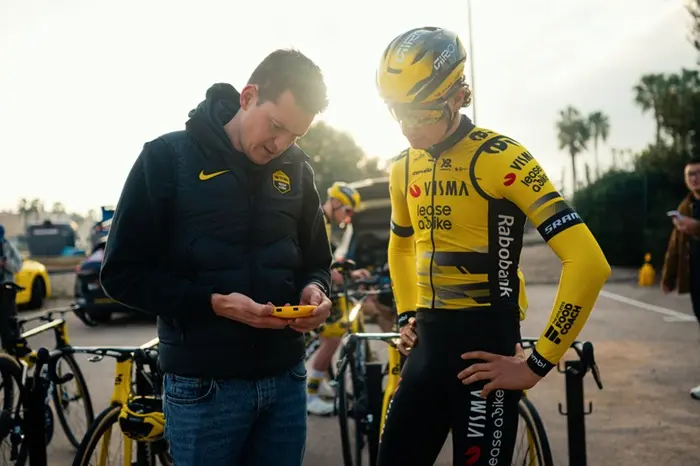
Lidl–Trek and SRAM: when the sponsor becomes a development partner
With Glen Leven and Thorsten Wilhelms, the discussion first revolved around a fundamental idea: today, the relationship between a WorldTour team and an equipment manufacturer can no longer be understood as a simple sponsorship relationship. A brand does not just supply equipment. It enters the team’s performance system. It listens, analyzes, adjusts, develops, responds, anticipates. It doesn’t just stick its logo on a bike: it participates in the evolution of the bike itself.
“Today, it’s a real collaboration,” summarizes Thorsten Wilhelms.
This sentence is simple. Yet it is crucial. Because it says everything about the shift in modern cycling. For a long time, the public imagined that the brand delivered, the team used, and victories then served as a marketing argument. This logic still exists, of course. But it is no longer sufficient. In the current WorldTour, teams have become validation platforms. Riders have become human sensors. Races have become stress tests. Classics have become extreme laboratories. And equipment manufacturers like SRAM don’t just design products in the lab: they have to understand how these products actually live, under pressure, in noise, fatigue, vibrations and the unpredictability of the race.
Glen Leven perfectly embodies this new generation of profiles within teams. At Lidl–Trek, his approach appears very Cartesian, almost clinical. He doesn’t speak to produce grand phrases. He speaks to frame, contextualize, bring each choice back to its real use. His world is one of constraints, options, data, possible configurations and the field. He is one of those modern profiles who stand at the intersection of engineering, performance, equipment, validation, aerodynamics and rider relations. They are no longer just “mechanics”. Nor are they scientists locked in an office. They are performance architects, capable of connecting a tire choice, a pressure, a drivetrain, a course, a rider and an objective.
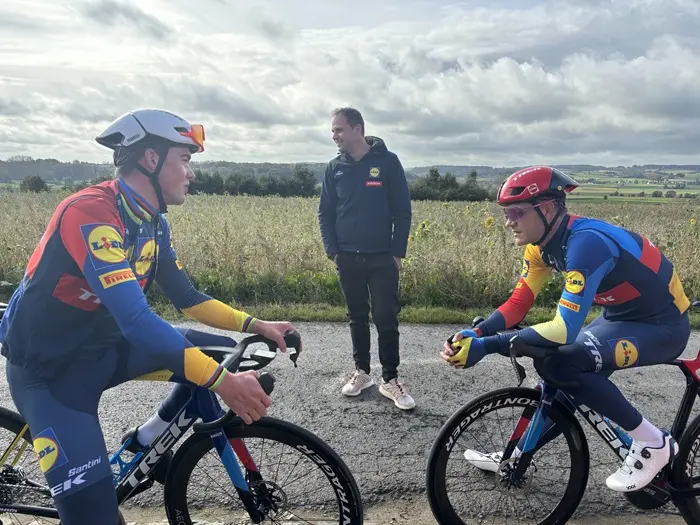
Facing him, Thorsten Wilhelms brings another depth. A former rider for the Team Bianchi structure in 2003, when the Coast team became Bianchi around the Jan Ullrich project, he comes from an almost mythical era of modern cycling. Rudy Pevenage, Ullrich, Bianchi, the post-Telekom years, the beginnings of an increasingly scientific approach to performance. Thorsten experienced old-school cycling, then the gradual rise of data, aerodynamics, protocols and ultra-professionalization. And it is precisely this background that makes his perspective interesting: he knows where professional cycling comes from, and he sees where it has gone.
For him, technology never erases the human element. It frames it, enriches it, helps it, but it doesn’t replace it. When he explains that “some riders have a much more developed sensitivity for giving feedback,” he opens an essential door. All riders know how to say whether they like a product or not. But not all know how to explain why. Some feel micro-variations better. Some can distinguish a vibration, a stiffness, chain stability, shifting precision or a difference in efficiency after five hours of racing. Some can formulate actionable feedback. And in modern development, this ability is worth its weight in gold.
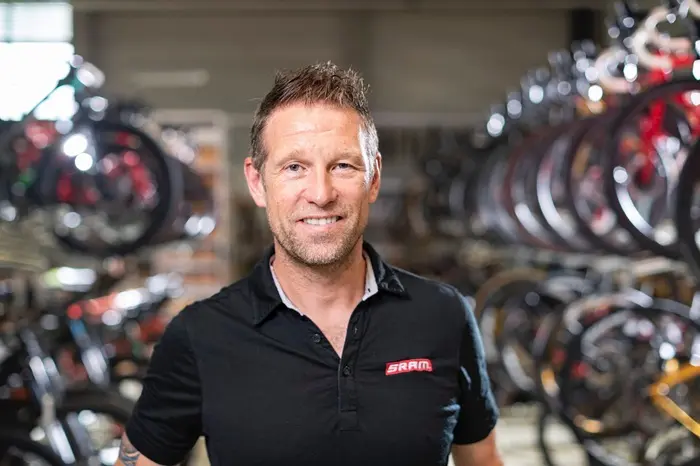
Single chainring is not a trend, it’s an answer
It is in this context that the subject of the single chainring and XPLR makes perfect sense. For several months, these technical choices have fascinated, intrigued or disturbed. The single chainring on the road remains culturally sensitive. In MTB, it has become obvious. In gravel, it has naturally established itself. But on the road, it touches on something almost identity-based: the subtlety of gear ratios, cadence control, the idea that the rider must always be able to precisely adjust their effort.
However, the answers from Glen, Thorsten, Jenco and Sam all converge on the same idea: the right question is never “single or double?”. The right question is: for which course, for which rider, for which strategy, with what constraint and what acceptable limit?
“People often think there’s a perfect setup. But today, that’s not how it works anymore,” explains Glen Leven.
This is probably one of the most important sentences in this entire feature. The perfect bike does not exist. It may never even have existed. The very highest level does not seek a universal truth. It seeks a correct answer. A coherent system. A combination performant enough to respond to a specific context. The Tour of Flanders is not Liège-Bastogne-Liège. Paris-Roubaix is not a mountain stage. A high-speed cobbled sector does not produce the same constraints as a twenty-minute climb. A rider like Wout van Aert does not necessarily have the same gear ratio preferences as Jonas Vingegaard. And that’s where equipment ceases to be a technical specification sheet and becomes a language.
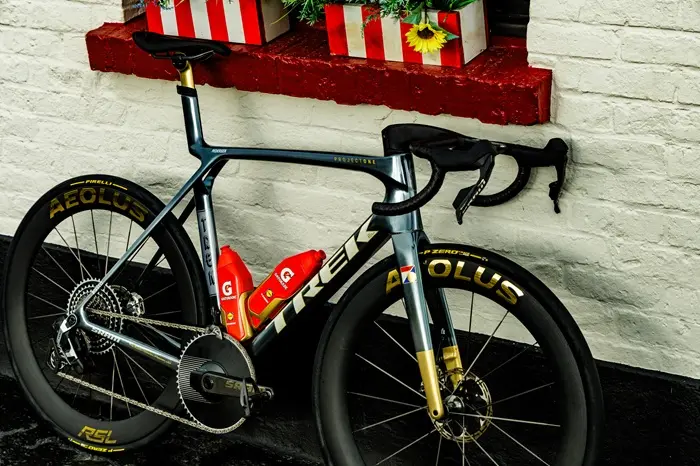
On the Tour of Flanders or Paris-Roubaix, XPLR should therefore not be read as a gravel gadget imported onto the road. It should be understood as a contextual solution. The 10-46 cassette widens the range of use. It largely adopts the logic of the 10-36, widely used in racing, while offering a reserve at the top of the cassette. Sam Watts explains it very well: on the first eleven cogs, the gear spacing is the same as a 10-36 road cassette. The larger gaps appear mainly on the larger cogs, where the objective is not to maintain a perfect cadence during a twenty-minute climb, but to offer a bail-out option for a short, violent, irregular effort.
To get over the Koppenberg, the Paterberg or certain Flemish climbs, this reserve may be enough. For Alpe d’Huez, Mont Ventoux or a long climb in the Tour de France, the logic changes completely. There, riders need closer gear ratios, to maintain a finer cadence, to stay in a precise gear ratio zone for a long time. The double chainring then retains its full meaning. The single chainring is not the end of the double. It is an additional solution in a broader environment.
On the cobbles, robustness becomes performance
One of the most interesting points of the discussion with Visma concerns the boundary between robustness and performance. The two are often opposed. As if a robust choice was necessarily defensive, slower, less noble. Yet on the cobbles, this separation no longer really makes sense.
“A more reliable setup is also a more performant setup,” explains Sam Watts.
This sentence is essential. At Paris-Roubaix, a system that keeps the chain under tension, that allows shifting under vibration, that limits chain drops, that remains stable when the bike violently hits the cobbles, is not only more reliable. It is more performant. Because a drivetrain that always works, even under pressure, allows the rider to pedal, to accelerate, to correct a gear ratio, to avoid a loss of concentration, not to suffer a mechanical micro-panic at the worst moment.
Jenco Drost also puts it very concretely: on the cobbles, the chain moves, jumps, vibrates. Anyone who has ridden on cobbles knows what happens. The XPLR, with its logic of tension, retention, narrow-wide single chainring and Full Mount derailleur mounted directly on the axle thanks to the UDH interface, limits this play. It keeps the chain better aligned. It allows shifting under stress. It makes a gear change possible in a situation where, with other systems, the rider would hesitate to touch the button.
And here again, we understand that modern performance is never limited to a single number. It’s not just a story of weight. Nor just of aero. Nor just of mechanical efficiency. It’s a complete system. A more stable drivetrain can save mental energy. A chain that drops less can prevent a break in rhythm. A more reliable gear change can preserve an attack. And in the WorldTour, all of that counts.
Visma: the culture of planning
Even if the discourse is the same on both sides, at Visma, the approach seems extremely structured. Jenco presents himself as Head of Performance Equipment, responsible for equipment, technical products, partners, but also for the way mechanics work. He doesn’t say he is “responsible for the mechanics” in the classic hierarchical sense, but he defines the procedures, standards, and the way bikes are assembled, prepared and validated. He embodies the pure equipment side of the team.
“For each race, I build a plan: which bike, which tires, which gear ratios, which wheels… every component is specified in this plan,” he explains.
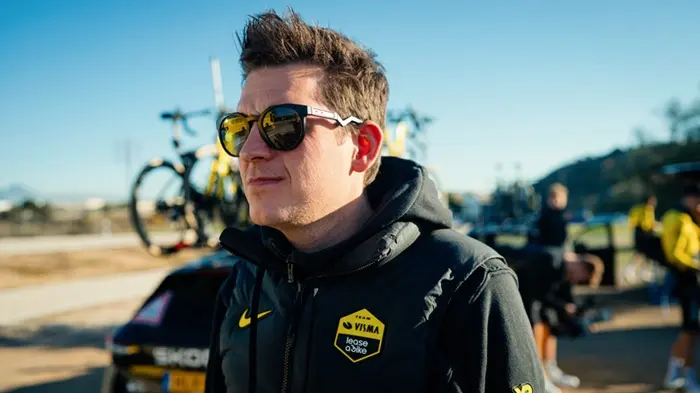
This sentence provides a major key. At Visma, every race starts with a plan. The bike, tires, wheels, gear ratios, every component is specified. But this plan is not fixed like a truth handed down from above. Jenco insists that he discusses, adjusts, confronts. The plan is a rational basis, built from data, the course, the strategy, the rider’s role and terrain constraints. But it remains connected to those who will execute it.
In his reasoning, equipment depends directly on the rider’s role. On a stage with Jonas Vingegaard as leader, some riders will have to accompany him in the mountains and will need lighter equipment, more suited to climbing. Others will have to pull on the flats and may be oriented towards a more aerodynamic setup. The bike is therefore not only chosen for the stage. It is chosen for the rider’s mission in the stage.
This is where performance becomes fascinating. The same course does not produce a single optimal configuration. It can produce several choices, depending on whether one is a leader, a mountain domestique, a rouleur tasked with controlling, or a rider called upon to protect a leader in a specific phase. The bike then becomes an extension of the tactical role.
90% data, 90% individualized
One of the most important figures from the discussion with Visma concerns the role of data. Jenco estimates that about 90% of decisions are data-driven. The figure is enormous, but it doesn’t speak of mechanical coldness. It primarily speaks of the level of structuring achieved by modern teams.
Choices no longer stem solely from a feeling, a habit or a tradition. They stem from an accumulation of data: course, expected speeds, gradients, history of gear ratios used, aerodynamics, efficiency, rider profiles, strategic role, weather conditions, feedback from previous editions. But this data does not eliminate the rider. On the contrary, it allows for a much stronger proposition to be presented to them.
Jenco also explains that equipment is largely individualized, around 90%, but in a different way than nutrition. This point is fascinating, because it echoes our previous exchange with Martijn Redegeld, at Visma, about nutrition. Martijn had explained that nutrition is extremely individualized, because each organism absorbs, tolerates and uses intake differently. Jenco makes a subtle distinction: in equipment, individualization also exists, but it depends less on the rider’s biological body than on their strategy, their role, their preferences and their sensitivity.
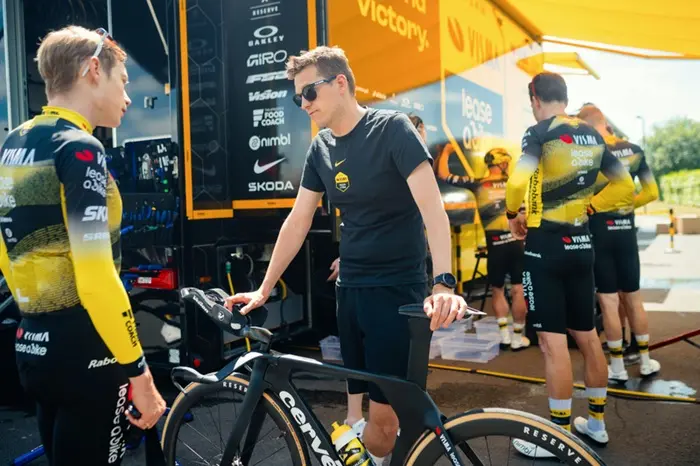
The fastest bike for Jenco will probably also be very fast for Sam. But how each person feels it can differ. In nutrition, what Sam can eat, Jenco may not be able to digest. In equipment, the scientific basis remains more common. What varies is the strategy, the role and certain very personal elements like the gear ratio.
And here, names become important. Jenco explains, for example, that Wout van Aert is very specific in his cassette choice. Certain cogs matter to him. He likes certain transitions. He knows what he wants. Conversely, Jonas Vingegaard seems much less sensitive to these gear ratio details. “Jonas, he just pedals,” summarizes Jenco, in a formula as simple as it is revealing. It’s not that Jonas feels nothing. It’s that he doesn’t attach the same importance to certain details as Wout. And for a team, knowing this is invaluable. Because individualization is not just technical. It is psychological.
The rider is not always a good tester
This is one of the strongest lessons from these two interviews. The public often imagines that the professional rider is naturally the best judge of equipment. This is not always true. All riders ride fast. Not all know how to finely analyze what they feel.
Thorsten had already emphasized this with Lidl–Trek: “Some riders have a much more developed sensitivity for giving feedback.” Jenco and Sam confirm this logic on the Visma side. There are riders who are more often asked to test, because they like it, because they know how to express feedback, because they are able to distinguish what relates to the product, the form on the day, the conditions or the context.
At Visma, the validation process does not always start directly with the main leaders. Jenco explains that it can first go through internal people, through staff members, to carry out durability tests or initial validation. Only then does the product “descend” to certain riders identified as relevant for giving feedback. This funnel process avoids putting a raw product into the hands of a leader too early. When the rider tests, the team already knows what it is looking for, what it expects, what needs to be observed.
“We already know some basics of the equipment’s behavior even before giving it to the riders,” explains Jenco.
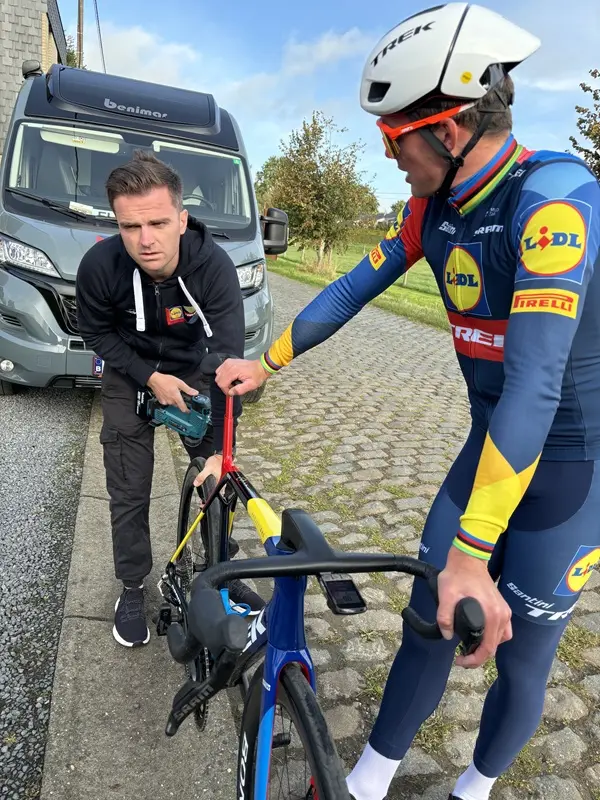
This is very important. The rider does not receive a product in “good luck, tell us what you think” mode. They receive prepared, contextualized, framed information. If you give them a product without preparation, they might give an irrelevant answer. If you explain what has been seen, what is expected, what they should observe, then their feeling becomes much more useful.
From R&D to race: sometimes a year, sometimes less
The transition of a product from development to race is never instantaneous. Sam and Jenco mention a process that can last about a year, sometimes less depending on the urgency of the need or the nature of the product. If a partner develops a new complete groupset, the timeline has nothing to do with a specific part responding to an immediate need for a particular race or use.
Regulatory constraints also factor into the equation. UCI rules impose a framework for commercialization and availability. Products cannot remain indefinitely in a phantom zone. Sam explains that the use of a prototype in a race cannot exceed twelve months and must then become commercially available. This partly limits the fantasies surrounding secret prototypes. Pros don’t just ride on objects from the future that no one will ever see. But they often ride on products in an advanced validation phase, sometimes before the general public truly understands what they are looking at.
This is exactly the difference between seeing and understanding. The public sees a component. The team sees a process. The public sees a novelty. The equipment manufacturer sees four years of development, iterations, corrections, validations, rider feedback, industrial constraints, trade-offs and a launch schedule.
The Roubaix example: what the public doesn’t understand
The discussion around Paris-Roubaix is one of the most revealing moments. I then bring up the Alpecin episode, Mathieu van der Poel, Jasper Philipsen’s prototype pedal, and this situation where a bike change suddenly becomes much more complex than the public imagines. Jenco responds with a very interesting nuance. He understands why it can be perceived as risky, but he also understands the internal logic: at Alpecin, Van der Poel and Philipsen are both leaders. The probability of them having to swap bikes is therefore much lower than between a leader and a domestique. Similarly, at Visma, Wout van Aert and Christophe Laporte would not be expected to swap bikes at Roubaix, because if Wout gets a flat, Christophe must continue, and vice versa.
But Roubaix remains Roubaix. And Jenco adds that he probably wouldn’t have taken that risk. This is where the nuance becomes interesting: there isn’t just one interpretation. There’s a team logic, a probability, a strategy, then a part of the unpredictable that only Roubaix can produce.
The same reasoning comes back with the story of multi-tools. Why don’t riders carry a tool in their pocket or in the thru-axle to be able to intervene themselves? Here again, the answer is not just technical. On major races like Paris-Roubaix, there are so many people on the roadside, so many assistance points, cars, motorbikes, mechanics, that the idea of asking a rider going at 190 beats per minute to pull out a multi-tool, place it in an axle, remove a wheel and think clearly is almost absurd.
Sam summarizes the idea with a lot of common sense: you have to remove as much stress as possible from the rider. Their job is to win the race, not to repair their bike in chaos. And Jenco adds a perfect example: on the Tour de France, during the cobbled stage, Visma had prepared an entire bike change strategy for Jonas Vingegaard. Several options existed. Only one was bad: Nathan Van Hooydonck’s bike. And in the chaos, Jonas precisely took that one. Everything had been anticipated, except this impossible decision made in panic.
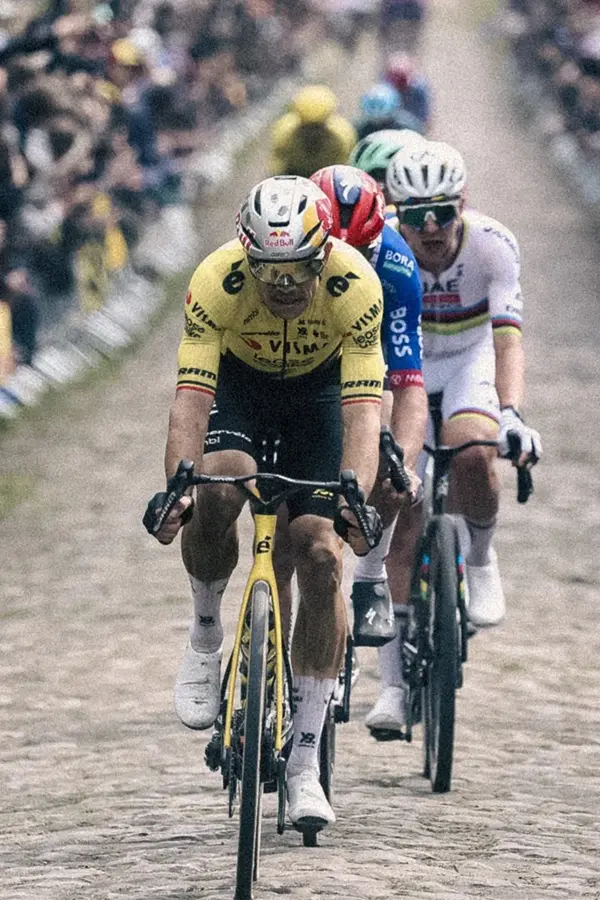
This anecdote says it all. Even the best riders in the world, the best prepared, in one of the most structured teams on the planet, can lose their lucidity in a moment of extreme stress. So imagining that they could manage a complex mechanical repair in full effort is almost a fantasy. Modern performance also consists of removing this type of mental load.
Two watts, 200 days a year
The end of the exchange with Visma perhaps touches on the core of the general public’s misunderstanding: marginal gains. For an amateur rider, two watts mean almost nothing. You move your head two centimeters, you slightly change your position, you already lose or gain something. At 30 km/h, many differences seem small, almost theoretical. But at 50 km/h, everything changes.
Jenco explains this shift very well. What seems insignificant at an amateur cyclist’s speed becomes considerable at the speed of a WorldTour peloton. A wheel that saves two watts, a better-suited gear ratio, a cleaner position, a more efficient drivetrain, a better-chosen pressure: in isolation, it may seem trivial. But if a rider pushes two watts less each day, over 200 days of racing or training, the sum becomes real. And if two watts can win a race, then you have to look for them.
This is probably one of the keys to the feature. The general public doesn’t always understand the teams’ choices because they don’t ride at the same speed, not with the same effort intensity, not with the same consequences. What seems excessive on an amateur bike becomes rational at the very highest level. What seems useless at 30 km/h can become decisive at 50 km/h.
What a simple gear ratio choice hides
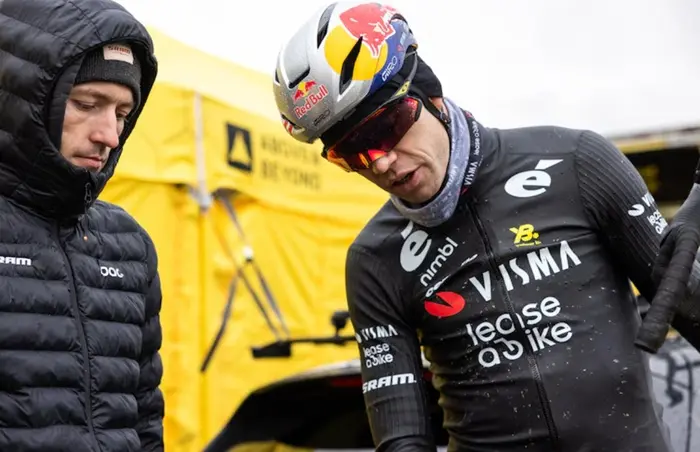
The question seems simple: how do you choose a gear ratio for a classic today? The answer, however, is immense. There’s the course, obviously. The profile. The cobbled sectors. The number of climbs. The expected speeds. Data from previous years. The rider’s preferences. Their role. Their mission. Their ability to maintain a cadence. Their need to accelerate. Their relationship to certain cogs. Their history. And then there’s the mechanics’ work, often totally invisible.
Jenco explains that the drivetrain adjustment is checked constantly. Every day. Every hour when the mechanics are on the road. A gear ratio choice is therefore not just a line in a plan. It’s a chain of preparation. Mechanical efficiency. Perfect indexing. Constant attention to the combinations used. Listening to the rider’s preferences.
And here again, Wout van Aert and Jonas Vingegaard become two perfect examples. Wout is specific. He knows what he likes in a cassette. Jonas seems less sensitive to these nuances. One needs a very precise environment. The other pedals with an almost brutal simplicity. For a team, these differences are not anecdotal. They are part of the preparation.
Understanding rather than judging
Ultimately, these two interviews extend our previous article on the single chainring and XPLR, but they go far beyond it. The first subject was technical. This one becomes cultural. It’s no longer just about understanding why a rider uses a single chainring on certain classics. It’s about understanding how modern cycling thinks. And this thinking is much more subtle than one might imagine.
It doesn’t oppose single and double chainrings. It doesn’t oppose data and feel. It doesn’t oppose sponsor and team. It doesn’t oppose robustness and performance. It seeks to make all of this interact. To build coherence. To create, for each race, each rider and each role, the fairest possible system.
Perhaps this is the great lesson from these exchanges with Glen Leven, Thorsten Wilhelms, Jenco Drost and Sam Watts. Modern professional cycling is no longer just an object. It is a consequence. The consequence of a plan, a culture, a partner, a rider, a strategy and an immense volume of invisible work.
The public sees the start. They see the finish. They sometimes see a close-up shot of a derailleur, a cassette, a chainring or a pedal. But they don’t see the hours of discussion, the upstream tests, the hesitations, the validations, the numbers, the sensations, the compromises, the decisions made weeks before the race. They only see the surface. And perhaps that is what makes this subject so fascinating. Because the more we understand the equipment, the less we ultimately talk about equipment. We talk about trust. About culture. About method. About collective intelligence. About that invisible part of the sport where victories are sometimes decided even before the riders start. Modern cycling is still watched with the eyes. But it is now understood beneath the surface.
=> Road single chainring: simplicity versus versatility, re-read this article
=> Why do Wout Van Aert and Jumbo-Visma use a single chainring? The answer is here
=> And to discover our other major portraits on performance and endurance: All our Portrait articles
Share the post "In the invisible laboratory of the modern WorldTour"