Share the post "Testing the Amidal POC: Disappearing the Smart Way"
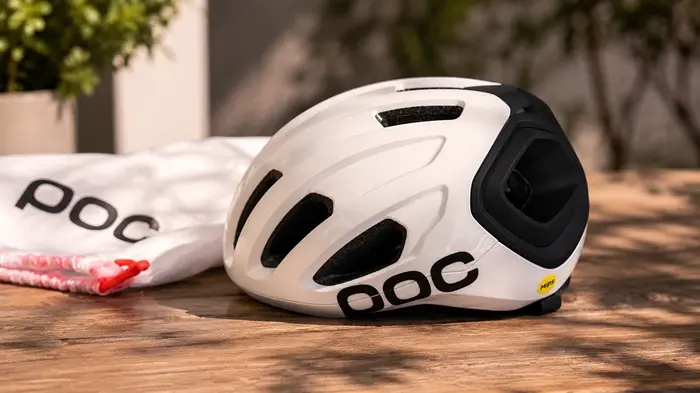
Review of the POC Amidal—or, in other words, the helmet that finally understands that modern cycling is no longer about making an impression… but about blending in intelligently. Through its ever-increasing sophistication, modern cycling has ultimately led to a strange evolution: the best gear is no longer necessarily the gear that seeks to stand out. Today, the truly successful products are often those that know how to fade into the background in favor of movement, comfort, and that fluidity of motion that all cyclists who ride a lot unconsciously seek. The new POC Amidal belongs precisely to this generation. A helmet that never seeks to draw attention to itself but rather to minimize anything that might disrupt the body over the course of hours: tension, vibrations, turbulence, and mental distractions. For several weeks, we rode this Hydrogen White / Uranium Black Matt version on fast roads, long endurance rides, rough terrain, and rolling gravel sections, often paired with the new POC Elicit sunglasses. And very quickly, one thought kept coming back to us: the Amidal never tries to be the main focus of the ride. It simply aims to be the perfect companion for the cyclist.
By Jeff Tatard – Photos: © Jeff Tatard
There are products that immediately seek to make a visual statement. Products designed to catch the eye even before hitting the road. For a long time, high-end helmets worked exactly like that: spectacular volumes, aggressive vents, showy aerodynamic features, shapes designed to convey speed even before actually delivering it. And honestly, for years, the cycling world loved it. We probably did, too. Because there was a very simple fascination at play: the more complex a helmet looked, the more we felt it must perform.
Then the modern bike changed. Bikes became faster. Tires got wider. Rides got longer. Terrain became more varied. Riding positions became more demanding. And above all, our relationship with our gear has evolved profoundly. Today, the best gear isn’t necessarily the kind that adds to the sensation. It’s often the kind that takes it away—the kind that reduces tension, turbulence, unwanted vibrations, and mental distractions. It’s the kind that allows the body to function more naturally.
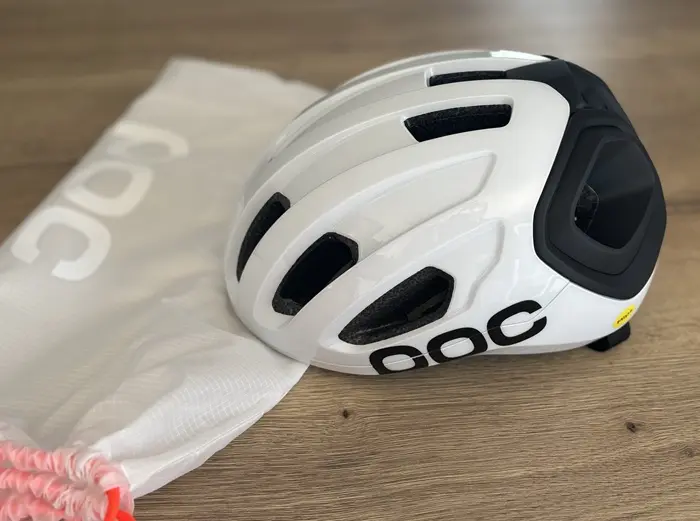
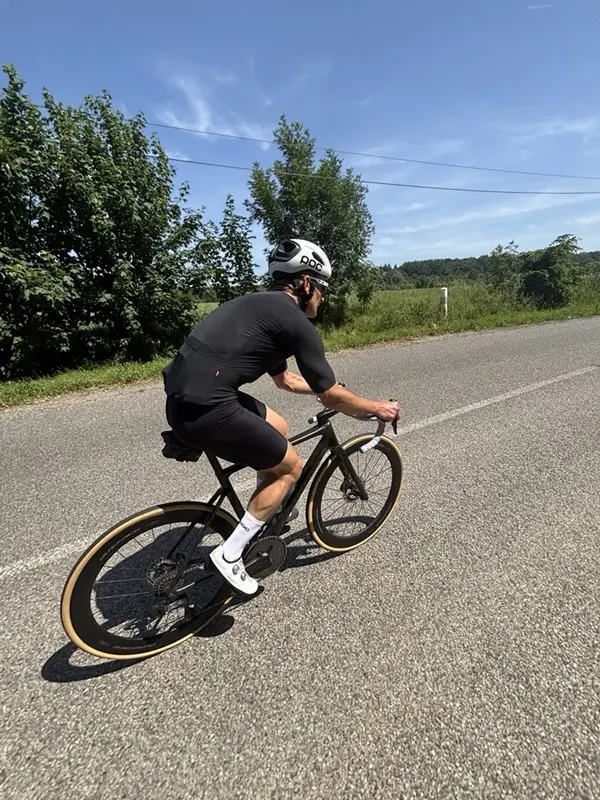
And from the very first few kilometers on the new POC Amidal, an extremely rare sensation emerges: this helmet seems to have been designed precisely around that idea. For several weeks, we rode this Hydrogen White / Uranium Black Matt version, size M, on fast roads, long endurance rides, rough terrain, rolling gravel sections, and “Bike Job” days—when the bike ceases to be merely a piece of sports equipment and becomes a true tool for daily commuting. Often paired with the new POC Elicit sunglasses and sometimes accompanied by the perfectly integrated Knog x POC taillight, the Amidal never sought to be the center of attention on our rides. And that’s precisely what made it so interesting.
A design that finally moves away from constant showmanship
For a very long time, POC helmets have always had an extremely strong visual presence. It was almost a brand philosophy. The Octal, Ventral, and Cytal never tried to blend into the background. The helmets were imposing in size. Their proportions were instantly recognizable. Safety became visible. So did aerodynamics. There was something very “statement product” about this approach to helmet design.
The Amidal subtly shifts this approach. And honestly, it’s probably one of the most aesthetically sophisticated POC helmets we’ve seen in recent years. Because it remains instantly recognizable as a POC—impossible to mistake for anything else—but everything now seems more restrained. More balanced. More mature. The overall profile seems more compact. The vents are no longer flashy. The lines become more fluid. More natural. The helmet no longer tries to look like a mobile wind tunnel.

And very quickly, something becomes clear: this visual restraint aligns perfectly with the current evolution of performance cycling. Today, many experienced cyclists no longer need a helmet that screams “high-tech.” Above all, they want it to function perfectly for five hours without ever disrupting their body’s rhythm.
Even the Hydrogen White / Uranium Black Matt color scheme speaks to this philosophy. The slightly off-white hue lends a genuine sense of technical sophistication without veering into the clinical white that can sometimes be too visually jarring. As for the matte black rear, it perfectly frames the overall design without disrupting the helmet’s general fluidity. The result is extremely contemporary. And extremely “quiet performance” as well.
And then there’s one thing we have to admit: when riding with the official Education First helmet, something suddenly feels missing to truly complete the picture. A Cannondale. And honestly, during some rides, we’ve sometimes had this strange feeling that by simply adding a SuperSix beneath us… we’d spontaneously gain 15 watts and develop an immediate passion for overpriced cafés and long white socks pulled up perfectly.
When you look at it, the Amidal seems almost simple. But when you put it on, you immediately appreciate the extremely precise balance of its proportions.
A helmet designed for true modern cycling
What stands out most about the Amidal is the sense of overall coherence of the product. At no point did we feel like we were using a helmet developed around a single marketing gimmick. It isn’t “the lightest.” It’s not “the most ventilated.” It’s not “the most aerodynamic.” And honestly, that’s probably exactly what makes it so good.
Because it feels as though it was developed based on a very realistic understanding of modern cycling: long, fast rides; high-intensity endurance; rough roads; accumulated fatigue; heat; vibrations; progressive neck tension; rolling gravel; everyday mobility; and a growing need for bodily stability. Ultimately, everything seems to have been designed to reduce the physical and mental strain placed on the cyclist.
And this philosophy is immediately apparent on the road. Very quickly, we began to forget we were even wearing the helmet. Not because it’s ultra-minimalist or physically nonexistent. But because it interferes very little with the body’s natural functioning. And in the modern high-end segment, this lack of interference is likely the most valuable quality.
On the head: the total absence of disruption
From the very first minutes, a very rare sensation emerges: the Amidal causes virtually no disruption. No excessive pressure on the forehead. No pressure points on the crown of the head. No aggressive lateral tightness at the temples. The rear support gently cradles the base of the skull with great smoothness and, above all, a lot of intelligence.
What’s most impressive is the way the helmet gradually ceases to exist in your mind. Many helmets provide an immediate feeling of comfort. Few truly maintain that quality after three or four hours, when the heat builds up, vibrations accumulate, and muscle fatigue begins to set in. The Amidal clearly belongs to this very rare category.
Because a helmet you’re constantly aware of always ends up taking a toll on the body—even subconsciously. A bit of neck tension. A few micro-adjustments. A vague sense of mental fatigue. A slight urge to reposition it after two hours. With the Amidal, that happens very rarely. And the more kilometers you ride, the more impressive this quality becomes.
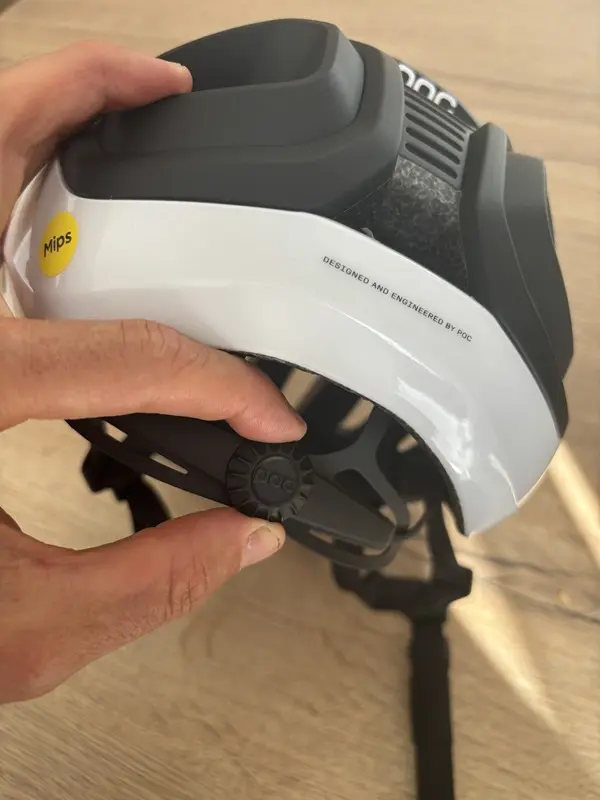
The occipital support wraps around the head with remarkable smoothness.
Stability that immediately inspires confidence
This is probably the helmet’s other great strength. When speed increases, when the road gets rough, or when you’re stringing together accelerations, some helmets still develop very slight unwanted movements. Nothing dramatic, of course. But enough to gradually tire the neck and the stabilizing muscles of the upper body.
The Amidal remains surprisingly stable. And most importantly: this stability never comes from being tightened too tightly. The helmet follows the head’s natural movements instead of trying to artificially restrict them. This distinction may seem minor. In reality, it drastically transforms the helmet’s dynamic feel.
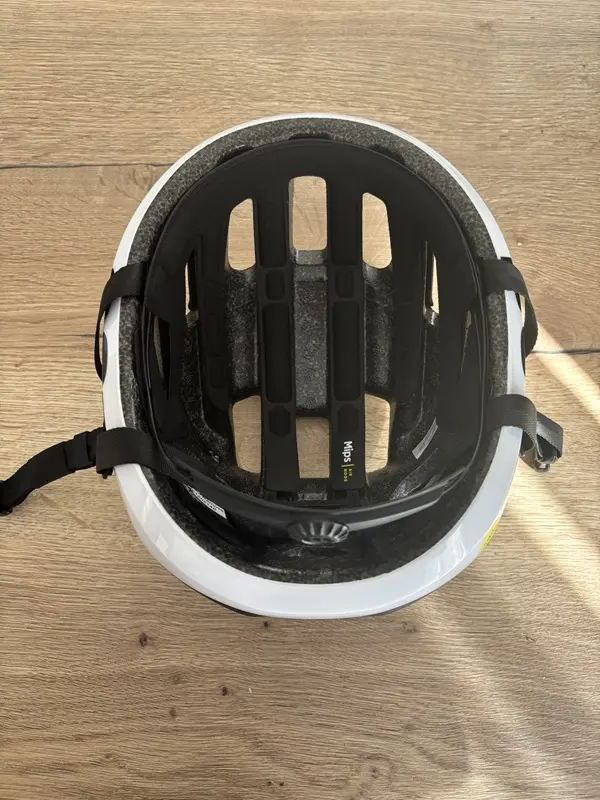
On fast roads, the helmet feels perfectly secure. On rough terrain or fast-rolling gravel sections, this stability becomes even more valuable. That’s because it greatly reduces that “floating” sensation that some helmets can sometimes create when vibrations increase. Very quickly, a sense of physical confidence sets in. And honestly, that’s probably one of the greatest qualities a helmet can offer.
Even when the terrain gets rougher, the Amidal maintains an extremely secure fit.
Ventilation That Avoids Being Overbearing
Visually, the Amidal never gives the impression of being an ultra-open helmet. And yet, on the road, the ventilation is excellent. But above all: it’s smart. We never experience those aggressive airflows that some highly ventilated helmets direct straight at the forehead or temples.
Here, airflow seems to be guided with much greater subtlety. The helmet breathes constantly. Air circulates deeply through the internal structure, but without ever creating that sensation of a constant cold draft that can become tiring during long, fast rides.
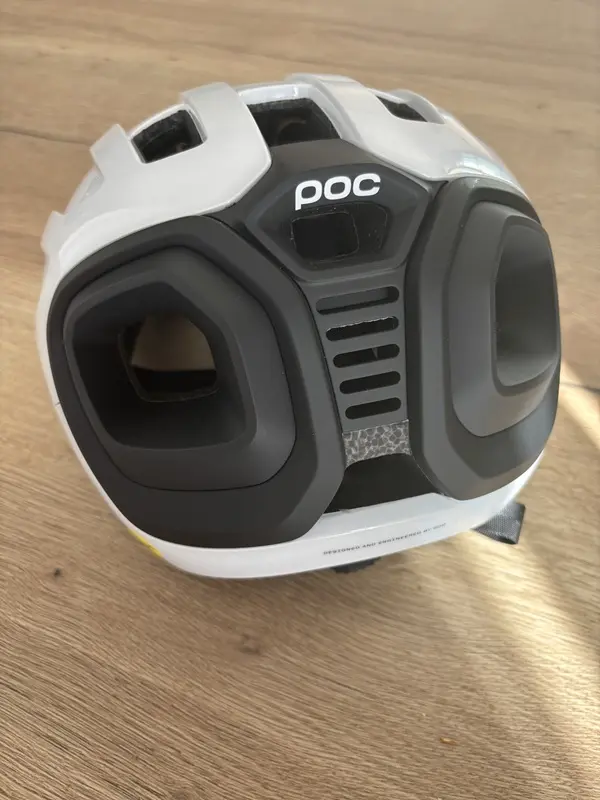
Ultimately, this aligns perfectly with the helmet’s overall philosophy: never to disrupt the cyclist’s experience. Everything seems designed for fluidity—even the ventilation. The helmet supports the rider’s effort rather than trying to make it spectacular.
The POC Elicit: the same philosophy applied to the face
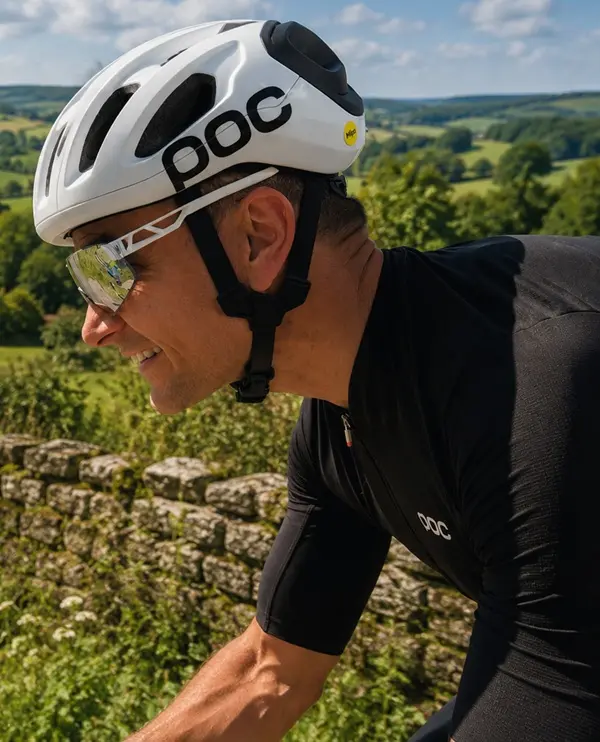
During this test, we also rode extensively with the new POC Elicit sunglasses in the Hydrogen White version with a Clarity Trail Partly Sunny Silver lens. And honestly, what struck us wasn’t just the aesthetic pairing—even though the combination works perfectly—but above all the philosophical consistency between the two products.
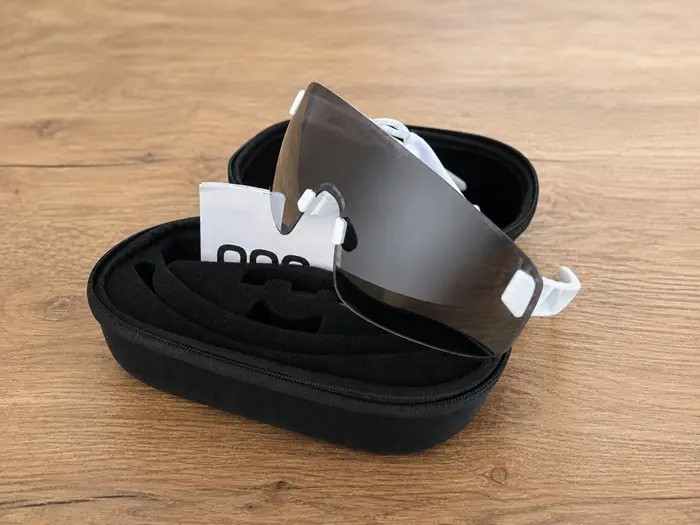
The Elicit glasses literally disappear on your face. Extremely lightweight and very open visually, they create that strange sensation of completely forgetting you’re wearing glasses. And ultimately, that’s exactly what the Amidal does on your head, too.
Less sensory pressure. Fewer disruptions. Less interference. More fluid body movement. And the more kilometers I covered with this setup, the harder it became to go back to gear that felt more “present.” POC seems to have grasped something extremely modern: the best technology is sometimes the one you no longer feel.
The little Knog x POC light: the detail that says it all
This philosophy of smart design extends even to a detail that might seem minor… but which, ultimately, perfectly sums up the current evolution of cycling gear: compatibility with the integrated Knog x POC rear light.
And honestly, we have to be completely transparent: so far this summer, we’ve had almost no opportunity to actually ride at night. Between days that start at 5 a.m. and daylight lasting until as late as 10:30 p.m., conditions haven’t allowed us to seriously test this light in a true, extended nighttime setting.
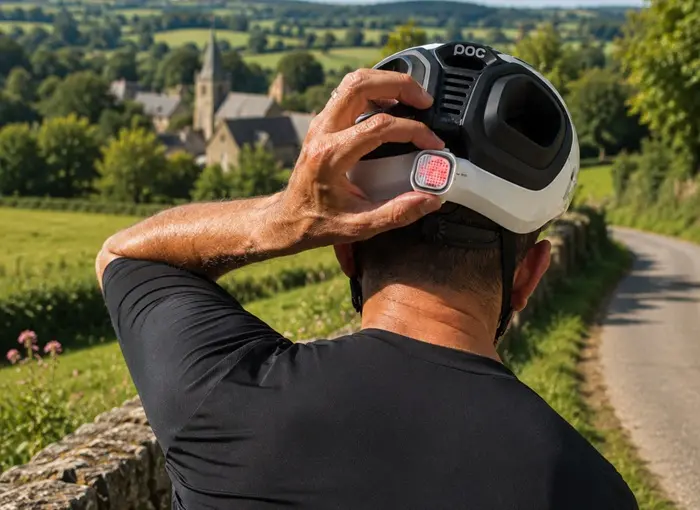
But paradoxically, that doesn’t stop us from immediately understanding the system’s value. Because today, modern cycling is no longer limited to perfectly planned Sunday morning rides. There are late returns. Days that run long. Long endurance rides where darkness falls faster than expected. And above all, this reality that’s becoming increasingly common among many enthusiasts: using the bike as a genuine tool for daily commuting.
In this context, the little Knog x POC light immediately makes sense. First, because it blends seamlessly with the helmet’s design. Nothing sticks out awkwardly. Nothing looks like an accessory added at the last minute. Second, because the idea of USB charging is extremely practical in real life. No need for a complicated proprietary system. You simply recharge the light like any modern everyday object. And honestly, the more we looked at this detail, the more we felt it perfectly encapsulated Amidal’s overall philosophy: making technology discreet, intuitive, and truly useful.
Sophistication That’s Become Almost Invisible
This is probably what best sums up the Amidal POC. Many high-end products still try to visually convince us that they’re sophisticated. The Amidal does almost the opposite. It simplifies the external appearance to focus all the intelligence on the user experience.
And the more kilometers you ride, the more this approach seems spot-on. Because today, true sophistication no longer necessarily means making technology visible. It means making the effort feel more natural. More fluid. Less disruptive.
And ultimately, that may be precisely what makes this helmet so modern. It never tries to impress the cyclist. It seeks to help them perform better.

3bikes Verdict
The POC Amidal is probably one of the most consistent helmets POC has produced in recent years. Not because it seeks to radically revolutionize the category with a spectacular marketing promise or a deliberately showy approach. But precisely because it seems to have grasped something much deeper about the current evolution of performance cycling.
Today, cyclists who ride a lot no longer expect a helmet to be merely lightweight, aerodynamic, or well-ventilated. Above all, they expect it to be so unobtrusive that it allows the body to function naturally for hours on end. And that’s exactly what the Amidal accomplishes remarkably well. Long-lasting comfort, dynamic stability, intelligent ventilation, reduced disturbances, and an overall sense of fluid body movement: everything seems to have been designed around an extremely modern vision of high-end performance.
Because, deep down, today’s best gear isn’t necessarily the gear that adds the most sensations. It’s often the gear that removes the most invisible constraints.
And that’s probably what struck us the most during this test. At no point does the Amidal try to artificially impress its user. It never tries to remind you that it’s high-tech. It doesn’t turn every ride into a showcase of visible engineering. It simply supports your movement with tremendous intelligence, fluidity, and discretion.
And honestly, after several weeks of riding with it, it’s probably become our favorite definition of the modern ultra-high-end category.
The POC Amidal never gives the impression of being a piece of technology that’s trying too hard to stand out. It feels like a piece of equipment smart enough to know when to fade into the background.
The POC Amidal at a glance…Pros: exceptional long-term comfort, remarkable stability on rough roads, smart and never intrusive ventilation, a more compact and modern silhouette than previous POC models, excellent compatibility with Elicit sunglasses, extremely smart integration with the Knog x POC light, and an overall feeling of high-end fluidity. Cons: a premium price tag, sunglasses storage that could be improved in certain positions, and a POC style that remains polarizing for some traditional cyclists. Technical Specifications
Accessories used during the test
Contact: POC |
- => SEE ALSO: All our Test Articles
Share the post "Testing the Amidal POC: Disappearing the Smart Way"