Share the post "Roval Terra CL Test: Aero Gravel Decoded"
We thought we were testing a pair of gravel wheels. We rode with an intention. Not to explore. Not to get lost. But to go fast. For a long time. Cleanly. Because deep down, maybe that’s what has changed without us really realizing it: gravel is no longer just an escape. It has become a field of expression for performance. A discipline where average speed counts as much as the ability to absorb impacts. Where aerodynamics makes an appearance where it wasn’t expected. Where a wheel is no longer judged by its tolerance, but by its ability to move an entire system—tire, bike, rider—in the same direction. The new Roval Terra CL arrive exactly at this point. Not to do everything. But to do better… when you need to go fast.
By Jeff Tatard – Photos: ©3bikes.fr
In gravel, we still often judge wheels as we judged frames back when it was enough for them to look fast for us to attribute all qualities to them. We look at the rim depth. The number on the scale. The hub’s name. The overall look. The object. Its standing. Its immediate effect. The way it sits in the garage, in the workshop, against a light wall, or in a well-framed photo that already makes you want to ride even before inflating the tires. It’s human. We like to believe that performance can be read even before the first wheel rotation.
The problem is that modern wheels rarely reveal their truth when stationary. And in gravel more than anywhere else, this truth is almost never found where the eye first looks for it.
Because a serious gravel wheel is not just a light wheel, nor a wide wheel, nor a stiff wheel, nor even a supposedly “versatile” wheel. It’s a wheel that takes a stand. A wheel that chooses its terrain, its logic, its ideal speed, its way of bringing the tire to life, of holding pressure, of stabilizing the bike, of relaunching a system, of absorbing shocks without killing efficiency, and sometimes also of making you understand, with great elegance or great frankness, that it was not designed for all interpretations of modern gravel.
This is exactly what the new Roval Terra CL that Specialized entrusted to us for the six weeks leading up to their release tell us. An anticipated pair of wheels, naturally, because it belongs to an already very prominent family at Roval, at a time when high-end gravel is becoming increasingly precise in its promises and less and less vague in its intentions.
We’re no longer just talking about riding on trails. We’re talking about average speed, global efficiency, real-world performance, aerodynamic control with large tires, impact resistance, tire retention, rider fatigue, and that increasingly fine line between “adventure” gear and “competitor” gear.

And that’s where these Roval Terra CL become interesting. Because they don’t so much seek to flatter the imagination of gravel as its most current evolution : a fast, committed, performance-oriented gravel, capable of handling long, intense, rolling, sometimes exposed, sometimes demanding races, but in which speed remains a central language.
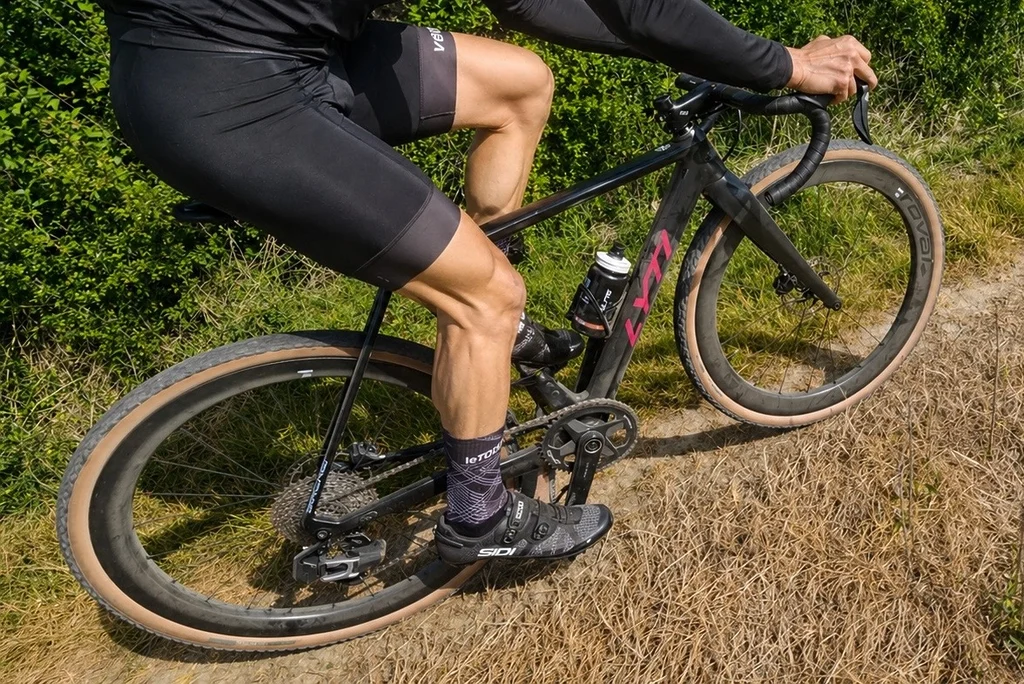
They are mounted here with a DT Swiss 350 hub, a SRAM XPLR 10-44 tooth 12-speed cassette, and Specialized Tracer Tubeless Ready 700x45C tires. In other words: a setup that doesn’t half-heartedly play at gravel. A setup that clearly seeks a modern, fast, ambitious interpretation, capable of pushing far this famous idea of competition gravel that everyone talks about, but which few products truly embrace to the fullest.
And very quickly, it became clear: these wheels are not gravel wheels in the vague sense of the term. They are racing wheels. Wheels for going fast. Wheels that love it when speed settles in. Wheels that make perfect sense when the course allows you to maintain momentum, keep the flow, and benefit from a 45mm tire well seated on a wide rim designed as a coherent system.
On the other hand, as soon as the terrain becomes truly broken, that the average speed collapses, that the ride becomes an alternation of brutal climbs, technical descents, tight singletrack, almost constant low-speed accelerations, and that you spend 70% of the time in zone 3 or zone 4, they already speak a little less loudly.
Not because they become bad. But because they then become more readable. And a very good wheel, sometimes, is also judged by the clarity with which it reveals its purpose.

A wheel arriving in a changed gravel landscape
We must start there to understand what Roval is doing today. High-level gravel no longer has much to do with the somewhat fluid field of expression it was just a few years ago. Races are faster. Riders are stronger. Profiles are sharper.
Aerodynamics, long treated as a road luxury, is now part of gravel considerations. Tires have gotten bigger, but speed has not decreased. On the contrary. Exposed straightaways, rolling sections, long phases at high speed, and the need to preserve the body as much as the clock have imposed another equipment culture.
It is in this context that Roval has built its entire new interpretation of the Terra segment. The brand itself explains it very clearly through its new Terra Aero CLX and Terra CLX III: today, a high-performance gravel wheel must work as a system, aerodynamics, tire-rim interface, impact resistance, tire retention, useful lateral compliance and overall stability.
Engineers now speak in hundreds of rim profiles modeled, in CFD-wind tunnel-CFD loops, in yaw angle management, in real wheel-tire-frame interaction, in large-volume drag reduction, in pinch flat protection. In other words: a global performance logic, far beyond a simple addition of numbers.
The Terra CLs tested here are not the absolute showcase of this technological peak, as the new CLX III or Terra Aero CLX can be. They do not feature ARRIS composite spokes or the most extreme choices in the range. But they are deeply nourished by this same philosophy. And that is immediately felt. They do not come from the world of adventure. They come from the world of speed.

When stationary, an almost deceptive sobriety
As often with truly serious products, the first encounter doesn’t necessarily trigger a grand show. The Terra CLs are beautiful, of course. Very beautiful even. They have this crispness of design, this quiet authority, this way of being immediately credible without falling into ostentation. But they don’t play the conceptual wheel. They don’t try to be spectacular when empty. They don’t try to impress through excess. They have something else to say, and that something else only appears in motion.
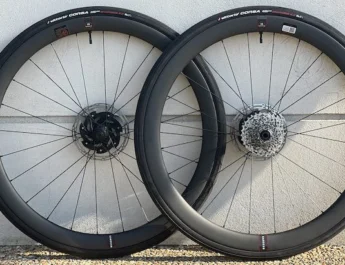
The bare weight we measured obviously contributes to this first impression of seriousness: 760 g for the front, 820 g for the rear. This immediately places the set in a category where it’s no longer just about good, honest robustness, but about a real ambition for efficiency. The choice of the DT Swiss 350 goes in the same direction. It’s not the hub of the spectacular. It’s the hub of confidence. That of proven mechanics, of concrete efficiency, of a product that doesn’t try to be clever but to do the job well, for a long time, without unpleasant surprises.

When stationary, then, everything seems calm. But this calm actually announces a wheel that has already chosen its way of existing: not by overacting. By riding.
Roval Terra CL – test configurationRims: Roval Terra CL carbon |
The heart of the matter: a wheel designed for rhythm
From the very first kilometers, what you feel most strongly is not so much a peak of responsiveness as a form of dynamic obviousness. The bike starts to roll fast with great ease. There is responsiveness, of course. There is support. There is feedback when you push. But above all, there is this very contemporary feeling of a system that likes to maintain pace. That likes established speed. That likes when the terrain allows the wheel to do what it was clearly designed for: maintain momentum, filter just enough, stabilize the casing of a 45mm tire, and transform power into progress without a feeling of dissipation.
It’s there that we understand that the right angle is not that of simple gravel versatility. The Terra CLs are not wheels that want to please everyone. They want to convince those who seek performance in a rolling, fast, modern gravel environment. They like it when the bike flies. They like it when fast sections follow one another. They like it when the terrain allows for this interpretation of gravel that already brings to mind the Gravel World Series, to those races where you don’t just win with tolerance, but with average speed, stability, precision and the ability to sustain high effort for a long time without degrading the bike’s fluidity.
On that terrain, they are formidably convincing.

A wheel that clearly has something of race about it
It’s probably the word that came back to us most often after the first truly significant rides: race. Not in the marketing sense of the term. Not in the sense that everything today proclaims itself “race” as soon as there’s carbon and a serious price tag. No. Race in the sense that the wheel seems to want to transform the ride into a structured effort. Race in the sense that it makes you want to push. Race in the sense that it likes high speeds, long sections where you can put the bike under tension, seek the best efficiency, exploit the tire casing, and feel that you are riding on a system that prioritizes performance above all else.
There is in these Roval Terra CL a very clear temperament. They have the personality of products that know for whom they were designed. One can easily imagine them under a rider aiming for a qualification for the UCI Gravel World Championships, under a rider who wants a pair of wheels capable of performing on fast courses, who knows that aerodynamics is no longer only played out on the road, that the wheel-tire interface matters enormously with 45 mm sections, and that maintaining a good average speed becomes a structural advantage over the duration of a race.
And this feeling doesn’t come by chance. All recent technical communication around the Terra range goes in this direction. Roval insists that modern gravel now demands the same level of rigor as the World Tour on road. The new Terra Aero CLX were thus developed from more than 300 rim concepts, by integrating not only aerodynamic resistance, but also crosswind stability, bead resistance, structural constraints, mass, and the interface with 35 to 60 mm tires. CFD simulations did not look at the wheel alone, but the wheel with its tire, on a frame, with realistic yaw angles from 0 to 20°, and even micro-variations specific to gravel surfaces.
Why recall this here, when our test concerns a Terra CL equipped with DT 350 hubs? Because it allows us to understand the overall direction of the Roval project. Even on a less extreme version, you feel a brand that no longer thinks of the gravel wheel as an adaptation of a road wheel, but as a specific answer. You feel a real change of era. And this, on the bike, translates into a very clear sensation: this wheel loves competition.
The tire, the width, the seating: where it all begins
The setup with Specialized Tracer Tubeless Ready 700x45C is obviously not neutral. And it alone says a lot about the logic of the whole system. Because today, fast gravel is no longer just about choosing a “go-anywhere” tire. It’s about knowing what casing you want to bring to life, on what platform, at what pressure, with what level of lateral support, what quality of retention, what interpretation of the terrain, and what speed ambition.
Roval emphasizes precisely the importance of width in the efficiency of a modern gravel wheel. On the most recent models in the Terra range, the sections are significantly more generous than before: up to 38.5 mm external and 27 mm internal on the Terra Aero CLX, for example, with the explicit desire to make the rim and tire function as a single profile. The idea is clear: with large tires, old narrow shapes derived from road cycling cause flow separations and penalize both stability and efficiency. Conversely, a wider rim, designed to support a 45 mm tire and guide the air cleanly, creates superior coherence.
Even without going into every exact millimeter of the tested Terra CL here, one immediately feels this philosophy at work. The Tracer 45 performs well. It finds its footing. It doesn’t float. It’s neither crushed nor undersupported. And this produces something very important: a dynamic stability that makes you want to ride fast without fighting against the bike.
It is also for this reason that we appreciated the tire’s grip. The Tracer offered very good grip, reassuring behavior, a real ability to play its role in fast sections as well as in more demanding turns. It’s not just a “gets the job done” tire. It’s a tire that, here, fully contributes to the feeling of coherence of the setup.

Where they truly shine: rolling, fast, open courses
There are wheels that you understand immediately on any terrain. And there are others that become extraordinary as the course approaches what they were designed for. The Terra CLs clearly belong to the second category.
On rolling, open, fast courses, where you can maintain speed, extract from the terrain superior efficiency and benefit from a system that continues to advance cleanly between two big accelerations, they become frankly very appealing. One thinks of those courses where gravel sometimes resembles less a wild hike than a fast endurance race. One thinks of fast white roads, clean tracks, long agricultural roads, exposed sections, terrains like the Strade Bianche, precisely. Terrains where you need tires, stability, comfort, yes, but where speed remains the main concern.
It’s there that we found the most convincing pair. It’s there that you truly understand this feeling of a competition wheel. The bike remains calm. It doesn’t get bogged down. It doesn’t become sluggish. It maintains a very good pace-holding ability. It helps to inhabit speed rather than endure it.
And that changes a lot of things. Because in modern gravel, going fast is not just a matter of power or daring. It’s also a matter of fatigue. A wheel that rolls well, which correctly stabilizes the tire, which saves you from permanent micro-corrections, which maintains efficiency on fast and imperfect surfaces, saves you energy. It allows you to stay clean longer. To be clear-headed later. And in a long race, that’s not a detail.
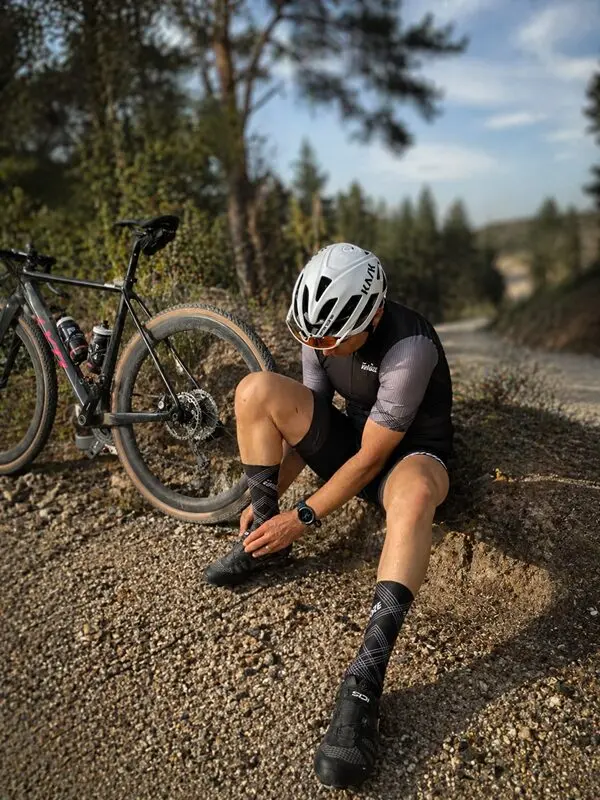
Where they show their limits: forest, big elevation changes, slow technical terrain
However, it must be said with the same frankness, because that’s also what makes a real test interesting. We liked these Terra CLs significantly less when the terrain moved away from this fast logic to enter a gravel environment that was harsher, more technical, more forested, more disrupted in its rhythm. Not because they suddenly become bad, once again. But because they are no longer as dominant.
As soon as the ride shifts into forest areas with many climbs, technical descents, low-speed accelerations, constrained handling, tight lines, and ultimately the average drops significantly below 20 km/h while you spend a huge amount of time in zone 3 or zone 4, something shifts. The terrain no longer allows the wheel to express its main advantage. You no longer benefit as much from its established efficiency logic. You ask something else of it. More docility at low speed. More ease in changes of pace. More comfort in very slow harsh terrain. More naturalness in sequences where handling and useful compliance take precedence sometimes more than the ability to maintain speed.
And there, without failing, they appear more demanding. More specialized. Less enjoyable. As if the wheel reminded you, without brutality but without ambiguity, that it prefers when gravel rides fast rather than when it gets tangled up.
This is perhaps the best way to summarize their personality: they excel when you can launch them. They are less convincing when you have to mentally carry them through terrain that almost forbids any momentum.

Why this feeling is logical
Here again, Roval’s overall technical discourse helps to understand what we felt. The brand today highlights two major responses to modern gravel: on one side, the aerodynamic and rolling logic with the Terra Aero CLX, on the other the ultra-light and more compliant logic with the Terra CLX III, announced at 1079 g with rim tape and valves, with 21.52% additional lateral compliance to improve control, comfort, and fatigue on rough terrain.
In other words: even at Roval, it is implicitly recognized that there is no longer a single interpretation of the high-performance gravel wheel. One aims for pure speed on rolling sections, with up to 5.84 watts of gain claimed compared to the Terra CLX II at 40 km/h with a Tracer 45, thanks to a profile “Chopped Aero Speed Shape” in 50 mm front / 45 mm rear. The other pushes very far lightness and compliance to better control the bike when the terrain becomes more demanding.
Our Terra CL tested here clearly falls more on the side of the first imaginary than the second. Not in the sense that it would be a disguised Aero. But in the sense that it shares this same culture of fast gravel, of cruising speed, of efficiency high in the hierarchy of values. It is therefore not surprising that it is less exhilarating as soon as one enters a universe where the priority becomes maximum compliance, liveliness in slow technical sections or the ease of handling very harsh sections at low speed.
The question of resistance and pressure: modern gravel wants it all
What is interesting in the new Terra philosophy, is that it no longer dissociates speed from robustness. It’s even one of its central discourses. Roval insists a lot on puncture prevention and on its logic FlatStop, with widened bead hooks on new generations to strongly reduce pinch flat risks. The brand even speaks of 91% additional energy required to cause a puncture compared to Terra II on certain recent versions, as well as high-pressure impact resistance standards inherited from other developments of the brand.
Here again, even if our test does not claim to validate these precise figures in the laboratory for the Terra CL used, in real use, one feels a product that was not built just to look pretty or to save a few grams. The wheel exudes seriousness. It supports the idea of a true sporting use. It inspires confidence. And the good grip of the Tracer 45, in this context, reinforces this general feeling of a setup designed to absorb impacts without losing its direction.

A wheel that doesn’t want to tell a false story
Perhaps that’s what we liked most, deep down. The Terra CLs don’t sell a vague myth of gravel. They don’t play the romantic wheel for bikepacking universal, nor the falsely adventurous wheel that claims to do everything from UCI racing to very harsh singletrack, passing through long-distance travel. They have a rather rare technical honesty. They want to go fast. They want to serve a modern, high-performance, fast, structured gravel. They want to be effective on terrains where speed still makes sense. And they own it.
This clarity is a quality. Because it brings some order to a market where it has sometimes been suggested that a single wheel could simultaneously be the best in aero, compliance, technical handling, bikepacking, comfort, and absolute efficiency. That’s not true. A serious wheel is always a choice. And here, the choice is clear.

A clear positioning
What characterizes these Roval Terra CLs most is not only their level of performance, but the clarity of their positioning. They do not seek to cover the entire spectrum of modern gravel. They make a choice. That of speed, efficiency, and a use oriented towards rolling courses, demanding, where average speed and the ability to maintain pace become decisive.
In this regard, their effectiveness is indisputable. As soon as the terrain allows for maintaining momentum, structuring the effort, and fully exploiting the wheel-tire interface, they provide real added value. The bike gains in stability, continuity, and readability. The feeling of efficiency settles in durably, without overplaying responsiveness, but by promoting a form of global efficiency particularly consistent with the current demands of competition gravel.
Conversely, as soon as the terrain closes in, speeds drop, and handling takes precedence over dynamics, their interest becomes more relative. Not that they are in difficulty, but their specific contribution is expressed less clearly. They require terrain capable of revealing their logic, and a rider ready to embrace this interpretation.
This is undoubtedly what makes them most interesting. The Terra CLs do not seek to correct or mask the constraints of the terrain. They accompany them in a precise direction. They are not versatile wheels in the classic sense of the term, but specialized wheels, designed for fast, structured, performance-oriented gravel.
In a market where the promise of versatility sometimes tends to smooth out products, this assumed positioning appears as a form of coherence. And it is precisely in this coherence that these wheels find their legitimacy.

What to remember
The Roval Terra CLs are not gravel wheels for telling stories. They are wheels for going fast. For racing. To maintain a high level of efficiency on terrains where speed still has a place.
On that terrain, they are truly very convincing. Elsewhere, they simply become more specialized. And that is perhaps, deep down, the best proof of their sincerity.
The Roval Terra CL in brief… Pros: true feeling of a competition wheel, very good ability to ride fast, excellent behavior on fast courses, good coherence with the Tracer 45, reassuring setup, good tire grip, modern efficiency sensation, very clear identity, relevant pair for performance gravel oriented towards racing Cons: less comfortable when the terrain becomes very technical and slow, less interesting on very forested and harsh gravel, requires terrain capable of expressing its speed, a pair more convincing for racing logic than for “doing absolutely everything” logic Rims: Terra Aero CL Carbon Clincher, 700c, 50 mm front, 45 mm rear – Width: 27 mm internal, 38.5 mm external – Number of holes: 21 / 24 – Disc compatibility: Centerlock – Weight: 1,608 g with valves – Price: 1,798 € – Contact: Specialized network / Roval – France distribution |
Share the post "Roval Terra CL Test: Aero Gravel Decoded"