Share the post "First Test Ride of the Specialized Crux 5: Gravel at High Speed"
With this fifth generation of the Crux, Specialized has thoroughly redesigned its competition-oriented gravel bike. More aerodynamic, lighter, and still designed for fast, long races, the new Crux 5 aims to push the boundaries of performance on the courses of a discipline that has evolved significantly in recent years. We had the opportunity to be among the very first media outlets to ride this new model. Before diving into the details of our on-the-ground test, here’s what you need to know about the updates announced by the American brand.
By Guillaume Judas – Photos: ©Etienne Schoeman/Specialized

Specialized is presenting this new Crux 5 as a major evolution of its race gravel bike. Whereas the previous Crux focused primarily on lightness and responsiveness, this new version aims to add a more pronounced aerodynamic dimension, following an approach inspired by the Tarmac road bike. The brand explains that it developed the bike around an internal metric called “Time to Finish,” an approach that aims not to optimize a single criterion—such as weight or aerodynamic drag—but rather the overall time achieved on a real-world course.

In practice, this translates to extensive work on the tube shapes, which are now more streamlined, while maintaining a very lightweight structure. Specialized claims to have used advanced simulations as well as wind tunnel testing incorporating an articulated dummy that replicates pedaling movements. The stated goal was to improve efficiency at high speeds without compromising the bike’s performance on rough terrain.

The S-Works Crux 5 frame has a claimed weight of 789 g, which would make it one of the lightest gravel frames on the market. The brand also notes that complete bikes can weigh under 7 kg depending on the build. To achieve this, Specialized has applied its Flow State Design concept—previously seen on the Aethos—optimizing the frame’s geometry to minimize the amount of carbon fiber required while maintaining stiffness and durability.

Another significant development concerns the bike’s geometry and handling. Specialized states that it has retained the responsive character of the previous Crux while seeking greater stability at high speeds. This is achieved in particular through a slightly more open head angle, a lowered bottom bracket, and a reach adjusted according to size.
The trend toward wider tires
Tire clearance has also increased significantly, with compatibility now rated up to 55 mm—a particularly high figure for a competition-oriented gravel bike. This feature requires some compromises in the bottom bracket area and the right rear chainstay to allow for the necessary clearance for the tire. A real headache, as Specialized’s engineers themselves admit, which necessitates the use of a single-chainring drivetrain. It should be noted, however, that the frame can accommodate a single chainring with up to 52 teeth.

The brand also emphasizes the work done on the wheels and tires. The new Roval Terra Aero CLX and CL wheels were developed to maintain good aerodynamic performance even with high-volume tires. In particular, Specialized claims that a 50-mm tire mounted on these wheels would generate drag similar to that of a 45-mm tire on the previous Terra CLX II.

New integrated cockpit
While the previous Crux, launched in late 2021, was designed to be more minimalist, this new version integrates the brake hose routing inside the cockpit and head tube. Specialized is therefore launching the Crux 5 alongside a new integrated cockpit called the Terra Cockpit. Developed specifically for modern gravel riding, this carbon handlebar/stem set aims to combine aerodynamics, vibration damping, and ergonomics on rough terrain. The brand explains that it drew on data from more than 100,000 Body Geometry posture studies to optimize hand positioning and comfort over long distances.

Notably, the handlebar features a 5° backsweep designed to promote a more comfortable hand position on the top of the handlebars, while the 107 mm compact drop and 12° flare are intended to improve control on technical sections. Specialized also reports a 78% reduction in measured vertical stiffness compared to the brand’s Rapide Road cockpit, with a claimed weight of just 298 g.

Adapting to the Evolving Sport
Competitive gravel riding is advancing rapidly, as evidenced by increasingly higher average speeds. In terms of pure performance, Specialized cites several notable figures, which should obviously be viewed within the context of the brand’s internal testing protocols. The Crux 5 is reportedly 15.2 watts more aerodynamically efficient than the Crux 4 at 45 km/h. Specialized also cites a theoretical time savings of nearly ten minutes on the Unbound Gravel for a professional female rider racing under identical conditions. These figures look spectacular on paper, even if they are based on simulations and assumptions specific to the manufacturer.

Specialized also details the breakdown of the aerodynamic gains achieved on the Crux 5. According to the brand, approximately 50% of the gains come from work done on the frame, fork, and seatpost. The new Roval Terra Aero wheels account for 30% of the gains, while the Roval Terra cockpit contributes the remaining 20%. This is the manufacturer’s way of emphasizing that the bike’s performance is based on a holistic approach to the entire system, not just the frame itself.
S-Level: A Less Exclusive High-End Line
The launch of the Crux 5 is also accompanied by the introduction of a new product tier called S-Level, which slots in between the S-Works and Expert models, replacing the former “Pro” designation. Specialized presents this model as a more accessible alternative to the highly exclusive S-Works, while retaining many of its technical features. The Crux 5 S-Level thus features the same frame design, the same aerodynamic philosophy, and much of the high-end equipment.

Its FACT 10r carbon frame is rated at 897 g, paired with a FACT 12r fork and a SRAM Red AXS XPLR drivetrain. With a verified weight of 8.04 kg in size 52 (without pedals, but with two bottle cages and 50 mm-wide tires), this version aims to offer a balance between high-level performance and a more affordable price in a particularly competitive premium gravel segment. Of course, price is all relative, since the S-Level is priced at €10,499. This is the model I had the chance to test during a particularly demanding 70-km ride on the trails of the Costa Brava, using two different sets of wheels.

For this new generation of the Crux, Specialized is currently structuring its lineup around four distinct tiers. At the top, the S-Works Crux 5 is the most exclusive model, featuring a FACT 12r carbon frame and fork, Roval Terra Aero CLX wheels, CeramicSpeed bearings, and a SRAM Red AXS XPLR drivetrain, priced at €13,999 and weighing around 7.2 kg. In addition to the S-Level model, there’s the Crux 5 Expert, equipped with a FACT 10r frame, Terra C III wheels, and an SRAM Force AXS XPLR drivetrain, priced at €6,999. Finally, the Crux 5 Comp, featuring the same frame but with DT Swiss wheels and a SRAM Rival AXS XPLR groupset, is priced at €4,499. Specialized is thus aiming to offer the Crux 5’s handling and sporty DNA across several price and equipment tiers. Note, however, that in Europe, for custom builds, only the S-Works Crux 5 frame kit is available, at a particularly high price of €5,799.


Unapologetically race-oriented
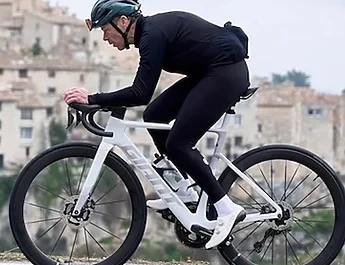
Visually, the Crux 5 borrows some design cues from the Tarmac SL7, with sleeker lines, more advanced integration than its predecessor, and a silhouette that immediately evokes speed. On the trail, this lineage is also evident in the bike’s handling. The Crux 5 immediately gives the impression of very high efficiency on fast sections, with noticeable stiffness in the bottom bracket and the front end of the bike. Despite the 50-mm tires fitted to our first test setup, the handling remains particularly compact and consistent. The bike feels very cohesive in its responses, with no sense of wobble when standing on the pedals or accelerating hard out of a turn.

The riding position plays a major role in this race-oriented feel. The cockpit is low and relatively narrow at the top, with a distinctly sporty stance that’s more reminiscent of a road race bike than a versatile, adventure-oriented gravel bike. Fortunately, the pronounced flare at the lower end of the handlebars provides a great deal of security when the terrain gets fast or technical. With your hands on the lower part of the bars, the bike immediately inspires confidence and allows you to maintain good control even on the roughest sections.
With your hands on the lower part of the handlebars, the bike immediately inspires confidence and allows you to maintain good control even on the roughest sections.
Specialized also touts a new Terra cockpit that’s more vertically flexible than the Tarmac’s, while maintaining good lateral stiffness. On the trail, this claim seems to hold true. The cockpit effectively filters out some of the vibrations and small impacts along the longitudinal axis, which helps reduce fatigue on long, rough stretches. On the other hand, it never feels mushy when you pull hard on the handlebars or accelerate sharply. The Crux thus maintains precise steering and remains highly responsive during weight shifts.

Our test ride on the Costa Brava was the perfect opportunity to highlight these characteristics. The route included two long climbs over particularly challenging terrain, alternating between rocks, dust, and ravines carved out by the region’s frequent thunderstorms. The descents proved just as challenging, with fast, bumpy sections requiring both precision and stability, as the surface often gave way beneath the wheels. Between the two mountain ranges, however, a long, rolling section on dry, well-compacted trails made it easy to maintain high speeds, averaging around 35 km/h.
In this first part of the test, the 50-mm tires proved particularly impressive. The boost in confidence is immediate, both on climbs and descents. Traction remains excellent on steep, loose sections, while the strong grip allows you to tackle fast descents with great confidence. Despite their substantial volume, these tires ultimately don’t slow you down as much as expected on fast sections. They actually suit this new version of the Crux quite well—a bike that now seems to fully embrace a very fast all-road approach, capable of maintaining excellent performance while significantly increasing comfort and control.

On the second half of the route, I was able to ride with another set of wheels, the Roval Terra CLX III, fitted with 45 mm tires. This lighter setup saves a little over 500 g on the entire bike. On the trail, this weight savings is most noticeable during accelerations or when changing direction, with the bike feeling slightly more responsive. However, on the second long climb of the route (about 500 m of elevation gain over 6 km, with several sections exceeding 15% on dirt), I quickly noticed a loss of traction and grip compared to the first setup. The bike demands more attention and is generally less forgiving on the most rough sections.
The same is true on descents. With the 45-mm tires, the Crux feels more direct, stiffer, and absorbs fewer bumps. The handling remains very effective and precise, but it’s also more physically demanding. Conversely, the 50-mm setup offers more comfort, grip, and—above all—confidence on fast, rough sections. The difference is pronounced enough to significantly alter the bike’s character depending on the tire setup chosen.

A More Radical Crux
After this test ride, the Crux 5 leaves the impression of a particularly well-developed bike and, above all, one that is very consistent in its design philosophy. Specialized has retained the strengths of the previous Crux (extremely low weight and remarkable efficiency) while clearly shifting its handling toward a more radically race-oriented profile. Whereas the previous generation placed greater emphasis on maneuverability and a certain degree of forgiveness, this new model embraces its DNA as a fast, taut, and efficient machine on fast-rolling sections much more openly.

That said, the Crux 5 never becomes a demanding or tricky bike on rough terrain. On the contrary, it remains very stable and quickly inspires confidence, thanks in large part to its very consistent handling and well-balanced geometry. And in this equation, tire choice plays an absolutely central role. With 50-mm-wide tires, the bike gains significantly in comfort, traction, and stability, ultimately allowing it to combine a very stiff and aerodynamic frame with a genuine ability to handle rough terrain.

This is probably where the Crux 5 becomes particularly interesting. Because beyond hardcore gravel riding, it’s easy to imagine this bike fitted with 35 mm road tires for fast, sporty, and versatile all-road riding. So much so that a question eventually arises: isn’t there a risk that this new Crux will eventually phase out the Specialized Roubaix from the lineup? Whereas the Roubaix has historically relied on specific vibration-damping solutions like the Future Shock suspension system up front or the After Shock seatpost at the rear, the Crux seems to achieve a similar result through simpler means: a lightweight frame, wide tires, and a particularly balanced geometry. This evolution perhaps says a lot about the direction modern, versatile road bikes are taking today.
The SPECIALIZED CRUX 5 S-LEVEL at a glance…Pros: handling, stability, stiffness, aerodynamics, integration, a real step up from the previous version Frame: Crux 5 FACT 10r Carbon – Fork: S-Works FACT Carbon – Wheels: Roval Terra Aero CL – Tires: Specialized Tracer 700×50 – Crankset: SRAM RED XPLR, Quarq power meter, 40 teeth – Rear derailleur: SRAM RED AXS XPLR 13-speed – Shifters: SRAM RED AXS XPLR 13-speed – Brakes: SRAM RED – Cassette: SRAM RED XPLR E1, 13-speed, 10-46 – Handlebar and stem: Roval Terra Cockpit – Seatpost: Tarmac SL8 Carbon – Saddle: Specialized Power Pro Mirror – Weight: 8.04 kg in size 52 without pedals (with bottle cages) – Sizes: 6 – Price: €10,499 – Contact: specialized.com
|

Share the post "First Test Ride of the Specialized Crux 5: Gravel at High Speed"