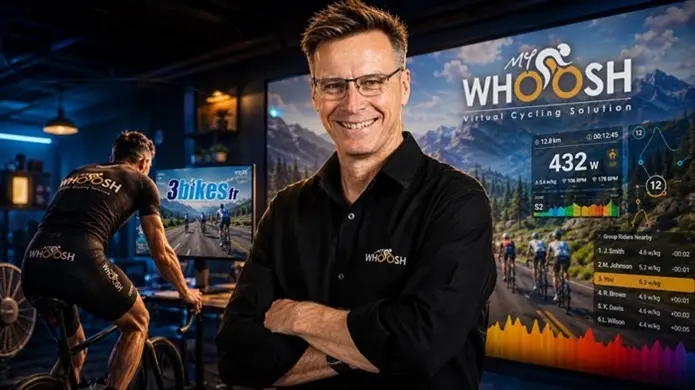
Share the post "MyWhoosh and Matt Smithson: the new era of cycling?"
Between sport, technology, and spectacle: immersion into the world of MyWhoosh with Matt Smithson. For a long time, virtual cycling was viewed with a form of amused condescension. For many, it was just a “video game for frustrated cyclists”, a digital and soulless version of a sport deeply attached to the road, the elements, and the beauty of reality. In the collective imagination, cycling remains linked to rain, wind, cobblestones, dangerous descents, mountain landscapes, faces marked by effort and to that visible suffering that feeds all the drama of cycling. So naturally, seeing athletes pedal alone in a closed room in front of a screen could seem artificial. Almost absurd. And yet, something is changing…
By Jeff Tatard – Photos: MyWhoosh / DR
In just a few years, eCycling has gone from a technological niche frequented by a few enthusiasts to a truly strategic territory for the sports industry. Platforms are professionalizing. Competitions are structuring. Prize money (prize grids as rewards) is increasing. Audiences are growing. Institutions are getting involved. And above all, performances are becoming impossible to ignore. Behind the avatars, the watts are very real.
To understand this shift, we had a long discussion with Matt Smithson, Director Esports & Game Operations at MyWhoosh, now the official platform for the UCI Cycling Esports World Championships. For a little over an hour, despite nearly two hours of time difference between us, the discussion connected Abu Dhabi to Paris around the same subject: the future of cycling. On one side, Matt was answering us from the United Arab Emirates, where MyWhoosh is building part of its global strategic development. On the other, we were in Paris, in the heart of a country where cycling remains deeply attached to its cultural, historical, and emotional heritage. Two visions of the world, almost two temporalities, united around the same question: how is technology transforming our way of experiencing sports performance?
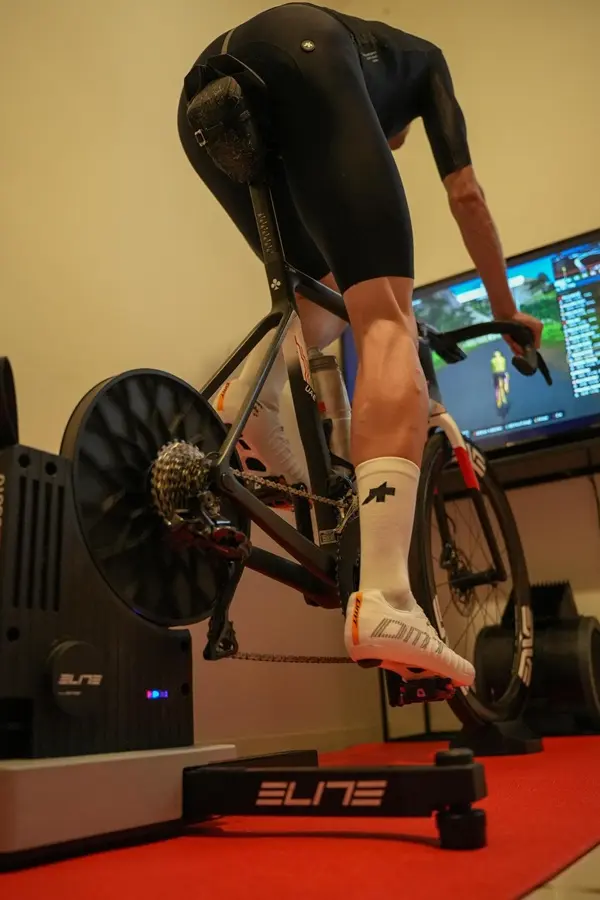
During this exchange, the conversation navigated between sport, business, technology, community engagement, competitive credibility, and vision for the future. But as the answers unfolded, one idea constantly recurred, almost like an invisible common thread: eCycling may no longer simply be trying to reproduce traditional cycling. It is now attempting to invent a new way of experiencing performance. What if the future of cycling was no longer played out only on the road?
BEHIND THE SCREENS, A SILENT REVOLUTION
There is an almost romantic culture of reality in cycling. Riders like to talk about the cold, the headwind, echelons, broken roads, the sensations of speed, the smell of rain on asphalt. Cycling is a sport of substance. A sport that is experienced physically as much as it is watched. This is precisely why virtual cycling has long aroused so much skepticism.
Matt Smithson is perfectly aware of this. And that is probably what makes his discourse interesting. He never seeks to directly oppose the virtual to the real. On the contrary. His entire reflection seems built around this idea of balance. Very quickly in our exchange, he also speaks of “balance” between several dimensions: balance between accessibility and competition, between technology and sport, between user experience and competitive integrity. This word comes up often.
Because ultimately, MyWhoosh operates in an extremely complex zone. The platform must simultaneously attract casual users who are simply looking for an immersive experience to train at home… while building an environment credible enough to host UCI-recognized world competitions. And this duality probably tells the whole story of the current evolution of modern sport.
For a long time, sports disciplines could content themselves with existing on their own. Today, they must also become digital experiences capable of retaining attention in a universe saturated with content, platforms, and distractions. Sport is no longer immune to the logic of the attention economy. Virtual cycling is precisely at this point.

THE MOST FASCINATING PARADOX OF ECYCLING
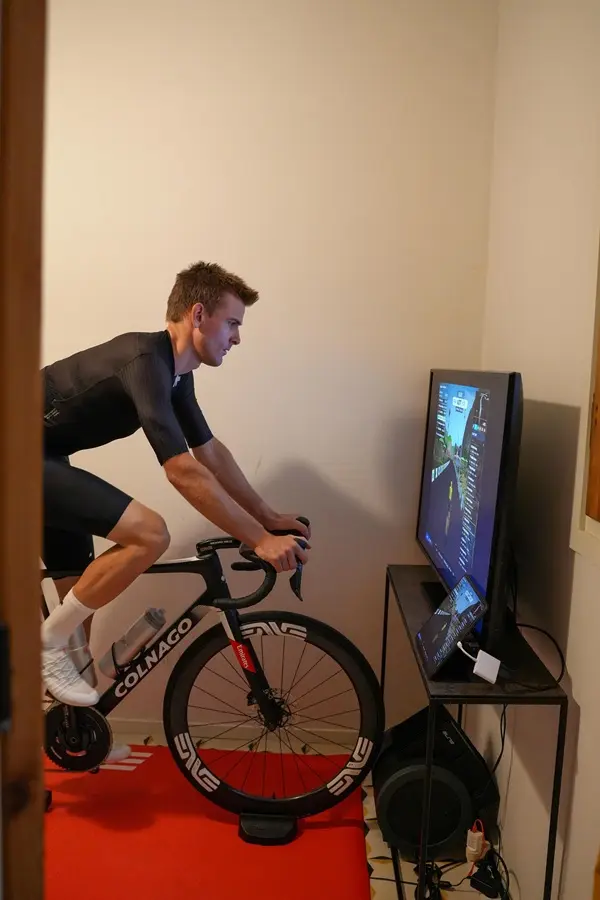
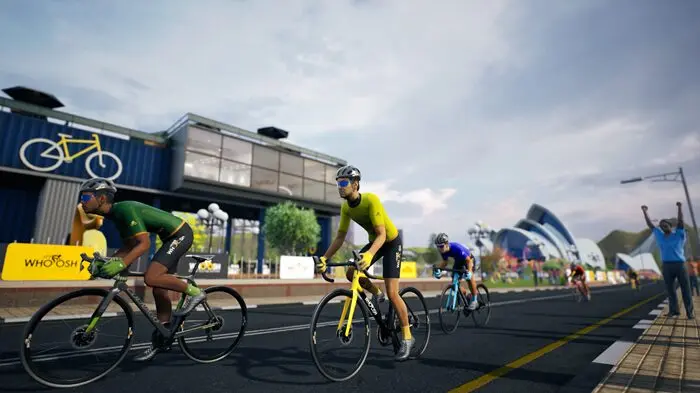
The further the conversation progressed, the more a fascinating contradiction appeared. Everything in eCycling seems virtual… except the effort itself. The roads are digital. The environments are digital. Opponents appear as avatars. Landscapes are computer-generated. Even spectators often watch competitions through screens. And yet, the bodies themselves remain totally real. Legs truly burn. The heart truly rises to 180 beats per minute. Physiological thresholds truly explode. The suffering is authentic.
And this is probably where virtual cycling becomes much more interesting than a simple technological product. Because ultimately, MyWhoosh doesn’t just sell software. The platform sells an experience of human performance in a digitized environment. The nuance is important.
During our exchange, Matt Smithson also emphasized that the credibility of eCycling comes primarily from the real level of performances produced. According to him, the major turning point of recent years is simple: it is now impossible to deny the physical qualities of the best competitors. This progressive recognition has profoundly changed the perception of the discipline.
THE MOMENT EVERYTHING STARTED TO CHANGE
One of the key elements of our discussion concerns precisely this question of credibility. At what point did eCycling truly become a serious sport? There is obviously no single answer. Matt rather evokes a progressive accumulation of factors: technological improvement of platforms, increasing quality of competitions, evolution of audiences, financial investment from certain players, and especially the involvement of the Union Cycliste Internationale.
The arrival of the UCI changed a lot of things. From the moment an international federation decides to officially recognize a discipline, the general perception immediately evolves. What previously looked like a technological niche suddenly begins to enter the realm of institutional sport.
But what’s interesting is that Matt never reduces this evolution to a simple political validation. For him, institutional recognition is just one step among others. What gives eCycling value today is above all the quality of the athletes and the intensity of the competitions. And on this point, his message is clear: the best eCyclists are true high-level athletes.
WHO IS MATT SMITHSON? |

A NEW BREED OF ATHLETES
One of the most fascinating questions of our exchange concerns precisely the profiles of the best competitors. Who are the eCycling champions really? Are they simply cyclists who ride indoors? Or are we gradually witnessing the emergence of a new type of hybrid athlete?

Matt Smithson immediately acknowledges that the question is complex. Of course, physiology remains fundamental. Without an exceptional physical engine, it’s impossible to exist at the highest level. Watts remain central. The power-to-weight ratio remains decisive. But reducing eCycling to a simple physiological equation would be a mistake.
The best competitors also develop very specific qualities related to the virtual world. They must understand digital race dynamics, perfectly master platform mechanics, optimize their effort management based on algorithms, and develop extremely subtle tactical abilities.
In other words, it’s no longer enough to simply be physically strong. You also need to understand the system. And this is where eCycling gradually begins to differentiate itself from traditional cycling. The discipline develops its own codes, its own race intelligence, and its own competitive logics.
Matt nevertheless remains cautious when it comes to directly opposing real and virtual cycling. There are obviously bridges. Some athletes are capable of excelling in both worlds. But as the discussion progresses, we also understand that he gradually considers eCycling an autonomous discipline.
This evolution is crucial. Because from the moment a sport develops its own specialists, its own competitive structures, and its own distinctive skills, it ceases to be a mere extension of another discipline. It becomes a territory in its own right.
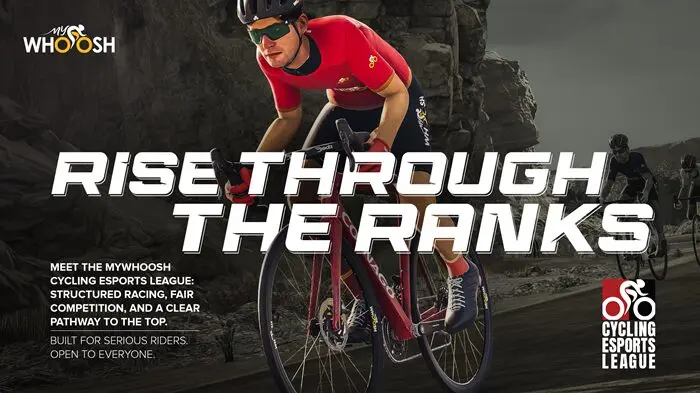
MYWHOOSH DOESN’T WANT TO BE “JUST AN APP”
Another very interesting aspect of the conversation concerns how Matt truly defines MyWhoosh. And the answer is revealing… On several occasions, he nuances traditional categories. MyWhoosh is obviously a training platform. But it’s not just that. It’s also a competitive environment, a community experience, a social space, a technological product, and a form of entertainment. This multiplicity is essential to understand what is currently at stake in virtual cycling.
The modern economic model of sport no longer relies solely on competition. It also relies on user engagement, loyalty, community, and the ability to maintain practitioners’ attention over time. This is precisely why Matt often speaks of a global experience.
Users don’t just come looking for a workout. They come looking for immersion, progression, a sense of belonging, a form of competition… and sometimes even a digital identity. This logic also brings eCycling very close to the world of gaming and modern digital platforms. And this is probably where much of its potential lies.

THE REAL CHALLENGE: CREATING EMOTION
But the further the interview progressed, the more a central question emerged: how to transform physiological data and digital avatars into a true sports spectacle? The problem is immense. Traditional cycling naturally produces drama. Landscapes, weather, danger, attacks, faces marked by effort, the sound of the crowd, or even the visual beauty of great mountain passes all contribute to the emotion. Cycling already possesses, in its classic form, an almost natural narrative power. In the virtual world, this emotion must be reconstructed differently.
And Matt Smithson seems perfectly aware of this challenge. eCycling cannot simply content itself with being sportingly credible. It must also become watchable. Understandable. Spectacular. In other words: watts must become interesting to watch.
This idea probably summarizes a large part of the sector’s current challenges. Because today, modern sport lives as much from its audience as from its practice. Platforms must now consider broadcasting, the pace of competitions, data readability, spectator engagement, event narration, and even the overall media experience.
Observing Matt speak about these subjects, one quickly understands that MyWhoosh is not only looking at cycling. The platform also looks at the world of streaming, competitive gaming, social networks, and new digital uses. And this is probably where the subject becomes truly fascinating. Because as these universes begin to blend, eCycling gradually ceases to be simply a sports practice. It becomes a hybrid object.
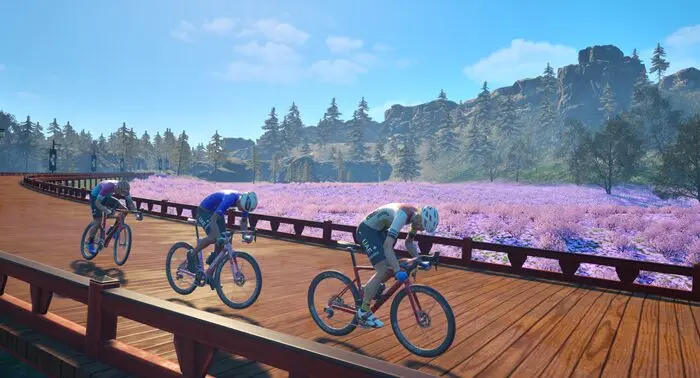
MONEY AND THE QUESTION OF PRIZE MONEY
It’s obviously impossible to avoid the financial question. Why invest so much in competitions? Why inject so much money into prize money? What is the real logic behind this strategy? Matt naturally remains cautious about certain economic aspects. But several ideas clearly emerge throughout the discussion.
First, MyWhoosh still seems to be in a phase of structuring its ecosystem. Massive investments serve to accelerate the discipline’s credibility, attract the best athletes, and build strong enough global visibility to durably establish the platform in the digital sports landscape. The prize money acts as a signal here.
In modern sport, money often represents a form of implicit validation. When a discipline starts distributing significant rewards, the general perception immediately changes. Media become more interested. Sponsors become more attentive. Athletes take the practice more seriously.
And MyWhoosh seems to perfectly understand this mechanism. But beyond the simple financial aspect, what is most striking is the overall strategic dimension of the project. The platform does not seem to simply want to accompany the evolution of eCycling. It clearly seeks to actively participate in its structuring.
This ambition is constantly felt in Matt Smithson’s discourse. Behind the competitions and virtual environments, one senses a much deeper desire: to contribute to defining what this discipline could become in the years to come.
THE QUESTION OF LEGITIMACY
During our exchange, a tension often recurs: does eCycling need the validation of traditional cycling? The question is much deeper than it appears. On one hand, the link with the UCI obviously brings recognition, an official structure, and strong institutional credibility. But on the other hand, eCycling is gradually developing its own culture, its own uses, and its own references.
Matt remains very diplomatic on this subject. However, one senses that a delicate balance is being built. Virtual cycling still greatly benefits from the emotional and cultural heritage of traditional cycling. But it could also, in the long run, become something much more independent than we imagine today.
And this is precisely what makes this period so fascinating. We may be witnessing something quite rare in the history of sport: a moment of transition where a discipline gradually begins to build its own identity, its own codes, and its own legitimacy. We may be witnessing the birth of a new discipline… live.

A GENERATION THAT CONSUMES SPORT DIFFERENTLY
Towards the end of the interview, the conversation gradually takes on an almost sociological dimension. Matt Smithson repeatedly mentions new generations, digital uses, and evolving behaviors. According to him, young audiences already consume sport differently. They naturally navigate between real and virtual. They watch competitions on Twitch, play online, follow content creators, and live in permanent digital environments.
For them, the boundary between physical sport and the digital world seems much less rigid than for previous generations. And this is probably where the potential of eCycling becomes immense. Because ultimately, this discipline speaks as much about the future of sport as about the future of our collective relationship to performance.
For decades, sport was deeply linked to a physical place: a stadium, a road, a track, a gym. Today, athletes from all over the world can compete simultaneously in an entirely digital environment while producing totally authentic physiological performances. The scenery changes. Not the effort. And perhaps the entire eCycling revolution lies precisely in this sentence.
THE FUTURE WILL BE HYBRID
As the discussion progressed, one idea became increasingly clear: the future of cycling will probably be hybrid. The real and the virtual will not cancel each other out. They will coexist, nourish each other, and influence each other. This almost caricatural opposition between “real cycling” and “virtual cycling” already seems to belong to the past.
Traditional cycling will obviously retain a unique emotional power. Nothing will completely replace the great Alpine ascents, the cobblestones of Roubaix, or the images of the Tour de France crossing magnificent landscapes. Real cycling will always retain this sensory and almost poetic dimension that makes up part of its magic.
But in parallel, virtual cycling opens up new territories. It allows riding without geographical constraints, connecting athletes from all over the world, democratizing certain practices, creating new competitive formats, and above all making the sport accessible to populations who might never have had access to this universe otherwise. And this is probably what interests Matt Smithson so much: this capacity of technology to broaden the scope of possibilities.

CYCLING MAY BE CHANGING ITS DEFINITION
Upon leaving the conversation, a strange sensation persists. As if the subject now largely exceeded the simple question of the indoor trainer, virtual cycling, or even technology itself. Because ultimately, what eCycling is really talking about is the evolution of modern sport. Our relationship to reality. Our way of experiencing performance, competition, effort… and perhaps even sporting emotion.
For a long time, we associated performance with a specific physical place. A road. A stadium. A track. A mountain. Sport existed in a tangible, almost sacred setting. Today, this idea is slowly beginning to transform. Digital environments are becoming capable of producing real sporting emotions, real competitions, and above all, real physiological performances.
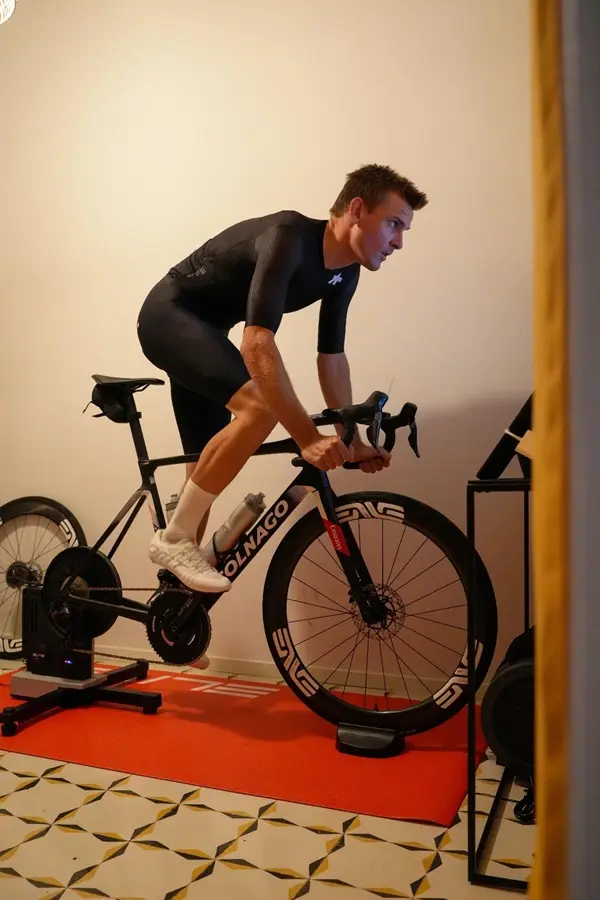
The scenery changes. Not the effort. And this is probably what makes this transition so unsettling. Because virtual cycling may not be destined to replace traditional cycling. Nothing will completely replace the sound of a peloton at full speed, the wet cobblestones of Roubaix, the switchbacks of Alpe d’Huez, or the almost unreal beauty of a sunrise on a mountain road. But it could profoundly transform our way of experiencing cycling. Throughout this hour of exchange between Abu Dhabi and Paris, despite the time zones, different cultures, and thousands of kilometers separating us, the same sensation constantly returned: that of witnessing a transition. Almost silent. Still almost invisible. But already very real.
On one side, a sport historically rooted in substance, the road, and landscapes. On the other, a new generation that naturally navigates between physical performance and the digital world, between avatars and real watts, between virtual community and authentic suffering. And perhaps the most fascinating thing in all of this is precisely there: in this precise moment where two worlds slowly begin to overlap. A world where one only rode on the road. And another where the boundaries between sport, technology, competition, community, and entertainment are gradually beginning to disappear. When the screen turns off and the conversation with Matt Smithson ends, an idea then continues to turn in one’s head. What if the future of cycling had already begun… in the silence of an indoor trainer?
=> To discover more in depth the MyWhoosh universe, understand its approach to virtual cycling… or simply take your first digital spins: Best Virtual Cycling
=> And here, to discover all our other portraits: All our Portrait articles
Share the post "MyWhoosh and Matt Smithson: the new era of cycling?"