Share the post "“The Seixas Effect”: Loose Gears, Early Success?"
Should the removal of gear ratio restrictions for young riders be seen as a career accelerator… or a risk to the development of future athletes? The rapid rise of Paul Seixas, a symbol of a generation ahead of its time, reignites a sensitive question: Does the end of gear ratio restrictions for young cyclists in France truly promote early success? Behind this debate, historical and scientific analysis calls for a more nuanced view and, above all, reveals a much deeper transformation in training and access to high-level performance.
By Guillaume Judas – Photos: depositphotos.com, DR
Gear ratio limits for young cyclists in France are not a recent issue. They are part of a training philosophy inherited from the 1960s and 1970s, a time when the French Cycling Federation sought to structure the training of road cyclists.
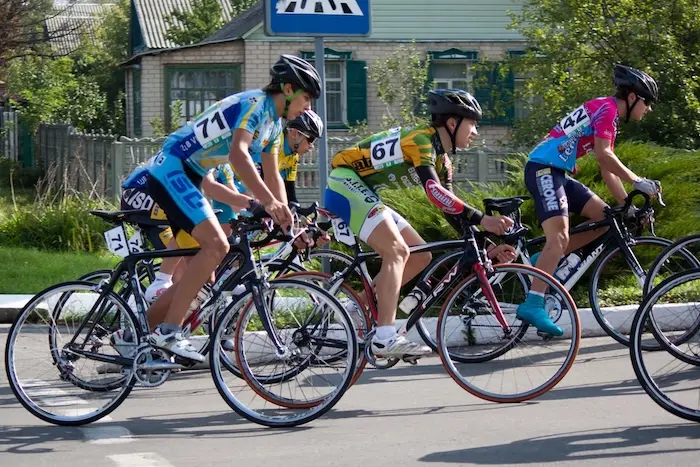
Starting in 1970, the rule became strict for cadets (ages 15–16), with gear ratios limited to 6.67 meters of development per crank revolution (i.e., 50/16). The goal was twofold: to protect the physical well-being of adolescents by avoiding excessive exertion, and to promote a pedaling technique based on cadence rather than raw power. This philosophy prevailed for several decades. It is based on the idea that a young rider must first learn to “turn the pedals” before being able to develop specific strength. Like all riders of my generation, I went through this phase, with a maximum gear ratio of 50/16 on my bike during my first two years of competition.
From 50/16 to 50/14: A First Gradual Relaxation
Starting in the 1990s and early 2000s, the rule began to evolve. The minimum wheelbase gradually increased to 7.62 meters (since 2013), which in practice corresponds to a 50/14 gear ratio. This change accompanies the transformation of modern cycling, where race speeds are increasing and equipment is becoming more advanced. This change does not represent a philosophical break, but rather an adjustment. The logic remains the same: to provide a framework for training while allowing for a slight increase in speed to keep pace with the evolution of the sport, as well as with the changing physiques of young cyclists.
Elsewhere in Europe, the trend is different. Belgium, Italy, Spain, Switzerland, and the Netherlands still impose maximum gear ratios ranging from 6.94 meters (52/16) to 7.32 meters (48/14), depending on the country. These nations maintain a more conservative approach, focused on cadence and technical development. At the international level, there are no rules governing gear ratios for U17 (cadets, which are governed by each national federation), and gear ratios were limited to 7.94 meters (52/14) for junior (U19) competitions until December 31, 2022. Today, gear ratios are unrestricted.
2022: The End of Gear Ratio Limits for Cadets in France
The real turning point comes in 2022. France became one of the few European countries to completely eliminate gear ratio limits for cadets in road racing. This decision marked a shift in philosophy: rather than restricting gear ratios (which caused real problems for parents or coaches in finding the right equipment, as it fell outside the standard offerings of equipment manufacturers), the focus is now on coaching and empowering clubs to ensure riders don’t go to the other extreme. In short, the goal is to teach proper derailleur use rather than imposing a maximum gear ratio.
This decision comes at a time when training methods have undergone profound changes. Young riders now benefit from precise scientific monitoring, power meters, and a training structure much more closely aligned with the professional elite level.

Paul Seixas, Symbol of a Generation in Transition
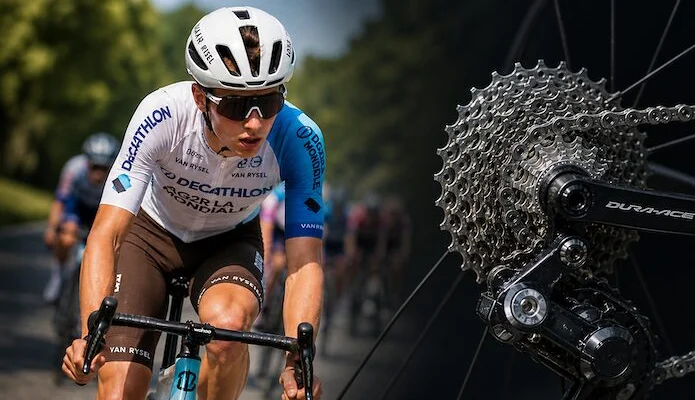
It was against this backdrop that Paul Seixas came of age. Competing in the cadet category in 2021 and 2022, he experienced this regulatory shift firsthand. His rapid progress among the juniors naturally drew attention and fueled the idea of a link between the removal of the gear ratio restriction and a surge in performance.
But this simplified interpretation does not hold up to scrutiny. The trajectories of young talents do not show a clear break linked to the rule’s repeal. The top European riders from countries where the gear limit is still in effect show similar development profiles. Furthermore, Seixas became the French cadet champion in his first year in the category—that is, with a limited gear range—before continuing to improve and perform the following year, with an unrestricted gear range.

Gear ratio: a secondary factor in performance
From a physiological standpoint, gear ratio primarily influences cadence and the distribution of muscular effort. It alters how effort is generated, but not the capacity to produce energy itself.
The key determinants of high-level performance remain VO₂ max, FTP, power-to-weight ratio, recovery capacity, and physiological maturity. These parameters are barely affected by the choice of gear ratio. In other words, riding with a larger or smaller gear changes the nature of the effort, but not the engine that produces it.
A Surge in Youth Performance Linked to Other Factors
The surge in performance among young riders in recent years is primarily due to a comprehensive transformation of the cycling ecosystem. The professionalization of training programs plays a central role. Junior teams now have full support staff, individualized training plans, and near-professional-level monitoring starting at age 16 or 17. The widespread adoption of power meters has also revolutionized training. Training loads are now calibrated with unprecedented precision, allowing for optimized progress without excessive overload.
Nutrition, recovery, and sleep management have also gained in importance, reducing the setbacks in progress that used to occur. Finally, talent selection has become faster and more efficient, integrating the most promising riders into elite programs at a very early stage.
The Overestimated Influence of Gear Ratios
In this context, attributing the early emergence of talent simply to the removal of gear restrictions seems simplistic. The rule change in France in 2022 is too recent, too localized, and too limited physiologically to explain a phenomenon affecting the entire global cycling community.
While the removal of gear restrictions may slightly alter the sensations and pedaling technique among young riders, it does not transform the fundamental abilities that determine long-term performance.
First and foremost, a cultural shift
The example of Paul Seixas illustrates not so much the effect of a mechanical rule as that of a generation trained in a profoundly modernized environment. His rapid rise is part of a global trend in which the performance of young riders is improving primarily through training, sports science, and the professionalization of team structures.
The liberalization of gear ratios in France marks an important symbolic shift, but it is not the driving force behind the emergence of early champions. It accompanies a much broader movement: that of a cycling world where performance is now built from a very early age, but above all, much more intelligently.
Share the post "“The Seixas Effect”: Loose Gears, Early Success?"