Share the post "Mono, XPLR: what the pros’ bikes are hiding"
We thought we had seen a limit. We mostly discovered a world. After our analysis of the Tour of Flanders, a discussion with SRAM allowed us to correct certain interpretations, but above all to open a rarely visible door: that of the hidden work between brands, teams, engineers, and athletes. Because behind a single chainring, an XPLR cassette, or a gear choice on a classic, there isn’t a trend. There are data, tests, constraints, compromises… and much less randomness than one might imagine.
By Jeff Tatard – Photos: SRAM / DR
Sometimes you have to be willing to retrace your steps. Our previous article on the single chainring at the Tour of Flanders started from an interesting observation: the impression, in the Paterberg, of seeing Mads Pedersen suffer a break in cadence when changing gears. The analysis was appealing. It described something visible on screen, almost obvious to anyone familiar with the brutality of the Flemish climbs: a rider spinning too much, dropping a cog, then seemingly hitting a brutally harder gear. Except that the actual mechanics were more subtle. And that’s where SRAM intervened.
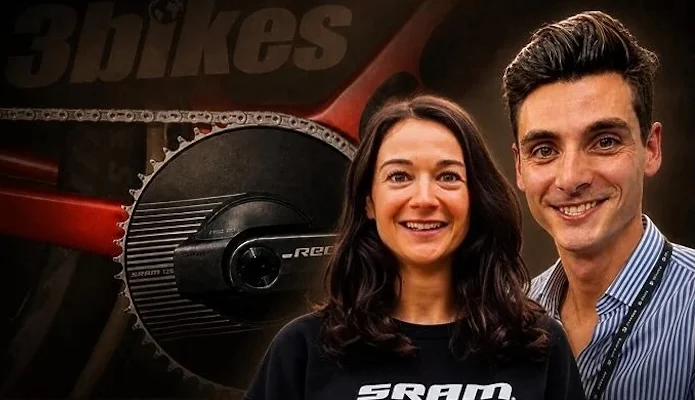
Marie Didier, press officer, contacted us after several inconsistencies were noted. Among them, the exact structure of the XPLR 10-46 cassette (pronounced Explore), but especially the overly direct interpretation of a race sequence. The discussion then continued with Pierre-Antoine Berche, Field Guide for France (meaning reseller representative)… And for 1h30, the subject largely went beyond simple technical correction.
Because ultimately, the interest was no longer to know if Pedersen had “skipped too many teeth.” The interest was elsewhere: understanding how a material choice ends up on a professional bike, why it’s made, how it’s validated… and why we sometimes jump to conclusions too quickly.
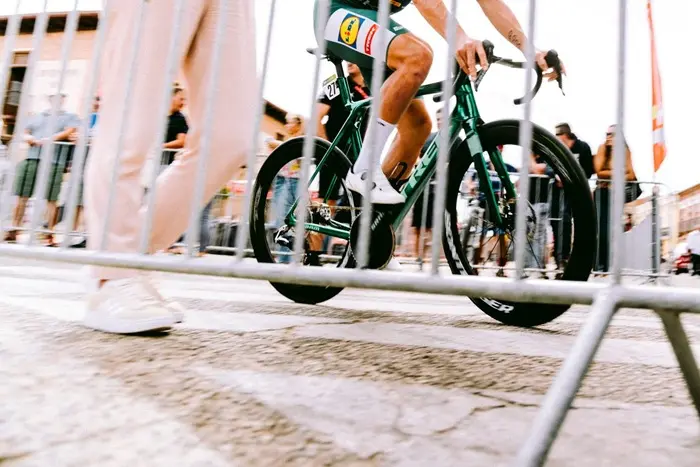
Single chainring is not a shortcut. It’s a contextual choice.
First idea to correct: “The single chainring is not chosen because it’s modern. It’s chosen when the context makes it relevant.” On the road, the single chainring appears mainly on certain classics, on fast stages, on specific profiles where the gear range remains consistent. Conversely, on races like Liège-Bastogne-Liège, where successive climbs require flexibility, the double chainring often remains more logical.
This is perhaps the most important point, as Marie reminds us: “The single vs. double chainring debate doesn’t really make sense if it’s posed in general terms. The right question is: for which rider, on which course, with what strategy?”
Pierre-Antoine adds: “Today, these decisions are no longer made by feel. They are informed by data, simulations, historical records, and field feedback.” Modern cycling still looks like cycling. But behind the scenes, it increasingly speaks the language of science.
Why pros choose single chainring
“The advantages of the single chainring are known, but often poorly prioritized,” explains Pierre-Antoine. There’s weight, aerodynamics, simplicity. But reducing the single chainring to just that would be a mistake. Its real interest lies elsewhere: it is systemic. “It works when everything is coherent: chainring, cassette, chain, frame, course.”
And that’s precisely where the SRAM XPLR drivetrain makes perfect sense: a global approach inherited from gravel and mountain biking, designed to work in a complete environment.
On the cobbles, the question isn’t just about shifting gears. It’s about maintaining a stable drivetrain despite shocks, vibrations, accelerations, and loss of traction. The single chainring then becomes a choice of robustness as much as performance.
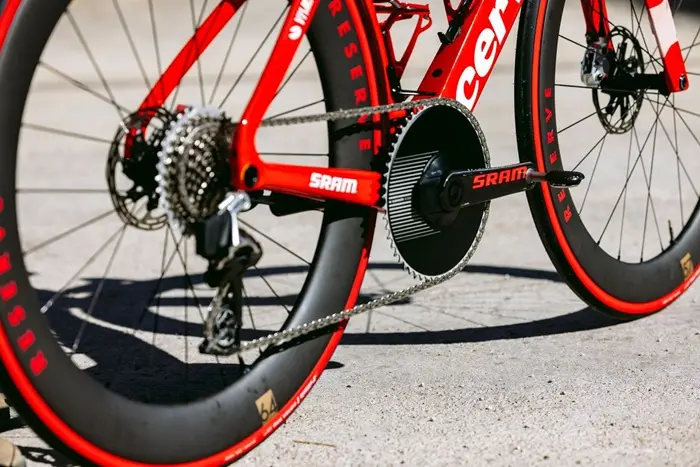
The invisible detail that changes everything: the tooth profile
Behind this robustness, there’s a detail that we almost never see… but which explains almost everything.
As Pierre-Antoine points out, SRAM chainrings, both double and single, use a specific tooth profile called narrow-wide, with alternating narrow and wide teeth, which SRAM calls X-Sync. But the reality goes even further: one tooth out of two is slightly beveled, profiled to guide the chain in its natural movement.
It’s not just retention. It’s active guidance. Each link finds its place, each transition is anticipated. Result: the chain remains mechanically locked, without a chain guide or anti-derailment collar.
It’s discreet. Invisible even. But formidably effective. And as Guillaume Judas emphasizes with a smile: “Today in cyclocross, the only ones you still see derailing… are often those who don’t ride with this type of profile.”
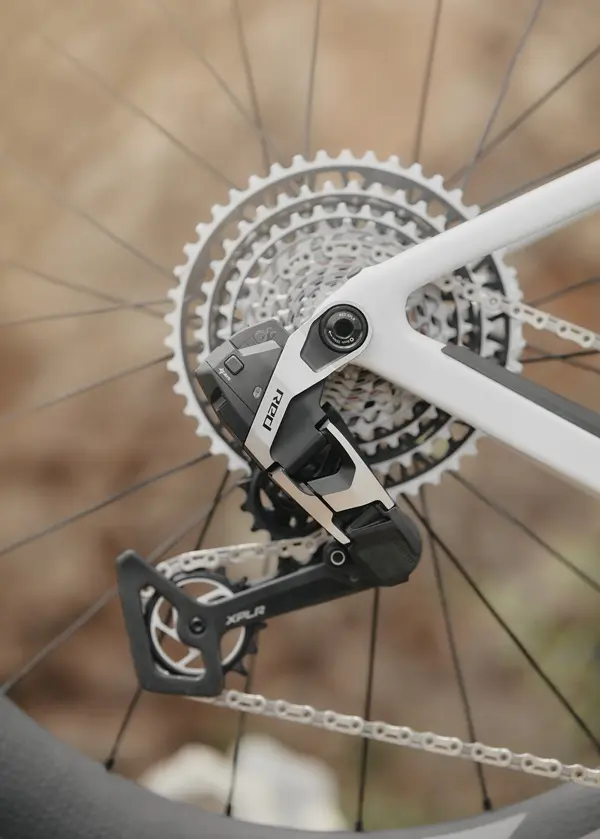
XPLR: what the cassette really changes
To objectify these differences and move beyond mere feeling, Pierre-Antoine relies notably on a simple but remarkably effective tool: Bicycle Gear Calculator. This interface allows for precise visualization of gear ratios, differences between cogs, and actual usage zones. A pedagogical tool, but above all, revealing: what appears “brutal” to the eye often becomes much more coherent once measured.
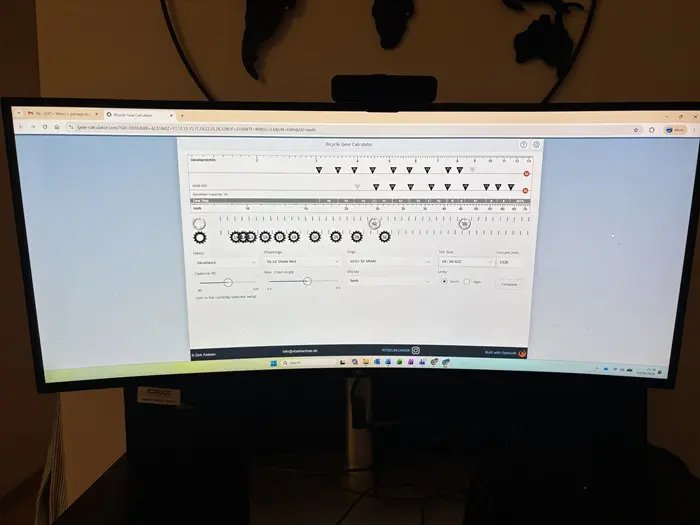
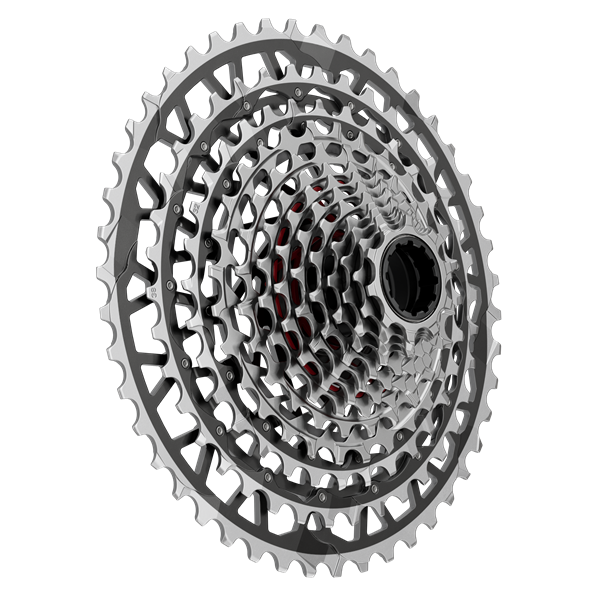
The XPLR 10-46 cassette is impressive. Visually first, because it broadens the spectrum. Mentally then, because it questions. We imagine brutal gaps, difficult-to-manage cadence breaks, less refined mechanics than on a classic road cassette. It’s almost instinctive. And yet, that’s precisely where the misunderstanding lies. “The mistake would be to believe that it imposes huge breaks everywhere,” explains Pierre-Antoine.
In fact, the construction is much more subtle. A large part of the cassette is still designed for fast riding, with gaps that maintain a logic close to road cycling. Indeed, its spacing is identical – with the exception of the last cog – to that of the 12-speed 10-36 road cassette. The XPLR cassette also has 13 speeds, thus an additional cog. And it’s only at the top, on the last two cogs, that the amplitude truly opens up, not to disrupt, but to offer a solution. A way out. A margin. “It allows you to ride fast… while keeping a reserve when things get tough.” And that’s precisely what changes the interpretation: the cassette is not there to impose a permanent compromise, but to broaden the range of possibilities at the critical moment.
And the Paterberg in all this? The image, meanwhile, remains misleading. It captures an instant, it freezes a sensation, it suggests an explanation. But it doesn’t tell the context. “The image says something. But it doesn’t say everything.” Behind a gear change, there can be accumulated fatigue, a poorly anticipated effort, a misplaced acceleration, a position in the group, a strategy… or simply a physical limit at that precise moment. Reducing this to a cog difference is simplifying a reality that is not simple.
This is undoubtedly the most interesting lesson: in modern cycling, what we see is almost never enough to understand what is really happening.
The detail no one sees: frame compatibility
The UDH changes much more than one might imagine. And it is undoubtedly one of the most misunderstood realities of modern cycling. UDH, for Universal Derailleur Hanger, refers to a universal derailleur hanger designed to standardize the integration between the derailleur hanger and the frame. On so-called UDH-compatible bikes, the frame features a UDH interface allowing the mounting of a traditional derailleur on a UDH hanger, but also – in this specific case – the mounting of a so-called Full Mount XPLR derailleur directly onto the frame and, more precisely, onto the wheel axle. Behind this discreet acronym lies a profound shift: without compatibility, no mounting. Without mounting, no choice. And therefore, without choice… no visible evolution.
This is a real discovery for many. Because spontaneously, we think that teams decide, test, and freely choose their equipment. In reality, they operate within a technical framework much more constrained than we believe. Some can exploit these solutions because their bike allows it. Others have the desire, sometimes even the conviction… but not yet the possibility. The frame, its standard, its interface then become determining elements, just like the cassette or the derailleur.
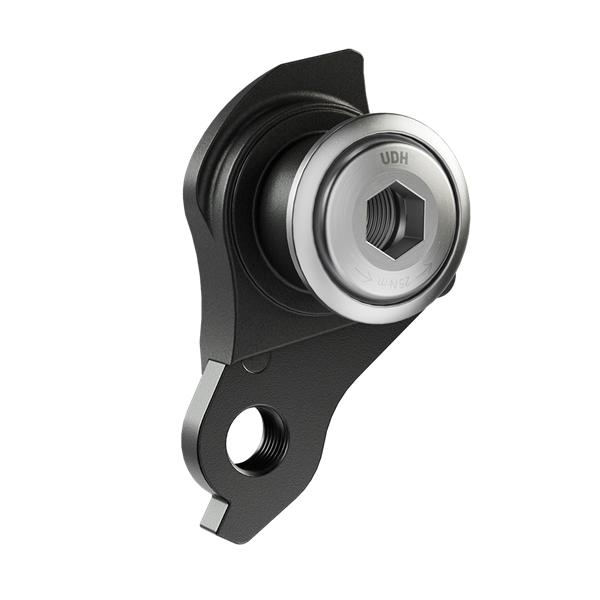
And very few people are aware of this point. We look at a bike, we think we see a choice. In reality, we often see a possibility. An option among those that the equipment truly allows.
To this is added another dimension, even more invisible: time. Industrial time. Development time. Integration time. An innovation does not deploy instantly, even among pros. It follows a calendar, validations, logistical constraints that completely escape external observation.
This is where understanding changes. The visible equipment is never solely the result of a sporting decision. It is the result of a complete ecosystem. A combination of technical constraints, timing, and overall coherence. In other words, what we see on the bike is always conditioned by what we don’t see.
Pros don’t test. They push.
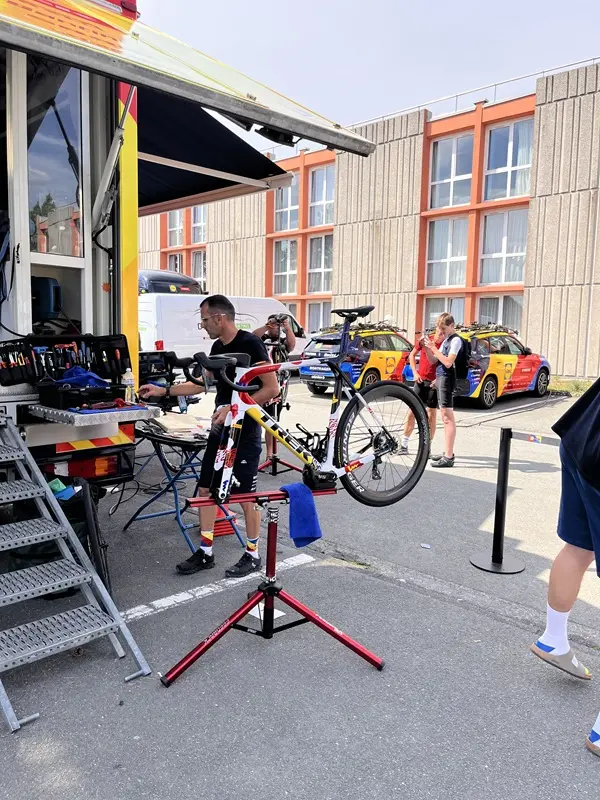
The equipment we find in stores has already lived. And not a quiet life. A hard life, more violent, more demanding than anything most riders will ever experience. This is a reality that many still ignore. We discover a new product, when in truth, it has already been pushed, tested, sometimes abused for months… even years.
Pros ride with prototypes, disguised versions, components still in development, often long before their official release. And this gap is considerable. Concrete example: nearly four years of development were needed for the new SRAM RED levers. Four years of testing, correcting, adjusting, starting over. Four years where the product already exists… without yet existing for the general public.
And here again, it’s a discovery for many. Because we often think that what we see in a race is identical to what we buy. In reality, the race is a laboratory. The store, meanwhile, is the result.
It’s not marketing. It’s an extreme filter.
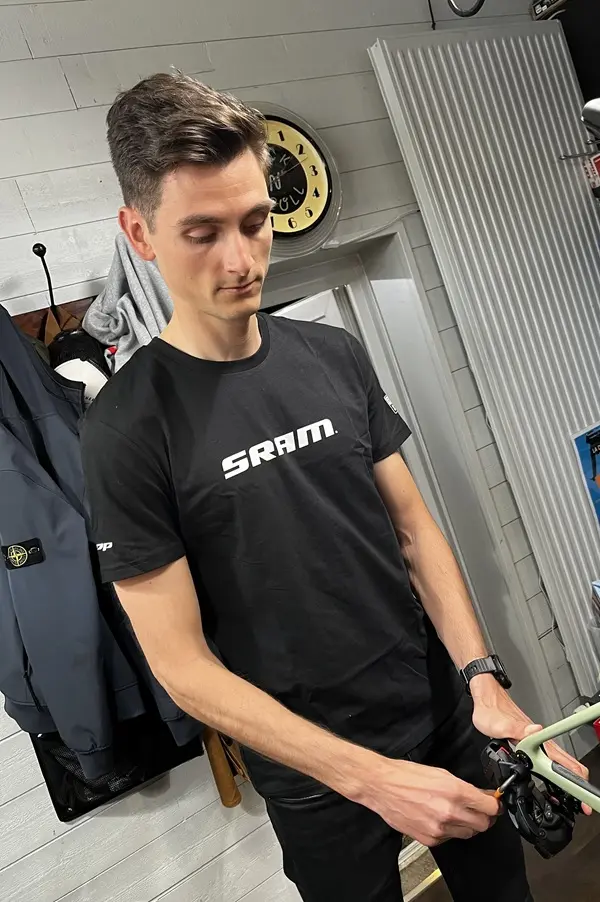
Marie summarizes it perfectly: “A rider doesn’t just say if it works. They say where it works… and where it stops working.” At this level, the rider doesn’t test. They measure. They feel invisible nuances, identify imperceptible limits, push the product into zones that few users will reach.
And that’s precisely why everything starts with them. Because no one pushes equipment as far as a professional.
And sometimes, this yields very concrete answers. At the Vuelta 2025, Jonas Vingegaard largely rode with a single chainring, notably with a 52-tooth paired with a 10-36 cassette… before winning the general classification. A simple illustration: the single chainring is not a constraint. It’s a high-performance solution, provided everything around it is coherent.
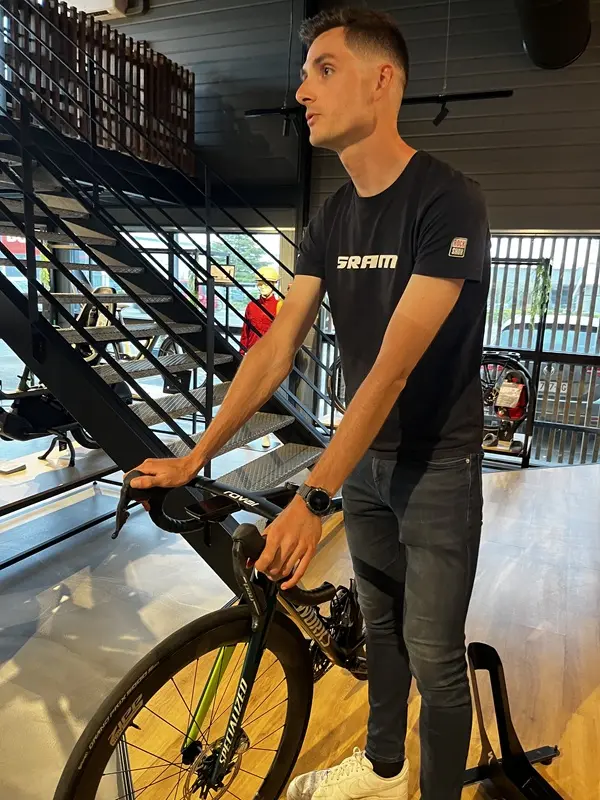
The invisible part
Behind every choice, there is an organization. And it is probably one of the most invisible and underestimated parts of modern cycling. We often imagine a decision made quickly, almost intuitively. In reality, nothing is left to chance. Everything is structured.
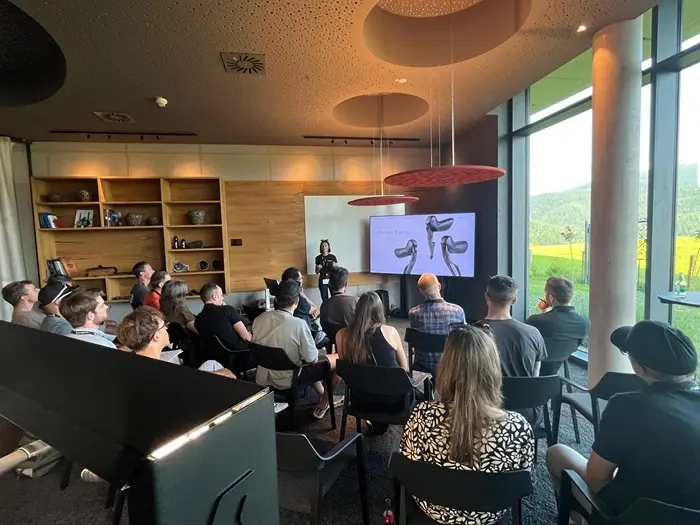
Marie summarizes it simply: “We are constantly in touch with the field.” Concretely, this means regular meetings, precise debriefs, continuous feedback. Every race becomes a source of data. Every use, exploitable feedback. “Everything comes back, everything is analyzed,” she adds. What a rider experiences on a Sunday on the cobbles can, a few weeks later, feed into product reflection. A sensation, a constraint, an identified problem… everything can become a starting point.
And that’s where reality far exceeds what we imagine. Because we’re not talking about a one-off exchange, but a permanent system. A continuous flow between teams, engineers, product managers, mechanics, and communications. An idea born in a race can become a product. A constraint can trigger an evolution. An athlete’s request can guide development.
It’s a collective mechanism. A networked, constant, living work.
And above all, it’s a reality that very few people perceive. We see a bike at the start. We see a result at the finish. But between the two, there is a chain of decisions, exchanges, and analyses that we never see. Nothing is isolated. Everything is connected.
Why this equipment reaches us
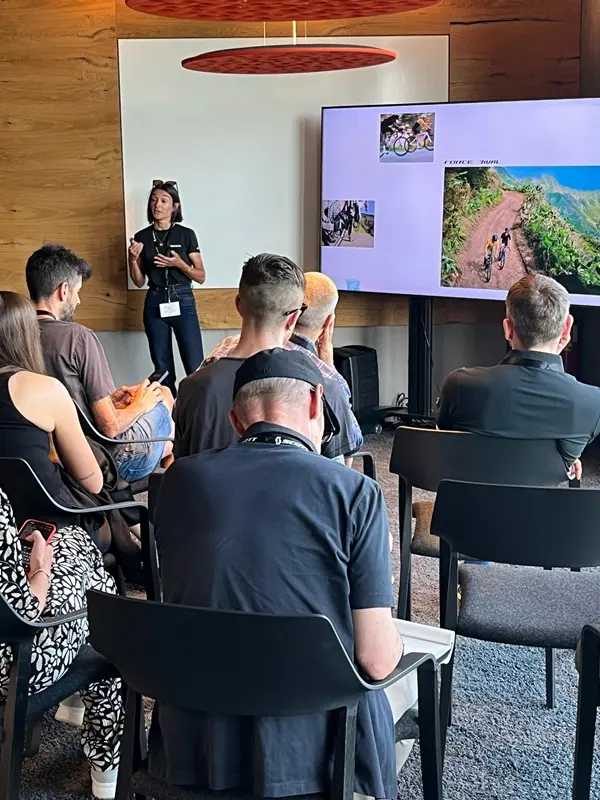
“What pros use is not always reproducible as is,” reminds Pierre-Antoine. This is even one of the most frequent misunderstandings. We look at a professional’s bike, we observe a gear ratio, a drivetrain, a configuration… and we imagine being able to reproduce it identically. Except that the engine is not the same. Power, training volume, recovery capacity, precision of movement: everything is at a level that far exceeds that of a typical rider. It is therefore not transferable. And that’s not the goal. Because the interest is elsewhere. What pros use, what they push, what they test, it’s not a recipe to copy. It’s a limit to explore. A way to find out how far a system can work, how far it can be optimized, how far it can hold up.
And that’s precisely where it becomes useful. Because this work doesn’t stay at the top. It trickles down. Slowly. Progressively. Filtered, adjusted, simplified. What was extreme becomes usable. What was tested becomes reliable. What was complex becomes accessible.
In other words, the very highest level doesn’t provide models to follow. It blazes trails.
And that’s why, a few months, sometimes a few years later, we find these evolutions on our own bikes. More coherent. More understandable. More adapted to our reality.
Cycling and innovation
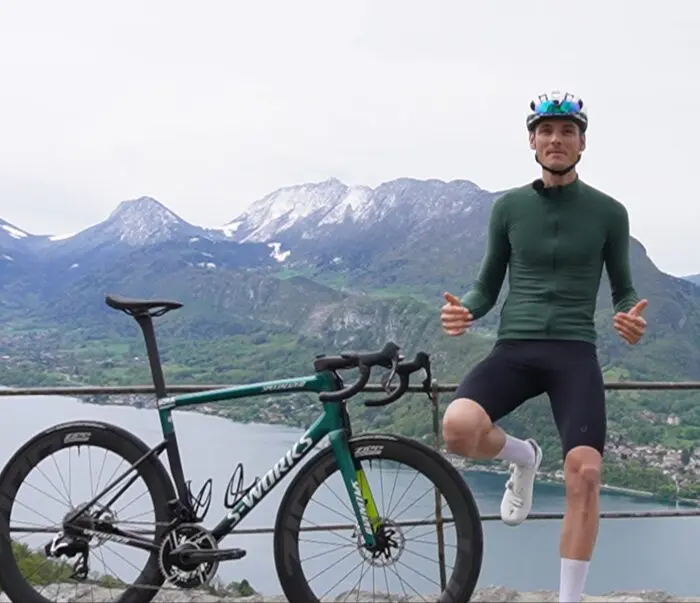
Road cycling loves technology. It embraces it, values it, highlights it. But paradoxically, it always resists change. It’s almost a signature. A permanent tension between innovation and heritage. Pierre-Antoine summarizes it very aptly: “It evolves quickly… but accepts slowly.”
The single chainring is undoubtedly one of the most revealing examples. In mountain biking, it has been an obvious choice for years. In gravel, it has established itself almost naturally, driven by the logic of the terrain and versatility. But on the road, it continues to spark debate, sometimes even mistrust. Not because it doesn’t work, but because it challenges a deeply ingrained culture.
Because road cycling was built around a very precise idea: that of absolute gear control, cadence finesse, permanent adjustment. The right cog at the right time. The right chainring at the right moment. A form of almost obsessive precision. The single chainring, however, offers something else. Fewer apparent choices, but another form of coherence. Another interpretation of effort.
And that’s precisely where the discrepancy appears. It’s not a technical opposition. It’s a cultural evolution. Because in reality, modern road cycling is no longer what it once was. It borrows from mountain biking, gravel, triathlon. It integrates data, aerodynamics, biomechanics, engineering. It absorbs, it blends, it evolves. And perhaps what still bothers people is not the single chainring itself. It’s what it represents: the end of a fixed framework.

Understanding rather than deciding
This second article does not erase the first. It extends it, corrects it, surpasses it. It doesn’t go back, it moves forward. It takes what was an intuition, a partial reading, an error too, and makes something else of it. A finer understanding. More complete. More accurate.
Because ultimately, modern cycling can no longer be understood with certainties. It is understood with nuances. With exchanges. With confrontations of viewpoints. With people who know, who test, who experience the product where it is most demanding. And with that rare but essential ability to accept that the first interpretation is not always the right one.
Behind every material choice, there is almost never a single truth. There is a construction. An accumulation of parameters that we don’t see. Constraints that we don’t imagine. Decisions made at the crossroads of the field, data, experience, and feeling. A series of adjustments. A sum of compromises. And that’s precisely what changes everything.
Because the very highest level doesn’t seek perfect equipment. It knows it doesn’t exist. What it seeks is something else. Something more subtle. More demanding. More intelligent. The right equipment. The one that responds to a precise situation. The one that fits a context. The one that works… here, now. In the right place. At the right time. For the right rider.
=> Road single chainring: simplicity vs. versatility, reread this article
=> Why do Wout Van Aert and Jumbo-Visma use a single chainring? The answer is here
Share the post "Mono, XPLR: what the pros’ bikes are hiding"