Share the post "ENVE AR40 Review: The Understated Art of Modern Speed"
In cycling, we often continue to look at wheels the same way we looked at frames fifteen years ago: through what they reveal. The profile. The weight. The sound of the hub. The overall look. The immediate impression they make when stationary—in a showroom, against a white wall, or in a well-composed photo. It’s only human. We like being able to quickly identify what’s supposed to make the difference. The problem is that with some modern wheels, the essentials aren’t there anymore. The essentials no longer jump out at you. It lies elsewhere, in things far less photogenic but infinitely more important on the road: the way the wheel works with a wide tire, the way it stabilizes the bike, the way it filters out vibrations without making the ride too dull, the way it allows you to hold a line without unnecessary tension. That’s exactly what the new ENVE Foundation AR40 wheels are all about.
By Jeff Tatard – Photos: ©3bikes.fr
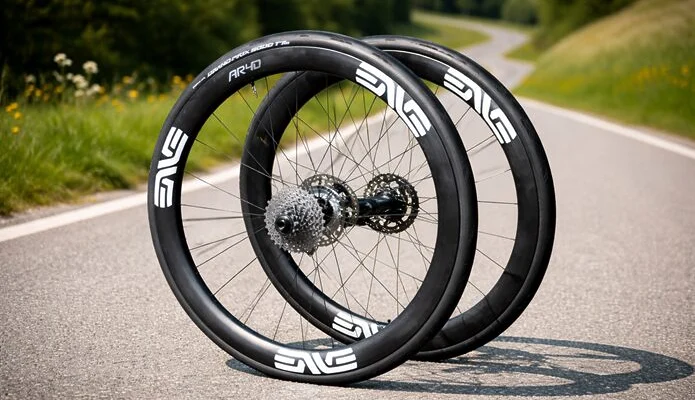
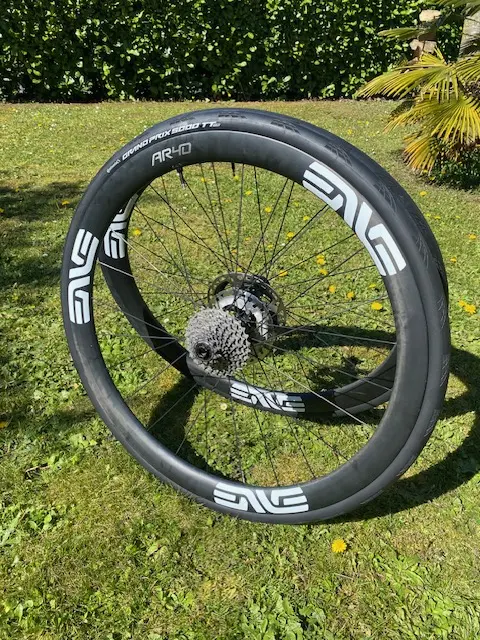
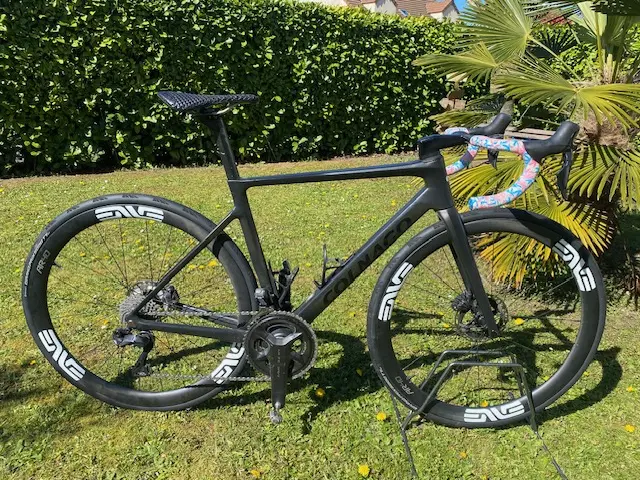
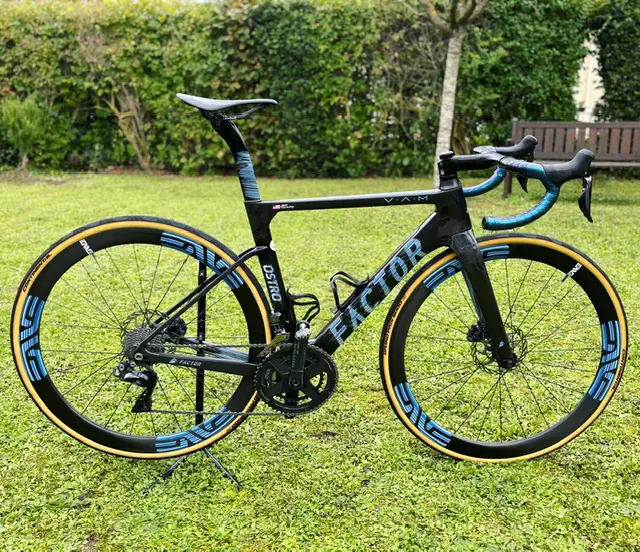
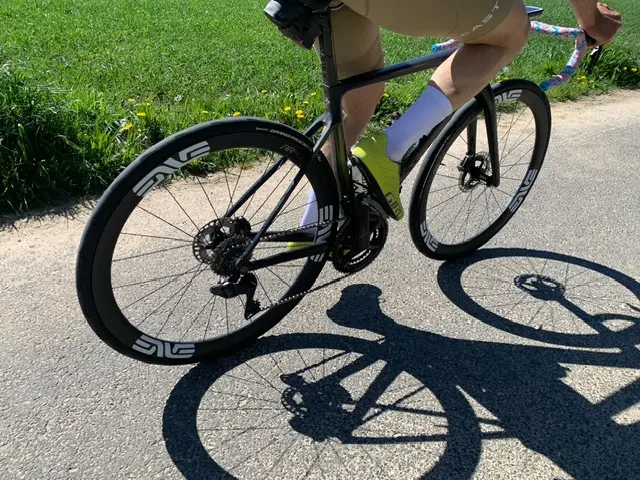
Mohawk’s lent us this pair for a long-term test. First on the road, with 30 mm Continental GP5000 TT tires, then in a few weeks in a gravel setup with 700x45C Continental Terra Speed ProTection tires. And right from this initial road phase, one thing became clear very quickly: these wheels aren’t trying to make a visual impression. They aim to create a sense of consistency. This isn’t just a nuance—it’s almost a philosophy. The AR40s don’t seek the spotlight. They serve the bike.
A wheel that doesn’t put on a show
There are products that immediately demand superlatives. You mount them, give them a little shake by hand, admire them—and already the praise veers into the spectacular. Here, that’s not really what happens. The ENVE AR40s are beautiful, of course, with that signature ENVE understated elegance, that “don’t overdo it” approach, and that clean, crisp finish. But when they’re at a standstill, they don’t yet reveal what they’re capable of. They don’t scream “modern.” They don’t try to make themselves desirable through excess. It’s almost frustrating for those who like their high-end gear to be immediately obvious. And that’s precisely why they’re interesting.
Because when you ride them, they reveal another kind of sophistication—one that’s less decorative, less showy, and more profound. Beauty and efficiency aren’t always meant to be on display. In the case of the AR40s, they lie in the sense of continuity, in the way the bike appears simpler, calmer, and more intuitive. A good modern wheel no longer necessarily needs to look radical to be radically good.
What Width Really Changes
On paper, the ENVE AR40s feature a 40 mm-high carbon rim with an internal width of 25 mm, 24 holes, a wide-sidewall tubeless hookless standard, an in-house hub with the Innerdrive system, and a claimed weight of 1,515 g per pair, including rim tapes and valves. ENVE also specifies compatibility ranging from 27 to 50 mm, with aerodynamic optimization for 29- to 30-mm tires.
The numbers here aren’t just anecdotal. They already speak volumes. An internal width of 25 mm isn’t just a passing trend or a design whim. It’s a statement. It’s an acknowledgment that modern road bikes are no longer designed around narrow tires and rims that constrain them. It’s an acknowledgment that a high-performance tire in 2026 isn’t simply an old 25 mm tire with a new name. It’s also an acknowledgment that true performance no longer depends solely on stiff frame stiffness or a spectacular tread pattern, but on the quality of ground contact, the stability of the casing, the uniformity of the tire’s profile, and the ability to ride fast without making the rider pay the price for that speed with every meter.
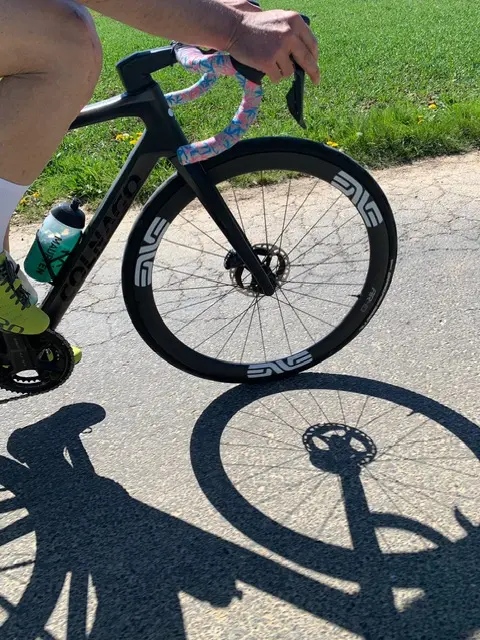
We had already tested the previous generation in 2023. And that’s probably where the most noticeable difference lies. Not in a visual departure. Not in some big marketing stunt. But in how it performs. The wheel feels more modern because it finally fully embraces what a wide tire brings to the table when paired with the right components. You get the sense of a more refined, more logical platform—one that’s more in line with current riding styles. And quite honestly, with an internal width like this, it’s hard to imagine a tire narrower than 28 mm still making any real dynamic sense on this wheel. Yes, ENVE claims compatibility starting at 27 mm. Yes, technically, that’s possible. But in real life, for a coherent setup, this wheel clearly calls for at least 28 mm—and ideally 30 mm.
The 30 mm GP5000 TT: A Perfect Match
Our test setup obviously plays a big part in this. The 30 mm Continental GP5000 TT is one of those tires that feels like it has already moved beyond the old debate between speed and comfort. It’s a very fast tire, with very clean performance, but also remarkably responsive. And on the AR40s, it finds a rim that seems designed to let it shine. The wheel gives it a solid foundation. It stabilizes it. It lets it perform without twisting it. It supports it without crushing it.
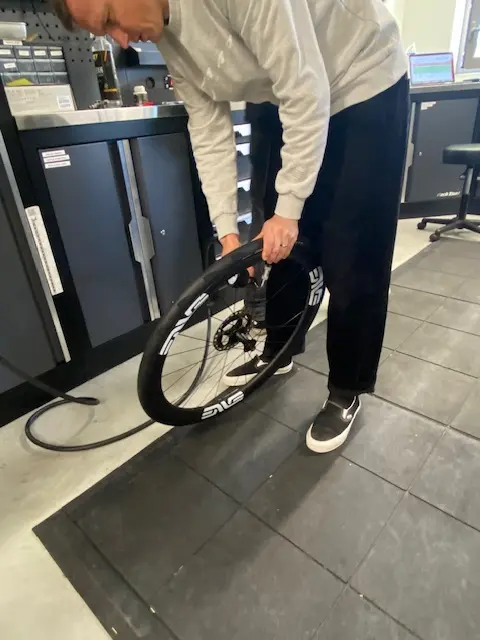
The result is superb. You get a bike that rides with a rare sense of ease. It’s always hard to pinpoint exactly where that comes from. With truly well-designed equipment, you should always be able to say that: it becomes difficult to pinpoint a single factor. Is it the rim? Is it the tire? Is it the pressure? Is it the tread pattern? Is it the width? In reality, everything seems to work together. And that’s often a sign that the product is well-designed.
With this setup, the bike immediately feels effortless. It rides smoothly. Extremely stable. Very quiet. Very safe. And yet it’s never sluggish. It moves forward very well. It maintains a truly efficient ride. It has that modern comfort that doesn’t sacrifice performance—it enhances it. You don’t feel held back by the suspension. On the contrary, you feel empowered to maintain a pace more easily, to stay in the right speed zone without feeling like you’re being pushed around by the road or fighting against it.

A very reassuring wheel
The word that comes up most often when we get off the bike is perhaps this one: reassuring. It may seem unglamorous, almost too tame for a pair of ENVE carbon wheels. And yet, it’s perhaps the greatest compliment we can pay them. The AR40s are reassuring because they expand the margin—the margin of grip, the margin of precision, the margin for reading the terrain. The bike feels more stable. More balanced. More grounded.
You really feel it in the turns. The lines are more secure. You enter without tension. You hold the middle of the turn more naturally. You exit with a sense of continuity, as if the wheel had made the line easier to draw. It’s not spectacular. It’s not the kind of sensation that immediately makes you throw your arms in the air. But on a three-hour ride, then a four-hour one, then on a rough road, then on a descent you’re not familiar with, it takes on immense value.
Many so-called high-performance wheels initially provide a sense of responsiveness. It’s flattering, but sometimes short-lived. The AR40s, on the other hand, first and foremost provide a sense of dynamic security. And that sense of security isn’t softness. It doesn’t come from a general dampening of sensations. It comes from a better harmony between the wheel, the tire, and the road. It comes from the fact that the bike handles better, rides more smoothly, and requires fewer unnecessary micro-corrections.

Smoothing out the road without sacrificing speed
This is probably the most appealing feature of this pair. The AR40s really do give the impression of smoothing out the road. Not in the sense that they turn everything into a billiard table—let’s not exaggerate. But they dampen bumps, smooth out vibrations, and reduce the typical harshness of some aero carbon wheels—and they do so without making you feel like energy is being lost somewhere.
The comfort is excellent. Truly excellent. And yet, the ride remains very compelling. This is where the modern wheel becomes fascinating. For a long time, comfort was associated with some kind of compromise. As if you inevitably had to sacrifice something to get a less harsh wheel. Here, that’s not the impression you get. Here, comfort is part of the efficiency. It lets you go longer, keep your pedaling smooth, stay focused, tense up less on the rougher sections, and not get worn down by little things that always end up taking a toll after a long ride.
Simply put, it smooths everything out and takes you far without burning you out. Put that way, it sounds almost too simple. But that’s exactly what it is. And in cycling, the simplest sensations are often the hardest to achieve.

Modernity that doesn’t seek to please the eye
There’s something rather amusing about these wheels. They perfectly encapsulate the shift in aesthetic criteria in high-end equipment. For a long time, visible performance was equated with desirability. The taller, thinner, and more aggressive it was, the more it seemed to “go fast.” The AR40s tell a different story. They show that the modern wheel no longer needs to be flashy to perform well. That the product’s ingenuity can lie in the internal width, the sidewall design, tire management, and the choice of a mid-range rim depth—rather than in the race for the highest numbers.
In fact, the rim itself is designed with this philosophy in mind. ENVE explains that it opted for a less complex carbon layup than on the SES models, with molded spoke head holes and a construction aimed at versatile use on road, all-road, and fast gravel riding. The rim alone is listed at 425 g, with a 3.6 mm sidewall and Wide Hookless Bead technology designed to minimize the risk of pinching.
There’s always room for debate about hookless rims, especially in France, where the topic continues to divide opinion. But we must at least acknowledge this: on a wheel designed this way, with these tire profiles and this riding philosophy, this choice isn’t just a marketing gimmick. It’s part of a coherent vision for the wheel.

The heart of the matter: a wheel designed as a system
This is often where the difference lies between a good set of wheels and a truly compelling set of wheels. A good set combines high-quality components. A great set creates a cohesive whole. The AR40s clearly belong to the second category. Their appeal doesn’t lie in a standout component that overshadows the rest. It lies in the way everything works together.
The 40-mm rim depth, for example, is very well chosen. It provides a real aerodynamic advantage without falling into the excesses of a more extreme wheel, which can be more demanding in crosswinds or more specialized for certain terrain. ENVE, in fact, presents this rim depth as aerodynamically optimized for both the front and rear wheels, with a clear focus on high-level versatility.
The Innerdrive hub also fits into this philosophy of understated efficiency. There’s no need for a showy sound. It’s about serious, functional mechanics, without unnecessary showmanship. The wheel doesn’t need to make noise to impress. It needs to transmit power effectively, stay clean, and take a back seat to the overall experience. And on the road, that’s exactly what it does.
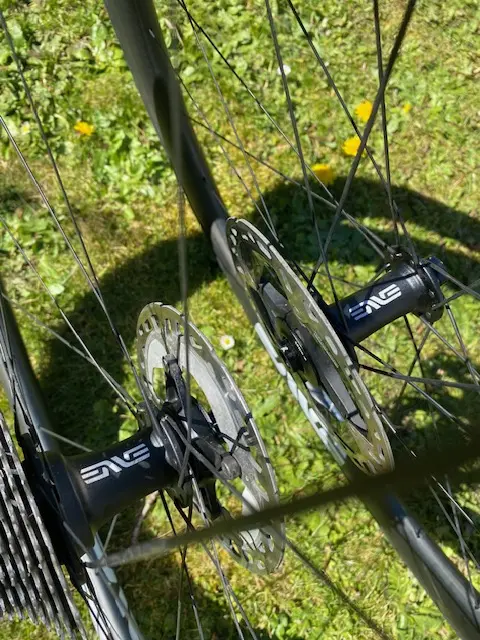
ENVE AR40 – Test Setup
|
What’s different on the road
On the road, the AR40s don’t immediately stand out for their explosive acceleration. This isn’t a wheel designed to deliver a constant burst of power. It accelerates well, no doubt, but that isn’t its primary strength. What it excels at is building speed, maintaining it, and making it comfortable. It loves bikes that really fly. It loves rides where you want to go far, fast, but cleanly. It loves hilly sections where overall handling matters more than a single burst of responsiveness.
That doesn’t mean it lacks character. It means it’s more mature than flashy. It doesn’t slap you in the face every time you accelerate to remind you it’s there. It helps you maintain a high level of performance without wearing you out in the process. And for many riders, that’s infinitely more valuable than a bike that’s more responsive but less comfortable.
On descents, in particular, the quality of the build really comes through in the ride feel. The bike feels stable, composed, and very predictable. You feel more “in” the line than “on” the line. There’s less mental wavering. Less distracting doubt. Less of that slight tension which, on more specialized or stiffer wheels, can end up costing more than it’s worth. Here, you gain, above all, the freedom to relax. And being relaxed—whether on descents or on flat terrain—is also a way to go faster.
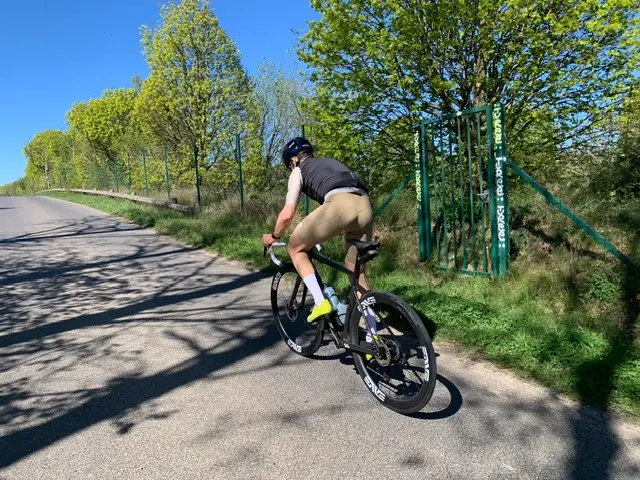
A real difference from the previous generation
This point deserves to be made clear. Yes, we’d already ridden the previous version. Yes, we can really feel a difference today. Modern roads have changed. Tires have changed. Expectations have changed. And this new AR40 finally seems to fully embrace that shift. Where the previous generation still had one foot in a more traditional interpretation of the road tire, this one seems much more in line with the actual standards of the road.
What’s changed the most, once again, is the width. A width that alters the tire’s shape, its stability, its cornering support, and the way it absorbs shocks without losing its shape. A width that makes the bike safer, more composed, and easier to ride. A width that, combined with an exceptional 30 mm tire like the GP5000 TT, produces a truly remarkable package.
You could almost say that this wheel isn’t just new—it feels more “at home” in the present. And that’s no small thing.
Mohawk’s, ENVE’s French Outpost
The fact that this pair was entrusted to us by Mohawk’s is no coincidence. Since Frépillon, Mohawk’s has established itself as ENVE’s distribution partner for much of Europe, with a French presence that has clearly brought the brand closer to our market. 3bikes had already highlighted this when the partnership took on a new dimension, with inventory and distribution managed from the Paris region.
Of course, this doesn’t change the intrinsic qualities of a wheel. But it does change our relationship with the brand. It makes it more tangible, less distant, and more deeply embedded in a genuine community of enthusiasts and distributors who truly live and breathe the product. And there’s a certain logic to the fact that these AR40s—wheels of modern maturity—reach us through a player who has managed to establish under his “teepee” much more than just a showroom: a truly lived culture of high-end cycling.
True luxury: consistency
Deep down, perhaps that is the real essence of these ENVE AR40s: consistency. We often talk about “premium” as if it were a matter of prestige, price, storytelling, or exclusivity. But true high-end in cycling is much simpler: it’s when technical choices finally converge in the same direction. It’s when nothing seems overdone. It’s when the product doesn’t have to constantly justify itself because it functions naturally.
The AR40s give exactly that impression. They don’t strive to be the lightest. They don’t strive to be the tallest. They don’t strive to be the most spectacular. They strive to be just right. And on the road, you feel it immediately.
They make riding easier. More reassuring. More stable. More enjoyable at high speeds. More composed on rough roads. More natural in corners. And they achieve this without sacrificing ride quality, without dampening the urge to accelerate, without making the handling feel sluggish. That’s a lot. It’s actually a tremendous amount.
And now, on to gravel
That’s also what makes what’s next so exciting. Because this wheel seems to naturally call for a second chapter on 3bikes.fr. With its 25 mm internal width and advertised compatibility up to 50 mm, the AR40 isn’t just a very modern road wheel. It’s also a confident bridge to all-road and fast gravel riding. ENVE explicitly presents it as designed for that very versatility.
In a few weeks, we plan to switch it out for Continental Terra Speed ProTection 700x45C tires for a test this time on trails and in the woods. We really like this idea, because it perfectly extends the logic behind this wheel: a single platform, two uses, two interpretations of modern performance. While the first part of the test showed us a road wheel that smooths out bumps, inspires confidence, and provides stability without losing its efficiency, the rest of the test will reveal just how well it lives up to that promise when the terrain gets really rough—when the path is no longer a line of asphalt but a mix of surfaces, ruts, dust, gravel, and forest trails.
And quite honestly, we’re already looking forward to it. Because it’s possible that this second life on gravel won’t feel like a conversion, but rather the confirmation of a broader truth: some modern wheels aren’t versatile because they sacrifice something, but because they’ve finally figured out what to prioritize.
The ENVE AR40 at a glance… Pros: remarkable stability, a very strong sense of security, top-tier comfort without sacrificing performance, very reassuring handling in corners, excellent compatibility with modern 30 mm tires, true road/all-road consistency, a very user-friendly wheel, a feeling of a more composed and predictable bike, intelligent modernity that doesn’t try to show off Cons: less explosive character than a more radical wheel when accelerating out of corners, hookless standard that won’t suit all riders, limited appeal with narrow tires, price that remains premium even though the package is well-rounded Size: 700c – Rim material: carbon – Tire compatibility: tubeless only / hookless – Brake compatibility: Centerlock disc brakes – Rim height: 40 mm – Weight for the wheel set: 1,515 g with rim tape and valves – Internal width: 25 mm – Sidewall width: 3.6 mm – Number of spokes: 24 – Hubs: ENVE Innerdrive – Tires tested: Continental GP5000 TT TR 30 mm – Advertised tire compatibility: 27 to 50 mm – Advertised optimized cross-section: 29 to 30 mm Price: approximately €1,649 per pair at the French retailer consulted; ENVE lists €749 for the front wheel and €899 for the rear wheel on its European website. Contact: Mohawk’s Cycles / Enve.com / Mohawk’s Cycles, 19 Avenue Roland Moreno, 95740 Frépillon. |
Share the post "ENVE AR40 Review: The Understated Art of Modern Speed"