Share the post "Florian Chabbal: when the storyteller becomes the story"
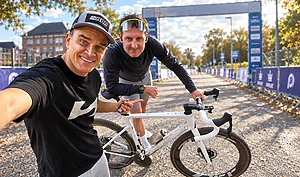
On April 25, 2026, what you think happened didn’t happen. Yes, a gravel team was born. That’s what the facts will say, what the announcements, images, and relays will remember. A date, a launch, one more project in an already dense landscape. From a distance, everything seems almost classic. Almost expected. And yet. If we agree to look a little further, something else appears. More discreet, but infinitely more interesting. Because this April 25 doesn’t just speak of a team. It speaks of a shift. That of a man who, for years, narrated cycling… and who, this time, decided to enter it differently. No longer from a distance. But from the inside. What Florian Chabbal launches that day goes beyond a simple project. It’s a statement. A way of saying that, sometimes, narrating is no longer enough. That one must accept to move from the one who explains… to the one who does. And if this story deserves to be told, it’s also because, for once, we had a rare chance: that of reversing roles, of trying to understand the one who, precisely, is supposed to understand others. And perhaps that’s where everything truly becomes interesting. Because behind this gravel team… lies a much deeper story.
By Jeff Tatard – Photos: ©Florian Chabbal
This interview exists for a simple reason. For once, the roles were reversed. The one who usually holds the microphone found himself on the other side. And inevitably, the perspective changes. The discussion too. It becomes less confrontational, more free, almost more real. Very quickly, it goes beyond the scope of a simple gravel project to tell something else: a trajectory, a tension, and undoubtedly a turning point.

Because what is taking shape here, at first glance, might seem classic. A team. One more structure in an already dense landscape. But from the first few minutes, something deviates. The words are not what one expects. No results. No calendar. No hierarchy. He speaks of community, exploration, aesthetics, gastronomy. Of riding, discovering, stopping, of “having a drink”, “because it’s deserved”. Of a group of cyclists who love cycling as much as what it allows them to experience. And very quickly, we understand that what is being born this April 25, 2026, with Pesto CC may not be a team in the traditional sense of the term.
A project born from a group… and a mindset
This project doesn’t come out of nowhere. It is part of a collective, almost organic dynamic. Around Florian Chabbal, we find notably Pierre-Arnaud Le Magnan, founder of the Chiru brand, known for its titanium bikes designed for exploration and extreme events. We also find Damien Bisetti, founder of Vélosophe Bière Cycliste, as well as François-Xavier Plaçais, former communications director in cycling. And then, there’s this idea of a movement, Pesto CC, born from a small group, almost a gang, with a common vision. A vision not dictated by pure performance, but by a certain way of experiencing cycling.

Gravel, in this context, is not a marketing opportunity. It is an obvious choice. Because it allows precisely that: not to choose. Not to choose between road and trail, between performance and pleasure, between effort and experience. “Gravel is the bike that does everything,” he says. And this phrase, almost innocuous, is actually central. It speaks of a form of freedom. It also speaks of an evolution in the relationship with cycling. We no longer just seek to go fast, we seek to go far. To understand what we are doing there, on this machine, in the middle of nowhere, sometimes for several days, sleeping with our bike, crossing landscapes, accumulating sensations.
What Pesto CC embodies, therefore, becomes something other than a team. It becomes a space. A framework in which very different profiles can coexist. From beginner to experienced. From roadie to mountain biker. From competitor to contemplative. Always with this idea of “not taking oneself too seriously while taking things seriously.” A rare form of balance, almost reminiscent of the spirit of the Barbarians in rugby: a selection, a mindset, more than a fixed structure.

The journey: a trajectory that doesn’t follow a straight line
To understand this moment, we must go back. Not to tell a biography, but to shed light on a trajectory. Florian Chabbal comes from cycling. From real cycling. Elite category, ten years of competition, a place among the best of his generation as a junior. Around him, names that speak to anyone who knows the scene a little: Guillaume Bonnafond, Anthony Roux, Pierre Rolland, Tony Gallopin. A dense, demanding, structured environment. And yet, something doesn’t fit.
It’s not a question of level. It’s not a question of potential. It’s a question of feeling. Of environment. Of relationship to the sport. “I didn’t like that environment much,” he says simply. And this sentence, again, is important. Because it explains a rupture. A real rupture… He stops. He leaves. He moves away from cycling. Not temporarily. Not to think. He changes his life. He works in pharmaceuticals, travels, learns languages, resigns, takes a sabbatical year. He explores.
For several years, cycling almost completely disappears from his daily life. And yet, it doesn’t really disappear. It remains there, somewhere. In standby.

The return through emotion: the pivotal moment
And then, one day, everything comes back. Without warning. A stage of the Tour de France. A breakaway. A victory. That of Blel Kadri, a friend. For some, it’s just another image in the flow of the Tour. For him, it’s something else. A foundational moment. He is in Bordeaux. He walks down the street with his partner. An almost mechanical glance at his phone, just to see. Almost out of habit, with no particular expectation. And then, suddenly, something shifts. Something raw, unexpected, that comes back without warning. “I have rarely felt so much emotion watching cycling as I did that day.” The sentence is simple. Without effect. But it hits home. Because it doesn’t seek to impress, it states. And what it states is essential: the connection was never broken. It hadn’t disappeared. It was there, in standby, somewhere. Waiting.
From there, something starts moving again. Nothing structured. No plan. No strategy. Just a desire. The desire to write. To tell stories. A blog, a first narrative, an attempt. He puts words to what he experiences, to what he feels. Without a specific goal. Without media ambition. Just to see. Just to say. And that’s often how stories that truly matter begin.
Eurosport: learning to see and to trust
Next came Eurosport. Three decisive years. Three years during which he learned everything. Not just how to speak in front of a camera. But to understand the entire system. The control room, interviews, production, direction. He touched everything. He explored every role. He wasn’t confined to one function. And above all, he was supported.
He speaks of Laurence Shirrecker, then editor-in-chief of cycling at Eurosport, now Head of Live at Red Bull Media House, who gave him responsibilities, who trusted him, who saw potential in him. He transformed this trust into competence. Not specialized expertise in a specific field, but a global vision. He understood how narrative works. How an image is constructed. How an emotion is captured. And above all, he gained self-confidence.

The GCN adventure: the revelation… and the limit
Then came the Global Cycling Network adventure. And there, everything accelerated. He became a face. A voice. Almost a benchmark for an entire generation of enthusiasts. He narrated cycling differently. He made it accessible without simplifying it, intelligible without betraying it. He showed what isn’t always seen: the behind-the-scenes, the faces, the silences. The riders, especially, as human beings. Humble, approachable, despite the extreme demands of their sport. He experienced powerful moments. The Tour de France, the Vuelta, the Monuments. Sometimes in the team cars of sports directors, right in the thick of the action. Total immersion. A rare position. And yet. “I (finally!) found my place… and a month later, I resigned.”
The phrase hits hard. It surprises. It almost disturbs. And yet, it is perfectly coherent. Because what he finds at GCN is not just a place. It is also a boundary. That of remaining, despite everything, on the outside. Of observing, analyzing, narrating… without ever truly acting. At some point, that is no longer enough.

Narrating without betraying: a fine line
What characterizes his work is this rare ability to make cycling accessible without simplifying it. To explain without impoverishing it. To translate without betraying it. This is no accident. It is the result of a blend. A natural ease in speaking, already visible when he was a rider, where he was often the one interviewed because he knew how to talk. And a structured, demanding learning experience, in contact with the media.
But this ability comes with a tension. That of staying aligned. Of not straying from who you are. “When you stray from yourself, it no longer works.” The public, he says, is “fickle”. They quickly sense discrepancies. Inconsistencies. Artifices. And in a world where content is constant, this demand becomes central.

Cycling today: a total object
When asked about the evolution of cycling, his answer does not seek to decide or simplify. It is nuanced, almost composed. Yes, cycling is changing. But what is perhaps changing even more is our way of looking at it. Performances are exploding. Formats are multiplying. Disciplines intersect and sometimes merge. Gravel, ultra-cycling, bike touring, endurance events like Ironman, Gran Fondo or even l’Étape du Tour… everything coexists, without obvious hierarchy.
What is emerging is a bicycle that has become total. An object that is no longer limited to a single function. At once a tool for performance, health, transportation, discovery, and even entertainment. An object that goes beyond the simple sporting framework to become part of a lifestyle.
And it is precisely in this transformation that his project makes sense. It is not about creating a team to exist in a discipline. It is about being part of a broader, almost inevitable evolution. To accompany this movement rather than follow it.
Narrative Timeline: Key Moments
|
Building rather than commenting
What Pesto CC crystallizes today is perhaps exactly that. A discreet but decisive shift. The transition from commentary to construction. The moment when narrating is no longer enough. The moment when one accepts to take part. To expose oneself differently. To no longer be just the one who explains, but the one who does. The one who, after spending years observing, analyzing, decoding, finally decides to get his hands dirty in what he was narrating.

This shift is not brutal. It is almost inevitable. Like a logical continuation. By dint of understanding others, translating their stories, giving meaning to their trajectories, there comes a moment when the question turns back. When it becomes impossible to remain solely at a distance. When one must accept to engage differently.
This gravel team project was born out of this necessity. Not from a strategy. Not from an opportunity. Not from a calculated positioning. But from a deep need. That of creating something that truly resembles him. Something that is not only coherent on screen, but coherent in life. A vision of cycling that is open, accessible, demanding without being closed. A vision that rejects simplistic oppositions. That does not choose between performance and pleasure. Between intensity and contemplation.
And in this vision, there is an almost simple idea, but one that has become rare: to be able to ride hard, yes. To seek effort, progress, commitment. But also to know when to stop. To look. To share. To take time after the ride. To give a place to what surrounds cycling as much as to cycling itself. A form of balance, almost fragile, but profoundly modern.

As he says, without really formulating it as a theory but rather as a lived evidence: “not taking oneself too seriously while taking things seriously.” And perhaps that’s where everything lies. In this controlled tension. In this ability to remain light without being superficial, engaged without being confined.
This project is therefore not just a team. It is a statement. A way of saying that cycling can be something else. Or rather, that it can become again what it should never have ceased to be.
The legacy: a discreet but strong ambition
When asked what he wants to leave behind, he doesn’t talk about victory. He doesn’t talk about records. He doesn’t talk about achievements. He doesn’t talk about a legacy in the classic sporting sense. He talks about accessibility. About openness. About this almost invisible, but essential, ability to inspire desire. To allow others to enter this world which, seen from the outside, can sometimes seem closed, coded, intimidating.
In his words, there is something very simple, almost disarming. He speaks of this desire to “open people’s eyes to the accessibility of this world among pros.” He also speaks, very concretely, of all this content that must serve a purpose, for someone. Of this desire to help those who are starting out, those who are still hesitant, those who think that cycling is reserved for an elite. To show them that no. That it’s possible. That it can be simple. That it can be theirs too.

He doesn’t seek to impress. He seeks to make it possible. To lower barriers without lowering standards. To show that cycling, even at a high level, even in its most technical or elitist spheres, remains profoundly human. That it is possible to project oneself into it, to recognize oneself in it, to find one’s place in it, whatever one’s level, history, or starting point.
And in this logic, he also returns to something very concrete, almost pragmatic: “giving all the advice to buy the right bike without necessarily spending 10, 15, or 20,000 euros.” A simple phrase, but one that says a lot. It says that beyond the narrative, there is a desire for useful transmission. A desire to ensure that what he produces truly serves a purpose.
And perhaps that is where the true coherence of his journey lies. In this continuity between the one who explained, the one who narrated, and the one who, today, builds. Because what he seeks to leave behind is not a spectacular imprint. It is a useful legacy. A legacy that serves. A legacy that remains because it has helped, enlightened, accompanied. It is a discreet ambition, almost withdrawn. But it is undoubtedly the most powerful of all.

The last question: like a mirror
In the end, the question turns back. Like a mirror. Like an almost silent loop closing where everything began. If tomorrow he were to interview today’s Florian, what would be the first question he would ask him? One might expect something strategic, constructed, almost calculated. A question about success, about the project, about what’s next. But no. His answer is much simpler. Much more direct. “Why do you cycle?” And everything is there. Because this question, seemingly obvious, is actually the most difficult of all. It goes beyond projects, it goes beyond structures, it even goes beyond journeys. It brings us back to something much more intimate. Much more personal. And by asking it, he is not just trying to understand a trajectory. He is trying to understand an intention. What drives one to stay. What drives one to return. What drives one to continue, despite everything. And behind this question, there is perhaps also his own. Because ultimately, by seeking to understand why others cycle, he is answering the only question that truly matters: why he, today, decided to enter it differently.

Conclusion: entering one’s own narrative
On April 25, a team was born. That’s true. But elsewhere, something deeper is unfolding. A man who, for years, narrated cycling has decided to enter it differently. To no longer just understand, but to build. To no longer just observe, but to propose.
If this text exists today, it’s also because, for once, the roles were reversed. And inevitably, the perspective changes. Because ultimately, as he himself says without making it a formula: “not taking oneself too seriously while taking things seriously.” And that’s exactly where everything shifts. In this ability to move from reading the world to embodying it.
It’s no longer just about narrating cycling. But about inhabiting it. To no longer choose between performance and pleasure. Between effort and experience. Between intensity and sharing. And perhaps, deep down, to narrate oneself differently. Without a microphone. Without distance. But this time, from the inside. And this time, he is no longer telling a story. He is writing it.
Key takeaways
|
=> To better understand Florian Chabbal’s world: La Pause Vélo
=> And here, to discover all our other portraits: All our Portrait articles
Share the post "Florian Chabbal: when the storyteller becomes the story"