Share the post "Three budget-friendly ways to make your bike faster"
In the world of cycling, speed sells. Aerodynamic wheels, ultralight frames, ceramic bearings… there’s no shortage of innovations promising performance gains. But they all have one thing in common: their high price. And above all, they are not always the most cost-effective. The good news? You don’t need to spend a fortune to go faster. A large part of your bike’s potential is hidden in often-overlooked details. With a little maintenance and a few accessible adjustments, you can already make a real difference.
By Guillaume Judas – Images: https://depositphotos.com/
As often happens, the idea for this article came during an informal discussion with a colleague. While we were discussing the best wheels on the market and those he plans to buy in the coming weeks, he eventually mentioned that he always felt the best sensations after carefully cleaning his bike. For my part, I always feel a real difference in efficiency when changing tires. What if we were both somewhat right?
In any case, it’s not always the most expensive solutions that systematically provide the best performance. Let’s first look at three simple ways to ride faster immediately, without spending a fortune.
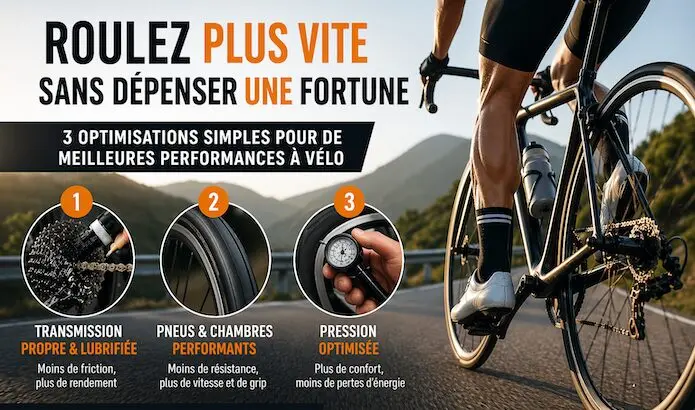
1. Clean your drivetrain (and lubricate it correctly)
A dirty drivetrain isn’t just unpleasant. It’s also inefficient. When the chain is dirty, it accumulates dust and residue. The result is more friction throughout the drivetrain. Part of the energy you produce no longer propels the bike forward but is lost in the friction between the links, the cassette, and the chainrings.
Independent tests have shown that a dirty chain can cause a loss of more than 5 watts at constant effort. This may seem minimal, but these losses increase with intensity. In other words, your training progress or high-end equipment can be partly negated by a simple lack of maintenance.
The solution:
- Clean your drivetrain regularly
- Use a quality lubricant, ideally wax-based
Wax lubricants require a bit more preparation, but they offer excellent performance and keep the chain clean longer.
2. Improve your tires (and inner tubes)
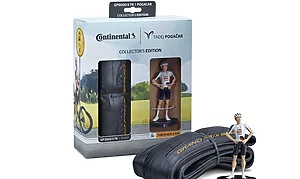
If you need to invest somewhere to gain speed, start here. The differences between tires are far from anecdotal. Structure, rubber compound, design… everything influences rolling resistance. An entry-level tire can be significantly slower than a high-performance model. In some cases, the difference can reach 10 watts per tire. On a bike, this can represent up to 20 watts gained. A huge gain compared to many other costly improvements.
But that’s not all. High-end tires offer a better rolling feel, more grip in corners, and more responsiveness during changes of pace. The change is often noticeable from the first few minutes. So, a high-end tire can cost up to €100. But that’s still affordable compared to buying a new pair of carbon wheels for €3,000 to save 200g, for example.
What about inner tubes? There are three types, with prices ranging from about €5 to €30 per unit.
- Butyl tubes: reliable and economical, but not very performant
- Latex tubes: faster and more comfortable, but require more maintenance
- TPU tubes: lightweight, compact, performant, and offer an excellent compromise for saving weight and approaching tubeless performance.
You can also choose to go tubeless (tire without an inner tube), a solution used by all pros today. The performance effect is guaranteed, even if the system is a bit more complex than tubed tires.
No need for competition-level equipment to feel an improvement: even a switch to mid-range tires can transform your experience.
3. Adjust your tire pressure
This is one of the most important parameters… and the most misunderstood. For a long time, it was thought that a highly inflated tire necessarily rolled faster. This is true on a perfectly smooth surface. But in reality, roads are full of irregularities. A tire that is too hard bounces off bumps instead of absorbing them. This generates vibrations, and thus energy losses. Furthermore, an overinflated tire wears out faster. Conversely, a slightly less inflated tire conforms better to the ground.
The result of slightly lowering the pressure: less energy loss, more comfort, better grip, and often… more speed. Remember: it’s better to be slightly below the ideal pressure than too far above.
Optimal pressure depends on several factors: your weight, tire width, and terrain type. Fortunately, there are free online calculators to help you find a good starting setting.
Small changes for big effects
It’s tempting to turn to high-end equipment to go faster. But in practice, the most effective gains are often the simplest. Before spending hundreds (or thousands) of euros, make sure you’re riding with a clean drivetrain, choosing high-performance tires, and using appropriate tire pressure. These optimizations cost little but can make a real difference to your performance and your riding pleasure. And in many cases, your bike will already feel faster… without having changed much.
Share the post "Three budget-friendly ways to make your bike faster"