Share the post "Mangeas or what a voice can do when it touches a life"
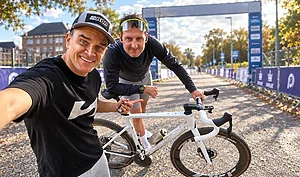
Gare du Nord! Where everything begins without warning. There are moments that don’t give notice. They arrive silently, in the midst of everyday life, and yet they irreversibly shift something within us. That day, at Gare du Nord, we were waiting for a TGV like thousands of other travelers. The flow, the suitcases, the screens, the announced departures… nothing suggested that something essential was about to happen. And then there was this presence. A silhouette, at first. And immediately, without a word being spoken, an obvious truth: we knew. Not by visual recognition, but by intimate memory. By that invisible bond that forms when a voice accompanies a life. Daniel Mangeas.
By Jeff Tatard – Photos: © mangeasdaniel
Something rare happened. An immediate emotion, almost unsettling. As if we were meeting someone close, a family member we hadn’t seen in a long time. And in that surge, a moment of confusion: the urge to go towards him as one goes towards a loved one. “I almost wanted to hug you… and then I told myself: that only works one way.” This sentence sums it all up. It speaks to the asymmetrical nature of this bond. And at the same time, it reveals a deeper truth: this bond truly exists.

What could have remained a suspended moment then became a meeting. Simple. Direct. Generous. Without distance. As if this familiarity was not an illusion, but a continuity. As if, somewhere, we had already met a thousand times without ever seeing each other. So a question naturally arises: how can one be so present in people’s lives… without knowing them?
Unanimity. An almost impossible thing
In sports as in life, there is a tacit rule: no one is universally liked. Champions divide. Voices annoy as much as they unite. Personalities polarize, sometimes despite themselves. And then, from time to time, an exception arises. A presence that escapes this logic. A figure who crosses generations without ever causing rejection, as if belonging to another register.
Daniel Mangeas belongs to this rarest of categories. And it’s not an isolated perception. In an era when Jean-Marie Leblanc directed the Tour de France, he already said it with a disarming obviousness: “When we talk about Daniel, there is never any reservation. We simply say: we love him.” As if, even at the highest level of sporting demand, where everything is analyzed, judged, compared… there remained a space where one does not discuss. Where one feels.

When Michel Drucker says of him that he is “the only one who is not on television and whom everyone knows, whom everyone loves“, it’s not just a phrase. It’s an observation. An almost unsettling obviousness in a world saturated with images. He never needed a screen. His voice was enough. And this voice has traveled through time, roads, summers, lives, never imposing itself, simply being there, at the right moment.
In a world where media exposure has become the condition for recognition, he embodies the exact opposite. Notoriety without image. Recognition without strategy. Affection without calculation. And that, ultimately, goes far beyond the realm of sport. Because what it tells… is not just a trajectory.
It says something much deeper. It says something about humanity.
What it means to be loved without reservation
“When we talk about you, we say nothing other than: we love him.” This phrase, attributed to Jean-Marie Leblanc, could be enough to sum up a life. And yet, it deserves a closer look. For to be loved, in this sense, is neither about charisma, nor performance, nor even talent.

It’s something else. Something rarer. A form of affective obviousness. A collective sensation that transcends individuals. A way of being that reassures, soothes, elevates without ever crushing. A presence that doesn’t take up space… but creates it in others. And this crosses generations without ever being altered. A grandfather, a father, a son… and soon another child who, without yet knowing it, will grow up with this voice as a landmark.
Five generations
Five generations! This figure, by itself, says it all. It’s no longer a career. It’s a presence in time. An almost organic continuity. A loyalty that is not decreed but built, day after day, without ever deviating. As if, deep down, some beings don’t just pass through our lives… but settle in them.

Excerpt from a Ouest-France article, carefully cut out of the newspaper, as one keeps what matters.
A voice that becomes a memory even before it is a sound
There is something extraordinary about the relationship we have with certain voices. They imprint themselves on us very early, often even before we understand what they are saying. They become emotional landmarks, beacons in time, fixed points in a world that, itself, never stops moving.
Very early, between three and four years old, when memory begins to fix its first images, this voice is already there. On the roadside, in the family car, in front of the television. It accompanies the first sporting emotions. The first expectations. The first joys. It is there even before we know why we are thrilled.
And then, without us realizing it… it never leaves us.
It becomes a common thread. An invisible link between eras. An anchor point in a changing world. We grow up, we evolve, faces pass, champions succeed each other… but some voices remain. As if they belonged to something other than the present.

In the 60s, he recalls, “there were only two sports: cycling and football. And cycling was even ahead.” This sentence doesn’t just describe an era. It says something deeper: the original place of cycling in our collective culture. And in that culture, his voice settled in very early… without ever leaving.
The world has changed. Sports have multiplied. Media has fragmented. Benchmarks have diluted. But he, has not changed.
Milestones of a life behind the microphone
Names, eras, one voice (1965 → 2026)Jacques Anquetil, Raymond Poulidor, Eddy Merckx, Bernard Hinault, Joop Zoetemelk, Bernard Thévenet, Laurent Fignon, Greg LeMond, Miguel Indurain, Claudio Chiappucci, Marco Pantani, Laurent Jalabert, Richard Virenque, Jan Ullrich, Lance Armstrong, Tom Boonen, Fabian Cancellara, Alberto Contador, Chris Froome, Peter Sagan, Julian Alaphilippe, Wout van Aert, Mathieu van der Poel, Tadej Pogačar, Remco Evenepoel, Paul Lapeira… From Anquetil to the new generation… these are not just names. It is the continuous thread of the same emotion. |

From Poulidor to Seixas! Sixty-one years of telling the same love story
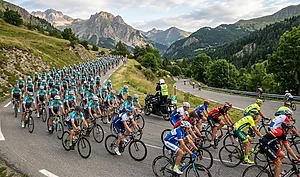
There are numbers that make your head spin. Sixty-one years behind the microphone. Forty-one Tour de France. Forty-one Paris-Roubaix. A trajectory that begins with Raymond Poulidor and extends to the current generation, that of Seixas.
Between the two, there is more than just time. There are entire decades. Technical evolutions. Cultural revolutions. Champions who appear and disappear. And yet, amidst this permanent movement, one thing remains unchanged: constancy.
For it is not simply longevity. It is fidelity. A rare ability to remain aligned, year after year, with an intention that has never changed. An intention almost disarming in its simplicity: to please people. “I always want to please people.”
This sentence, spoken without emphasis, without pretense, perhaps holds the entire key. Because that pleasure cannot be manufactured. It cannot be theorized. It cannot be claimed. It is felt.

It cannot be explained. It cannot be demonstrated. It is perceived in an intonation, in a breath, in a gradual rise. In the way a name is spoken as if it mattered more than others. In the way tension is built… then a silence is left. And it is perhaps in these silences that everything plays out.
Galvanize! When a voice becomes energy
There are, in certain situations, moments when everything shifts. Where the crowd ceases to be a sum of individuals to become a single entity, where emotion rises without warning, without apparent logic, like a wave that sweeps everything in its path. And sometimes, at the heart of this shift, there is a voice. His. Daniel Mangeas.
He says it himself, without hesitation: he sometimes gets carried away. Because there are moments that cannot be controlled, that cannot be prepared, that impose themselves. Like that Sunday at Paris-Roubaix, when Wout van Aert finally wins. He talks about what he could have done, what he might have done. Like Rodrigo Beenkens alongside Cyril Saugrain on RTBF, letting emotion overflow, breaking codes, abandoning restraint. Because sometimes, you have to step outside the box. Because sometimes, emotion is more accurate than control.

And he himself experienced it. In 1980, in Sallanches. The World Championship. The victory of Bernard Hinault. “I still get goosebumps,” he says. As if time had erased nothing, as if the intensity of that moment continued to vibrate, intact, decades later. That day, he didn’t just comment on a race. He was moved by something. And that is precisely what we still hear today.
Memory! Emotional intelligence in its purest form
There is something in him that goes beyond mere competence. A seemingly infinite memory. Names, palmarès, trajectories. Professional riders, of course. But also amateurs, unknowns, stories no one else tells… and yet he never forgets.
And yet, these are not data. These are not files. These are not archives. These are emotions. Each name is laden with a story, each evocation is alive, as if memory did not pass through the brain… but directly through the heart.

Albert Einstein said that memory is nourished by emotion, that it strengthens when it is linked to what one feels. In Daniel Mangeas, this idea becomes a concrete obviousness. Nothing is learned coldly. Everything is lived, felt, integrated.
A rider is never just a name. It’s a story. A trajectory. A life in motion. And when he pronounces that name, he doesn’t just announce it. He restores it.
Anecdotes & living memory
|
The fragile moment… When the voice falters
There are moments when everything can stop. Without warning. Without transition. A stroke. A voice that no longer responds. The tool disappears, and with it, a part of identity. What seemed acquired suddenly becomes fragile, almost inaccessible. And in these suspended moments, there is no more technique, no more mastery, no more projection. All that made the strength fades away. Only the essential remains. The brutal awareness of what truly matters. Fear, perhaps. Doubt, surely. And above all, that silent, almost dizzying question: what remains if the voice disappears?

Then time changes its rhythm. It slows down. It forces one to look differently. To feel differently. To understand that what seemed to be a means, a voice, a microphone, was in reality much more than that. It was a bond. A way of existing. A way of giving.
And then, one day, it returns. Not quite as before. Perhaps more fragile. But infinitely more precious. And with it, a new way of living every moment. More intensely. More consciously. As if every word regained its weight. As if every silence mattered as much as what is said. As if every time he took the microphone became a privilege.
And perhaps that is where, ultimately, everything makes even more sense. When you almost lost… you never speak the same way again.
The man: a disarming simplicity
Let’s go back to Gare du Nord. To that precise moment when everything could have been different, when distance could have set in, when the encounter could have remained formal, almost anonymous, like so many others in these transit places. And yet.

There is this simplicity. This way of welcoming without filter, without calculation, without pretense. An immediate, natural, almost disarming presence. And then this phrase, seemingly innocuous, but which says it all: “All people are good.”
Perhaps everything starts there. From a worldview. From an initial trust granted unconditionally. From a way of approaching others without suspicion, without distance, without ulterior motives. As if human relationships should never be built on caution… but on impulse.
And in a world where distrust has become the norm, where one protects oneself even before meeting, that has immense value. Because this simplicity is not naive. It is rare. And perhaps that is precisely why it touches so deeply.
And then, as often with him, the story never truly ends. It continues, almost naturally, like a conversation picked up where it left off.
He recounts those summers after the Tour de France. The criterium tour. A Peugeot 504. Four men. Three bikes piled in the trunk and on the roof rack. He, the only one without a bike… but already at the heart of the peloton. Alongside him, Gilbert Duclos-Lassalle, Roger Legeay, Raymond Martin, Jean Hauvieux.
They ride, they laugh, they share. The restaurants, the journeys, the fatigue, the joy. They are young. They are together. And above all, they are living.
In Brittany, in particular, thousands of spectators flock to every town. The Tour has passed… but the party continues. And they, in the midst of it all, simply savor the pleasure of being there. Of being together. Of being a part of it.
And then he slips in this number, almost as an obvious fact: 41 Tours de France. Starts and finishes. Nearly 850 stages. As if, deep down, telling the story of cycling had never been a job… but a way of life.

What remains… And why it matters
Then comes the last question. The one that doesn’t seek a brilliant formula, nor a perfect answer. But a truth. “Daniel… what do you leave to people?”
He could answer. Find the words. Explain. Summarize. And yet… there isn’t really an answer. Because what he leaves cannot be put into words. It is felt. It is lived.
It slips into a childhood memory, on the side of a summer road. Into a Tour de France finish where everything suddenly accelerates. Into a long-awaited victory. Into a name pronounced at the right moment, as if it mattered more than others.
And there was this privileged moment for 3bikes.fr. A little over an hour, one-on-one. Listening to this voice without filter, without distance. As if, for once, it was addressed only to us. A rare interlude. Almost unreal.
And above all, in something even more discreet. Almost invisible. Almost imperceptible. That rare sensation, difficult to name, but which everyone recognizes when it passes: that of having been, for an instant… a little happier. Thanks to a voice.
=> To better understand who Daniel Mangeas is: WIKIPEDIA PAGE
=> And here, if you want to discover all our other portraits: All our Portrait articles
Share the post "Mangeas or what a voice can do when it touches a life"