Share the post "Favero Assioma PRO RS Review: A Shimano Benchmark… Really?"
Eagerly awaited by users of Shimano SPD-SL cleats, the new Favero Assioma PRO RS power meter pedals finally promise a true native platform—lightweight, integrated, and free from the biomechanical compromises of the Q-factor found in older models. On paper, they have everything it takes to become the new industry standard. On the road, however, our initial tests suggest a more cautious approach, particularly when it comes to power measurement out of the saddle. By David Polveroni – Photos: DR 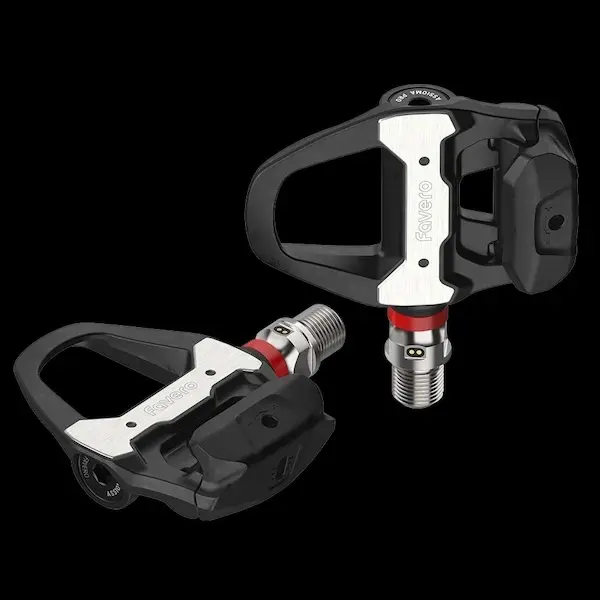 Over the past decade, Favero has gradually established itself as one of the leading names in power meters. The story began in 2015 with the bePRO, before taking on a new dimension with the Assioma in 2017. In 2021, the Italian brand introduced its first offering for Shimano system users with the Assioma DUO-Shi. Then, starting June 3, 2025, it launched the new Assioma PRO RS. Favero’s listed prices are €435 for the single-sided PRO RS-1 and €693 for the dual-sided PRO RS-2.
This journey is worth highlighting. Favero isn’t a brand that started out in cycling, but in electronics. And that is undoubtedly its strength: while some major “cycling” brands have sometimes struggled to offer truly reliable, simple, and accessible products, Favero has succeeded in building genuine trust in its power-meter pedals. The Assioma pedals have thus played a major role in making power-based training more widespread. Today, it’s hard not to find at least one person in your cycling group who uses Assioma pedals.
DUO-Shi: A Solution with Compromises
For a long time, the Assioma DUO’s greatest strength was its overall balance. They offered good accuracy, were easy to use, were reliable, and provided particularly competitive value for the price. But there was still one major drawback for many users: they were virtually limited to the Look Kéo ecosystem.
Favero had indeed attempted to meet the demand of cyclists riding with Shimano SPD-SL pedals through the DUO-Shi. The concept involved taking the sensor-equipped axle from the Assioma and pairing it with a Shimano pedal body. It was a clever idea. But it remained an adaptation, with a biomechanical compromise that was far from neutral: a Q-factor increased to +64 or +65 mm depending on the pedal bodies used, compared to +52 mm on the original Shimano pedals. On the road, this translated to a wider pedal stroke—sometimes tolerable, sometimes downright annoying, depending on the rider. For some, it was just a minor detail. For others, it was simply a deal-breaker, especially for smaller riders.
PRO RS: A True Breakthrough
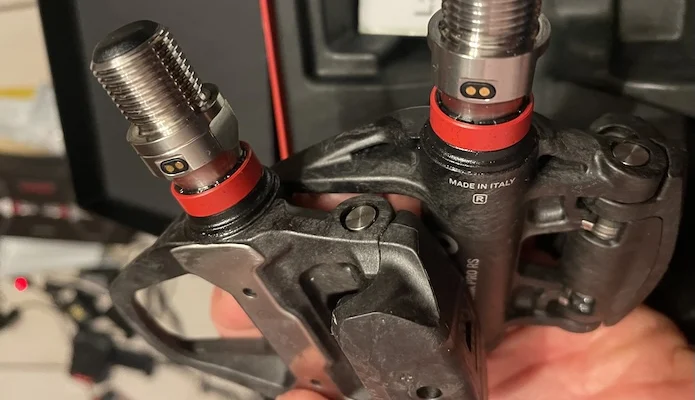
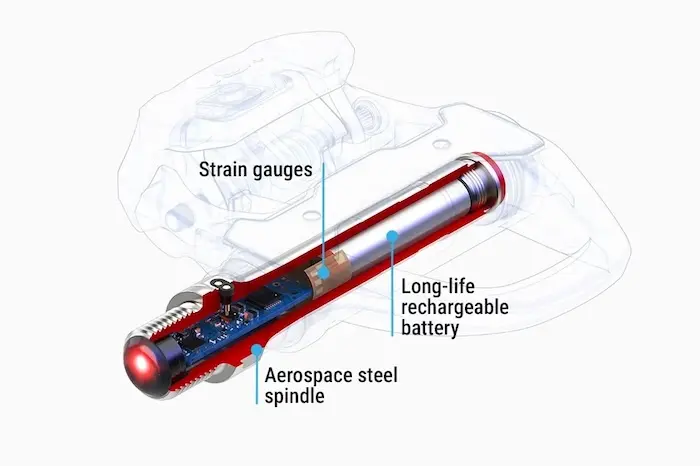
It is precisely on this point that the Assioma PRO RS marks a breakthrough. This time, Favero has developed a true power meter pedal designed from the ground up for Shimano SPD-SL compatibility. The electronics are now integrated into the axle, eliminating the need for the external pods seen on previous generations.
 On paper, the offering is particularly appealing:
- Full compatibility with Shimano SPD-SL (Shimano standard)
- 124.5 g per pedal
- 249 g per pair (verified)
- Stack height (height relative to the axle) of 10.5 mm
- Q-factor of +53 mm
- You can choose the RS-1 or RS-2 version, depending on whether you want unilateral or bilateral measurement.
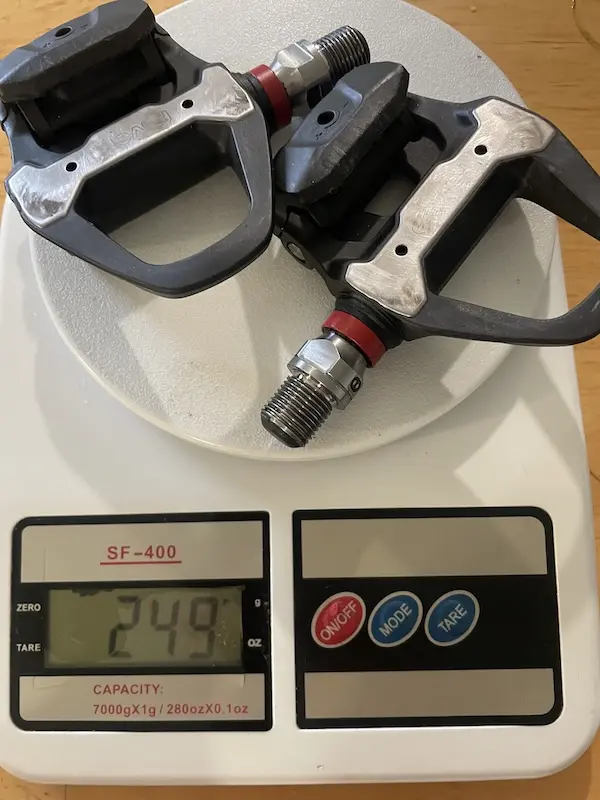
In other words, Favero finally delivers what many have been waiting for: a Shimano pedal with a built-in power meter that’s lightweight, well-integrated, and free from the Q-factor compromises of the DUO-Shi generation.
Installation and Setup
Upon opening the box, nothing particularly spectacular, but a solid, well-presented set: the pedals, the charging system, and the cleats. The first minor practical change concerns the installation. Gone is the 8 mm Allen wrench used on the older Assioma models; installation is now done with a 15 mm open-end wrench. Favero also notes that the PRO pedals are mounted like a standard pedal, requiring manual calibration during the initial installation or after transferring them to another bike.
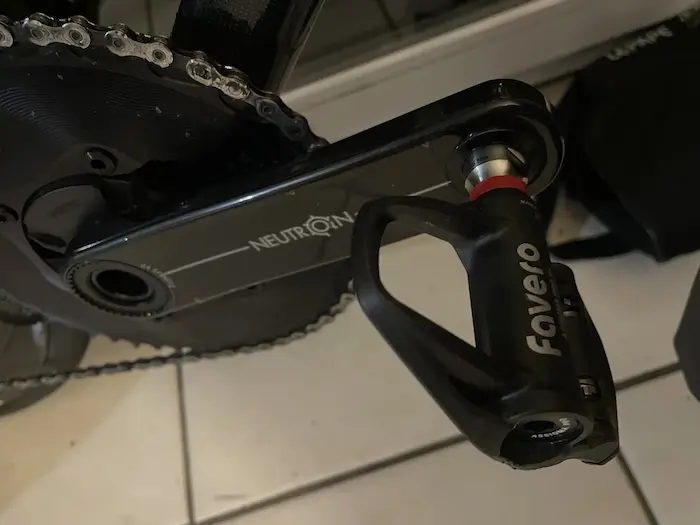
The entire process is straightforward to set up. You’ll need to use the Favero app to register the product, activate it, and then verify the basic settings—particularly the crank length—which must be entered both in the app and on the bike computer. This is a detail that’s often overlooked, even though it directly affects data consistency… Favero also notes that initial activation via the app is required.
First Impressions
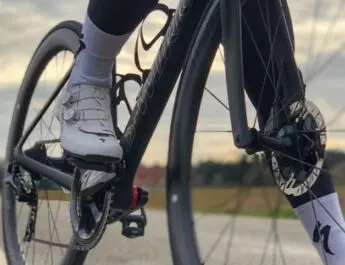
Once installed, the PRO RS pedals immediately make a positive first impression: at last, we have a Shimano platform that no longer gives that feeling of pedaling with your feet spread apart, which some riders may have experienced with previous SPD-SL-compatible solutions.
The included cleats offer 6° of angular float, with a feel similar to Shimano’s yellow cleats. In use, the engagement and release clearly resemble the SPD-SL system. For a cyclist already accustomed to Shimano, the transition is therefore natural. This is a real strength of the product. Despite a stated axle height that is 4.1 mm lower than that of a standard Shimano pedal, I personally didn’t feel the need to adjust my saddle height. From the very first few kilometers, the feel was solid and natural, requiring no special adjustment. https://www.3bikes.fr/2024/02/08/guide-dutilisation-dun-capteur-de-puissance/
Wear and Performance Over Time
After about 3,000 km of use, another point is worth highlighting: wear on the platform remains minimal. Unlike some competing pedals—particularly those from SRM, where premature wear can set in more quickly—Favero has clearly put a lot of thought into protecting the contact area, featuring an aluminum plate reminiscent of what’s found on Shimano Ultegra or Dura-Ace pedals. It’s a small detail, but one that matters over the long term for those who ride a lot. 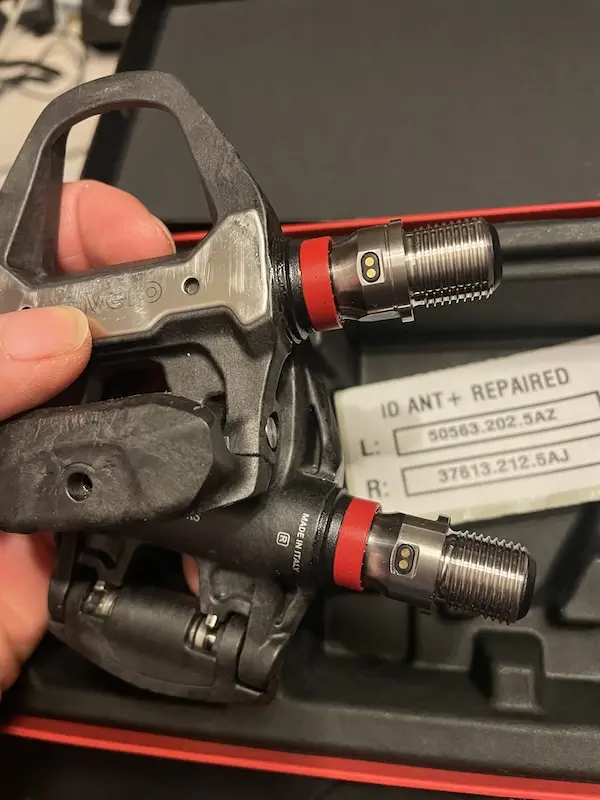 On the other hand, we’ve also noticed a slight amount of play developing over time. At this stage, however, there’s nothing to worry about: this is quite common with ring-bearing pedals, and the same phenomenon can be seen on Look or Shimano Ultegra models, for example. In other words, this isn’t a deal-breaker, but rather a fairly common mechanical behavior in this type of design.
Battery Life: An Update That’s a Real Game-Changer
This is a point worth highlighting now, as Favero updated the product in February. The firmware for the Assioma PRO line, version 7.11, explicitly mentions an extension of battery life. Favero now claims up to 160 hours of use per charge (compared to 50 hours previously) on the Assioma PRO RS models, thanks to algorithm optimization, without compromising the advertised accuracy. The update is easy to install by following the instructions in the app.
Favero also retains its magnetic charging system and notes that a 15-minute quick charge provides approximately 15 hours of use.
Power Measurement: The Key Factor
It’s obviously in the area of measurement that things get more sensitive. Favero has built a solid reputation on the reliability of its sensors. Many users now consider the brand a serious benchmark, and previous generations have often served as points of comparison in various independent tests. In my case (though I’m not alone…), however, this new pair of PRO RS sensors raises a significant question. It concerns performance when riding out of the saddle.
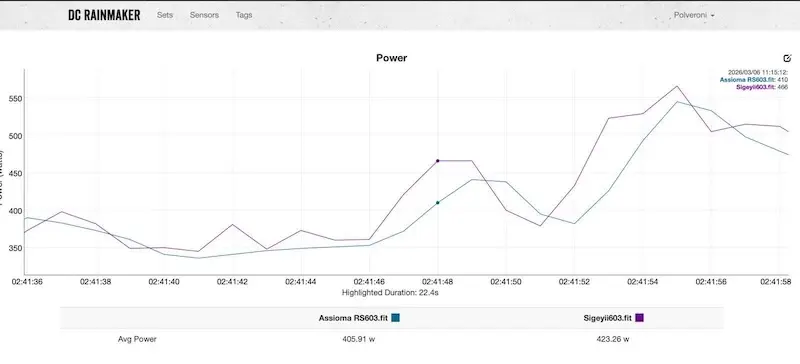
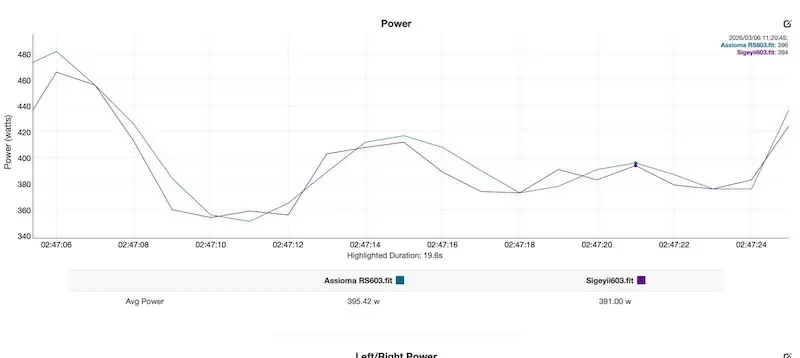
My current reference crank sensor is a Sigeyi AXO SL, which has consistently provided reliable data so far, including in other comparisons. My protocol is simple: two bike computers mounted on the handlebars to observe discrepancies in real time, followed by a more in-depth analysis afterward. I was also able to compare the results with the Wahoo Kickr V5. And one thing immediately stood out to me: the differences in power output when riding out of the saddle.
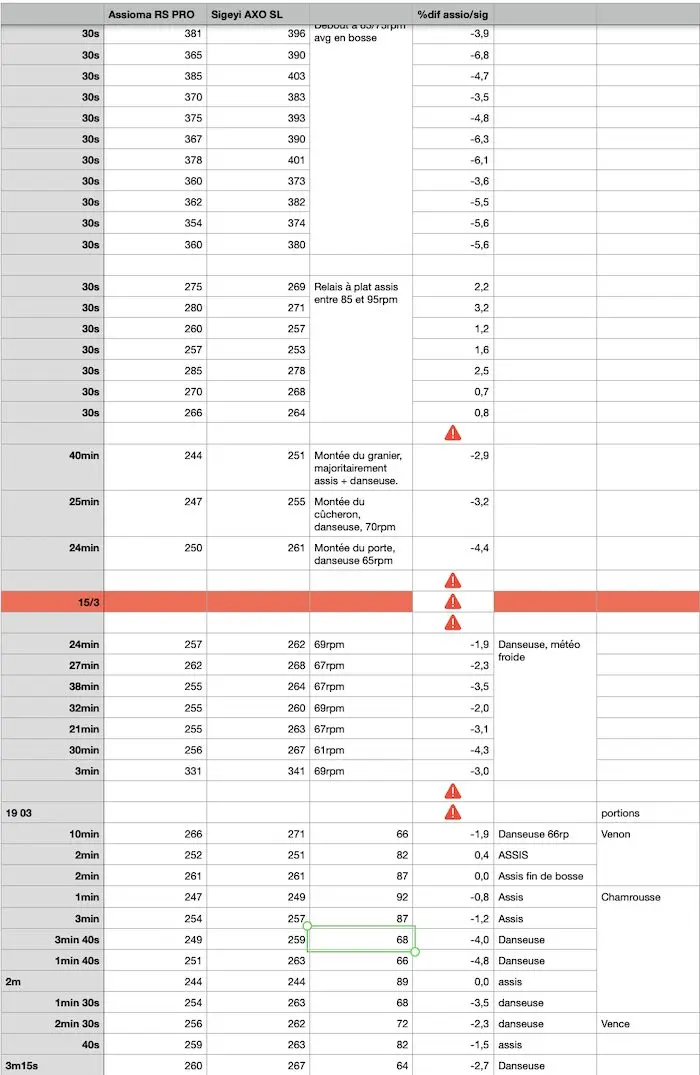
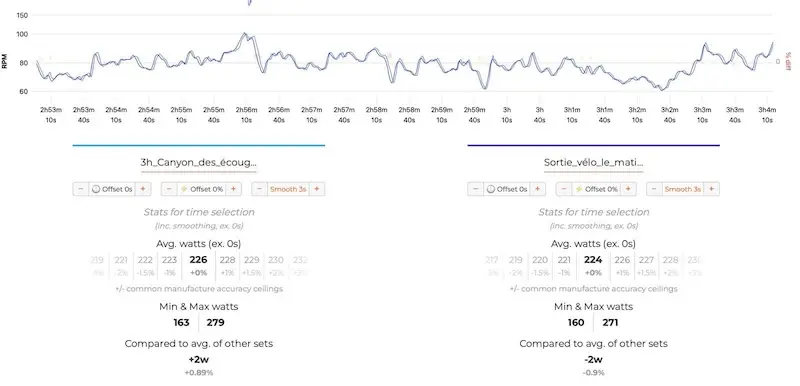
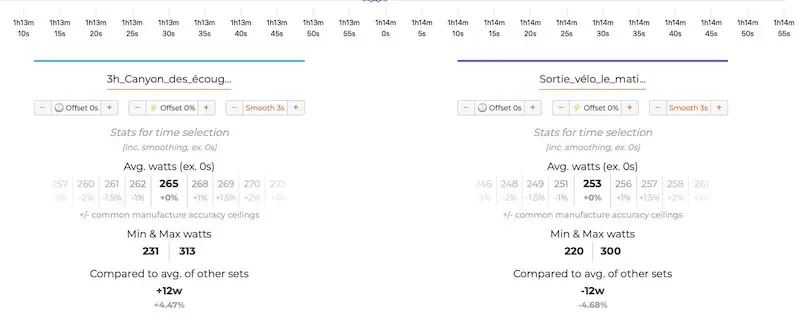
Seated, the numbers from the two systems stay pretty much the same, whatever the cadence. But the moment I get out of the saddle, the Assioma PRO RS consistently shows lower power, in the region of 5 to 7%. This discrepancy is neither trivial nor an isolated occurrence: I observed it repeatedly over a period of about two weeks, during various training sessions.
Impact Depending on Terrain
This is all the more significant because the issue manifests differently depending on the terrain. On flat terrain, riding out of the saddle often accounts for only a very small fraction of total pedaling time. If we consider, for example, that out-of-the-saddle riding accounts for only 2% of total time, a 7% discrepancy would ultimately amount to only about 0.14% of the overall average—which is practically nothing. In the mountains, however, where you might spend 20% of the time—or even more—out of the saddle, that same potential bias already rises to 1.4% of the total. That’s where the issue becomes significantly more sensitive, especially when analyzing short periods, climbs, targeted effort sequences, or comparing data sets within specific power zones.
Tests and Customer Service
So I decided to take the testing a step further. The pedals were sent back to Favero for service after I conducted a comparison between my Wahoo indoor trainer and the pedals, as they had requested… After their own analysis, the manufacturer informed me that the axles appeared to be in spec, but they proceeded with a preventive replacement nonetheless. Upon their return, the findings remained the same: consistent when seated, lower when out of the saddle.
To be precise, this doesn’t automatically mean the pedals are “faulty” or unusable. However, it does mean that, in my case, there’s a behavior I can’t yet fully explain.
Several hypotheses remain possible: • The Assioma underestimates when out of the saddle • The Sigeyi overestimates • The phenomenon depends on pedalling style • Or a methodological bias has not yet been identified
The Paradox of Pedal Power Meters
But several factors also prevent us from closing the case too quickly. First, I’ve been using power meters for a long time and have already accumulated numerous cross-comparisons. Second, the numbers don’t really match up with real-world experience: when I stand up on the pedals, I obviously don’t lose speed—quite the opposite. Finally, during several side-by-side comparisons with another cyclist equipped with a SRAM Quarq, his readings remained stable at equivalent riding positions while my Favero data dropped. It’s not ironclad proof, but the pattern repeats often enough to deserve more than a shrug.
That, in fact, is the whole paradox of pedal-based power meters. They’re probably the simplest solution to install, the easiest to transfer from one bike to another, and often the most practical for everyday use. But it’s also a mechanically very complex measurement system, potentially sensitive to posture, foot placement, pedaling style, or force distribution.
And that’s undoubtedly where the real issue lies. It’s far too rarely explored by coaches and in the tests we see here and there… which often settle for short sprints or riding at 90 rpm on the HT…
Preliminary Verdict
In the vast majority of cases, an individual user won’t notice anything. The numbers will look consistent, the feel will feel normal, and the ride can roll on just fine. But as soon as you cross-reference the data with other benchmarks—especially during specific efforts or when changing position—more nuanced questions can pop up.
In terms of the product itself, the Favero Assioma PRO RS likely represents what many have been waiting for: a true Shimano-compatible power pedal that’s lightweight, elegant, well-designed, and free from the compromises of the DUO-Shi and its Q-factor, which suits very few people.
On paper and from first impressions, Favero ticks nearly every box. And at this price point—especially the RS-1 version at €435—the package looks highly competitive compared with several rivals on the market. The RS-2 version, priced at €694, is also competitively priced for a bilateral measurement system. In terms of measurement accuracy, however, my personal experience leads me to be more cautious. At this stage, I cannot unreservedly endorse the idea of a new “gold standard.” Not because the product is flawed, but because my tests raise a genuine question about its performance when riding out of the saddle.
The logical next step will therefore be a second part of this review, with more comparisons—ideally against an SRM—to determine whether the observed phenomenon holds true. One thing is certain: this topic deserves better than a hasty verdict, as we see (far) too often.
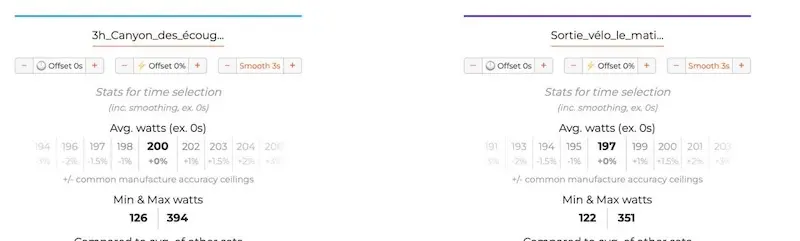
The FAVERO ASSIOMA PRO RS pedals at a glance…The pros: a proper Shimano pedal at last, excellent ergonomics and integration, weight, price, customer service, the ability to calibrate with weights at home (rare), battery life Cons: Data on out-of-the-saddle power varies depending on the rider and pedaling style; Favero Electronics’ objectivity regarding this issue… Compatibility: Shimano SPD-SL – Stack height: 10.5 mm – Q-factor: +53 mm – RS-1 version (left pedal measurement only): €435 or RS-2 (measurement on both sides): €693 – Weight: 250 g per pair – Contact: cycling.favero.com SIGEYI / ASSIOMA comparison data 1/ Seated on flat terrain 200 / 197
|
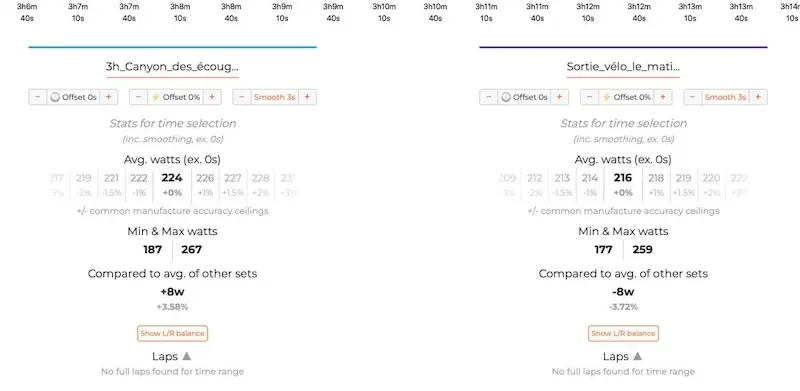
 2/ Out of the saddle on an incline 8 min 224 / 216
 3/ Seated, 2 min: 226 / 224
 4/ Out of the saddle, 3 min: 265 / 253 W
Share the post "Favero Assioma PRO RS Review: A Shimano Benchmark… Really?"